Opening Reflection
Much of our digital transformation stack begins with a simple assumption:
To understand the physical world, we first need to capture an image of it.
UAV mapping, computer vision, autonomous inspection, Digital Twins, photogrammetry, robotics and AI analytics all depend, in different ways, on cameras.
But conventional cameras carry a limitation inherited from photography.
They capture the entire scene repeatedly.
Thirty frames per second. Sixty frames per second. Sometimes hundreds.
Whether something changed or not, every pixel is captured again.
That approach works well when the objective is to create photographs or video.
But autonomous machines do not necessarily need photographs.
They need to know what changed, where it changed and when it changed.
That distinction is opening an entirely different direction for machine vision.
It is called event-based vision.
And it could change not only how machines see, but how spatial intelligence itself is captured.
The Technological Shift: From Frames to Events
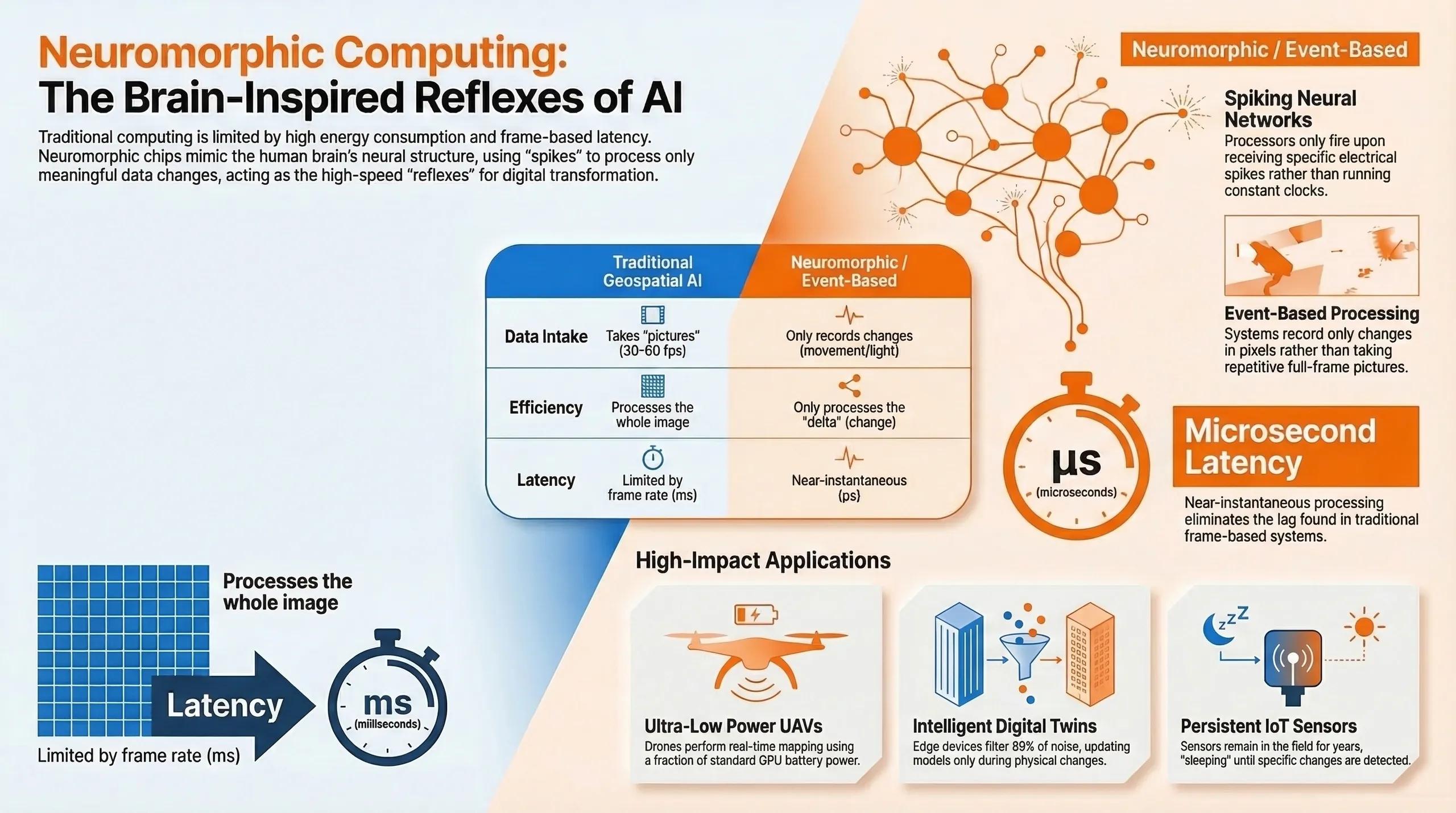
A conventional RGB camera observes the world through frames.
At every capture interval, millions of pixels are recorded simultaneously. Most of those pixels may contain exactly the same information as the previous frame.
The wall has not moved.
The road has not moved.
The machine housing has not moved.
Yet all those pixels are captured again.
An event-based camera, built around principles from neuromorphic engineering, works differently.
Rather than operating as one sensor capturing complete frames, individual pixels work independently.
A pixel reports information only when it detects a meaningful change in light intensity.
No change?
No event.
Imagine a UAV hovering in front of a static industrial structure.
A conventional camera continues generating frames.
An event-based sensor may generate almost nothing until something changes.
A moving worker.
A rotating component.
A shifting vehicle.
A vibration.
A moving edge.
A change in illumination.
The sensor is therefore not continuously photographing reality.
It is responding to change within reality.
That sounds like a subtle technical difference.
Operationally, it is much bigger.
The Deeper Question: Do Machines Need Images to Understand Space?
For decades, machine vision inherited the architecture of human photography.
First capture an image.
Then process it.
Then identify objects.
Then determine whether something changed.
Event-based vision challenges that sequence.
What if change itself becomes the primary observation?
Instead of:
Image → Process → Compare → Detect Change
we begin moving toward:
Change → Event → Interpretation → Action
This matters enormously for autonomous systems.
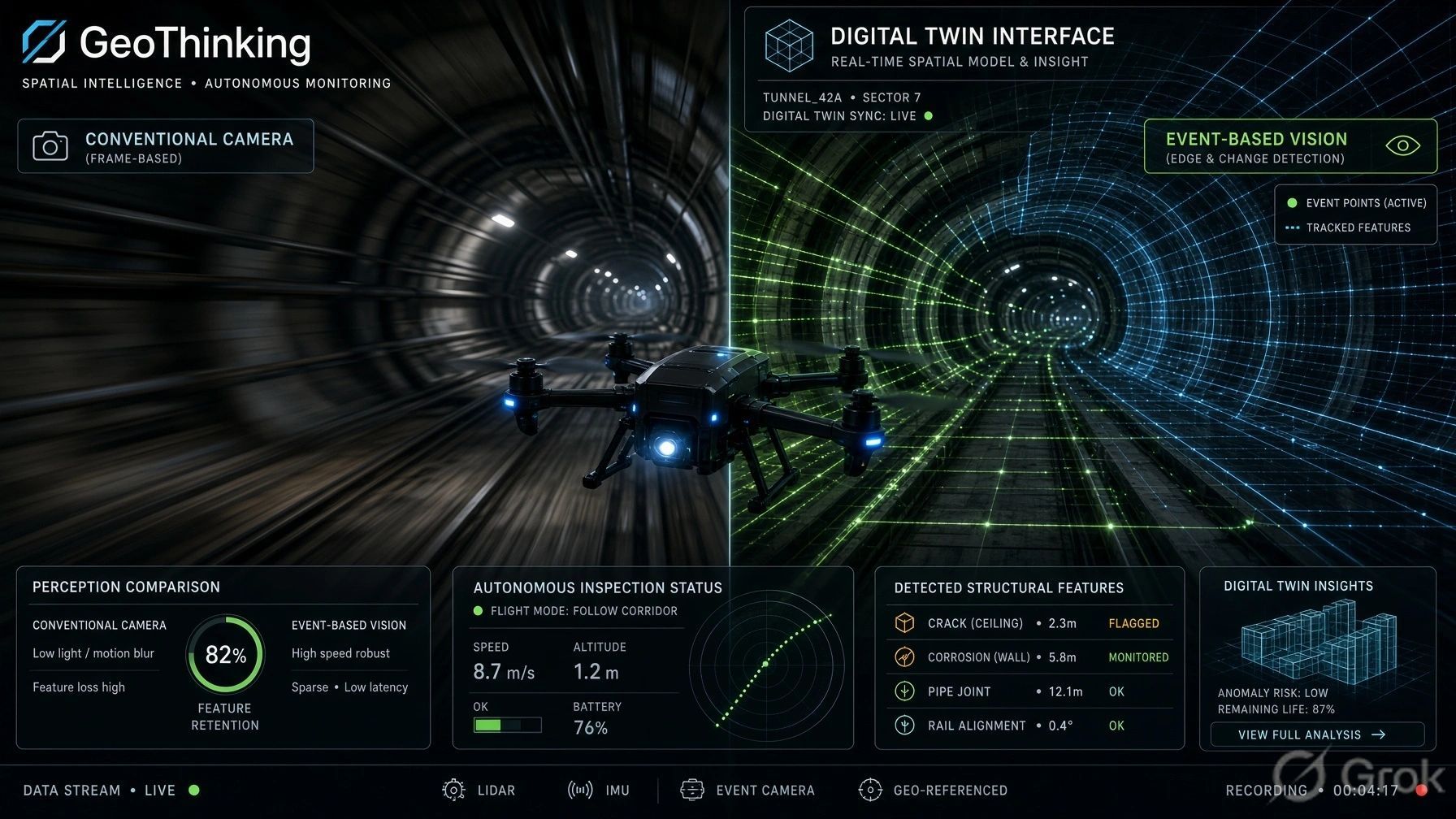
A drone moving rapidly through a tunnel does not necessarily need another beautiful 4K frame.
It may need to know that a structural edge has suddenly appeared 40 milliseconds ahead.
A mobile robot navigating a factory may not need to repeatedly analyse an unchanged wall.
It needs immediate awareness when a worker enters its trajectory.
A monitoring system may not need hours of static imagery.
It needs the moment something physically changes.
Machine perception therefore starts moving away from continuous documentation toward selective attention.
That begins to resemble biological perception much more closely.
The Spatial Intelligence Perspective
This is where event-based vision becomes particularly interesting from a GeoThinking perspective.
Spatial intelligence has traditionally been built around snapshots.
A satellite image represents Earth at a particular observation time.
A UAV survey represents a site during a particular flight.
A LiDAR scan represents geometry during a particular capture campaign.
A Digital Twin is then updated using these discrete observations.
But physical environments do not operate as snapshots.
They operate continuously.
Infrastructure vibrates.
Vehicles move.
Machines rotate.
People enter and leave spaces.
Water flows.
Structures deform.
Objects appear and disappear.
Event-based sensors introduce another possibility:
spatial systems that observe change as it happens rather than repeatedly reconstructing an unchanged world.
That changes the economics and architecture of sensing.
This highlights the potential for very significant reductions in data because static portions of the scene no longer need to be repeatedly transmitted and processed.
For edge systems, this could be important.
Less redundant data means potentially lower bandwidth requirements, less unnecessary processing and faster machine response.
The question shifts from:
How much imagery can we capture?
to:
How little information do we actually need to understand what changed?
Real-World Implication: UAVs, Robotics and Difficult Environments
Consider high-speed UAV inspection.
Traditional cameras face a familiar problem: motion.
As movement increases, exposure, shutter behavior and image blur become increasingly important.
Event-based sensors operate without conventional frames. Their extremely low latency makes them particularly suited to observing rapid changes and fast-moving edges.
That could create new possibilities for UAV navigation and inspection inside:
- tunnels,
- industrial plants,
- warehouses,
- underground infrastructure,
- confined spaces,
- transportation corridors,
- high-speed robotic environments.
Lighting creates another challenge.
Conventional imaging systems can struggle when scenes contain extreme contrasts between dark and bright regions.
This highlights the very high dynamic-range characteristics possible with event-based sensors because pixels respond independently to local intensity changes.
For autonomous inspection, that matters.
A drone moving from a dark tunnel toward a bright opening cannot afford to temporarily lose perception while exposure adjusts.
A robot moving between indoor and outdoor environments cannot simply stop seeing.
When perception becomes part of operational control, vision reliability becomes a system requirement rather than an image-quality preference.
The Digital Twin Implication: Stop Capturing Everything
This may also change how we think about Digital Twin updates.
Today, many Digital Twin workflows operate through periodic recapture.
Survey the asset.
Process the data.
Compare against the previous state.
Identify differences.
Update the model.
But imagine a sensing layer continuously detecting spatial events.
Instead of asking the Twin:
“What is the latest model?”
we could increasingly ask:
“What has changed since the last trusted state?”
That creates an interesting architecture.
The Digital Twin maintains the stable spatial context.
Event-based sensing concentrates on the parts of reality that are changing.
AI determines whether those changes matter.
The Twin updates only where required.
This could make continuous reality synchronization far more efficient than repeatedly rebuilding the entire observed environment.
In other words:
the Digital Twin does not always need another picture of reality.
Sometimes it only needs the delta.
Insight: The Future Camera May Become a Spatial Change Sensor
Event-based cameras should not simply be viewed as faster cameras.
That description misses the deeper shift.
A traditional camera is fundamentally designed to produce images.
A neuromorphic vision sensor is closer to a change-detection system operating directly at the sensing layer.
That distinction becomes important as cameras increasingly become components inside autonomous systems rather than devices operated by humans.
The value of tomorrow’s sensing systems may therefore be measured less by:
megapixels,
frame rates,
or video resolution,
and more by:
latency,
event relevance,
energy efficiency,
bandwidth efficiency,
dynamic perception,
and how quickly observation can become action.
This represents a broader transition across technology.
We are moving from systems that continuously collect everything toward systems that selectively sense what matters.
Closing Reflection
For years, the geospatial industry has focused on improving our ability to capture reality.
Higher resolution.
Denser point clouds.
More frequent imagery.
Larger datasets.
Better 3D reconstruction.
All of that remains important.
But neuromorphic vision introduces a different question.
What if the next breakthrough in reality capture comes not from capturing more, but from knowing what does not need to be captured at all?
That is a very different philosophy of sensing.
And as UAVs, robotics, Digital Twins, edge AI and autonomous infrastructure continue converging, it may become increasingly important.
Because machines do not experience the world as a collection of photographs.
They experience it as a continuous stream of change.
Perhaps our sensing architecture should begin doing the same.
The future of spatial intelligence may not be about giving machines better cameras.
It may be about teaching them when reality is worth noticing.