Digital Twins are often described as living digital replicas of physical systems . They mirror factories, cities, infrastructure networks, farms, and even entire ecosystems in the digital world.
However, behind this vision lies a practical challenge: keeping the digital model synchronized with the physical world in real time.
Most current digital twin architectures rely on constant data streams from sensors, cameras, and connected devices. These streams are processed in centralized systems or cloud platforms to update the twin continuously.
While this approach works, it introduces three significant limitations:
Massive data volumes
High energy consumption
Latency in decision-making
As digital twins expand across cities, industries, and landscapes, these limitations become harder to manage.
A new computing paradigm, Neuromorphic Computing , may provide an alternative approach.
Instead of continuously monitoring the world, neuromorphic systems react only when meaningful events occur .
This shift could fundamentally change how digital twins operate.
Why Traditional Digital Twin Architectures Struggle
Many digital twin platforms today are built on traditional computing architectures that process data continuously.
Sensors send constant telemetry. Cameras capture frames repeatedly. AI systems analyze every frame or dataset whether or not anything has changed.
This results in large data pipelines where:
Sensors generate continuous data
Networks transmit large volumes of information
Cloud systems process and filter it later
In large-scale environments, such as smart cities, transportation networks, or industrial operations, this creates a heavy computational burden.
For example:
Traffic cameras may process thousands of frames even when traffic patterns remain unchanged.
Industrial machines send telemetry even when operating normally.
Agricultural monitoring systems transmit continuous environmental data regardless of stability.
In many cases, over 90% of this data represents no meaningful change .
What is needed instead is an architecture that detects change first and processes data later .
This is precisely the design principle behind neuromorphic computing.
Understanding Neuromorphic Computing
Neuromorphic computing is inspired by the structure and behavior of the human brain .
Traditional computers separate memory and processing, which leads to energy inefficiencies when moving data between the two.
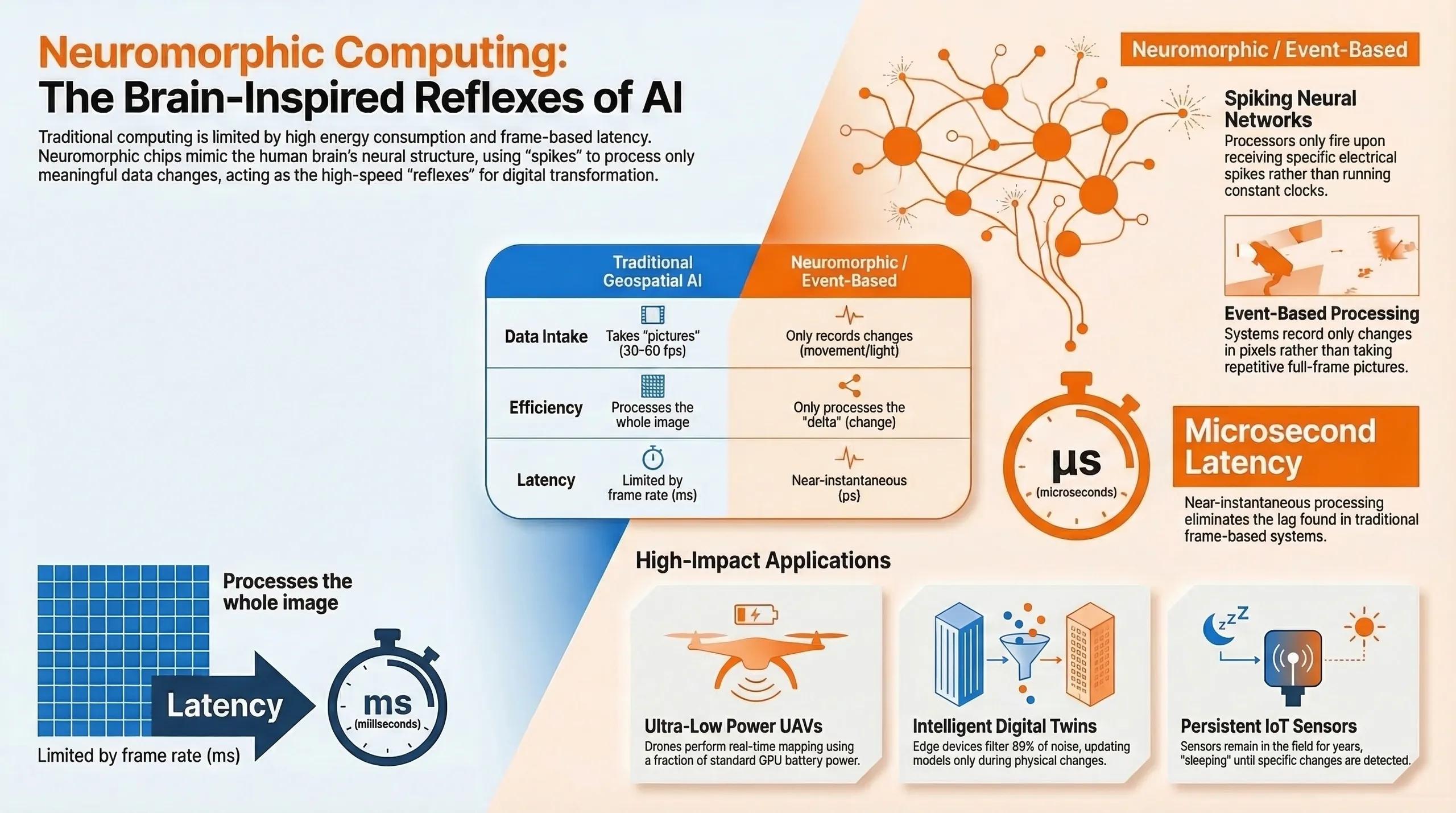
Neuromorphic systems mimic neural networks found in biological brains by using Spiking Neural Networks (SNNs) . In these systems, computation occurs only when a neuron receives a signal strong enough to trigger a spike.
Instead of running on a constant clock cycle, neuromorphic chips operate in an event-driven manner .
This means:
The system remains idle until a relevant signal appears.
Processing occurs only when required.
Energy consumption drops dramatically.
Several technology companies are already exploring this approach with neuromorphic chips designed to support ultra-efficient AI workloads.
While still an emerging technology, its potential applications in sensing and real-time decision systems are significant.
Event-Based Sensing vs Frame-Based Sensing
One of the most important innovations linked with neuromorphic computing is event-based sensing .
Traditional computer vision systems rely on frame-based cameras. These cameras capture images at fixed intervals, typically 30 to 60 frames per second, and process each frame completely.
Neuromorphic vision sensors operate differently.
Instead of capturing full frames, they record only changes in individual pixels , such as variations in light or movement.
This difference leads to several advantages:
Lower Data Volume: Only changes are recorded rather than entire frames.
Faster Reaction Time: Events are detected instantly rather than waiting for the next frame.
Energy Efficiency: Processing occurs only when movement or change is detected.
In environments where rapid responses are required, event-based sensing offers clear benefits.
Neuromorphic Computing as the Nervous System of Digital Twins
To understand the relationship between neuromorphic computing and digital twins, it is useful to think of the digital twin ecosystem as similar to a biological nervous system .
In biological systems:
Eyes capture visual information
Nerves transmit signals
The brain processes only meaningful stimuli
Not every visual detail is processed continuously. The brain reacts primarily to changes or events.
Neuromorphic systems bring this same logic into digital infrastructure.
In a digital twin architecture, neuromorphic edge devices can act as the nervous system of the twin .
Instead of streaming raw data continuously, these devices filter information at the edge and transmit only meaningful changes to the digital twin model.
This approach allows the twin to remain synchronized with reality while reducing unnecessary computation.
Practical Applications in Digital Twin Ecosystems
Neuromorphic computing could enhance several domains where digital twins are already being deployed.
Infrastructure Monitoring
Bridges, tunnels, and industrial facilities require continuous monitoring for safety.
Neuromorphic sensors could detect structural vibrations, material stress, or abnormal patterns and trigger alerts only when thresholds are crossed.
This would allow infrastructure twins to remain efficient while still providing early warning signals.
Smart Manufacturing
Factories are increasingly adopting digital twins to optimize operations.
Instead of streaming constant machine telemetry, neuromorphic systems could monitor vibration patterns, temperature shifts, or production anomalies and trigger updates only when deviations occur.
This approach could reduce network traffic and processing load significantly.
Agriculture and Environmental Monitoring
Large-scale agricultural monitoring systems rely on sensors to measure soil moisture, temperature, crop health, and environmental conditions.
Neuromorphic sensing could enable field sensors to remain inactive for long periods and activate only when environmental changes occur.
This would extend sensor life and reduce power consumption in remote locations.
UAV and Remote Sensing Systems
Drones and autonomous vehicles require efficient onboard computing.
Neuromorphic chips could enable UAVs to perform real-time tasks such as object detection or simultaneous localization and mapping using significantly lower energy consumption than conventional processors.
This could extend flight duration and enable more advanced autonomous capabilities.
Immersive XR Environments
Extended reality systems require extremely low latency to create comfortable and immersive experiences.
Neuromorphic event-based cameras can track movement and environmental changes with microsecond latency, reducing lag and improving interaction quality.
This capability could enhance digital twin visualization environments used for training, simulation, and planning.
A Strategic Perspective
Digital transformation discussions often focus on data platforms, cloud infrastructure, and AI models .
However, the efficiency of these systems depends heavily on how data is sensed and processed at the edge .
Neuromorphic computing introduces a new layer to digital architectures, one that prioritizes event-driven intelligence rather than continuous monitoring .
For digital twin ecosystems, this shift could be significant.
Instead of relying on massive data streams, future twins may operate more like biological systems:
Observing the environment
Reacting to meaningful changes
Updating the model only when necessary
If satellite imagery can be considered the eyes of spatial intelligence , neuromorphic computing may become its reflex system .
Looking Ahead
Neuromorphic computing is still in the early stages of commercial adoption. However, the convergence of edge AI, event-based sensors, and digital twin platforms suggests a clear direction.
As industries deploy larger sensor networks and real-time digital models, event-driven architectures will likely become increasingly important .
Organizations building digital twin ecosystems today may benefit from understanding how these emerging technologies can enhance scalability, responsiveness, and energy efficiency.
The next generation of digital twins may not simply mirror the physical world.
They may respond to it almost instantly .