For many organizations, weather is still something people check before starting work.
A project manager opens a forecast. A drone operator checks wind conditions. A utility team watches a storm map. A port receives a severe-weather warning.
The information may be timely, but the response often remains manual, fragmented and difficult to audit.
This is becoming a serious operational gap.
As weather observations become more frequent and precise, their value will no longer depend only on forecasting accuracy. It will depend on whether an organization can connect a changing weather condition to an exposed asset, a defined threshold and an authorized action.
Weather data is moving from the dashboard into the operating workflow.
From weather awareness to operational action
The launch of Europe’s Meteosat Third Generation Imager-2, or MTG-I2, illustrates this shift.
The satellite was launched aboard Ariane 6 on 27 August 2026. Once commissioning of the satellite and its ground segment is completed, its rapid-scanning service is expected to provide new observations over Europe every 2.5 minutes.
Its instruments will support the monitoring of fast-developing weather systems, lightning, wildfires and atmospheric pollution. The full operational service is expected after commissioning in 2027
This is important because many hazardous conditions evolve faster than conventional reporting and response cycles.
But observing a storm every 2.5 minutes does not automatically protect a construction site, electricity network or port.
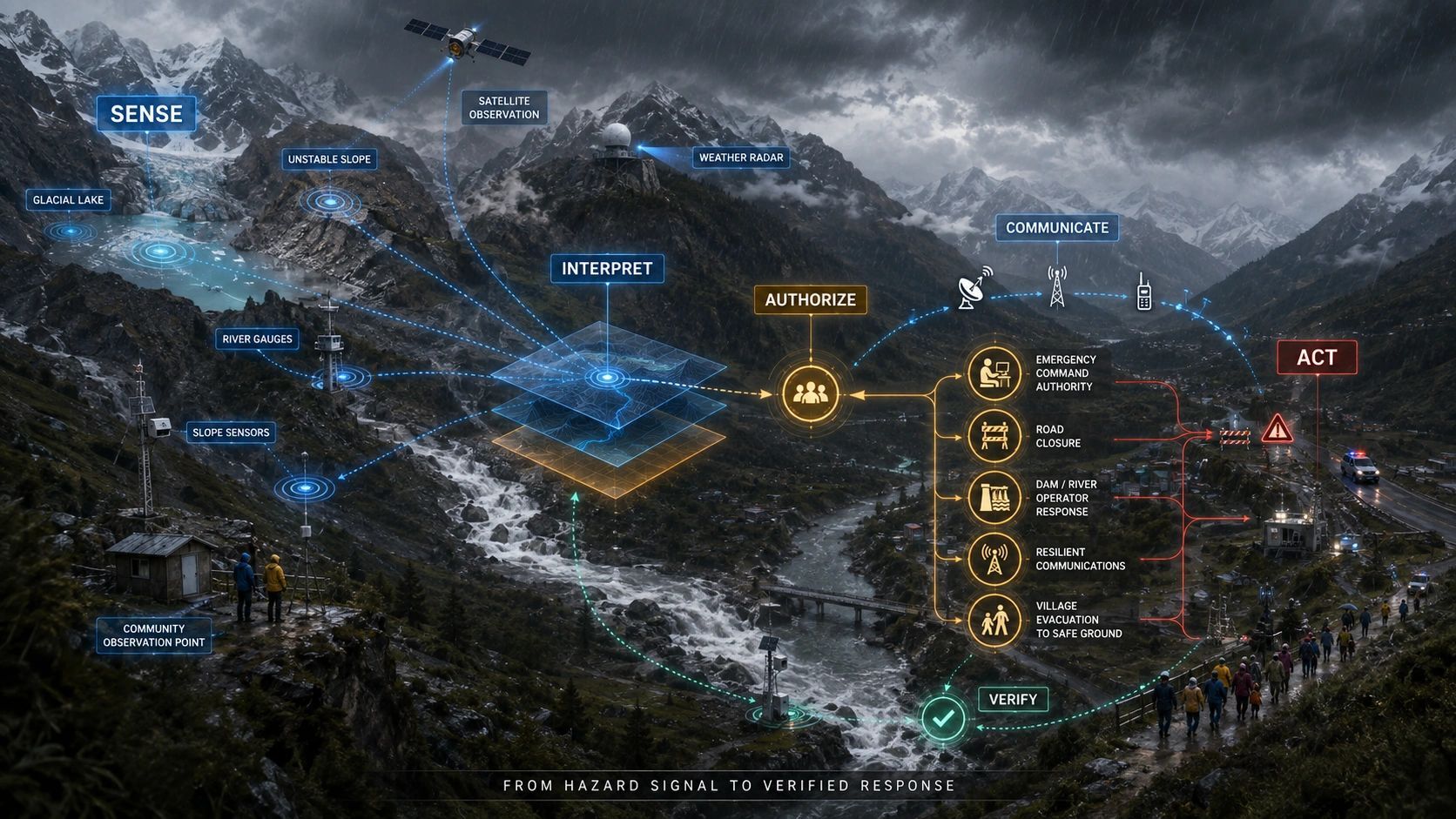
Between the observation and the intervention sits a decision chain:
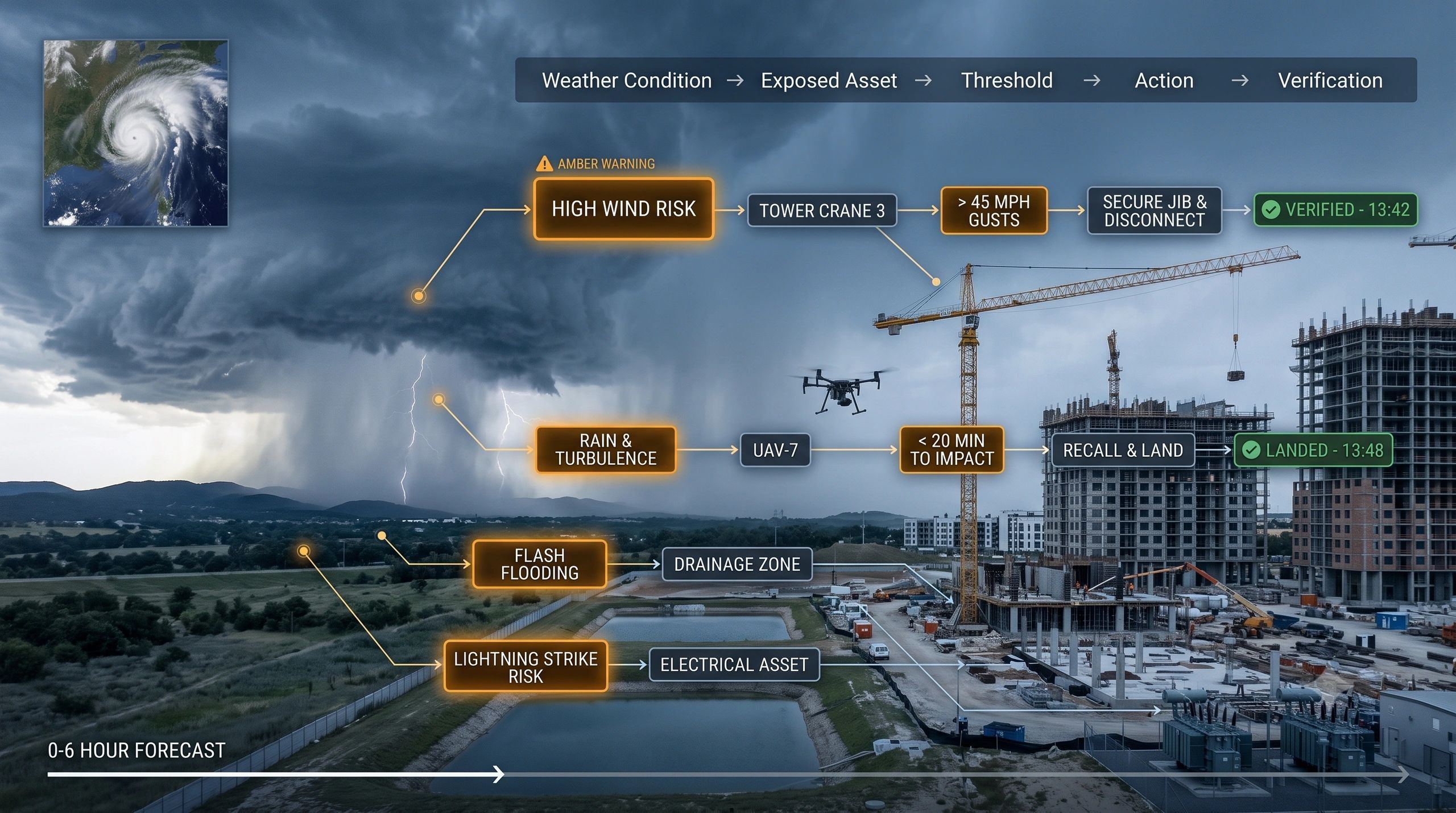
Weather condition → exposed asset → operational threshold → authorized response → field confirmation → restart condition
If these connections are absent, better weather data may produce more alerts without producing better decisions.
Weather should be treated as an external operational signal
Most digital platforms still handle weather as a visual layer.
Cloud cover, rainfall, temperature, wind and lightning are displayed over a map or digital twin. The operator is expected to interpret the information and determine what to do.
That is useful for situational awareness. It is not yet operational integration.
A weather-triggered system must understand more than the weather itself. It must know:
- Which assets and activities are exposed?
- Which threshold applies to each operation?
- How reliable and current is the observation?
- Who is authorized to suspend or modify the activity?
- Who must confirm that the action was taken?
- What evidence is required before operations can restart?
The same storm can create very different decisions across the same location.
A crane may need to stop because of wind speed. A UAV mission may need to be postponed. A drainage team may need to inspect known flood points. A solar facility may need to prepare for reduced generation. A transmission operator may need to position field crews near vulnerable assets.
Weather is the common signal, but the operational consequences depend on context.
Consider a construction site
Suppose a severe storm is approaching an active construction zone.
A conventional system might display the warning on a dashboard and send a general notification.
An operational trigger would go further:
- Identify the affected work zone.
- Determine which cranes, temporary structures and outdoor activities are exposed.
- Compare predicted conditions with approved safety thresholds.
- Recommend suspension of specific activities.
- Route the recommendation to the authorized site manager.
- Record the decision and notify affected teams.
- Request field confirmation that equipment has been secured.
- Continue monitoring local conditions.
- Permit restart only after defined safety conditions are satisfied.
This turns weather information into a governed intervention.
It also creates a record of what was known, what action was recommended, who approved it and what happened afterwards.
That record becomes valuable when reviewing safety performance, contractual delays, insurance claims or regulatory compliance.
The same architecture can support multiple sectors
The operational logic is reusable even when the decisions are different.
For UAV operations, changing wind, visibility or precipitation can trigger a mission delay, revised flight path or return-to-base instruction.
For utilities, rainfall, wind and lightning can be connected to vulnerable assets, vegetation risks, crew deployment and inspection priorities.
For ports, weather conditions can affect crane operations, vessel movements, yard safety and cargo handling.
For agriculture, weather observations can trigger irrigation changes, crop protection measures, harvesting decisions or field verification.
For renewable energy, forecasts can inform generation planning, battery dispatch, inspection schedules and maintenance windows.
For data centers, temperature, humidity and extreme-weather conditions can be connected to cooling demand, backup power readiness and site resilience.
In each case, the value does not come from displaying weather. It comes from linking weather to the operating state of a physical asset or activity.
A trigger still needs governance
Automating this process does not mean every weather alert should directly control equipment.
Forecasts contain uncertainty. Observations can conflict. Local conditions may differ from regional estimates. Sensors can fail. Operational rules may vary between sites.
A responsible architecture should therefore separate three levels of response:
Inform: Make the condition visible to the relevant people.
Recommend: Suggest an action when a defined threshold is reached.
Control: Execute a pre-authorized response in cases where the evidence, rules and safety procedures justify automation.
Not every decision should reach the third level.
Stopping an irrigation cycle may tolerate more automation than shutting down a port operation. A low-risk scheduling change is different from a safety-critical intervention.
The authority to act must be designed around the consequence of being wrong.
The digital twin needs to preserve the decision chain
A digital twin should not simply show the current weather beside the asset.
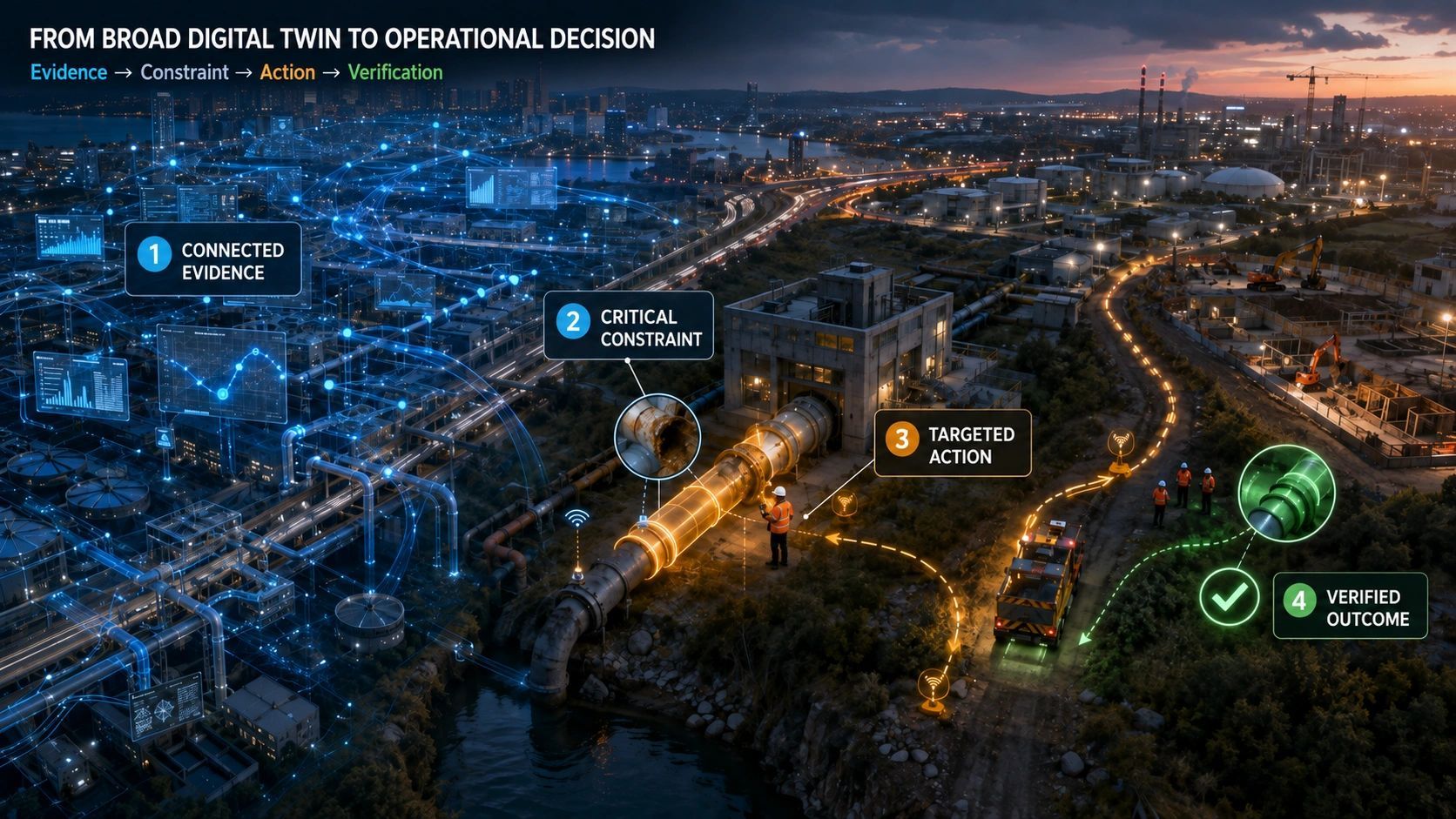
It should retain the relationship between:
- the forecast or observation;
- the affected asset or activity;
- the threshold that was applied;
- the confidence and provenance of the data;
- the recommendation produced;
- the person or system that authorized the action;
- the field response;
- and the resulting outcome.
This allows the organization to ask better questions later.
Did suspending work reduce the expected risk?
Were teams notified early enough?
Did the threshold produce too many false alarms?
Was the restart decision supported by current evidence?
Which assets repeatedly become vulnerable under similar conditions?
This is where historical weather data becomes operational intelligence. It helps improve future thresholds, response procedures, asset design and resource planning.
The next constraint will not be weather-data availability
Weather observations are becoming faster, richer and more accessible.
The unresolved problem is organizational: many businesses still lack the asset context, operational rules, responsibilities and verification mechanisms required to use those observations consistently.
The opportunity for geospatial platforms is therefore not to build another weather viewer.
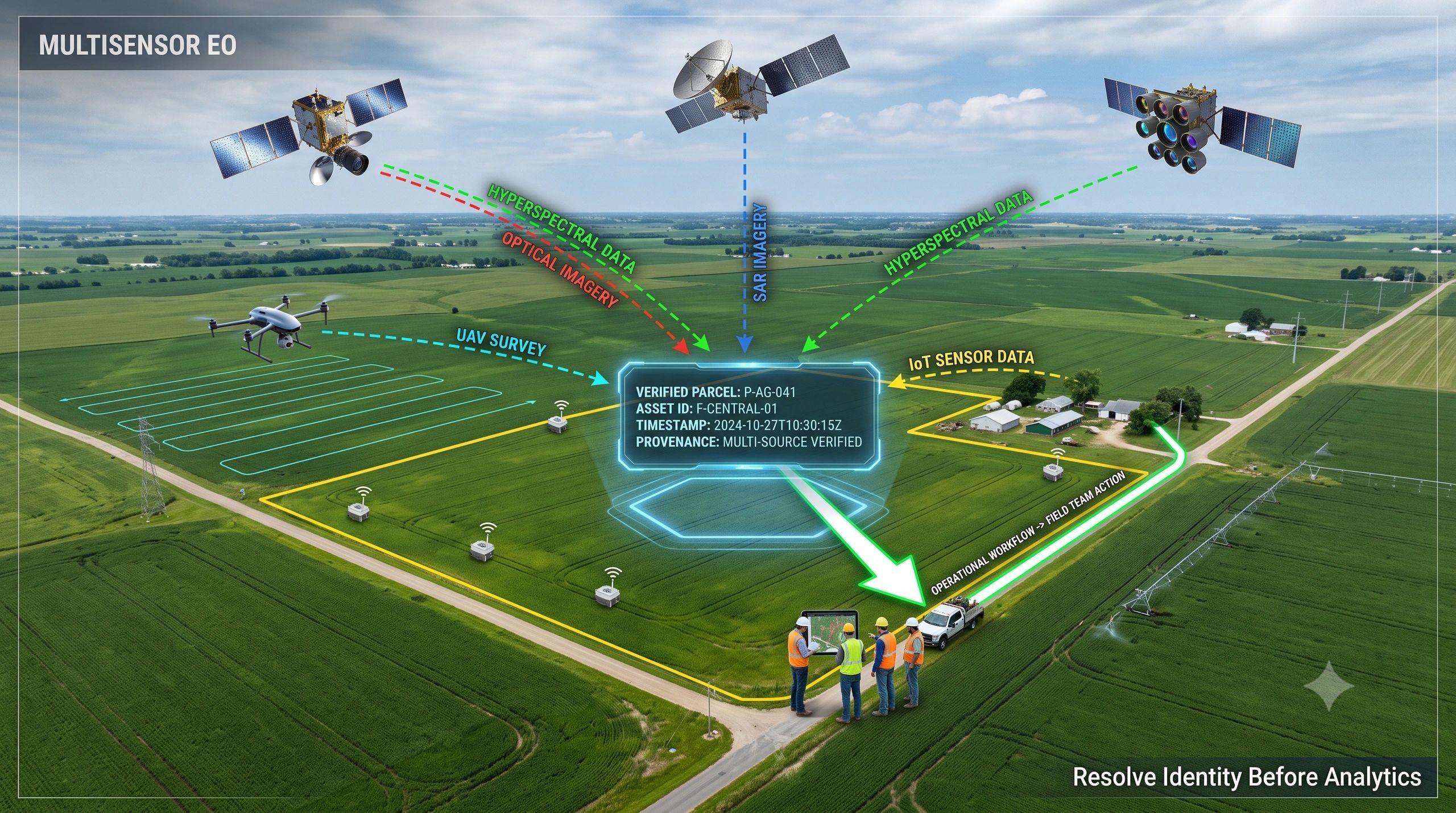
It is to create a reusable external-event layer that connects weather services with assets, work zones, digital twins, IoT systems and enterprise workflows.
The platform must help an organization move from:
Something may happen here
to:
These assets are exposed, this rule applies, this person must decide, this action is required, and this evidence will confirm when normal operations can resume.
Better observations will improve forecasting.
But operational value will come from shortening and governing the distance between a changing condition and the right response.
Weather data is becoming an operational trigger. The organizations that benefit most will be those that design the decision architecture around it.