A drone can record a construction site every month.
A laser scanner can measure installed work.
A 360-degree camera can document progress corridor by corridor.
But none of this automatically makes a payment decision easier.
The real value emerges when captured reality can be compared with the approved scope, linked to the correct asset or work package, reviewed by an authorized person, and retained as evidence of why a claim was accepted, reduced, or rejected.
That is when reality capture moves beyond project documentation.
It becomes part of commercial control.
The construction industry does not lack images
Large infrastructure projects already generate extensive visual and spatial data:
- Drone imagery and video
- Progress photographs
- LiDAR and point clouds
- Mobile mapping
- 360-degree walkthroughs
- Satellite imagery
- BIM models
- Survey measurements
- Inspection reports
Yet payment certification often still depends on manually assembled records, disconnected spreadsheets, site diaries, email exchanges, and professional judgement that can be difficult to reconstruct later.
The problem is not simply capturing reality.
It is creating a defensible connection between what was observed, what was contracted, what was completed, and what can be paid.
Monthly drone recording points toward a larger shift
India’s highway sector provides a useful example.
The NHAI approach referenced in the briefing requires monthly drone-video recording of highway projects. The footage can be reviewed against reported progress, archived for month-on-month comparison, and potentially used as evidence when disputes arise.
The important change is not the use of drones.
It is the changing status of the resulting data.
The same video can serve several purposes:
- Communicating progress
- Checking site conditions
- Comparing work across reporting periods
- Supporting progress claims
- Investigating discrepancies
- Preserving a record for future review
Once reality capture begins influencing contractual or financial decisions, the standard it must meet changes.
A visually convincing flyover is no longer enough.
Evidence requires more than visibility
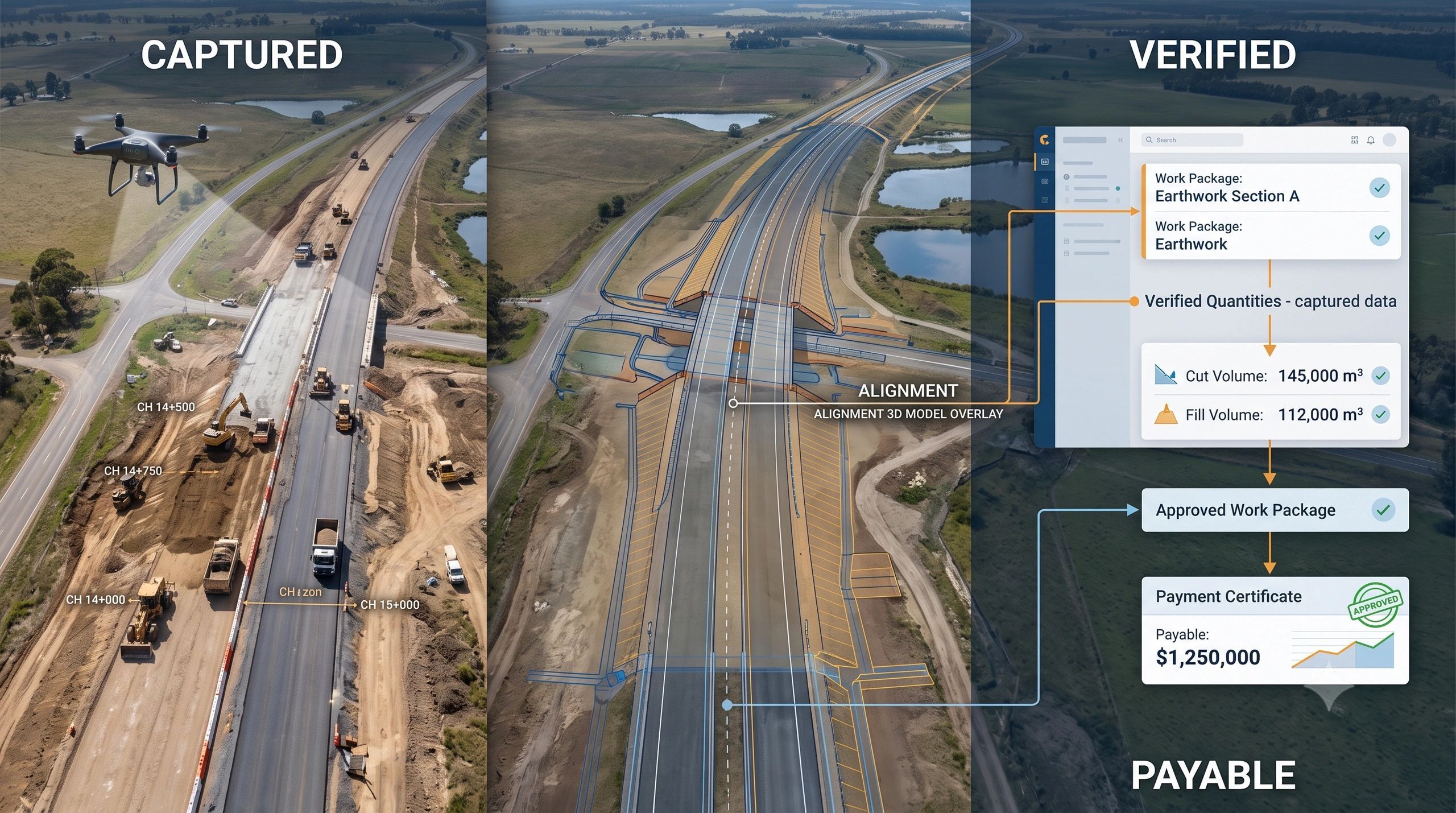
Suppose a contractor claims that 80% of a road section is complete.
Drone imagery may show that much of the corridor has been worked on. But the payment decision may depend on more precise questions:
- Which chainage was completed?
- Which pavement layer was installed?
- Was the work completed before the measurement date?
- Does it comply with the approved design and specification?
- Has the relevant inspection been completed?
- Is the claimed quantity measurable from the available evidence?
- Has the supervising engineer accepted it?
- Was any part subsequently reworked?
An image may help answer some of these questions. It rarely answers all of them by itself.
This is why reality capture must be connected to project controls rather than treated as a separate media archive.
From progress image to progress evidence
A useful workflow can be structured as a Progress Evidence Twin:
Approved programme or BIM → dated reality capture → measured progress → detected discrepancy → contractor claim → reviewer decision → payment or rework implication → retained evidence
Each step adds context.
The approved programme explains what should have happened.
The BIM model, drawings, schedule of quantities, or work breakdown structure identifies what is being assessed.
Reality capture records what was visible at a defined time and location.
Measurement converts observations into quantities or completion status.
Review establishes whether the evidence is sufficient.
The commercial process then determines the payment, withholding, correction, or reinspection required.
The twin does not replace the engineer, quantity surveyor, project manager, or contractual process. It gives them a more coherent evidence environment in which to make and defend decisions.
Five conditions make the evidence usable
For reality capture to support payment decisions, at least five conditions must be controlled.
1. Identity
Every observation must be linked to the correct project element.
That could be a chainage range, bridge pier, utility segment, room, equipment item, BIM object, bill-of-quantities line, or work package.
Without stable identity, the evidence remains searchable media rather than decision-ready information.
2. Time
The system must preserve when the data was captured, uploaded, processed, reviewed, and accepted.
This is important because construction status changes continuously. Evidence collected after a reporting cut-off cannot automatically prove what was complete at the cut-off.
3. Provenance
The record should show where the data came from, who collected it, which equipment and processing method were used, and whether the original record has been altered.
If AI was used to classify progress or calculate quantities, the result should remain distinguishable from the underlying observation.
4. Baseline
Captured reality must be compared with an approved reference:
- Contract drawings
- Approved BIM revision
- Construction programme
- Method statement
- Specification
- Quantity schedule
- Previous certified status
Comparing the site against an outdated model can produce a precise but commercially incorrect conclusion.
5. Authority
The system must preserve who is permitted to review, challenge, approve, or certify a finding.
Technology can identify a likely discrepancy. It should not silently convert that finding into a contractual determination.
AI can accelerate review, but it should not conceal judgement
AI-assisted progress monitoring can detect objects, segment completed areas, estimate quantities, compare reporting periods, and flag deviations.
These capabilities can reduce the time spent manually reviewing large volumes of imagery.
But an automated percentage should not become the payment decision without qualification.
The system should show:
- What was directly observed
- What was inferred
- The confidence of the inference
- Which approved baseline was used
- What could not be observed
- Whether human verification is required
This distinction matters when work is concealed, partially complete, visually obstructed, or technically complete but awaiting testing and approval.
“Detected” is not always the same as “installed.”
“Installed” is not always the same as “accepted.”
And “accepted” is not always the same as “payable.”
The strongest business case is not better visualization
Reality-capture proposals are often presented through impressive 3D models, point clouds, time comparisons, and fly-throughs.
Those outputs can help teams understand a project. But decision-makers will ask a more commercial question:
Which delay, dispute, rework event, or payment uncertainty does this remove?
The clearest benefits are likely to come from:
- Faster progress validation
- Earlier identification of discrepancies
- Less time spent assembling supporting records
- More consistent measurement across reporting periods
- Better coordination between site and commercial teams
- Stronger evidence during claims and disputes
- Clearer visibility for lenders and project owners
This also changes who should be involved in designing the workflow.
Reality capture cannot remain only within the survey or BIM team. Project controls, contracts, quantity surveying, finance, quality, construction, and legal stakeholders may all influence what qualifies as usable evidence.
Start with one payment-sensitive workflow
A project does not need a complete digital twin before this approach can create value.
It can begin with one measurable use case:
- Monthly earthwork verification
- Pavement-layer progress
- Façade installation
- Structural element completion
- Solar-panel installation
- Utility trench progress
- Equipment installation
- Milestone validation for lender reporting
Define the approved baseline, evidence requirements, measurement method, reviewer, exception process, and decision authority.
Then connect reality capture to that workflow.
The most useful construction twin may not be the one that represents the entire project in the greatest detail.
It may be the one that helps authorized people answer a narrow but expensive question:
What work was completed, what evidence supports it, and what should happen financially next?
Reality capture becomes commercially important when it no longer ends with seeing the site more clearly.
It continues into a governed decision.
The next stage of construction intelligence will be defined not by how much reality we capture, but by how reliably that evidence can support action, accountability, and payment.