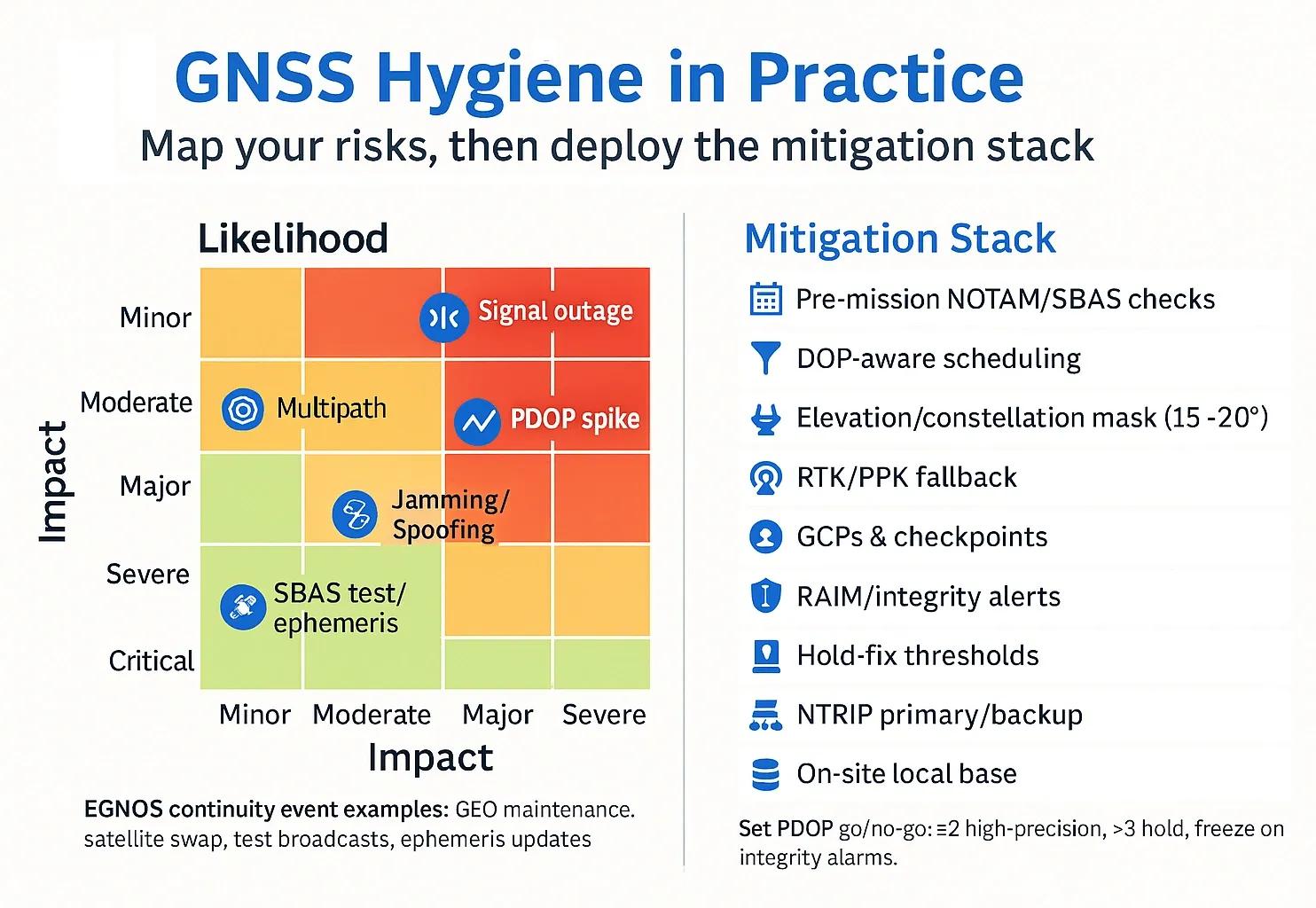
GNSS is superb, until the day it isn’t. EGNOS (Europe’s SBAS) boosts accuracy and integrity, but planned maintenance, GEO switchovers, or constellation events can briefly degrade service. In drone mapping and precision construction, those minutes matter. “GNSS hygiene” is a practical discipline for anticipating these blips and protecting Positioning, Navigation, and Timing (PNT) continuity.
What is “GNSS hygiene” (and why it’s non-negotiable)?
Think of it as preventive care for your positioning stack, simple guardrails that keep accuracy and integrity in check:
Plan by DOP: Schedule missions during low PDOP/HDOP windows; set thresholds (e.g., PDOP ≤ 2 for centimeter work).
Check notices: Review SBAS service notices/NOTAMs and your provider’s status feed before field work.
Mask wisely: Apply elevation masks (≥ 15°) and drop unhealthy satellites automatically.
Integrity on: Enable RAIM/integrity checks and alarms.
Fallbacks ready: Keep RTK/NTRIP alternatives, local base options, and PPK routes available.
Log everything: Record RINEX/RAW for after-action QC and reprocessing.
Ground truth: Use GCPs/checkpoints for independent verification.
In India or projects with Indian contractors, treat GAGAN similarly to EGNOS; the hygiene discipline is the same even though the SBAS system differs.
How EGNOS continuity issues surface in the field
When satellites are swapped or a GEO moves to test/maintenance, you may see:
PDOP spikes (briefly > 3–6)
Fix instability (RTK float–fix oscillation)
Vertical bias (height drifts when SBAS mode toggles)
Integrity flags (receiver says “do not use” for some corrections)
Fast thresholds that work on sites:
Go / No-Go: PDOP ≤ 2 (go for high precision); > 3 (hold), > 6 (abort or switch mode)
Elevation mask: 15–20° for construction; 10–15° for open-sky mapping
Fix freeze: If integrity alarm or PDOP > 3, freeze machine control and prompt operator
A field-tested mitigation playbook
1) Pre-mission
Status checks: SBAS/EGNOS service page, NOTAMs, and rover/base health.
DOP scheduling: Use predicted DOP to choose flight windows; avoid mid-day PDOP humps.
Redundancy: Configure two NTRIP mountpoints (primary/backup). Pack a portable base if cellular is spotty.
Design for tolerance: Place GCPs/checkpoints (targets well spread, good geometry).
Receiver config: Enable RAIM; set PDOP and SNR masks; log raw data.
2) In-mission
Live guardrails: Show PDOP and satellite health on the console; warn on PDOP > 3.
Auto-mask: Drop unhealthy/SBAS-flagged signals; keep elevation mask active.
Fallback logic: SBAS unstable? Switch to GPS+Galileo+GLONASS without SBAS, maintain RTK. RTK drop? Continue capture, but mark segment for PPK and add overlap or refly.
Flight tuning (drones): Increase sidelap/frontlap temporarily if PDOP is rising; slow speed to improve solution stability.
Machine control: “Hold-fix” on alarm; supervisor review before resuming cuts or pours.
3) Post-mission
QC with logs: Reject or down-weight epochs with PDOP > 3.5 or missing integrity. Compare to GCP/checkpoints; isolate bias windows.
Reprocessing: Run PPK with different constellation masks; test alternate ephemerides where available.
Traceability: Archive status screenshots, logs, and QC plots with the deliverable.
Drone mapping settings that save the day
Waypoints: Include a loiter/hover at the start to stabilize fix; auto-abort on PDOP > 3.
Overlap: Baseline 75/65 (front/side); bump to 80/70 if PDOP window looks noisy.
Altitude: Favor slightly higher altitude to widen FOV when geometry is weak (tradeoff: GSD).
Triggers: Time-based triggering can be more robust than distance-based during speed variance from wind/holds.
Precision construction (machine control) guardrails
Treat SBAS as assist, not authority. RTK is primary; SBAS fills gaps, never overrides design.
Fix-freeze and supervisor unlock. If any integrity or PDOP alarm, lock output and require human review.
Local base on site. UHF/cellular fallback; power backup and clear sky view.
Audit trail. Keep daily PDOP plots, rover/base status, and change logs.
A short, real-world scenario
Bridge deck survey, night shift. A contractor plans a drone scan with 12 GCPs. The EGNOS bulletin shows scheduled maintenance in the second hour. The team flies Window A first (PDOP 1.6–2.1), holds when PDOP crosses 3.2, then refies Window B after maintenance. Segments with PDOP > 3.5 are flagged and reprocessed via PPK, achieving 2.4 cm RMSE on checkpoints. Concrete pours proceed without rework.
Benefits & ROI
Fewer refies: DOP-aware scheduling cuts refly hours.
Accuracy you can sign for: GCP-validated outputs withstand client audits.
Safety & cost control: Machine control locks prevent bad cuts and over-excavation.
Operational continuity: Redundant comms and PPK keep deliverables on time.
Reputation: Demonstrable integrity processes win repeat work.
Conclusion
EGNOS improves accuracy and trust, but continuity events happen. GNSS hygiene isn’t fancy, it’s the basics done every time: plan by DOP, monitor integrity, keep fallbacks, and verify with ground truth. Build these steps into SOPs and your PNT will stay resilient, no surprises when satellites shuffle.