A BIM model can look complete and still be unusable by a machine.
The geometry may be detailed. The rendering may be convincing. Every component may appear to be in the right place.
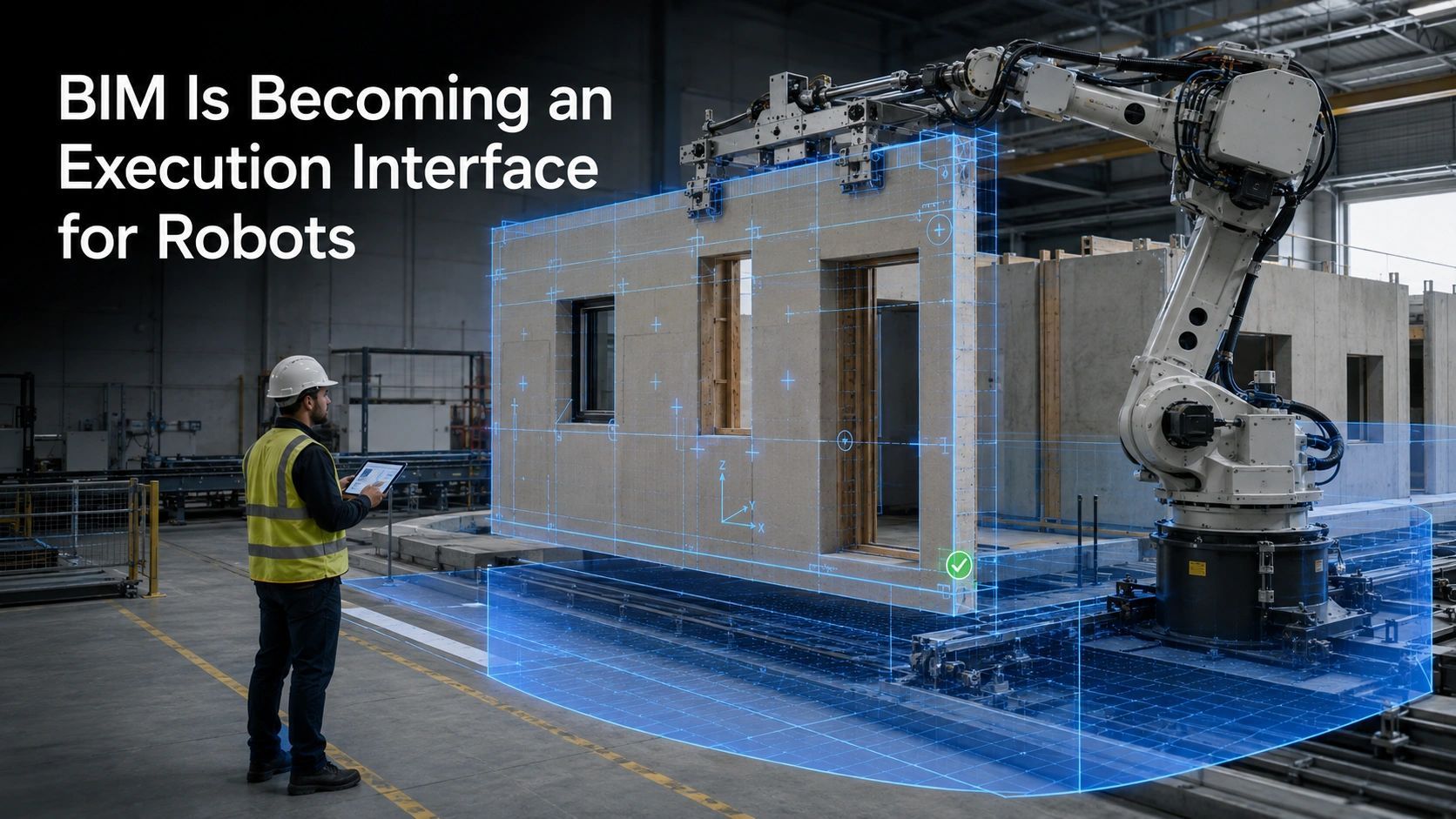
But a robot operating on a construction site or inside a facility needs more than a visual representation.
It must know:
- What is this object?
- Which object record is authoritative?
- Is it already installed?
- Can I enter this zone?
- What task is permitted here?
- What tolerance applies?
- Has the physical condition changed since the model was updated?
- What should happen if the model and reality disagree?
These are not visualization questions.
They are semantic, spatial and operational questions.
As Physical AI moves from demonstrations into real working environments, this distinction will become increasingly important.
A machine does not see a BIM model as we do
People can interpret incomplete information.
An experienced engineer may recognize a wall, notice that its location differs slightly from the drawing and understand whether the difference matters. A supervisor can interpret a temporary obstruction, consider the current work sequence and decide whether an activity can continue.
Machines cannot safely depend on the same implicit understanding.
Computer vision may help a robot detect a wall, pipe, door or piece of equipment. But detection alone does not establish operational meaning.
The machine still needs to determine:
- Is this wall W-124?
- Does it match the approved revision?
- Is drilling permitted?
- Are utilities concealed behind it?
- Is the adjacent area an active exclusion zone?
- Does another task depend on this work being completed?
- Who has the authority to approve an exception?
A model that answers these questions is fundamentally different from one designed primarily for coordination meetings, presentations or visual inspection.
Visualization supports understanding. Semantics supports action.
BIM visualization has delivered considerable value.
It helps teams communicate design intent, identify clashes, review constructability and understand complex facilities. It remains important.
Physical AI, however, raises the requirement.
When a person is looking at a model, ambiguity can be resolved through experience, conversation or site inspection. When a machine is expected to act, ambiguity becomes an operational risk.
A visually recognizable door is not enough. The system may need to know:
- its asset identifier;
- fire rating;
- opening direction;
- access classification;
- current state;
- maintenance status;
- surrounding clearance;
- emergency function;
- relationship to the robot’s assigned task.
Geometry explains what something looks like and where it is expected to be.
Semantics explains what it is, how it relates to other objects and what actions are allowed.
Physical AI needs both.
Machine-ready BIM requires more than additional object properties
The answer is not simply to add more fields to every BIM object.
More data can create more uncertainty if properties are incomplete, outdated or inconsistent across systems. Machine-ready information must be relevant to the action being performed.
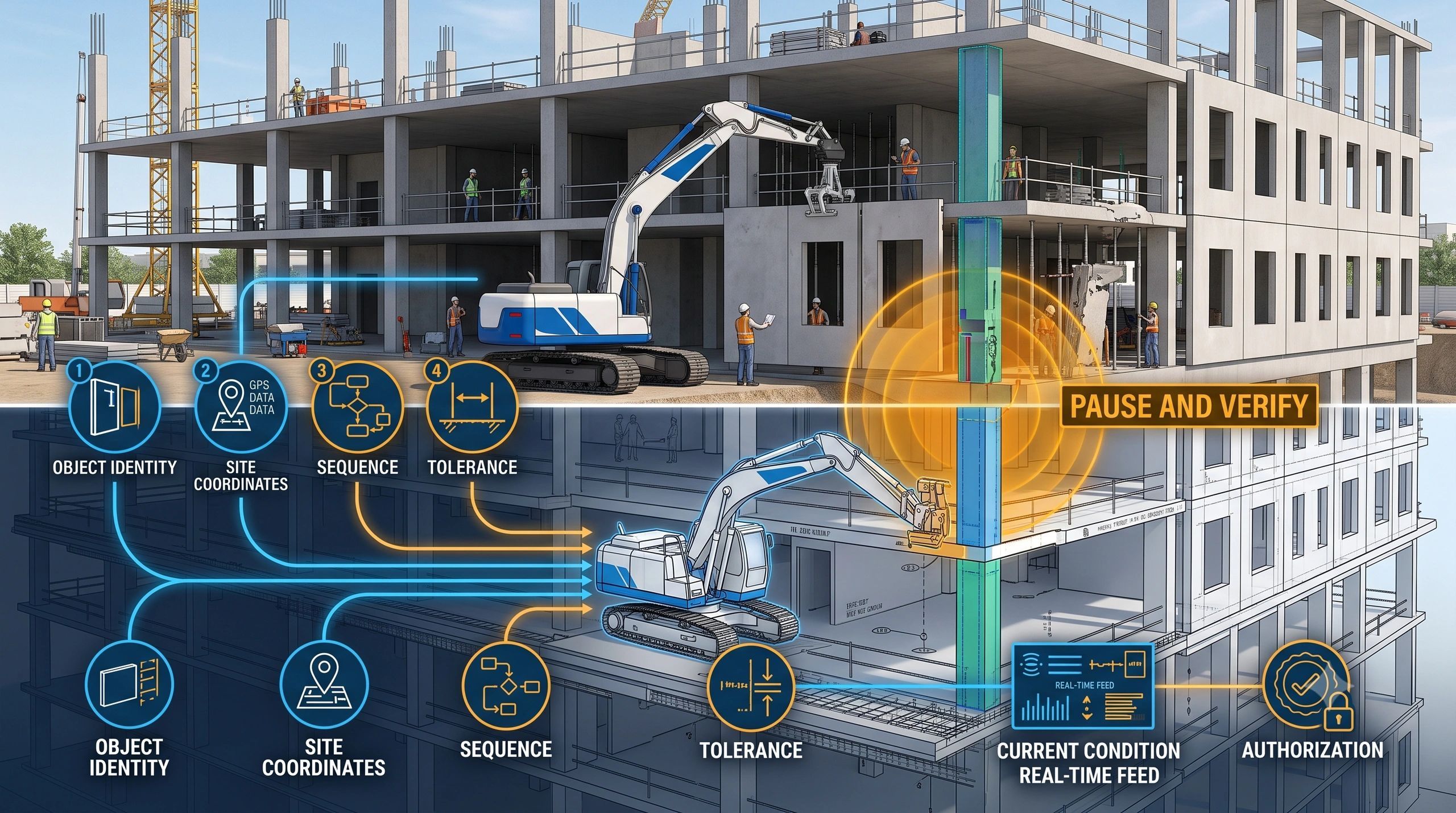
A practical structure could include six connected layers.
1. Identity
Every operationally significant object needs a persistent identity.
That identity must survive exchanges between BIM, GIS, asset-management systems, schedules, sensors and field applications. Without it, observations cannot be reliably connected to the correct physical asset.
2. Spatial context
The machine needs a dependable coordinate reference, not just locally correct geometry.
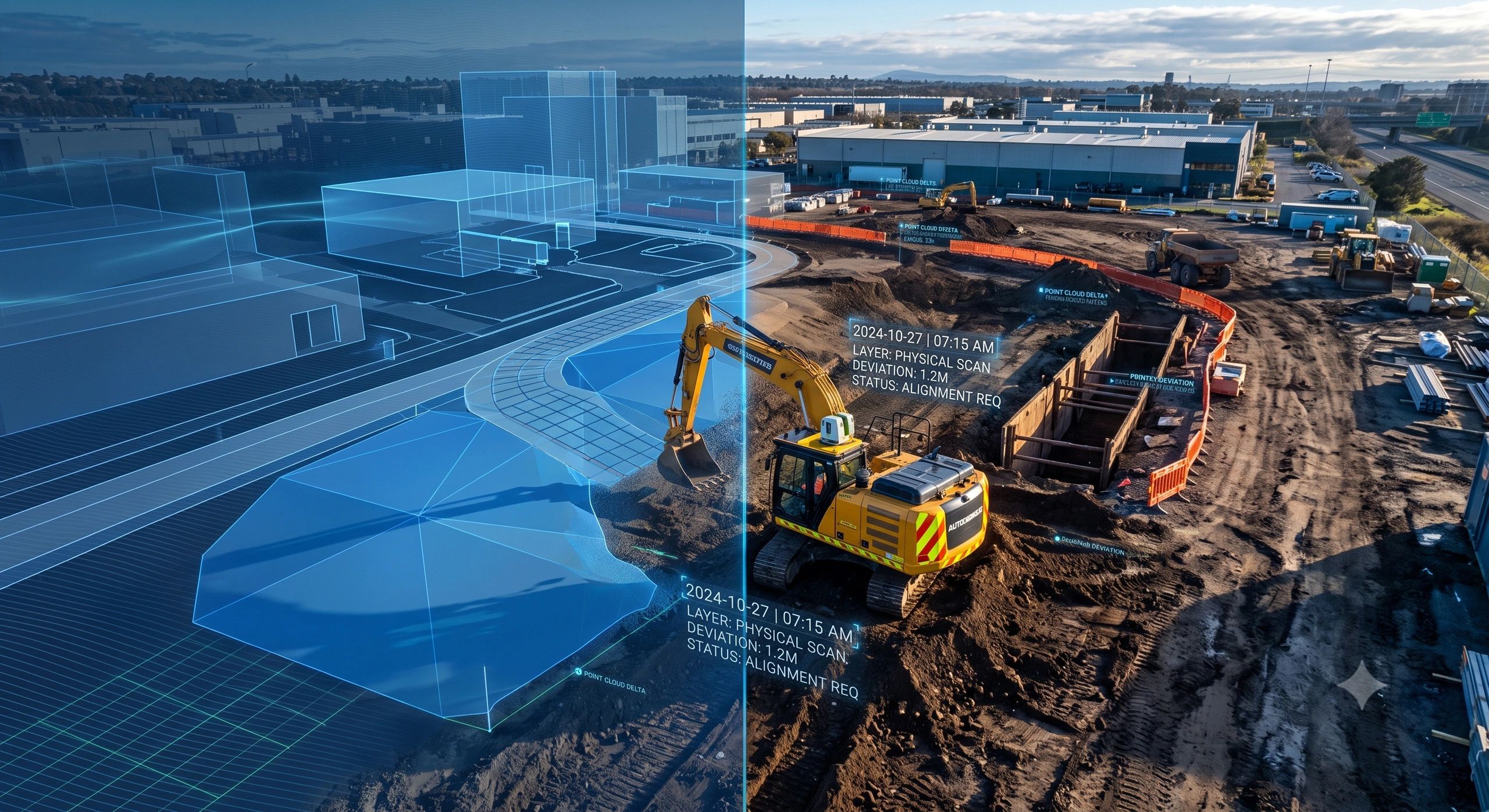
Models, point clouds, site control, indoor positioning and external geospatial data must agree sufficiently for the task. A small alignment error that is acceptable for visual review may be unacceptable for drilling, lifting or robotic inspection.
3. Operational meaning
Objects and zones need task-relevant classification.
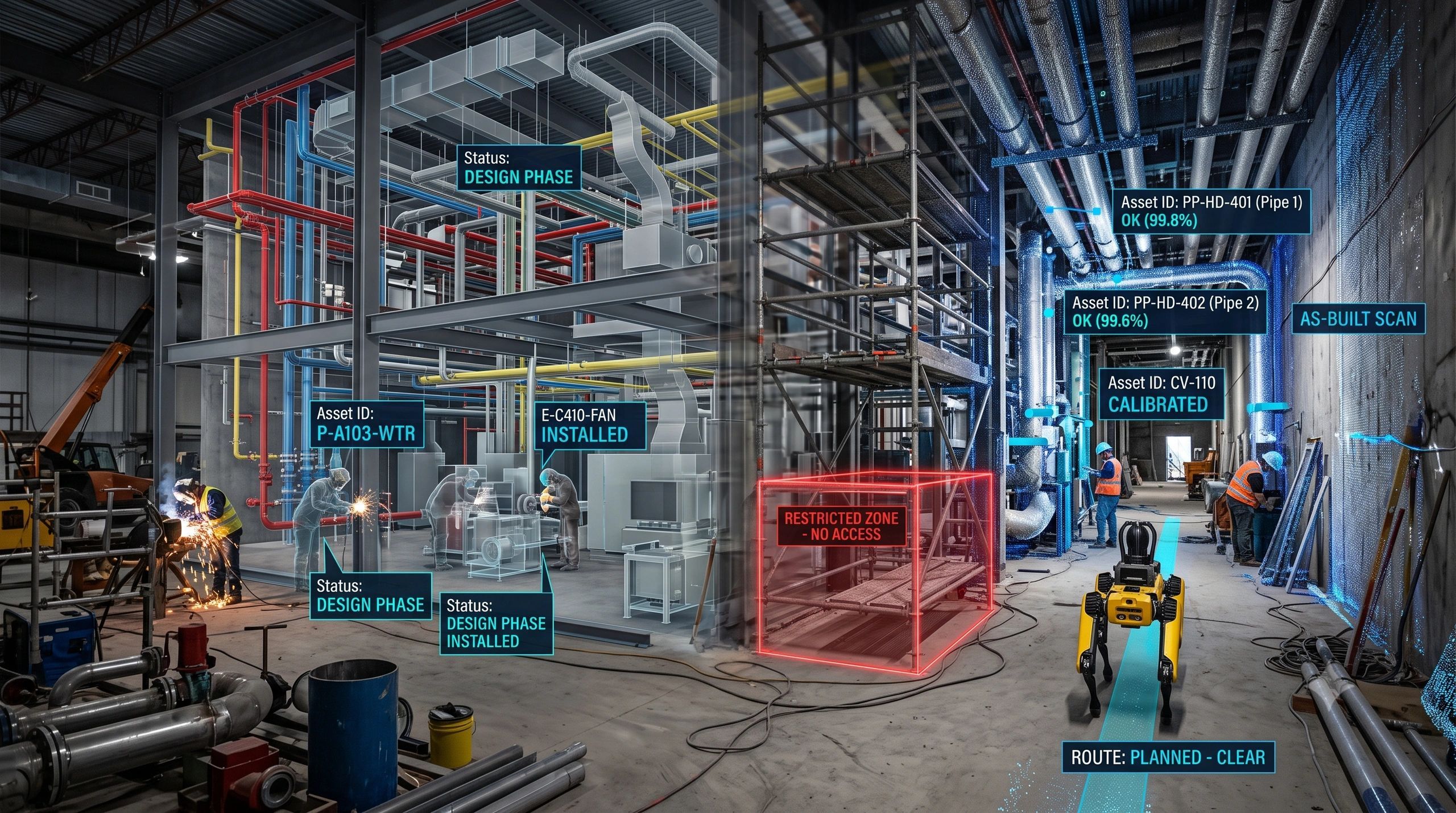
A space may be identified as traversable, restricted, temporarily occupied or hazardous. A component may be ready for installation, awaiting inspection, energized or under maintenance.
These states change what the machine may do.
4. Authority
The system must know which information is allowed to influence action.
A design model may define intended geometry. A recent scan may describe the current site. A certified sensor may provide the authoritative equipment state. A work permit may determine whether an action is currently allowed.
No single source should automatically override every other source.
5. Constraints
Physical work takes place within boundaries.
These may include safety distances, load limits, installation tolerances, protected areas, access permissions, work sequences and environmental conditions.
Constraints must be expressed in a form that a machine can evaluate before acting.
6. Verification
Execution should create evidence.
After a robot inspects, installs, moves or modifies something, the system should record:
- what action was attempted;
- which model and rules were used;
- what was observed;
- whether the outcome met tolerance;
- whether human review was required;
- how the asset state was updated.
Without this feedback loop, automation can scale actions without producing trustworthy operational records.
BIM will be part of a wider spatial context layer
BIM alone will not contain everything Physical AI needs.
Current reality may come from laser scans, cameras, UAVs, indoor positioning, IoT sensors or equipment telemetry. Permissions may come from work-management and access-control systems. Task sequence may come from a construction schedule. Asset history may sit in an enterprise asset-management platform.
The operational loop may therefore look like this:
BIM task definition → current reality check → identity and state confirmation → constraint evaluation → permitted action → machine execution → outcome verification → evidence update
BIM becomes the structured foundation for design intent, asset relationships and task context. GIS provides broader location and environmental context. Reality capture establishes current physical conditions. Sensors provide changing states. Operational systems contribute authority, responsibility and workflow.
Physical AI depends on these sources working together.
The real readiness gap is trust
Recent investment in humanoid robots, autonomous equipment and spatial-temporal AI models shows how quickly Physical AI is developing. XPENG’s robotics business raising more than $900 million in August 2026 is one indication of the capital moving toward machines that can perceive, reason and act in physical environments.
Yet investment in machines does not automatically make the environments around them machine-ready.
Many BIM models were created for design coordination, approvals or handover. They may contain duplicated identifiers, inconsistent classifications, uncertain coordinate alignment or outdated site conditions.
A human team can often work around these problems.
A machine should not be expected to.
This creates a practical opportunity for BIM, geospatial and reality-capture specialists. The next service category may not be another modelling deliverable. It may be a Physical AI Readiness Assessment covering:
- coordinate integrity;
- object and asset identity;
- semantic completeness;
- model-to-reality alignment;
- spatial operating zones;
- safety and access constraints;
- information authority;
- update frequency;
- task traceability;
- post-action verification.
The purpose is not to make every BIM object equally detailed. It is to make the information supporting a defined machine task reliable enough for action.
BIM value will increasingly be measured by what it can safely enable
For years, BIM maturity has often been demonstrated through model detail, coordination capabilities and visual sophistication.
Physical AI introduces a different test:
Can the model help a machine recognize the correct asset, understand the current situation, respect operational constraints and produce a verifiable result?
A visually impressive BIM model may still have value.
But a semantically governed model can become part of the control environment through which robots and autonomous systems operate.
That is a much larger role.
Physical AI will not reduce the importance of BIM. It will expose which BIM information is genuinely operational and which information was created mainly to be seen.