For years, BIM has mainly helped people coordinate, review and communicate construction information.
That role is beginning to change.
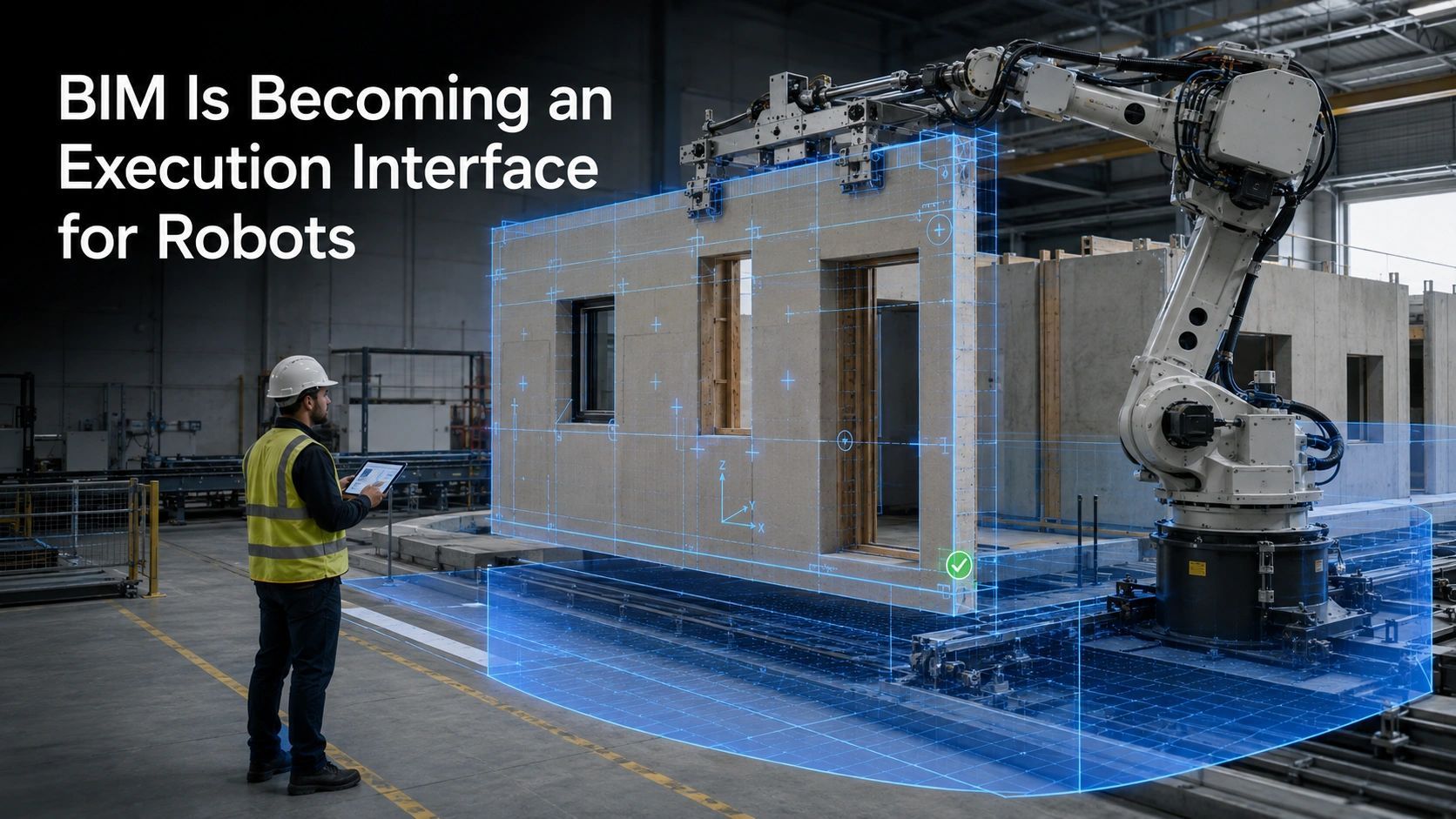
As robotics enters industrialized construction, the BIM model is moving closer to the point of physical execution. A robot may use model information to locate a component, understand an assembly, plan its movement and perform a task.
BIM is no longer only describing what should be built.
It is beginning to influence how machines build it.
The early signal from industrialized construction
In August 2026, Autodesk and the University of Florida opened a robotics laboratory focused on industrialized construction. The facility brings together collaborative robots, computer vision, BIM and digital twins.
One research system uses design information from a digital twin to help robots interpret a construction design and translate it into physical assembly. The work remains at an early stage, but it offers a useful indication of where BIM is heading.
The laboratory is not built around replacing construction workers. Collaborative robots are intended to perform heavy and repetitive activities such as framing walls and assembling panels. People retain responsibility for quality control, exceptions and tasks requiring professional judgment. Autodesk and the University of Florida describe this as human–robot collaboration within off-site and modular construction.
That distinction matters.
The immediate shift is not from manual construction to fully autonomous sites. It is from BIM as a human-readable reference to BIM as one input within a controlled machine-execution workflow.
A coordination model is not automatically robot-ready
A BIM model can appear complete to a project team and still be unsuitable for machine execution.
People are remarkably good at compensating for incomplete information. An experienced engineer can interpret a drawing, recognize an outdated detail, ask a colleague for clarification or adjust to an unexpected site condition.
A robot cannot rely on the same informal knowledge.
It requires information that is structured, current and unambiguous.
A robot-ready model may need to establish:
- The exact coordinate and orientation of every relevant component.
- The identity and classification of the object.
- Its dimensions, material, interfaces and tolerances.
- The required sequence of assembly or intervention.
- The tools, access zones and working clearances involved.
- The allowable movement and safety envelope.
- The relationship between the design position and current physical reality.
- The conditions under which the task must stop or return to a person.
This is a different standard from producing visually correct geometry or passing a clash-detection review.
Once software-generated information influences physical movement, model quality becomes a safety and execution concern.
BIM must become connected to current reality
A robot may receive an accurate instruction based on an outdated condition.
A panel could be stored in a different position. Temporary equipment might block the planned route. A previous installation may have shifted the available tolerance. A worker may have entered the operating zone.
The design model alone cannot resolve these conditions.
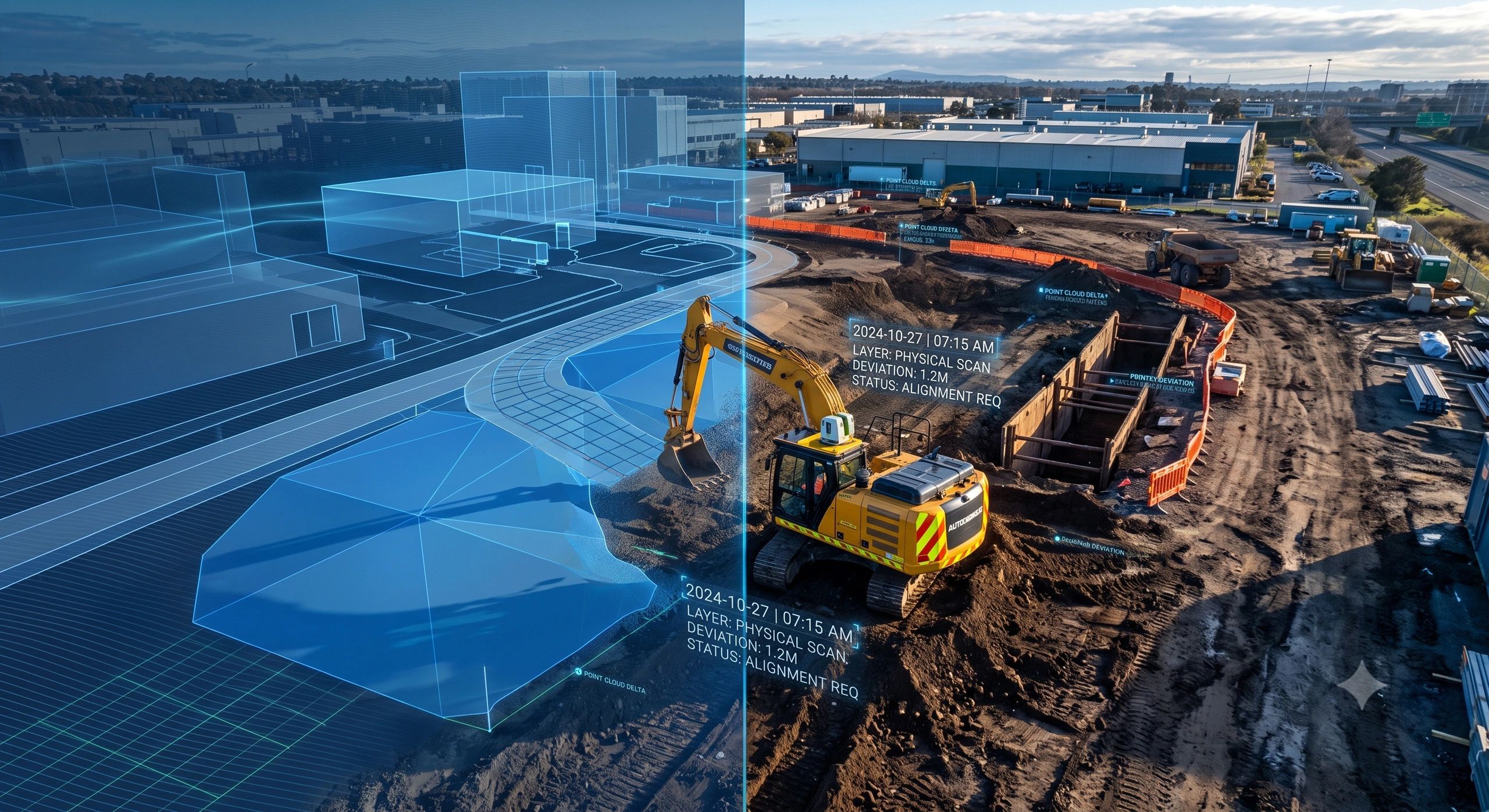
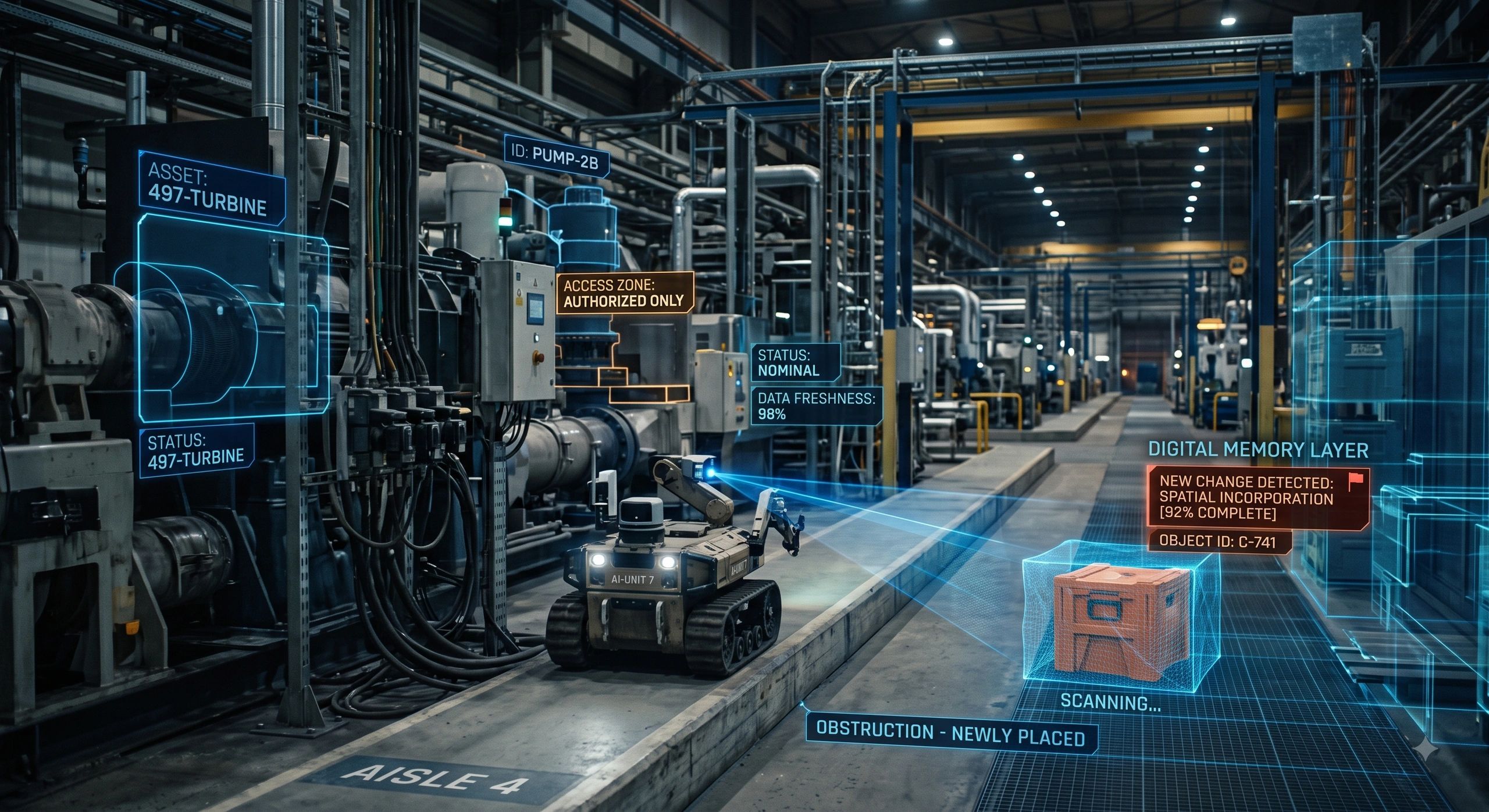
Robotic execution therefore needs a live connection between BIM and reality capture. Computer vision, LiDAR, positioning systems, force sensing and other observations must determine whether the current environment still supports the planned action.
The operating loop begins to look like this:
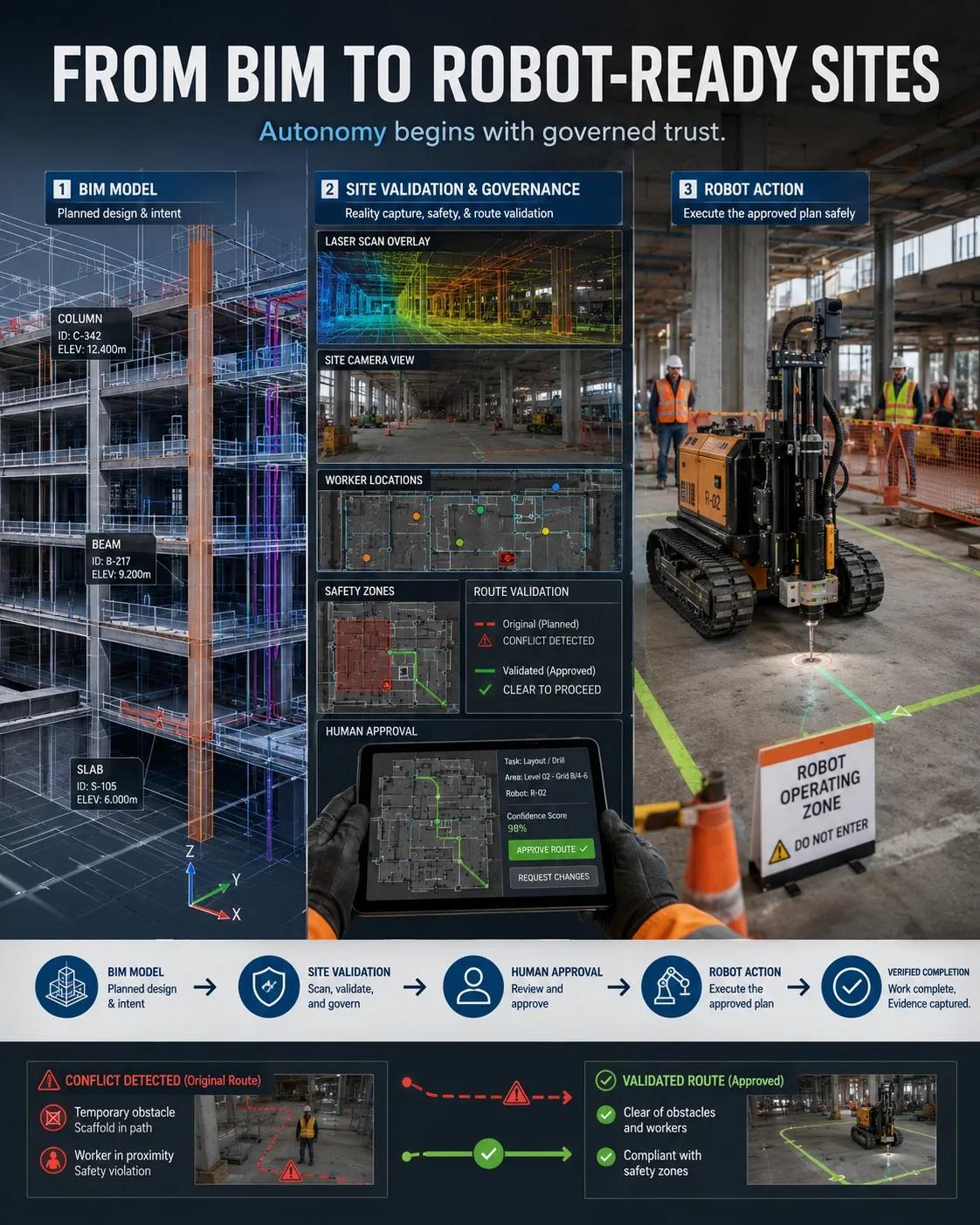
BIM task → physical location → current observation → constraint check → permitted action → execution → verification → model update
Every stage serves a different purpose.
BIM supplies design intent and object context. Reality capture establishes current conditions. The control layer determines whether execution is permitted. The robot performs the approved task. Verification confirms whether the result matches the applicable requirement.
Without that closed loop, BIM risks becoming a precise instruction about a site condition that no longer exists.
The model must describe permission, not only geometry
Construction robots will also need to know what they are allowed to do.
A technically possible action is not necessarily an authorized action.
The system may need to distinguish between several levels of authority:
OBSERVE → ANALYSE → RECOMMEND → APPROVE → ACT → VERIFY
A robot may be permitted to inspect an assembly but not modify it. It may position a component but require operator approval before fixing it permanently. It may execute repetitive movements inside a defined zone but stop when tolerances are exceeded.
Those operating boundaries should not sit in an informal procedure disconnected from the digital model.
They need to connect with:
- The task and affected asset.
- The current design revision.
- The physical work zone.
- The responsible contractor or operator.
- The applicable engineering constraint.
- The required approval.
- The machine’s permitted action.
- The evidence needed to accept the completed work.
This is where BIM begins to overlap with a governed digital twin.
The model supplies more than a representation of the asset. It becomes part of the system controlling the relationship between design intent, physical condition, human authority and machine action.
Verification becomes part of execution
Today, construction verification often happens after the work is completed.
A robotic workflow offers the possibility of bringing verification much closer to the action. The same system that positions or assembles a component may also capture its installed location, orientation and condition.
But automatic capture should not be confused with automatic acceptance.
The verification record must still show:
- What requirement applied.
- Which model and revision governed the task.
- What the robot was instructed to do.
- What it actually did.
- Which observations support that conclusion.
- Whether tolerances were satisfied.
- Who or what accepted the result.
- How the authoritative model was updated.
A robot completing a movement is not the same as the project accepting the work.
Professional authority and configuration control remain essential, particularly when the result changes an as-built record, payment claim or safety-critical asset.
A practical opportunity: Robot-Ready BIM Assessment
Most organizations considering construction robotics will not begin by buying fleets of robots.
They will first need to understand whether their digital environment can support machine-assisted work.
That creates a practical service opportunity: a Robot-Ready BIM Assessment.
The assessment could evaluate a project across five areas:
- Geometry: Are coordinates, dimensions, interfaces and tolerances reliable?
- Semantics: Can each required object, task and relationship be interpreted consistently?
- Reality alignment: Is there a governed process for comparing the model with current physical conditions?
- Operating constraints: Are access zones, movement limits, hazards and approval boundaries machine-readable?
- Verification: Can the completed action produce a traceable evidence record and controlled model update?
The result would not claim that a model is ready for every robot. Each machine and use case will have different requirements.
It would identify the gap between a model prepared for human coordination and an information environment capable of supporting controlled robotic execution.
BIM’s next test is not visual quality
Across more than two decades in geospatial and digital engineering, I have repeatedly seen organizations assume that a detailed model must also be an operationally reliable model.
Those are different things.
A model can look accurate while carrying uncertain coordinates, inconsistent identities, outdated conditions or unclear ownership. People often work around these weaknesses. Machines will expose them.
This may become one of the most important effects of construction robotics.
Robots will not simply automate physical tasks. They will force the industry to become more precise about what its models mean, how current they are, what actions they authorize and how results are verified.
BIM is therefore not becoming an execution interface because robots can read a 3D model.
It becomes an execution interface when design intent, spatial reality, operating constraints, human authority and verification are connected in one governed workflow.
As Physical AI enters construction, the real question is no longer whether a robot can interpret the model.
It is whether the project’s information is trustworthy enough for the robot to act on it.