India’s private space sector is entering a new phase. The early question was whether private companies could build launch vehicles, satellites, sensors and mission capabilities. That question has not disappeared, but it is no longer the only one that matters.
The harder commercial question is now this: once observation becomes available, who turns it into a decision that an enterprise can act on?
A satellite image may show a change. It does not automatically identify the affected asset, interpret the business consequence, assign responsibility, start an authorized workflow or prove that the issue was resolved. That gap is where a large part of India’s next space opportunity will emerge.
The value chain is moving downstream, from satellites and observation products toward operational intelligence.
India is strengthening the upstream base
Recent signals show a private space ecosystem that is becoming deeper and more integrated. GalaxEye’s acquisition of spacecraft-engineering company StarOps Technologies is one example. The transaction strengthens in-house satellite engineering capacity, but it also reflects a wider direction: private companies are assembling capabilities across spacecraft, sensors, analytics and mission operations rather than remaining narrow suppliers.
Capital and public support are moving in the same direction. The founder briefing reports that Indian space startups raised about $113 million during 2026, taking funding since 2021 to roughly $871 million, based on Tracxn figures reported in the market. It also notes new support mechanisms intended to lower access barriers for launch services, technology transfer, satellite data and ISRO facilities, alongside IN-SPACe’s Technology Adoption Fund.
These measures matter because they can increase the number of constellations, sensors, datasets and analytical products entering the market. But more supply does not guarantee commercial adoption. As access to observation expands, the bottleneck shifts.
An observation is not yet an operational outcome
Earth observation providers are often strongest at detecting conditions: vegetation stress, land-use change, surface movement, flood extent, encroachment, thermal anomalies or construction progress. Enterprise users, however, do not buy an image simply because it is accurate. They buy a better operational result.
A utility needs to know which network asset is affected and whether a field inspection is required. An insurer needs to connect an observed event to a policy, exposure and claims workflow. A mining operator needs to know whether a detected change crosses a permitted boundary. A port needs an exception routed to the responsible team. An agriculture programme needs to translate crop conditions into a timely intervention and later verify whether it worked.
This creates a longer value chain:
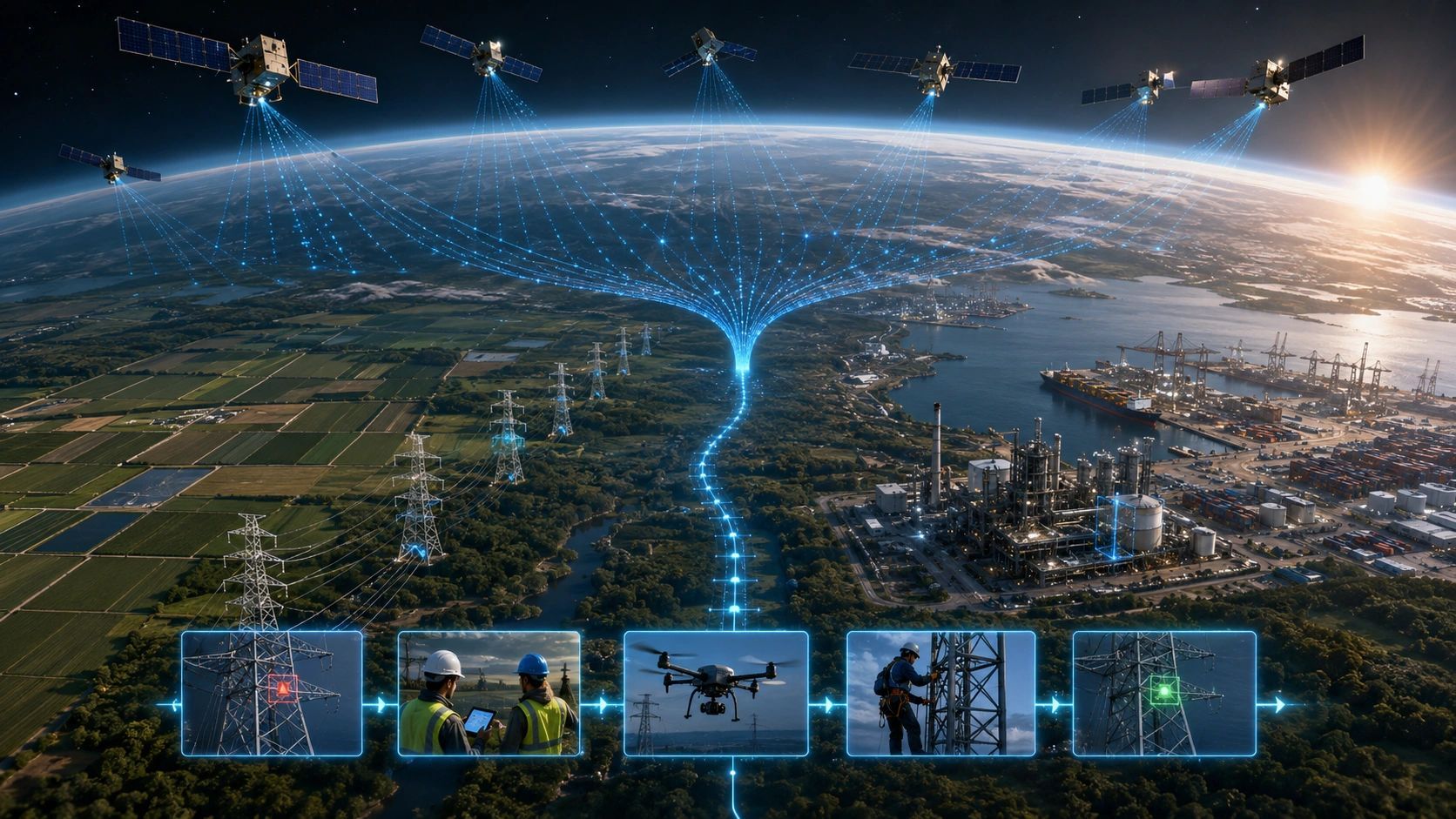
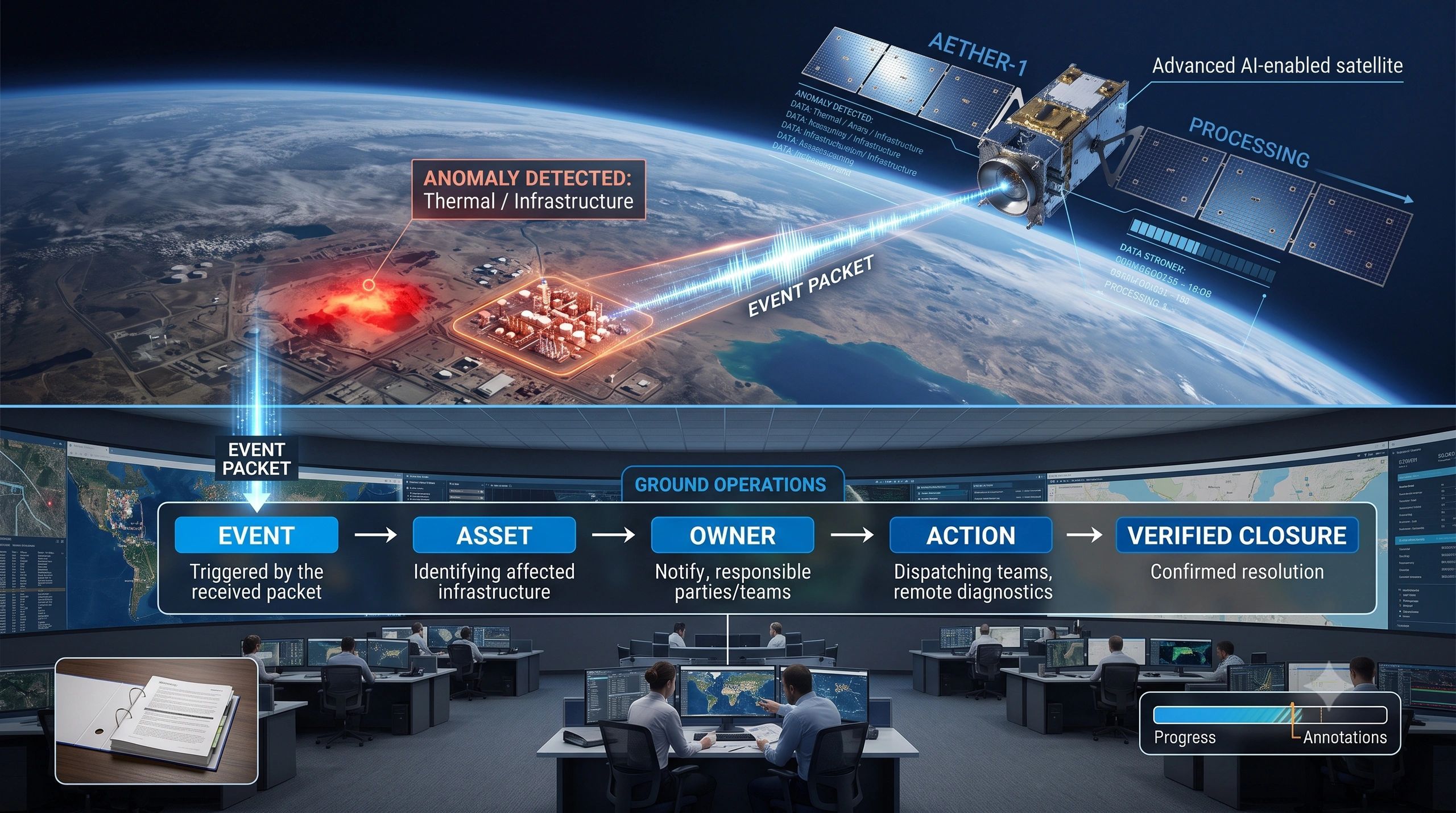
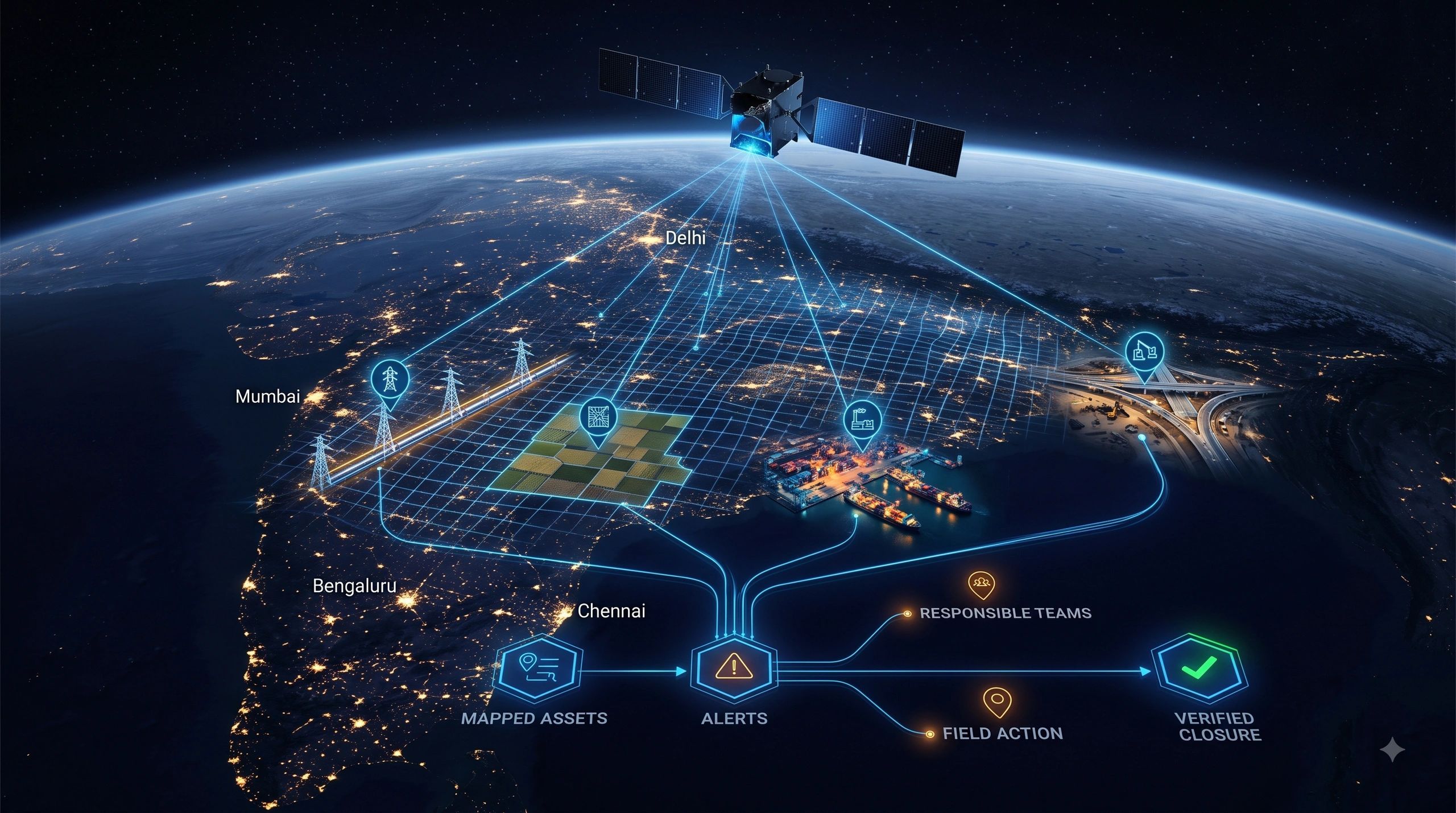
satellite observation → asset or territory → business event → rule or obligation → responsible party → authorized action → field evidence → verified outcome.
Most of the operational difficulty sits after the observation. It involves identity, context, integration, workflow design, governance and evidence. These capabilities are less visible than a launch or a new sensor, but they are what make recurring enterprise use possible.
The application layer becomes the commercial bridge
This does not mean every Earth observation company should build a complete enterprise platform. Doing so can dilute its technical focus and force it to recreate customer-specific integrations, asset models, permissions, field workflows and reporting systems for every sector.
A more scalable model separates responsibilities. The EO company owns sensing, scientific processing and its core intellectual property. An operational platform connects the observation to assets, parcels, networks and business processes. A domain implementation partner configures the workflow for the sector. The client retains authority over its data, decisions and operating procedures.
This structure supports white-label delivery, joint market propositions and repeatable sector solutions. It also makes the offer easier for a customer to understand: the provider is not selling another dashboard; it is delivering a controlled path from evidence to action.
What operational intelligence must add
A useful downstream layer should do more than display imagery. It should provide five connected capabilities.
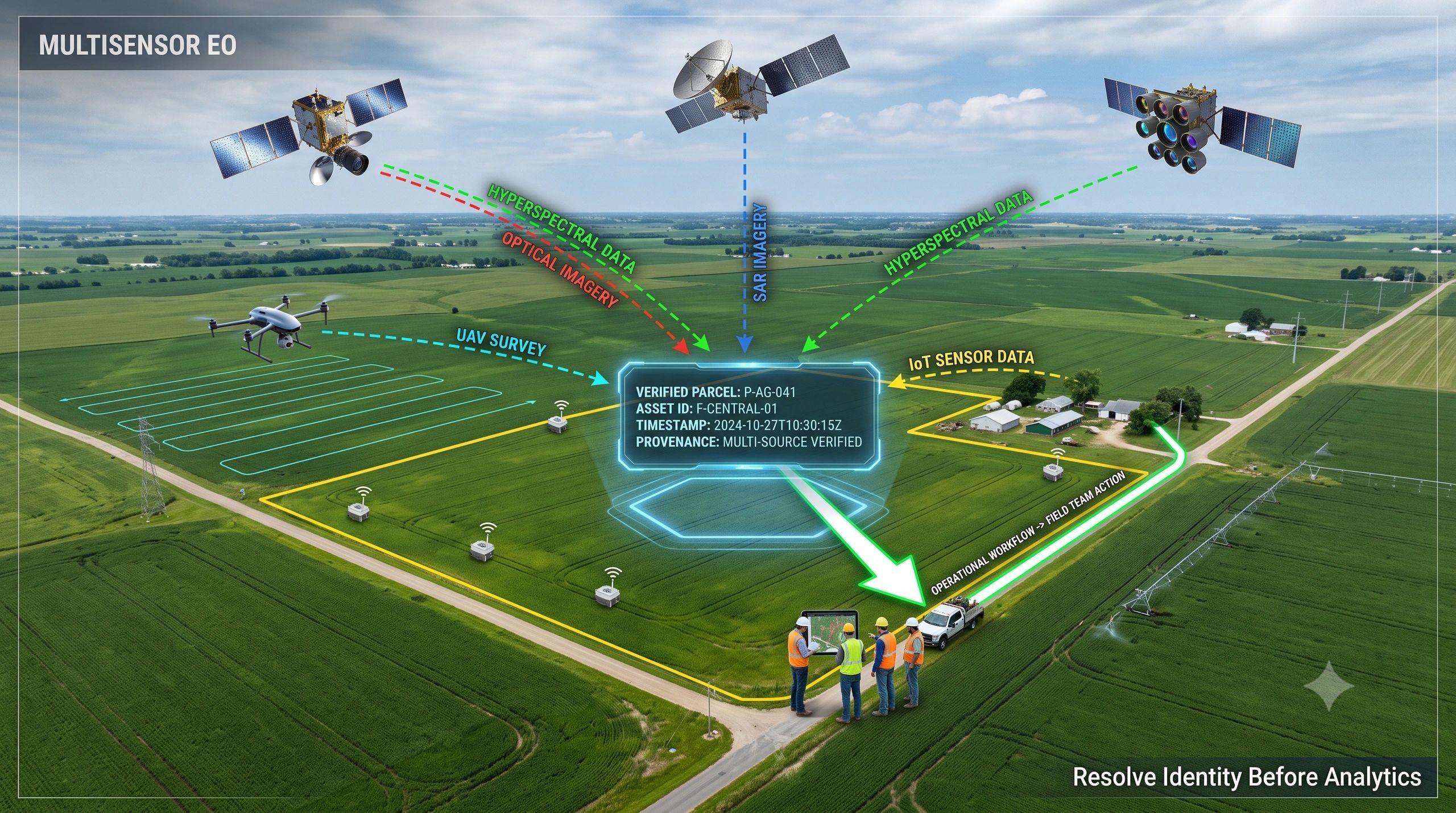
1. Operational identity: Link each observation to the correct asset, parcel, corridor, facility, project or administrative unit.
2. Decision context: Apply the relevant threshold, contract, permit, service rule or operating boundary so the system can distinguish an interesting change from an actionable exception.
3. Workflow orchestration: Route the exception to the right organization and person, with clear authority for review, escalation or intervention.
4. Multi-source verification: Combine satellite data with UAV capture, field observations, IoT signals, BIM, maintenance records or other evidence when one source is insufficient.
5. Closure evidence: Preserve what was observed, which decision was made, who acted, what changed and whether the outcome was verified.
The strongest markets are operationally complex
The downstream opportunity is especially relevant where assets are distributed, field inspection is expensive and decisions have regulatory or financial consequences.
Utilities can use repeat observations to prioritize inspection across corridors and networks. Agriculture can move from broad crop monitoring to parcel-level intervention and programme accountability. Infrastructure owners can connect construction or environmental change to work packages, permits and responsible contractors. Insurers can strengthen event verification and claims triage. Mining, ports and environmental programmes can maintain a traceable record of change, response and compliance.
In each case, the satellite is essential but it is one component of a wider operating system.
India can also become the deployment market
India’s opportunity is not limited to domestic technology creation. International space and geospatial startups entering India will need pilot customers, local integration, field deployment, regulatory understanding and evidence of business value.
That opens a second downstream role: becoming the India deployment partner for Earth observation and infrastructure intelligence. A strong proposition would take an overseas technology through a defined sequence, market problem, pilot customer, local data integration, field implementation, measurable outcome and scale-up path.
This is more useful than generic market access because it gives the technology a route into an actual operating environment.
The strategic choice for geospatial firms
For Indian geospatial and GeoAI companies, the wrong response may be to compete with every satellite provider or build another isolated analytical model. Observation capacity will continue to expand, and AI analysis will become cheaper. The scarcer capability will be the system that can answer:
What does this observation mean for this asset, under these constraints, for this organization and what must happen next?
That is the space where platforms such as NeuSpatial can contribute: connecting Earth observation with asset intelligence, digital twins, alert workflows, field verification, historical evidence and enterprise systems. BSMA Enterprises can support the domain and implementation layer required to turn that platform into a sector-specific operating workflow.
The commercial proposition should remain clear. It is not ‘we can show your satellite data on a map.’ It is ‘we can help convert your observation product into a recurring enterprise service with accountable action and evidence of outcome.’
The next space winner may not look like a space company
India still needs stronger upstream capacity. Satellites, sensors, launch access and mission engineering remain foundational. But the market will not capture their full value until observations enter the daily decisions of utilities, farms, insurers, infrastructure owners, mines, ports and public agencies.
The next phase is therefore not a move away from space technology. It is the completion of its value chain.
The companies that matter most may be those that make satellite intelligence operational: connected to the right asset, interpreted under the right rule, delivered to the right person and preserved as evidence of what happened next.
India’s space opportunity is moving downstream. The strategic advantage will belong to those who can turn observation into controlled action and controlled action into a verified result.