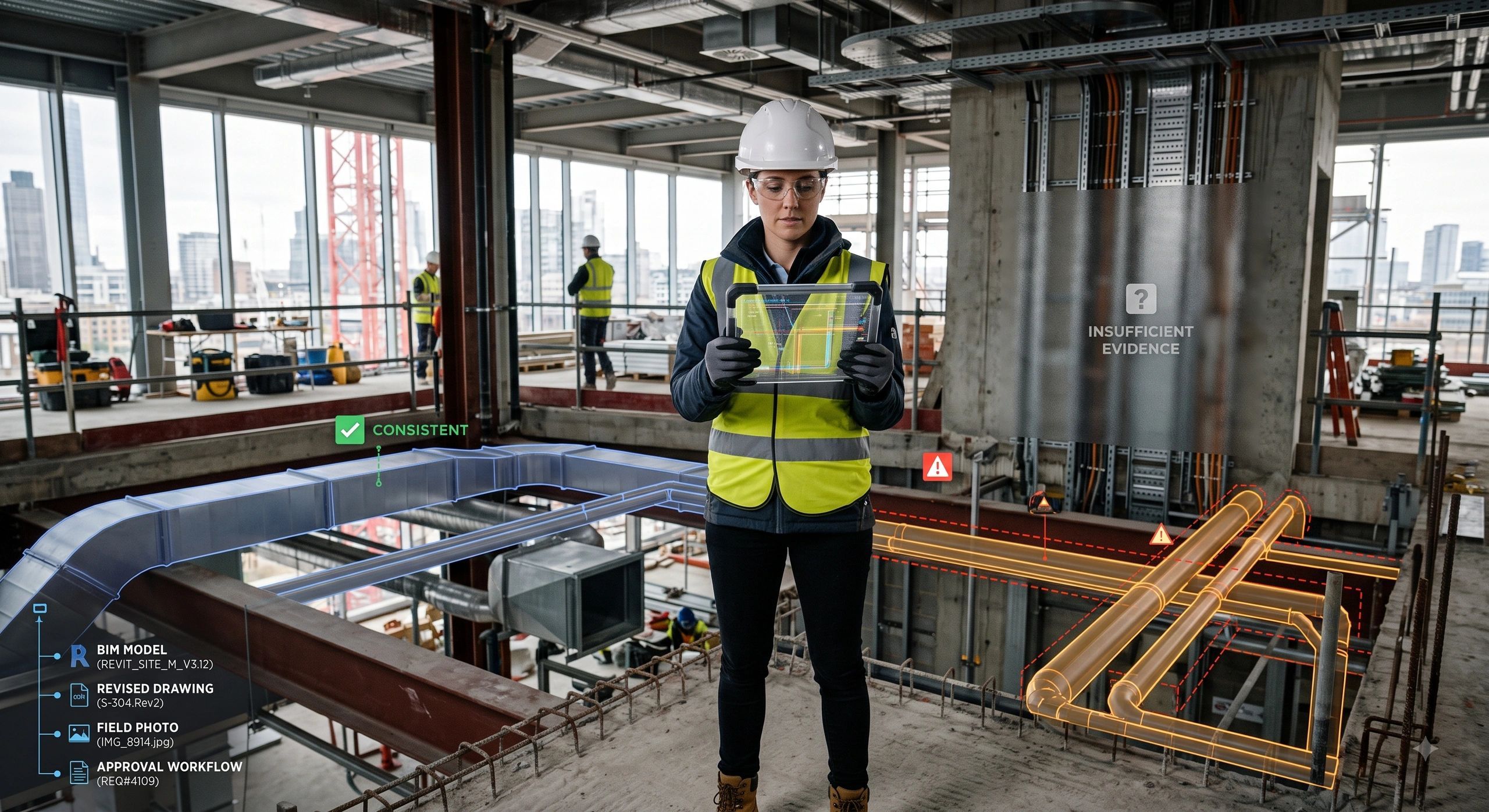
Construction’s AI conversation is dominated by generation.
Can AI create a design option?
Can it produce drawings, schedules, estimates or project reports?
These capabilities will continue to improve. But generation may not be where construction companies realize the first dependable return from AI.
A more immediate opportunity sits inside a familiar and expensive problem: verification.
Every construction project produces revisions, submittals, models, specifications, site photographs, inspection records and payment claims. The challenge is rarely a shortage of information. It is determining whether these different sources agree and identifying what changed when they do not.
A drawing may have been revised without the corresponding BIM element being updated.
An approved material may differ from what was submitted.
A progress claim may report completion that the latest field evidence does not fully support.
An as-built model may look complete while installed equipment, asset identifiers or locations remain inconsistent.
These are not content-generation problems. They are evidence-comparison problems.
Construction already depends on verification
The construction industry has never operated on the assumption that information should be accepted simply because someone produced it.
Drawings are reviewed.
Submittals are checked against specifications.
Quantities are measured.
Work is inspected.
Claims are certified.
Installed assets are compared with approved requirements before handover.
AI can strengthen these processes without attempting to replace the professionals responsible for them.
A recent example highlighted in the construction technology market involved AI being used to compare drawing packages and identify revisions and design changes. The principle was effectively “trust, but verify.”
That positioning matters.
It places AI within an established review workflow. The system does not need unrestricted authority to create or approve project information. Its initial role is to find differences, organize evidence and direct professional attention to the areas most likely to require review.
This is a lower-risk and potentially higher-value entry point than asking AI to generate something that may quietly introduce new assumptions.
Generation expands possibilities. Verification reduces uncertainty.
Generative AI and verification AI solve different problems.
Generative AI can propose:
- alternative layouts;
- design narratives;
- schedules;
- construction methods;
- summaries and reports.
Verification AI can examine:
- what changed between revisions;
- whether the BIM model and drawings remain consistent;
- whether a submittal matches the specification;
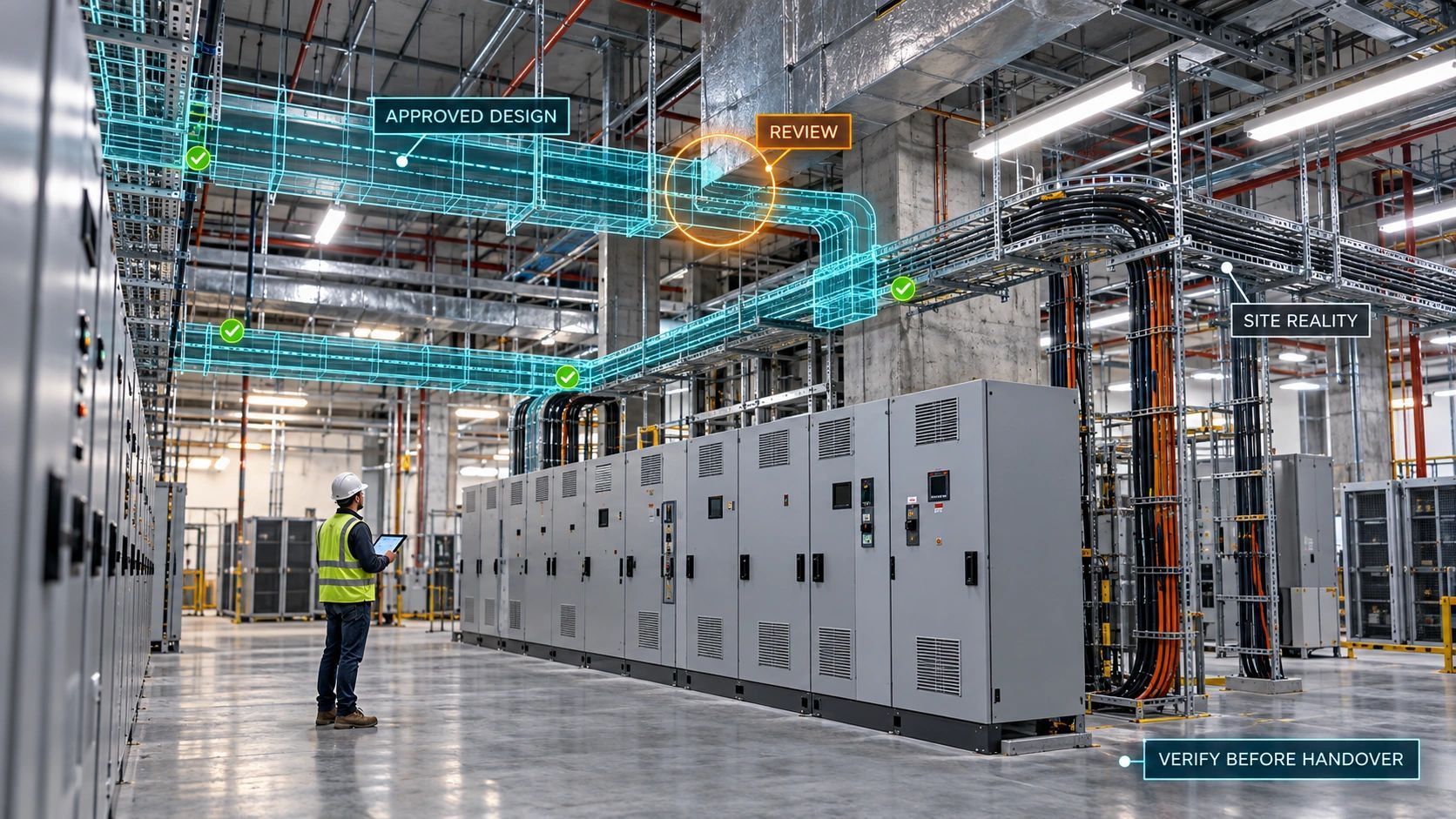
- whether installed conditions correspond to the approved design;
- whether reported progress is supported by field evidence;
- whether handover information reflects the assets actually delivered.
Generation helps teams move from a blank page to a possible answer.
Verification helps them decide whether an existing answer can be trusted.
In construction, that difference has direct commercial consequences. Unnoticed discrepancies can lead to rework, delay, disputes, incorrect payments, compliance failures and unreliable asset information at handover.
The value of verification is therefore not measured by how much content AI produces. It is measured by how many material inconsistencies it identifies before those inconsistencies become costly.
Highlighting a difference is only the beginning
A basic AI comparison tool may show that two drawing packages differ. That is useful, but it is not yet an operational workflow.
A project team still needs to know:
- Which building, floor, room or corridor is affected?
- Which BIM element is involved?
- What work package does it belong to?
- Which specification or approval applies?
- Has work already been executed?
- What field evidence is available?
- Who must review the issue?
- Does it require acceptance, clarification or rework?
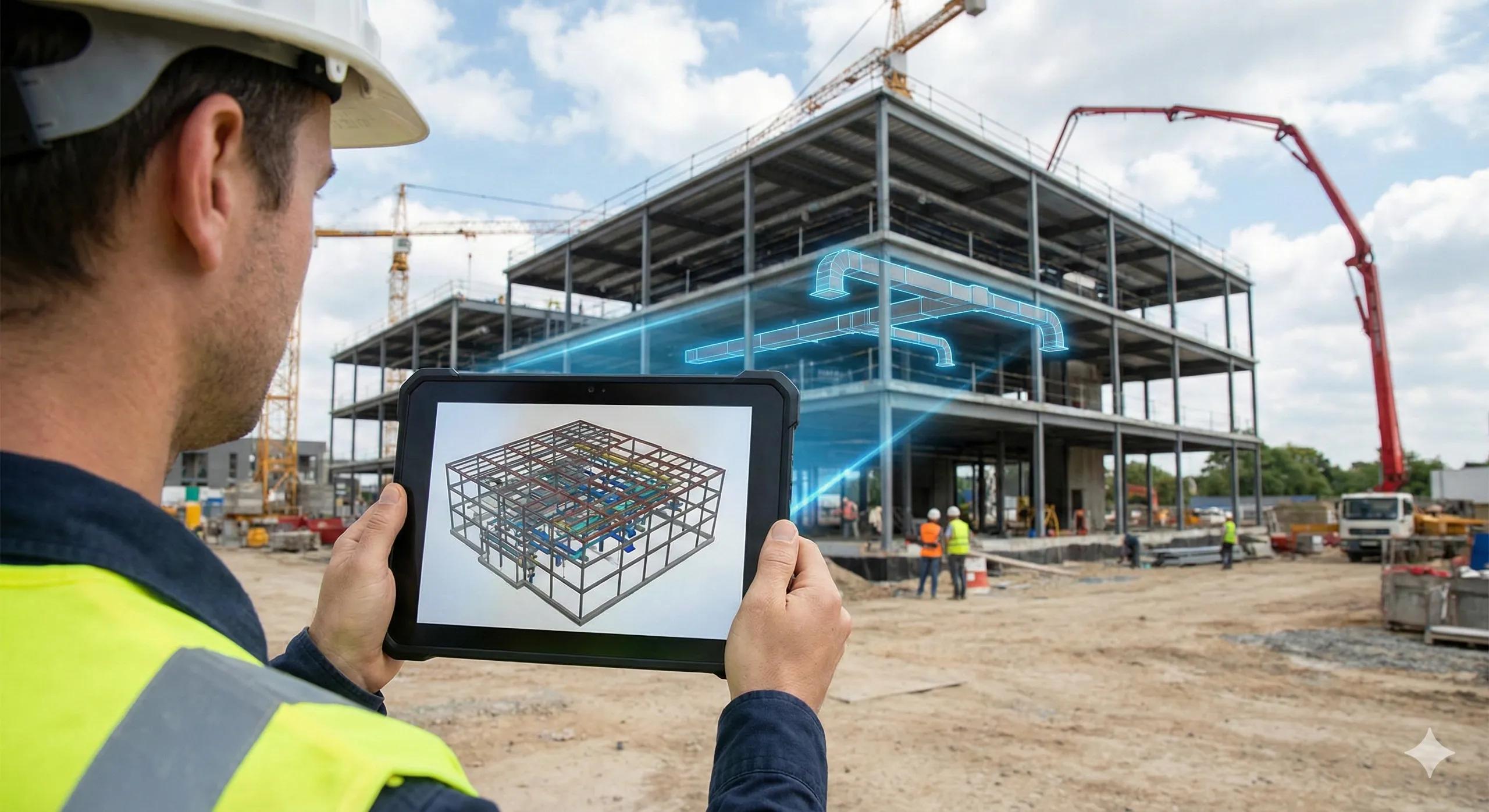
This is where BIM, geospatial context and reality capture become important.
The verification chain should move from document comparison to project consequence:
Detected difference → affected BIM element → physical location → work package → governing requirement → field evidence → responsible party → decision
For example, suppose AI detects that a mechanical drawing has changed between two revisions.
A document-level system highlights the altered area.
A project-level verification system identifies the corresponding equipment, locates it within the model, checks whether procurement or installation has begun, retrieves recent site evidence and routes the issue to the authorized reviewer.
The first system detects a change.
The second helps the project manage its consequence.
Six practical verification workflows
AI-assisted verification can enter construction through clearly bounded use cases.
1. Drawing revision comparison
AI can identify additions, deletions and modified technical information between drawing packages. The result should distinguish potentially consequential changes from formatting or annotation noise.
2. BIM-to-drawing consistency
The system can check whether plans, sections, schedules and model elements still represent the same design state. This is especially useful when different disciplines or contractors update information through separate workflows.
3. Specification-to-submittal review
AI can extract requirements from specifications and compare them with submitted product data. Exceptions can then be presented to an engineer for assessment rather than silently approved.
4. BIM-to-reality verification
Reality capture from laser scanning, mobile mapping, drones or site imagery can be compared with the approved model to identify missing, displaced or differently installed elements.
5. Progress-claim verification
Reported quantities and completion status can be compared with dated field evidence, model locations and work-package records. AI can flag unsupported or ambiguous claims for closer inspection.
6. Handover verification
Asset registers, BIM data, commissioning records and installed conditions can be checked before information enters facilities-management systems. This reduces the risk of transferring a visually complete but operationally unreliable digital asset.
These workflows share a common feature: AI does not make the final professional decision. It improves the completeness, speed and traceability of the review.
Verification needs three possible outcomes
A verification system should not reduce every comparison to “pass” or “fail.”
Many construction conditions are incomplete or ambiguous. The evidence may be outdated, obstructed, poorly aligned or insufficient to determine compliance.
A more useful operating model has three outcomes:
Consistent: the available evidence supports the expected condition.
Exception: a material discrepancy has been identified and requires action.
Insufficient evidence: the system cannot make a reliable comparison and further inspection or information is required.
The third outcome is essential.
An AI system that cannot distinguish “no discrepancy found” from “not enough evidence to check” can create false assurance. Confidence becomes meaningful only when it changes the next step: accept, review or collect more evidence.
The evidence trail matters as much as the result
For every flagged issue, the system should preserve:
- source documents and revision identifiers;
- model and element references;
- location;
- comparison criteria;
- field evidence and capture date;
- detected discrepancy;
- confidence or evidence limitation;
- reviewer;
- decision;
- corrective action;
- closure evidence.
This record protects professional authority rather than weakening it.
The engineer or project manager remains responsible for judgement. AI provides a structured trail showing what was compared, what was found and how the issue was resolved.
Without that trail, verification AI risks becoming another opaque alert system. With it, the technology can support audits, claims management, quality control and handover assurance.
Start where discrepancies are frequent and consequences are measurable
Construction firms do not need to begin with an enterprise-wide AI platform.
A practical starting point is one repetitive verification workflow with:
- accessible source information;
- frequent comparisons;
- a known review owner;
- measurable delays or rework;
- clear escalation rules.
Drawing revision comparison may be suitable for design coordination.
BIM-to-reality comparison may deliver more value on installation-intensive projects.
Progress verification may be the stronger starting point where claims, quantities and field evidence already follow a structured cycle.
The business case should measure more than hours saved. It should also track review coverage, exceptions detected, rework avoided, decision time and the percentage of issues closed with traceable evidence.
AI’s first construction advantage may be disciplined doubt
Generative AI attracts attention because its output is visible. Verification often operates more quietly.
Yet construction value is frequently created by preventing the wrong drawing from reaching site, catching a mismatch before installation, challenging an unsupported claim or stopping unreliable asset data from entering operations.
The near-term opportunity is therefore not to let AI produce more project information without restraint.
It is to use AI to test whether the information already guiding the project is consistent, current and supported by physical evidence.
In construction, the first dependable return from AI may not come from asking it to create.
It may come from teaching it what must be checked and ensuring that every exception reaches someone authorized to decide.