
A project buys a lower-carbon material.
The design team includes it in the model. Procurement approves the supplier. The sustainability report records the expected benefit.
Then construction changes something.
A different product arrives. A cable route becomes longer. A component is substituted. The installation team updates its drawings, but the carbon assessment still reflects the original specification.
At handover, the owner receives a building model and a carbon report.
Can they establish whether both describe the same physical infrastructure?
That question could shape the next stage of BIM.
Carbon claims are reaching individual infrastructure components
On 18 September, Prysmian announced that electrical cables using aluminium produced with ELYSIS technology had been contracted for installation at an Amazon data center in Ohio.
The technology eliminates direct greenhouse-gas emissions from the aluminium smelting process. That is a specific process improvement, not a claim that the finished cable has zero lifecycle emissions.
For infrastructure owners, this creates a practical information challenge.
If procurement selects a cable partly because of its environmental performance, the project needs to preserve the evidence behind that decision through delivery, installation and handover.
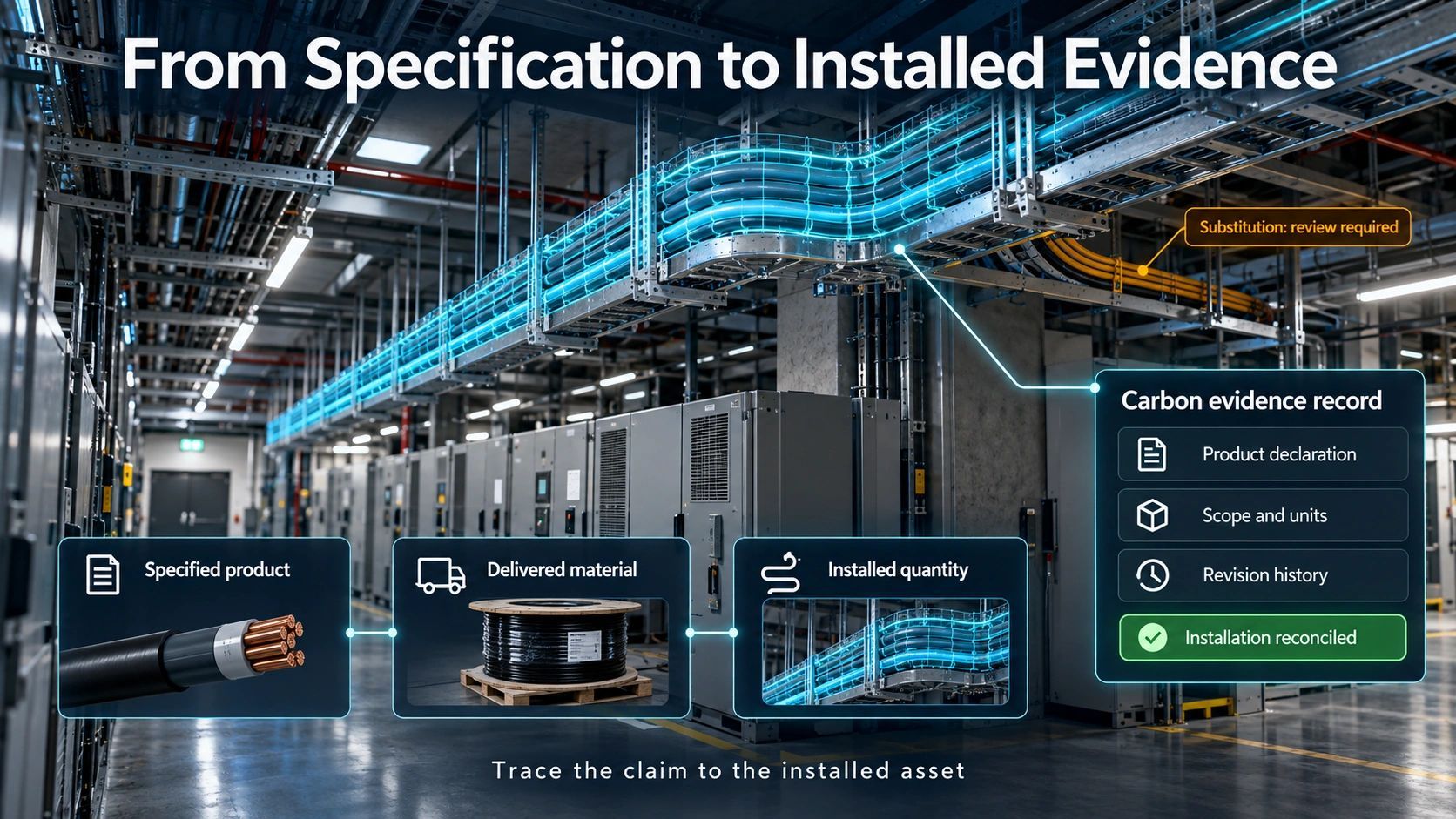
Which product was specified? Which was delivered? Where was it installed? Which environmental information applies?
My reading of this development is that carbon performance is becoming another reason to connect procurement information with physical asset identity.
A carbon value needs context
Consider a cable represented in a BIM model.
Its record might already contain a route, specification, manufacturer and quantity. Adding a field called “embodied carbon” seems straightforward.
But the number alone leaves several questions unanswered.
Does it describe the aluminium conductor or the complete cable? Is it expressed per kilogram or per meter? Which lifecycle stages are included? Does it come from a manufacturer-specific declaration or a generic estimate?
And does the installed product match the product used in the calculation?
ISO 22057:2022 already provides a framework for structuring environmental product declaration information for use in BIM. The underlying idea of connecting environmental data with building information is therefore established.
The opportunity I see is to extend that connection into a maintained record of what the project actually bought, installed and changed.
What a carbon evidence record could contain
I would organize the record around three questions.
1. What physical asset or material are we describing?
Maintain the asset identifier, location, product type, installed quantity and relevant material information.
Not everything needs an individual serial number. A cable segment, concrete pour or material batch may be the appropriate level of identity.
2. What supports the environmental assessment?
Link the applicable environmental declaration or assessment dataset, its version, declared unit, lifecycle scope and calculation assumptions.
Show whether the information is product-specific, supplier-declared or estimated.
3. What connects that information to installation?
Preserve delivery records, substitution approvals, installation quantities, inspection evidence and subsequent replacement history.
These connections allow a reviewer to move from the physical asset to the evidence supporting its carbon assessment.
The supporting documents can remain in specialist systems. The asset record needs stable references and clear version control.
The difficult moment is a substitution
Imagine a project specifies one cable product and calculates its expected embodied carbon.
During construction, availability constraints lead to an approved alternative.
The replacement meets electrical and safety requirements. The contractor installs it. The engineering team accepts it.
However, its environmental information differs from the original product.
If the carbon workflow never receives that substitution, the project can retain a calculation for something that was not installed.
A useful evidence workflow would flag the change, retain the original assessment, request the replacement product’s information and route the update to the responsible reviewer.
That preserves the relationship between engineering approval and environmental assessment without assuming that one automatically validates the other.
BIM can connect the evidence
There are practical obstacles.
buildingSMART’s sustainability work identifies mismatches between BIM element quantities and environmental declaration units, difficulties referencing product information, and assessment data becoming outdated as models change. These are recognized implementation challenges.
A sensible architecture would assign different responsibilities.
BIM provides geometry, quantities and asset relationships. Procurement systems identify purchases and deliveries. Document systems retain declarations and approvals. Carbon specialists determine the assessment methodology.
The asset information layer connects them.
That connection also needs allocation rules. One delivery may serve several installation areas. One BIM object may contain several materials. Counting the same evidence twice can produce a misleading total even when every document is genuine.
Reality capture has a supporting role
Geospatial information and reality capture can help establish location, installation progress and changes to the physical environment.
They cannot independently establish a material’s manufacturing footprint.
A scan may help confirm that a cable route exists or that its length has changed. It cannot establish which smelting process produced the conductor.
That requires supplier and procurement evidence.
AI could assist by extracting product references, matching documents and flagging inconsistent units or missing declarations. Those matches should remain reviewable, particularly when a document’s applicability is uncertain.
The value comes from connecting complementary evidence while preserving its limits.
Start with one material category
An owner does not need a complete carbon record for every object before beginning.
A practical pilot could focus on one significant category, such as concrete, structural steel or electrical cables.
Define the required information before procurement. Assign responsibility for accepting it. Connect deliveries to installation records. Make substitutions trigger review.
At handover, distinguish what was estimated, what is supported by product information, and what has been reconciled with installed quantities.
A missing declaration should remain visible as a gap. It should not quietly become a confident-looking number.
The business value is continuity
This approach could make carbon assessments easier to reconcile, procurement decisions easier to explain and later replacements easier to evaluate.
It also gives owners a clearer starting point for refurbishment and reuse.
For BSMA, I see a relevant consulting role in helping organizations define asset information requirements, connect procurement and installation workflows, and prepare the evidence architecture alongside lifecycle assessment specialists.
The long-term opportunity is broader than adding sustainability properties to a model.
An asset’s digital record may increasingly need to explain its material history, the basis of its environmental assessment and the changes that followed.
When a project claims a carbon reduction, the owner should be able to trace that claim to the infrastructure it actually received.