For decades, Earth observation has helped us understand what is happening across landscapes, cities and infrastructure.
A satellite captures the condition. An analyst interprets it. A map communicates the result. A person decides what to do.
That sequence is beginning to change.
Earth observation is moving closer to the operational systems that control buildings and infrastructure. Environmental data is no longer useful only for mapping conditions outside an asset. It can help determine how the asset should operate inside.
This is a significant step towards operational digital twins.
From environmental observation to operating schedules
An ESA-backed concept called CoolStorAge illustrates this shift.
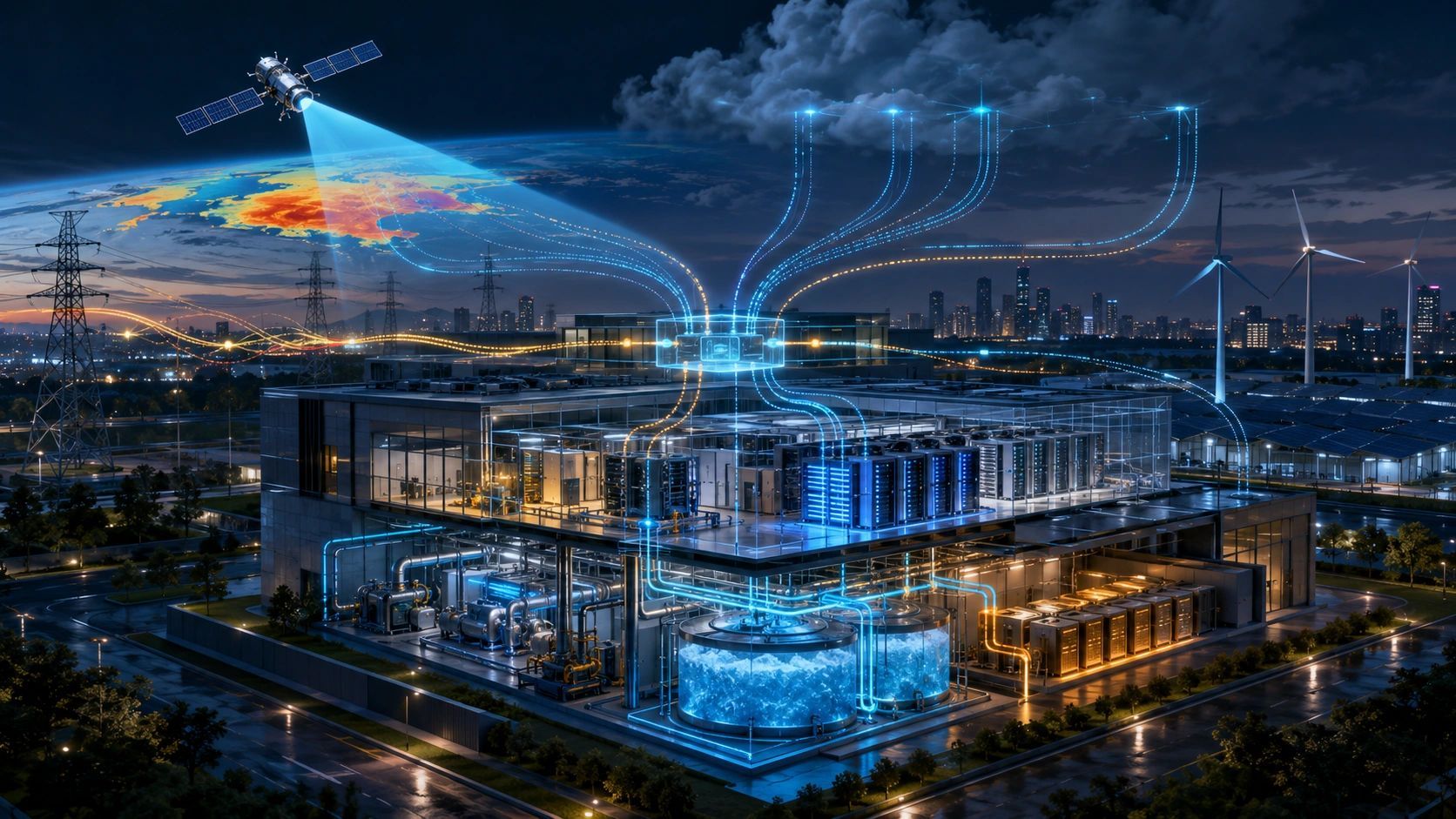
The proposed service combines Earth observation, weather forecasts and electricity-market prices to dynamically schedule ice-based thermal storage in commercial and industrial buildings.
Instead of running cooling equipment according to a fixed timetable, the system would continuously produce an optimized 24-hour operating plan.
The intended workflow is no longer:
image → analysis → map → human decision
It becomes:
environmental observation → forecast → optimization → operating schedule → measured outcome
The concept targets a 20–30% reduction in cooling-related electricity costs without requiring additional on-site hardware.
The important point is not the percentage alone. It is the change in the role of geospatial data.
Earth observation is becoming an operational input.
A building does not stop at its property boundary
Most building digital twins concentrate on what is happening within the facility:
- Equipment condition
- Room temperature
- Energy consumption
- Occupancy
- Alarms
- Maintenance status
These are necessary inputs, but they describe only the internal state of the building.
A building’s performance also depends on conditions beyond its physical boundary:
- Local temperature and humidity
- Solar radiation
- Urban heat
- Air quality
- Electricity prices
- Grid constraints
- Renewable-energy availability
- Water availability
- Regional infrastructure disruptions
A cooling system may be working exactly as designed while operating at the most expensive time of the day.
A battery may be healthy and fully charged but unavailable when the grid is under stress.
A data center may optimize its internal equipment while ignoring an emerging constraint on external power or water supply.
The equipment can be functioning correctly while the operating decision remains wrong.
The digital twin must understand dependencies
This is why the next generation of building twins must extend beyond monitoring equipment.
It must model the dependencies that determine how the facility should operate.
For an energy-intensive building, the decision chain could look like this:
weather and Earth observation → anticipated thermal demand → electricity tariff or grid signal → equipment and storage capacity → permitted operating boundaries → recommended schedule → approved BMS action → measured energy outcome
This creates an external-context energy twin.
Such a twin would not replace a building management system. The BMS would continue to manage equipment, controls and local automation.
The digital twin would add the broader context that a conventional BMS may not see.
It could help answer:
- When should thermal storage be charged?
- Which cooling loads can be shifted?
- What happens if grid capacity falls?
- Which loads must remain energized?
- When should backup generation be prepared?
- Will an action reduce cost without affecting comfort or safety?
- Did the approved action produce the expected result?
That is more valuable than another dashboard showing equipment status.
From prediction to governed optimization
Many current digital twins remain at the observation or prediction stage.
They can show what is happening and sometimes estimate what may happen next. Operational value grows as the twin progresses through five levels:
- Observe: What is happening?
- Predict: What is likely to happen?
- Recommend: What should the operator consider doing?
- Optimize: What is the best permissible action under current constraints?
- Execute and verify: Did the approved action occur, and did it deliver the expected outcome?
The difficult transition is not from observation to prediction. It is from prediction to controlled action.
An accurate forecast does not automatically justify changing a building’s operating state.
Before a recommendation reaches a BMS, the system must consider:
- Equipment limits
- Occupant comfort
- Safety requirements
- Critical-load priorities
- Contractual obligations
- Operator authority
- Model confidence
- Fail-safe conditions
- Manual override
- Evidence of the final outcome
The optimization engine therefore needs boundaries, not simply objectives.
“Minimize electricity cost” is not a sufficient instruction. The actual requirement may be:
Minimize cooling cost while maintaining temperature limits, protecting critical equipment, preserving required storage capacity and respecting operator-approved control boundaries.
That is governed optimization.
Earth observation becomes part of the control context
The title of this shift requires one qualification.
Earth observation will not usually send a direct command to a chiller, pump or battery. It will contribute external evidence to the system deciding what the facility should do.
That distinction matters.
Cloud cover, land-surface temperature or a regional heat signal may change the expected cooling requirement. Weather forecasts may influence when thermal storage should be prepared. Grid and tariff signals may change when flexible loads should run.
Earth observation becomes part of the control context rather than the sole controller.
This is also where digital twins, GeoAI, IoT and BMS platforms begin to converge.
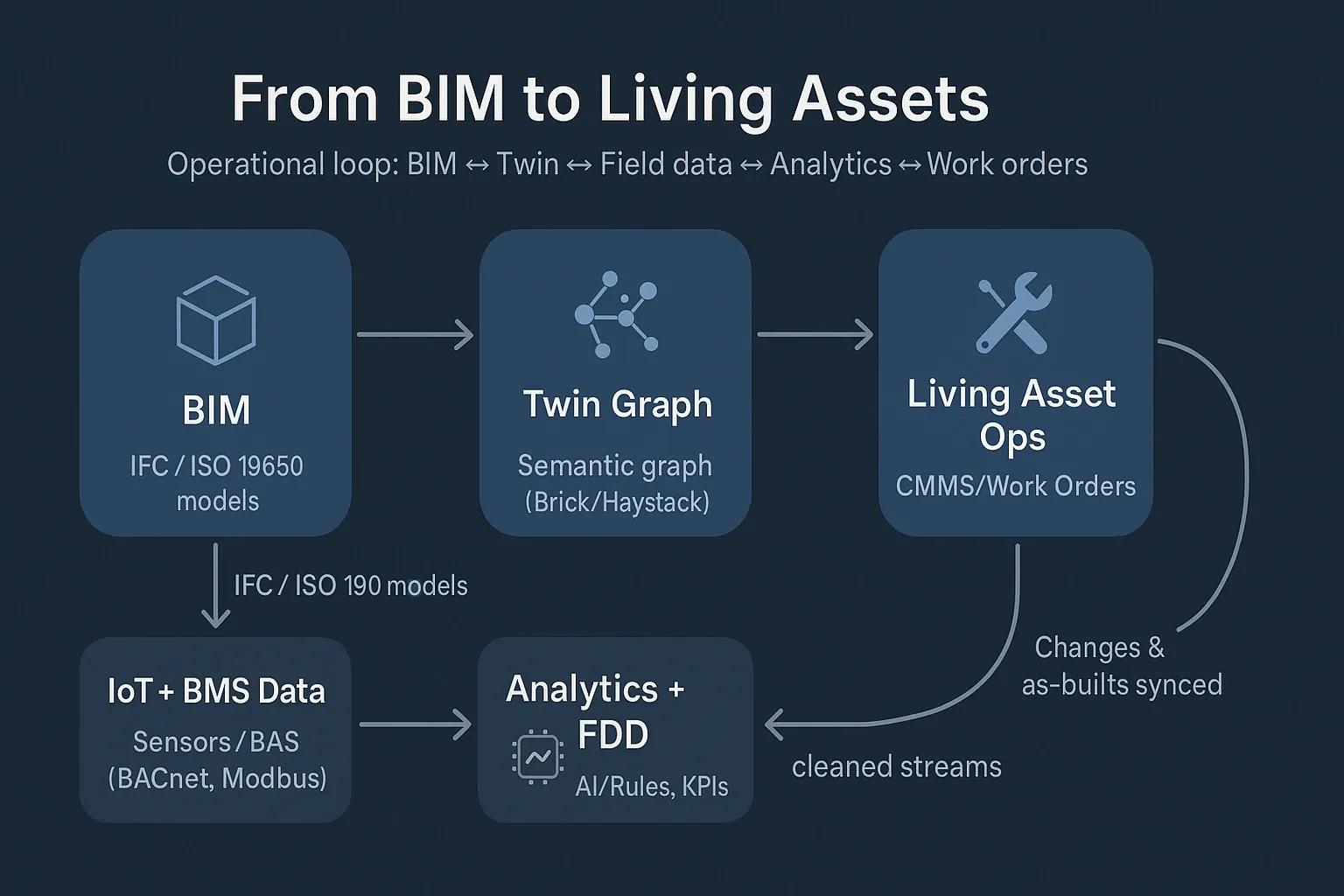
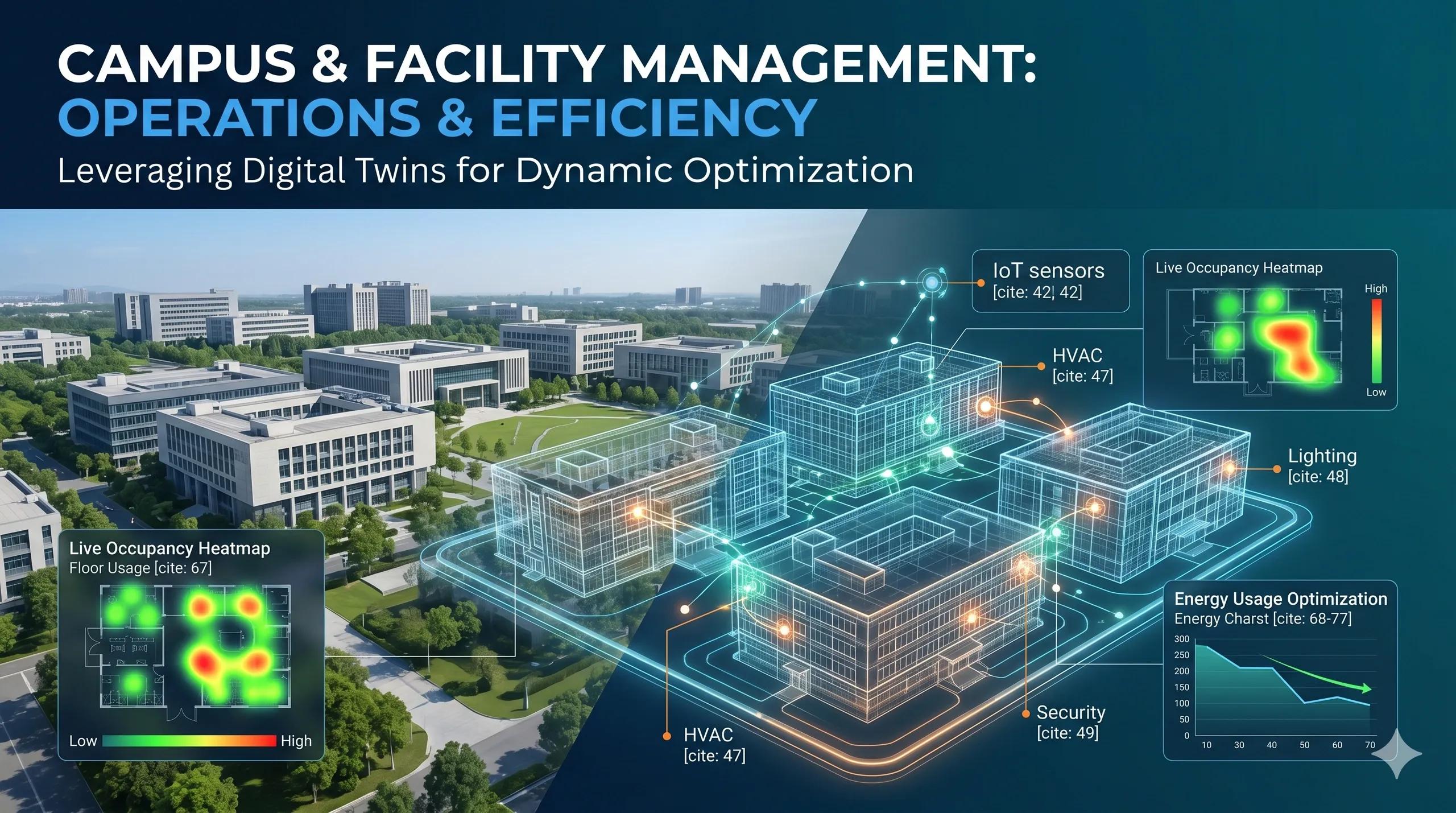
IoT describes the immediate condition of the asset. BIM provides asset identity and engineering context. Earth observation and weather data describe the surrounding environment. Grid and market data introduce infrastructure and commercial conditions. The digital twin connects these inputs to an operating decision.
No single dataset creates the outcome. Value comes from their coordinated use.
Where the business case is strongest
The clearest early opportunities will be facilities where energy demand is high, operations are continuous and some loads can be shifted:
- Data centers
- Industrial campuses
- Hospitals
- Malls
- Hotels
- Cold-storage facilities
- Large office portfolios
Data centers are especially relevant.
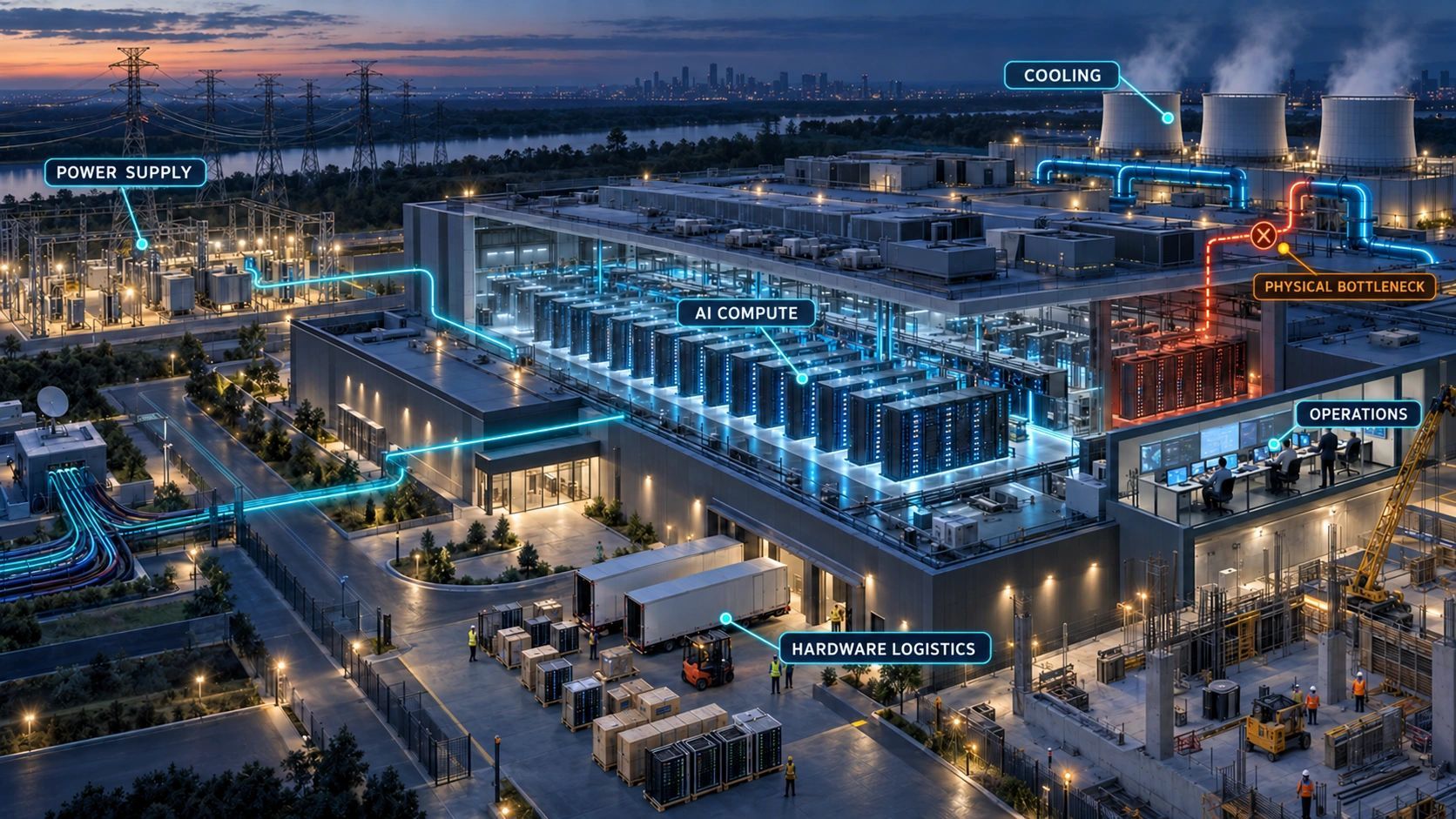
Their digital twins cannot remain limited to servers, cooling units and internal energy flows. They must eventually account for external power reliability, local renewable generation, storage, water stress, extreme heat and infrastructure dependency.
This creates an opportunity for an integrated intelligence layer spanning BIM, BMS, DCIM, IoT, energy, water, carbon and operational workflows.
The commercial proposition should not be “a better 3D model.”
It should be measurable improvement in energy cost, resilience, equipment utilization and operational response.
Start with advice before control
Organizations do not need to begin with autonomous building control.
A sensible implementation path is:
First, observe: connect external conditions to facility performance.
Then, recommend: generate operating suggestions for human review.
Next, optimize: calculate the best permissible schedule within approved boundaries.
Finally, execute selectively: allow approved actions to pass into the BMS and verify the outcome.
This staged approach helps establish trust, confirm data quality and prove value before control authority expands.
It also creates the evidence needed to answer the question that matters most:
Did the intervention actually improve the building’s performance?
The asset boundary is becoming a limitation
Earth observation has traditionally helped us understand where assets are and what is changing around them.
Its next role may be more operational.
It can help buildings prepare for heat, respond to grid conditions, schedule energy storage and adapt to environmental constraints.
The digital twin that sees only the building will increasingly miss the conditions determining how that building should operate.
The next operational twin must understand not only the asset, but also the environment, infrastructure and commercial systems on which the asset depends.
Earth observation is therefore moving beyond the map.
It is becoming part of the decision loop.