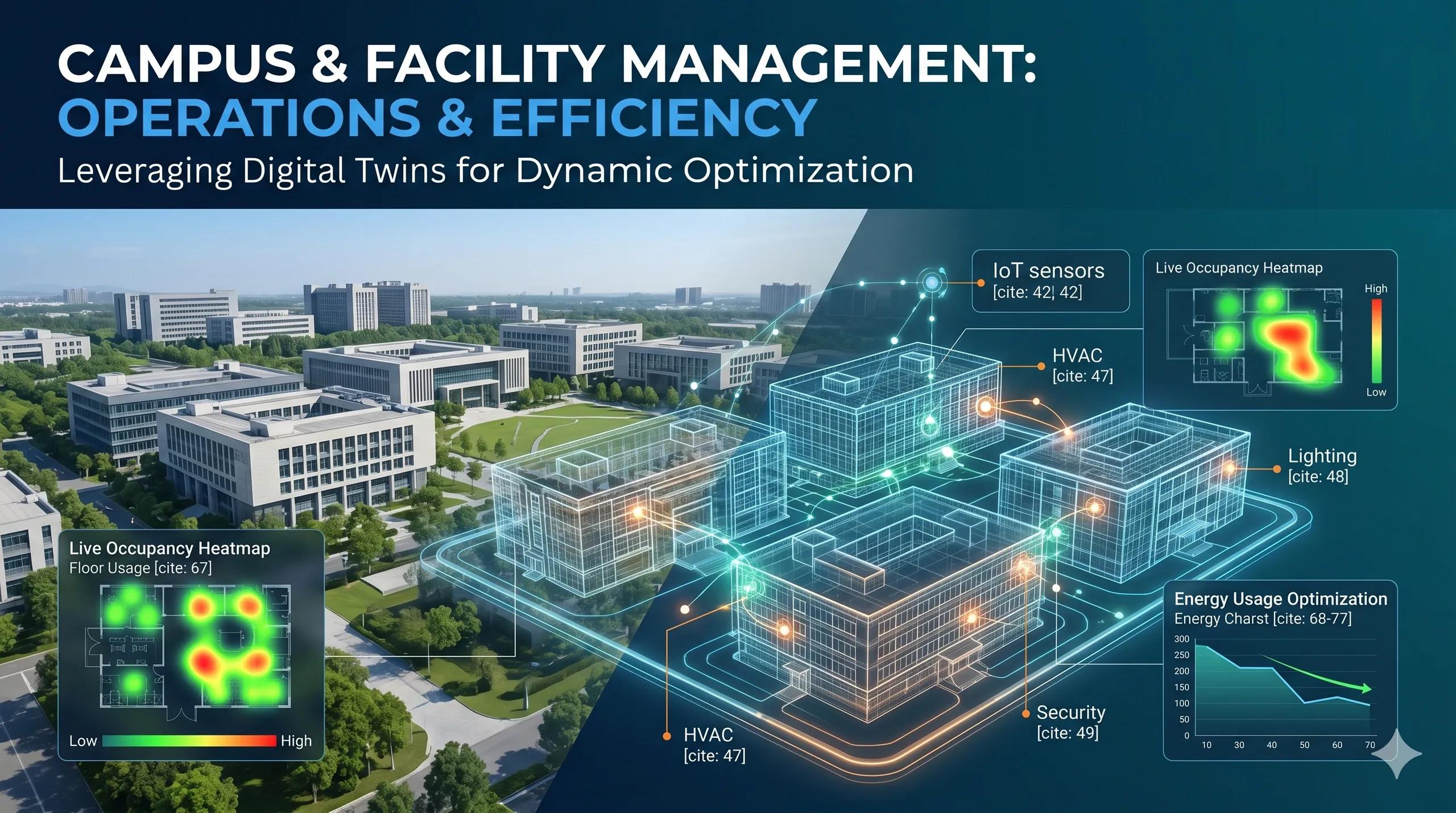
Buildings don’t fail because of design.
They fail because operations are not continuously managed.
Introduction
In the previous articles, we explored how Digital Twins enable:
infrastructure monitoring
operational optimization across sectors
environmental intelligence
healthcare infrastructure planning
Now we move to a domain that sits at the intersection of:
👉 people, infrastructure, and daily operations
👉 Campus & Facility Management
This includes:
corporate campuses
hospitals
universities
industrial facilities
In Phase 3, the focus remains:
👉 how Digital Twins enable real-time operations, efficiency, and user experience
The Core Problem: Static Buildings, Dynamic Usage
Most facilities today:
are designed using detailed models (BIM)
monitored through isolated systems
operated based on fixed schedules
But:
👉 usage is dynamic
This leads to:
energy inefficiency
underutilized spaces
delayed maintenance
poor occupant experience
Where Digital Twins Change the Approach
A Facility Digital Twin enables:
👉 continuous monitoring and dynamic optimization of building operations
Instead of:
static operation
It creates:
a responsive, data-driven facility system
Key Components of a Facility Digital Twin
1. Data Layer
IoT sensors: occupancy temperature energy usage
building systems: HVAC lighting security
BIM models
2. Integration Layer
connects: building systems occupancy data maintenance systems
👉 creates a unified facility view
3. AI/ML Layer
predicts energy demand
optimizes HVAC usage
identifies maintenance needs
4. Simulation Layer
tests space utilization
evaluates operational scenarios
5. Visualization Layer
3D building models
dashboards for operations
occupancy heatmaps
Use Case 1: Energy Optimization
Traditional Approach
fixed schedules
manual adjustments
👉 inefficient energy usage
Digital Twin Approach
adjust HVAC and lighting based on occupancy
👉 Outcome:
reduced energy consumption
improved efficiency
Use Case 2: Space Utilization
monitor occupancy patterns
optimize workspace allocation
👉 Outcome:
better utilization
improved planning
Use Case 3: Predictive Maintenance
monitor equipment health
schedule maintenance proactively
👉 Outcome:
reduced downtime
improved reliability
Use Case 4: Occupant Experience
adjust environment based on usage
improve comfort and accessibility
👉 Outcome:
enhanced user experience
Practical Example
Scenario: Office Space Underutilization
occupancy data shows low usage in certain areas
Digital Twin identifies:
👉 underutilized zones
System triggers:
space reallocation
HVAC adjustment
👉 Outcome:
optimized space and energy usage
Where Most Implementations Fail
1. Siloed Systems
HVAC, lighting, and security operate independently
2. Data Without Action
insights exist 👉 operations remain unchanged
3. Static Operations
schedules not aligned with real usage
4. Lack of Integration with BIM
design and operations disconnected
Ask Yourself
Is your facility:
👉 being managed
Or
👉 being optimized continuously?
Indian Context
India’s campuses and facilities are expanding across:
IT parks
hospitals
universities
Challenges include:
energy efficiency
space utilization
operational cost
Digital Twins can help:
👉 optimize operations
👉 reduce cost
👉 improve experience
Benefits & ROI
reduced energy consumption
improved space utilization
lower operational cost
better maintenance planning
enhanced user experience
Conclusion
Facilities are not static assets.
They are:
👉 dynamic environments
Managing them requires:
👉 real-time data
👉 predictive insights
👉 coordinated action
Digital Twins enable this shift.
From:
👉 static facility management
To
👉 intelligent, adaptive environments