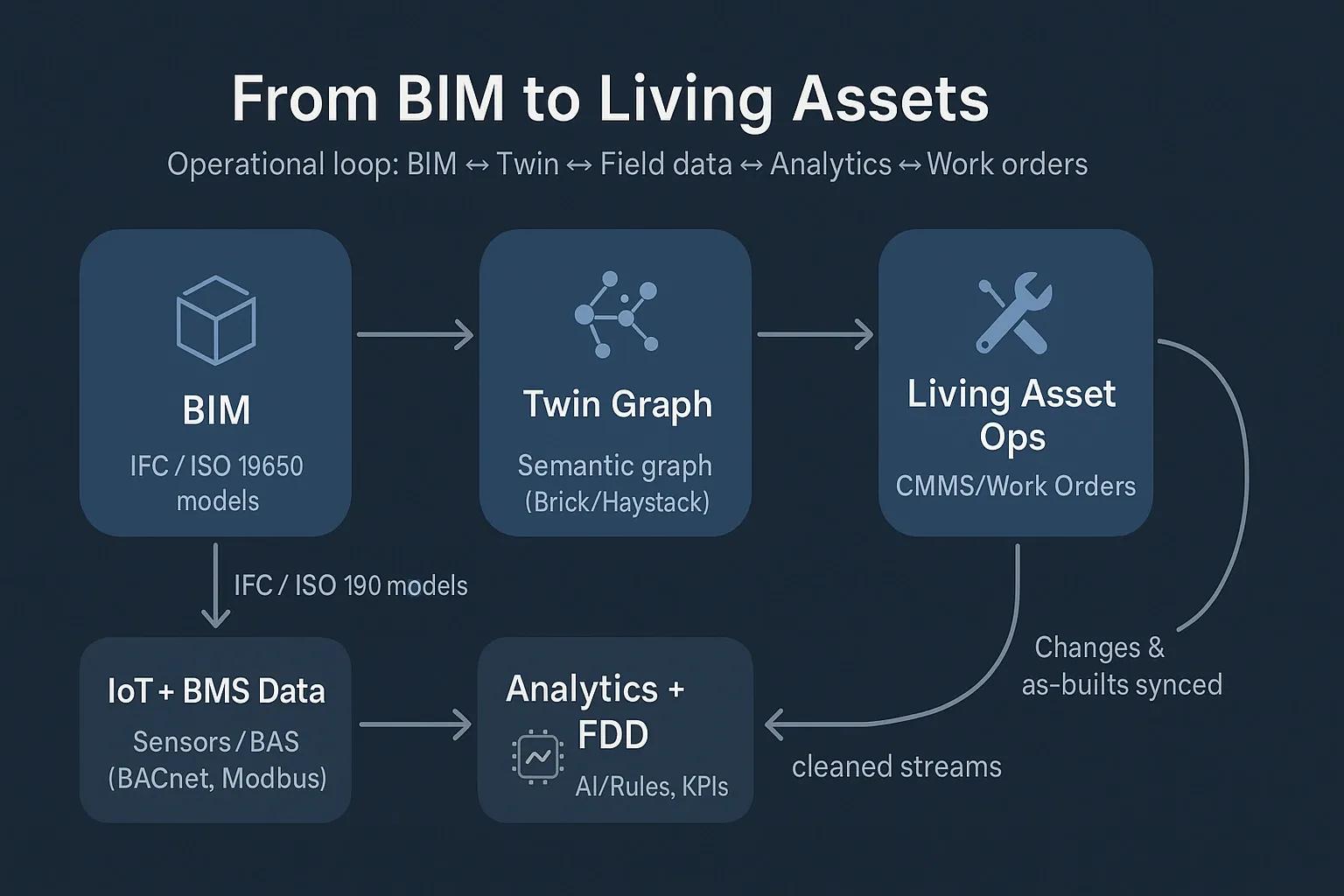
Smart buildings are shifting from static BIM files to living digital twins that sync with the field, sense changes in real time, and optimize operations continuously. This shift improves sustainability, asset performance, and maintenance outcomes, with measurable ROI. In India, it also aligns well with ECBC, IGBC, and GRIHA compliance goals.
What a “Living Asset” Means
A living asset is a building whose digital representation stays in lockstep with reality: geometry (BIM/IFC), semantics (zones, systems, equipment), and live telemetry (BMS/IoT). It supports analytics, automation, and closed-loop work orders, so every improvement feeds back into the model.
Information backbone: ISO 19650 for information management over the asset lifecycle; IFC to exchange openBIM data
Operational data: BACnet for BAS integration; Brick Schema (or Haystack) to standardize points and equipment semantics for analytics.
Why this is different from “just BIM”
Traditional BIM is a design-and-construction artifact. A digital twin adds:
Live state: streams from HVAC, power, water, occupancy, and environment.
Semantics + graph: a consistent ontology across assets, spaces, and sensors.
Continuous ops: fault detection & diagnostics (FDD), optimization, forecasting, and automated work orders.
Result: lower energy, fewer failures, faster issue resolution, and audit-ready sustainability reporting.
Real-world signals this works
Microsoft campuses: Azure Digital Twins underpin smart building experiences with CI/CD pipelines for model and logic updates, showing twins can be run like software products.
DFW Airport: NREL and partners report a twin-led program targeting reduced peak power, improved HVAC efficiency, and published maintenance cost reduction goals of ~20–25% by 2030.
The Edge, Amsterdam: Often cited for data-driven operations and large energy reductions enabled by tightly integrated systems and analytics.
How the stack fits together
Design & Handover
Author models in BIM and exchange via IFC; set up ISO 19650 information requirements and CDE.
Integration & Semantics
Connect BAS/IoT (BACnet, Modbus, meters).
Normalize points into a semantic layer (Brick/Haystack) to make analytics portable across sites and vendors.
Twin & Analytics
Instantiate the twin graph, bind live data, run FDD, optimization, and forecasts; automate work orders via CMMS/CAFM.
Use CI/CD to version models, templates, and rules.
Field Feedback
Close the loop: approved changes and as-builts flow back to BIM and the twin so the asset stays “living.”
Core use cases with fast payback
Energy optimization: chiller plant sequencing, AHU supply-air resets, occupancy-based ventilation, lighting schedules.
Predictive maintenance: vibration and temperature patterns flag bearing wear, filter clogging, and valve stiction before failures.
Space and comfort: demand-driven conditioning, thermal/IAQ monitoring, and service-level tracking.
Compliance reporting: automated baselines, ECBC/IGBC/GRIHA documentation support in the Indian context.
“Would you enable automated setpoint changes today, or start with alert-only FDD and phase in control later?”
Adoption tips (what to do next)
Start narrow, scale fast: pick one critical system (e.g., chiller plant) for a 90-day pilot; prove savings and reliability.
Get the data model right: define an IFC-anchored asset list and a Brick/Haystack tagging plan before connecting anything.
Integrate the BAS cleanly: use BACnet objects and standardized topics; avoid bespoke mappings where possible.
Productize the twin: set up CI/CD for twin templates, analytics rules, and tests, treat it like an application.
Operationalize the loop: route insights to a CMMS with SLAs; verify fixes and measure persistence of savings.
Indian context: map outcomes to ECBC tiers (ECBC / Plus / Super ECBC) and IGBC/GRIHA credits; look for local incentives (e.g., municipal property tax rebates for green certifications, as seen in Nagpur).
Security by design: network segmentation for BAS/IoT, role-based access, and change logs for all setpoint adjustments.
KPIs: kWh/m², HVAC kW/ton, avoided truck rolls, mean time to repair, and work-order closure time.
Example: 12-month building twin rollout
Month 0–1: data inventory, IFC export, Brick tagging plan.
Month 2–3: connect BAS/IoT, bind to twin; stand up FDD on HVAC and lighting.
Month 4–6: tune controls; implement chiller optimization and occupancy ventilation; integrate CMMS.
Month 7–12: expand to water and IAQ; automate reporting for ECBC/IGBC; scale to additional floors.
What to expect: 6–12% site energy reduction from low-risk control strategies, earlier fault detection, fewer reactive calls, and clearer compliance documentation (ranges depend on baseline and system condition; see DFW and Edge references for directional evidence).
Benefits & ROI (summary)
Lower energy and demand charges
Fewer failures and better parts planning
Faster issue resolution with root-cause context
Higher comfort and IAQ, with auditable data
Cleaner compliance path (ECBC/IGBC/GRIHA) in India
Conclusion
Moving from BIM to living assets is a process change as much as a technological change. Standardize data (ISO 19650, IFC, Brick), wire the building once (BACnet/IoT), and run the twin like software with CI/CD and KPIs. Start small, show value, and scale. The result is a smarter, cleaner building that keeps improving.