For the past few years, the AI race has largely been measured through models, parameters, GPUs and funding.
That view is becoming incomplete.
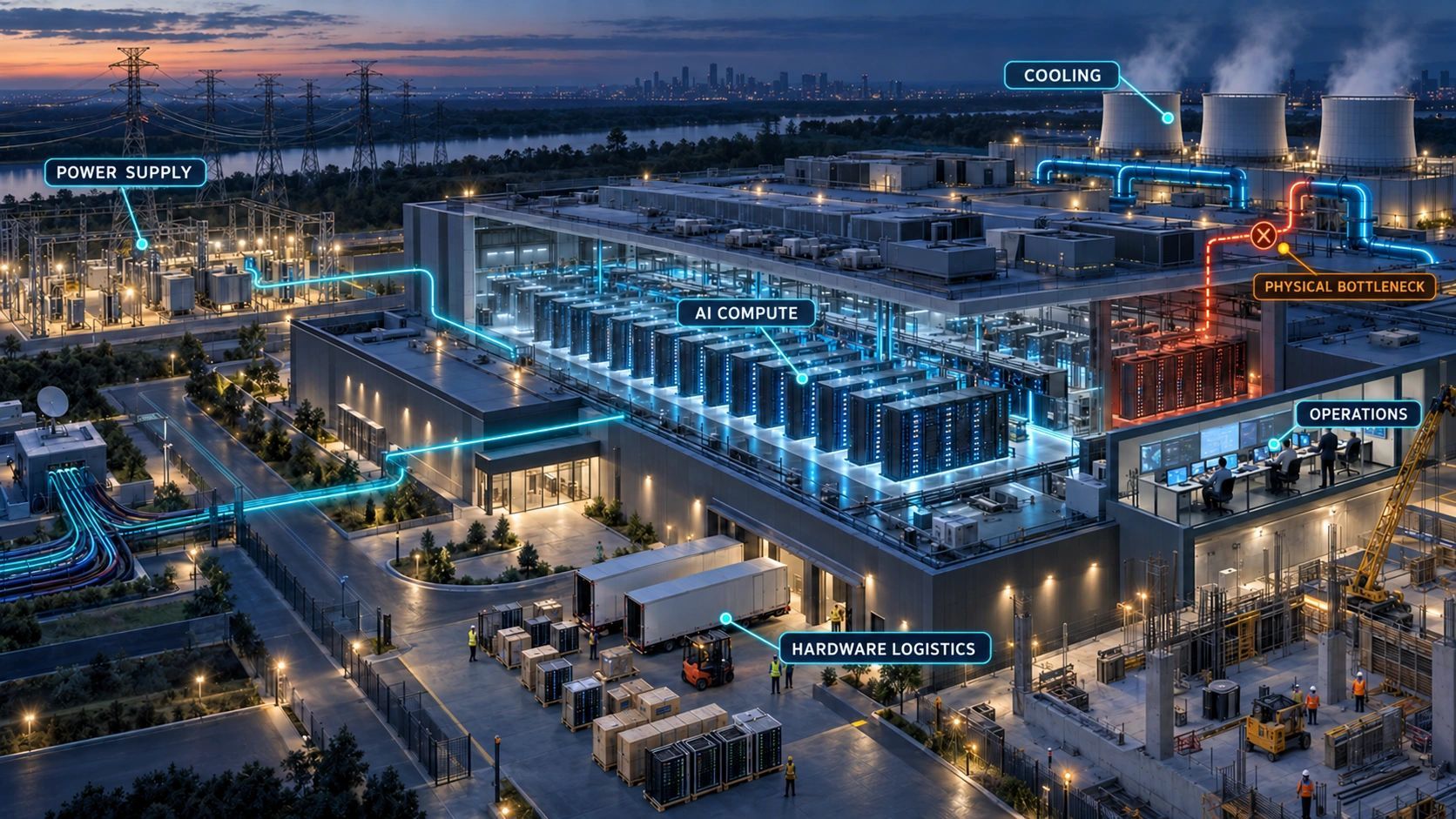
As AI moves from experimentation to industrial deployment, its constraints are becoming increasingly physical:
- Is sufficient electrical capacity available?
- Can cooling systems support the compute load?
- Will the required hardware arrive on schedule?
- Are networks ready?
- Has the facility been commissioned?
- Can sensors be trusted?
- Are people available to supervise operations?
AI may be digital, but its ability to deliver value now depends on physical infrastructure, supply chains and operational readiness.
This changes where the next layer of intelligence is needed.
Contracted capacity is not operational capacity
Large AI-compute commitments can create the impression that capacity already exists.
But three states must be distinguished:
- Contracted capacity
- Physically ready capacity
- Deliverable compute capacity
The gap between them can contain grid delays, cooling constraints, hardware shortages, network dependencies, construction risks and commissioning failures.
A company may have sold or reserved compute capacity years in advance. That capacity has little operating value until every physical dependency is ready at the same time.
This creates a decision problem that conventional project dashboards do not answer well:
Which physical dependency threatens the capacity we have already committed to deliver or purchase?
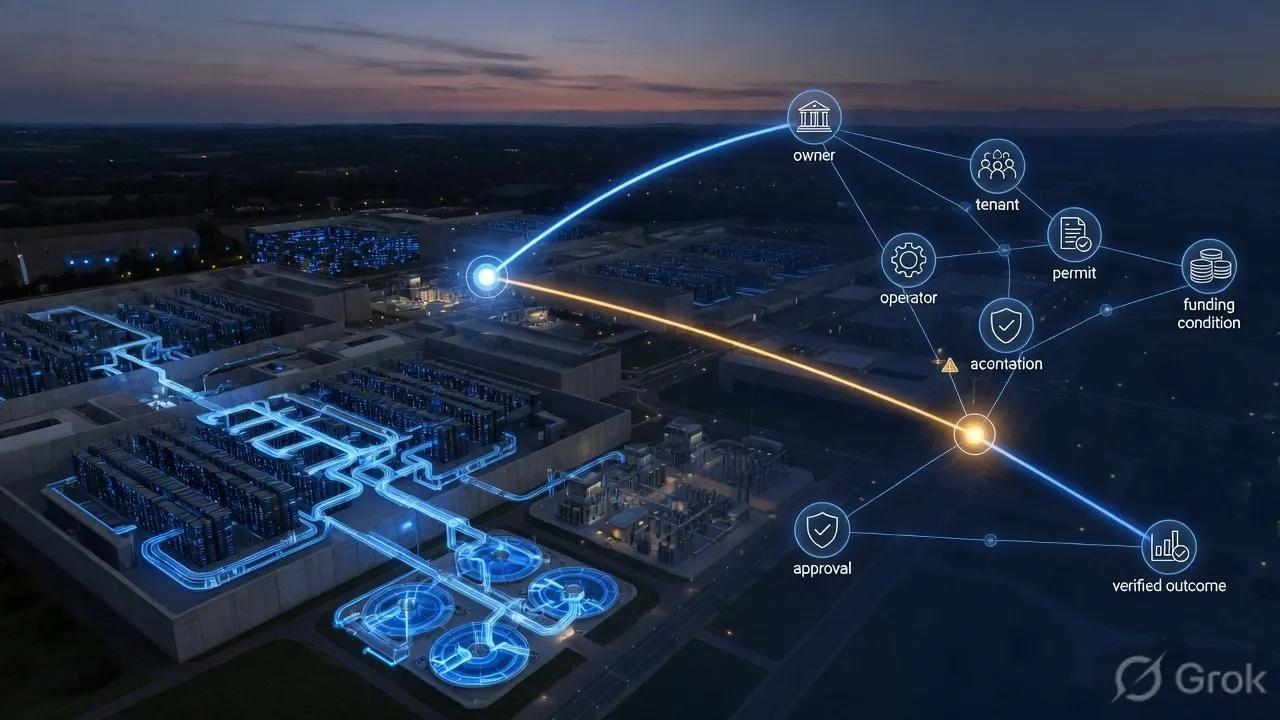
A facility model may show buildings, equipment rooms and utility networks. A useful operational model must go further. It must connect commercial commitments to the infrastructure required to fulfil them:
Customer commitment → compute block → hardware → network → power → cooling → commissioning → usable capacity → service obligation
That is not simply a data-center digital twin.
It is a contract-to-capacity intelligence system.
AI is becoming an infrastructure industry
Investment in AI hardware, networking, memory, robotics and energy infrastructure reflects a wider shift.
AI performance now depends on a connected physical stack:
Model → compute → memory → network → electrical infrastructure → cooling → building → grid → supply chain
A failure at any layer can affect every layer above it.
Consider a memory supply constraint. It may leave a GPU cluster incomplete. That can keep a commissioned room underutilized, delay customer capacity and create contractual exposure.
The technical problem begins in a component supply chain. The business consequence appears in revenue, customer commitments and financing.
Most enterprise systems do not preserve that connection.
This is where spatial intelligence becomes strategically useful. It can relate equipment, rooms, utility networks, construction progress and geographic dependencies to commercial obligations.
The objective is no longer to create a more detailed picture of the facility.
It is to understand what makes the facility economically productive and what could stop it from becoming productive on time.
Three connected graphs are needed
AI infrastructure cannot be understood through a physical asset register alone. It requires at least three connected views.
1. The physical graph
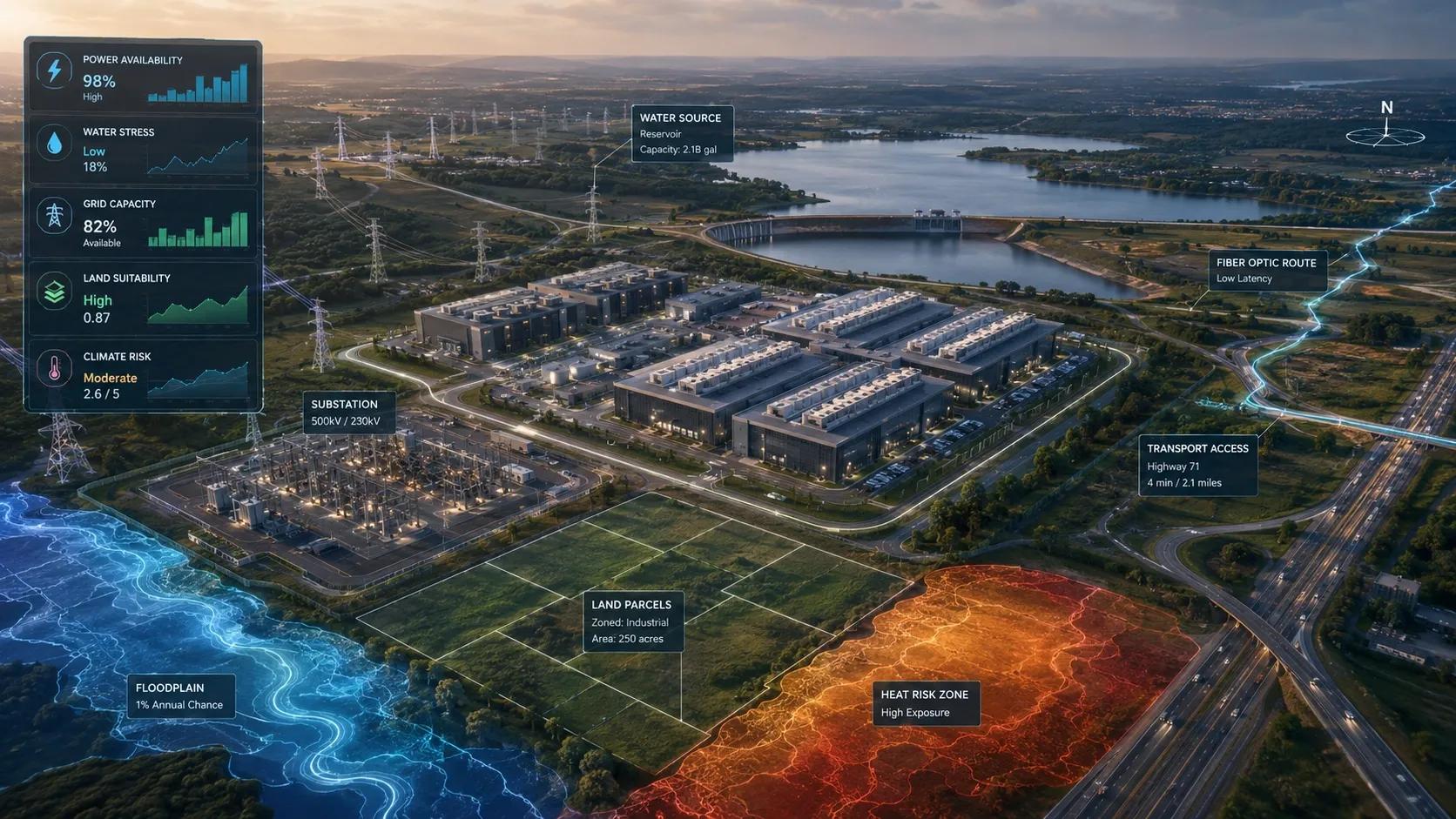
This includes buildings, rooms, racks, electrical systems, cooling infrastructure, substations, water systems and transport access.
2. The digital graph
This covers compute clusters, memory, storage, network paths, software platforms, data flows and cybersecurity dependencies.
3. The commercial graph
This represents suppliers, construction packages, contracts, financing conditions, capacity reservations, delivery obligations and service-level commitments.
The real value comes from tracing failure paths across all three.
A delayed grid connection is not only an engineering issue. It may delay commissioning, make contracted compute unavailable and affect revenue.
A hardware shortage is not only a procurement issue. It may leave energized infrastructure economically idle.
A cooling failure is not only a maintenance issue. It may reduce the usable capacity that has already been promised to customers.
Spatial intelligence provides the common context for connecting these relationships because the physical dependencies ultimately exist somewhere: inside a rack, across a facility, along a utility corridor or within a regional supply network.
The same pattern extends beyond data centers
This physical bottleneck is not limited to AI factories.
Smart-city services depend on assets, sensors, power, communication networks, platforms, departments and field-response teams.
A flood sensor may be functioning correctly, but the service still fails if its gateway loses power or its communication path becomes unavailable.
A persistent drone programme may own capable aircraft, but it cannot guarantee coverage without charged batteries, operational docks, authorized airspace, trained remote operators, maintenance support and an incident-response workflow.
An industrial AI application may receive a sensor reading with the correct timestamp, format and asset identity. Yet the reading may still be physically wrong because the sensor has drifted through vibration, humidity, thermal cycling or ageing.
In every case, the visible technology is only one element in a wider operating chain.
Connected does not mean trustworthy
This may become one of the most important lessons as AI begins to influence physical operations.
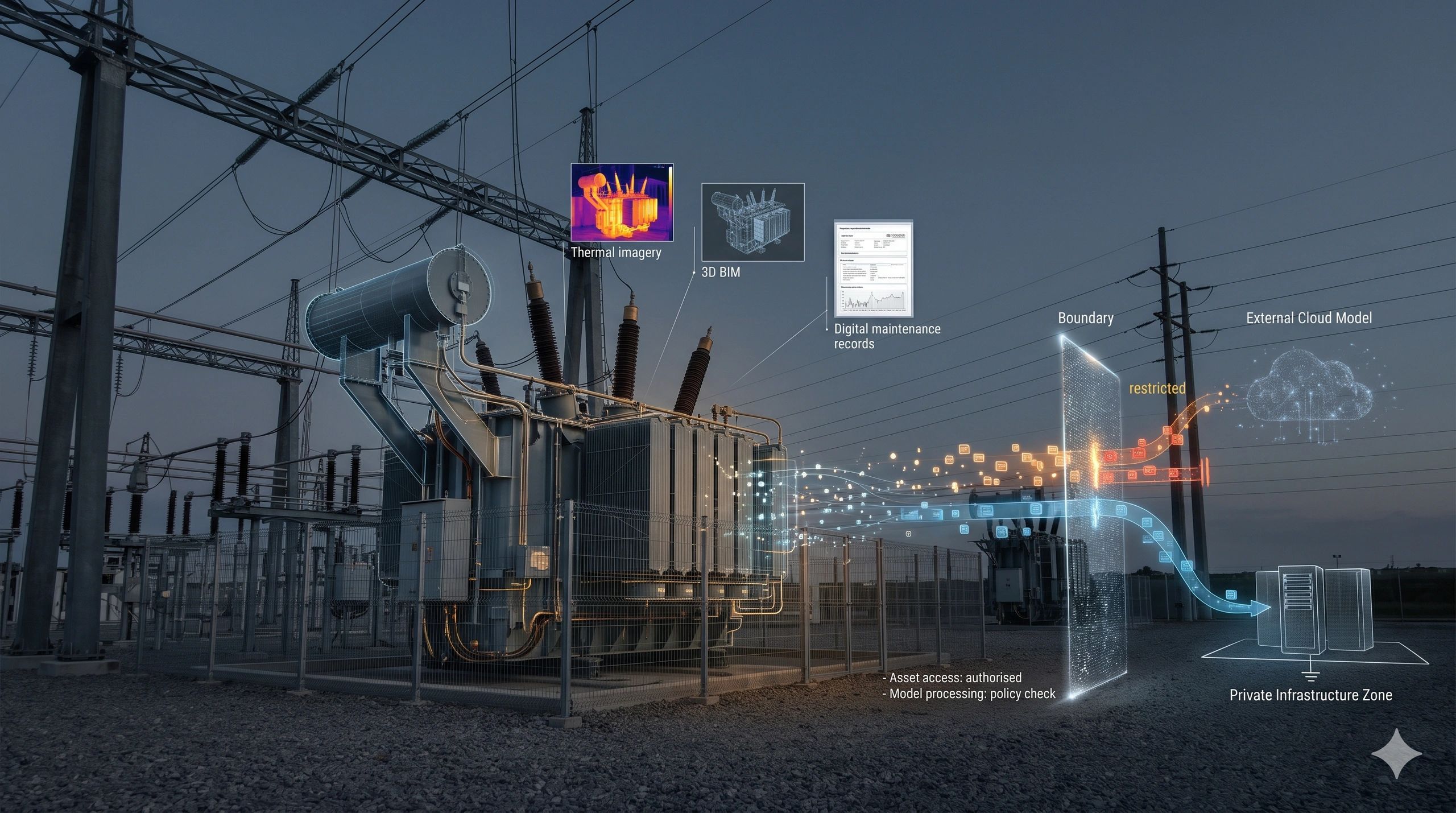
A digital twin may show that a sensor is connected and transmitting. That does not establish whether the reading remains credible.
Decision-ready systems will need an evidence-health record for each important device:
- Last calibration
- Expected tolerance
- Drift indicators
- Comparison or redundant source
- Maintenance history
- Current data-quality state
The device could then carry an operational status such as:
TRUSTED · DEGRADED · SUSPECT · UNVERIFIED
That status should influence what the system is authorized to do.
A suspect reading may still help inform an operator. It might justify an alert or field inspection. But it should not automatically control equipment or stop a production process.
In other words, authority should change when evidence health changes:
INFORM → ALERT → DECIDE → CONTROL
This distinction will matter as digital twins move from visualization and monitoring toward AI-supported action.
Spatial intelligence must model people too
Physical operations do not depend only on assets.
Persistent UAV monitoring illustrates this clearly. Increasing aircraft autonomy does not immediately remove the need for mission scheduling, pilot availability, regulatory approval, escalation procedures, maintenance and evidence handling.
The operational model therefore needs to connect:
Asset → monitoring commitment → drone → dock → operator → mission authority → observation → anomaly → response
The product is no longer simply a drone survey.
It becomes guaranteed observation and response coverage for an asset, corridor or facility.
That shift changes the commercial model as well. Services can be structured around availability, assets monitored, kilometers covered, response time or incidents handled not only the number of flights completed.
What this means for digital twins
Across 27 years in geospatial work, I have repeatedly seen organizations focus on collecting more data while leaving the decision chain loosely connected.
AI raises the cost of that weakness.
When software merely displays information, missing context may inconvenience an analyst. When AI uses the same information to recommend, approve or control an action, the missing context can create operational and commercial risk.
The next generation of spatial systems therefore needs to model more than location and state.
It should also model:
- Dependencies behind the state
- Confidence in the supporting evidence
- Authority attached to each source
- People required to complete the action
- Commercial consequences if the chain fails
This is the opportunity for spatial intelligence.
Not because every AI system needs a map, but because physical infrastructure, operational evidence and accountability all have location, identity and relationships.
AI’s next constraint may not be another model breakthrough.
It may be whether the physical world underneath the model is ready, connected and trustworthy enough to act.