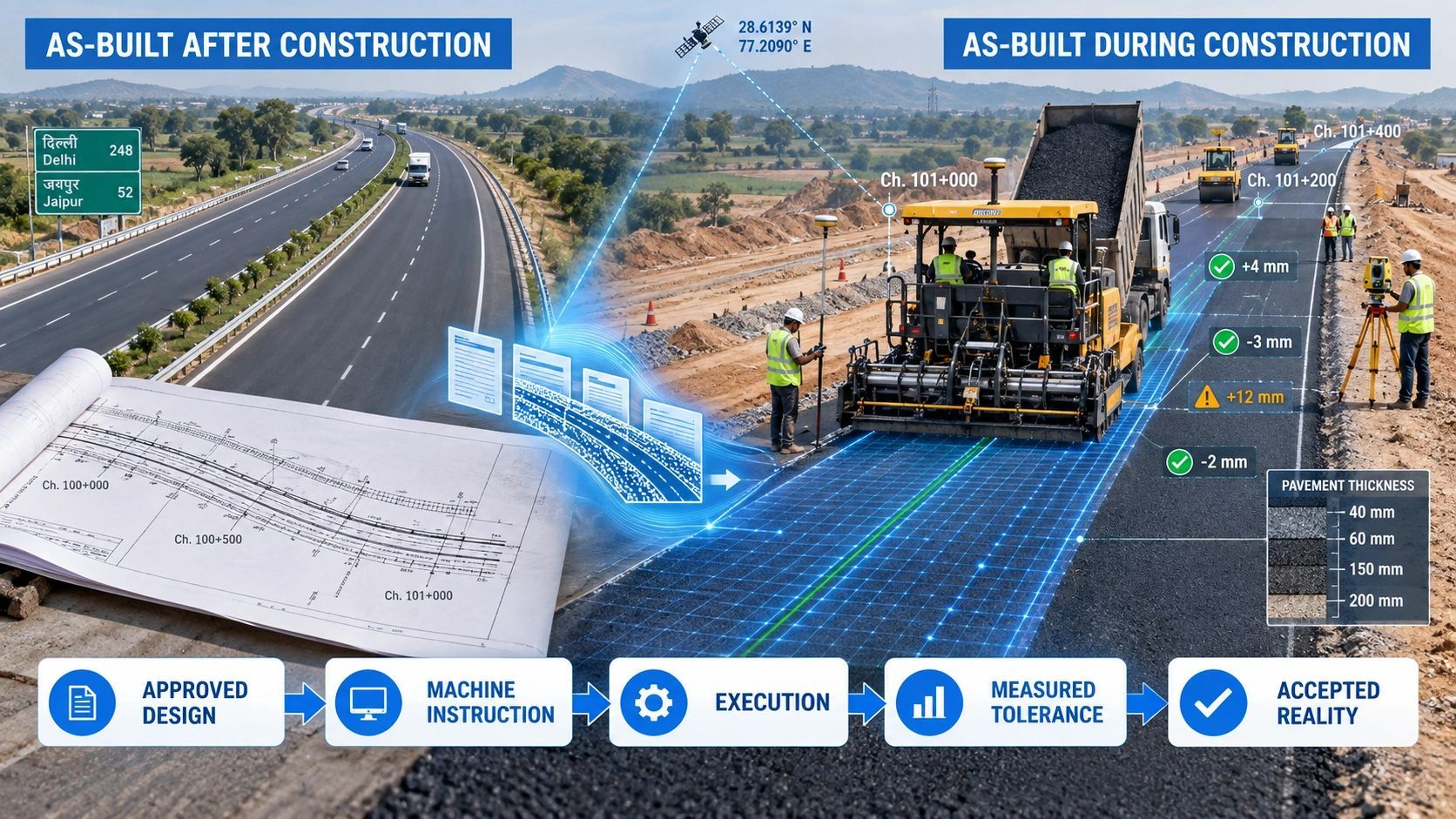
For decades, the “as-built” record has been produced after construction.
Engineers design the highway. Contractors interpret the drawings. Machines execute the work. Surveyors then measure selected elements and prepare records showing what was constructed.
Automated and Intelligent Machine-Aided Construction could fundamentally change this sequence.
India’s National Highways Authority is reportedly mandating end-to-end AI-MC deployment for highway projects longer than 20 kilometers and costing more than ₹500 crore. The aim is to improve construction quality through machine guidance, automated data capture and real-time oversight.
The immediate discussion may focus on automation, productivity and construction speed.
But the deeper shift concerns evidence.
When machines can consume approved designs directly and sensors can record how those instructions were executed, the as-built record no longer has to begin after the work is finished.
It can be generated while construction is happening.
From Design Interpretation to Machine Execution
The traditional construction information flow looks broadly like this:
Design → contractor interpretation → machine operator → construction → survey → as-built record
Each handover creates room for delay, ambiguity and information loss.
A machine-guided process creates a different sequence:
Approved design → machine-readable instruction → physical execution → sensor measurement → tolerance verification → acceptance or rework
The machine is no longer working only from an operator’s visual interpretation of drawings, stakes or markings. It can receive digital information about levels, alignments, slopes and construction surfaces.
Positioning systems can record where the operation occurred. Machine sensors can capture execution parameters. Intelligent compaction systems can record coverage, passes and compaction-related measurements. Survey and reality-capture systems can independently verify the resulting surface.
The project therefore begins producing a digital evidence trail as the asset is built.
A Drawing Is Not the Same as Evidence
Most conventional as-built drawings answer an important but limited question:
What does the completed asset appear to contain?
An AI-MC evidence record could answer more operational questions:
- Which approved design version guided the machine?
- What surface or pavement layer was being constructed?
- Where and when did the operation take place?
- Which machine performed it?
- What measurements were recorded during execution?
- Were the results within the specified tolerances?
- Which deviations were detected?
- Who reviewed and accepted the work?
- Where was rework required?
- What evidence supports the final acceptance?
This is a major difference.
A final drawing represents an interpreted state of the completed asset. A continuous construction record preserves how that state was created and verified.
The future as-built may therefore be less like a document and more like a structured chain of evidence.
The New As-Built Has Several Layers
A useful AI-MC record would need to connect at least five information layers.
1. Design intent
The system must identify the approved alignment, surface, cross-section, pavement layer, slope, elevation and construction tolerance.
Version control is critical. Knowing that a machine followed a digital model is not enough. The project must know whether it followed the correct approved model.
2. Machine instruction
The design must be converted into a format the construction equipment can consume without losing engineering meaning.
This requires dependable coordinate systems, survey control, machine-compatible surfaces and clearly defined tolerances.
3. Execution record
The system should capture which machine performed the work, where it operated, when it operated and which instruction it received.
This establishes traceability between the digital design and the physical activity.
4. Measured result
Machine sensors, GNSS observations, survey instruments and reality-capture systems can record the resulting condition.
Depending on the activity, this may include elevation, thickness, coverage, compaction indicators, material identity or geometric deviation.
5. Acceptance decision
Measurements become commercially meaningful only when they connect to a decision.
The record must show whether the work was:
- within tolerance;
- accepted with an approved exception;
- rejected;
- sent for rework; or
- awaiting further verification.
Without this layer, AI-MC produces more data but not necessarily stronger accountability.
The Important Unit Is the Construction Event
Today, many project systems organize information around drawings, files, models and reports.
Machine-aided construction may require a more precise unit: the construction event.
For example:
Pavement section → chainage range → layer → approved design revision → machine operation → sensor observations → measured result → exception → acceptance
This event-based structure can connect engineering, location, time, responsibility and evidence.
It also allows teams to investigate a future defect more effectively.
Instead of finding only a final drawing, they could retrieve the design used, the machine activity, the measurements captured, the deviations recorded and the acceptance decision for that specific location and layer.
That would make the as-built record useful throughout the highway’s operational life not merely at project handover.
Automation Does Not Automatically Create Trust
The introduction of AI-MC will not remove every quality problem.
It may expose new ones.
A machine can execute the wrong design accurately. A positioning error can affect an otherwise correct operation. Sensor readings can be incomplete or poorly calibrated. Contractors can use different naming conventions. Data can lose its meaning when transferred between proprietary systems.
Projects will therefore need controls covering:
- coordinate reference systems and survey control;
- design approval and revision status;
- equipment and sensor calibration;
- timestamps and spatial coverage;
- asset, layer and material identity;
- tolerance definitions;
- missing or invalid observations;
- exception approval;
- data ownership and access;
- long-term evidence retention.
The key principle is simple:
Machine-generated does not automatically mean trustworthy.
The evidence must remain traceable to its source, location, time, design version and acceptance authority.
This Also Changes the Digital Twin
Many highway digital twins are still positioned mainly as visualization or monitoring environments.
AI-MC creates a more demanding role.
The twin can become part of the construction control loop:
Design requirement → machine activity → measured condition → deviation → responsibility → acceptance or rework → permanent record
That is more valuable than displaying construction progress on a map or 3D model.
It allows the digital environment to participate in quality control.
However, it also raises the standard expected from the twin. The data must be current enough for construction decisions, precise enough for machines, structured enough for automated comparison and governed enough to support contractual acceptance.
A visually impressive model with uncertain coordinates, outdated revisions or disconnected evidence will not meet this requirement.
What Highway Organizations Should Prepare Now
Before deploying machine-aided construction at scale, project owners and contractors should assess the complete information chain.
They should ask:
- Is the survey control reliable and consistently used?
- Are approved designs available as machine-readable engineering surfaces?
- Can every machine instruction be linked to a controlled design revision?
- Can sensor observations be associated with the correct location, layer and activity?
- Are tolerance breaches identified while corrective action is still possible?
- Is there an independent verification process for critical work?
- Can acceptance and rework decisions be traced to supporting evidence?
- Will the resulting information remain usable after handover?
These questions connect technology deployment with engineering governance.
They also reveal why AI-MC cannot be treated as a machine procurement exercise alone. It requires coordination between survey, geospatial, design, pavement engineering, construction, quality assurance, contracts and asset management.
A New Meaning for As-Built
In my experience, infrastructure projects rarely suffer from a complete absence of information.
The larger problem is that design, construction, measurement and approval records remain separated.
AI-MC creates an opportunity to connect them at the moment the physical asset is being created.
The future as-built may not be a drawing prepared after completion.
It may be a continuously updated evidence system showing:
what was intended, what instruction was issued, what the machine executed, what was measured, what differed and what was accepted.
That would make the record more useful for quality assurance, payment certification, dispute resolution, maintenance planning and future rehabilitation.
But the real value will not come from collecting every possible machine and sensor output.
It will come from preserving the evidence required to make and later defend a construction decision.
When construction machines can both execute the design and generate evidence of what they actually built, the digital twin stops being only a model of the highway.
It becomes part of the construction control system.