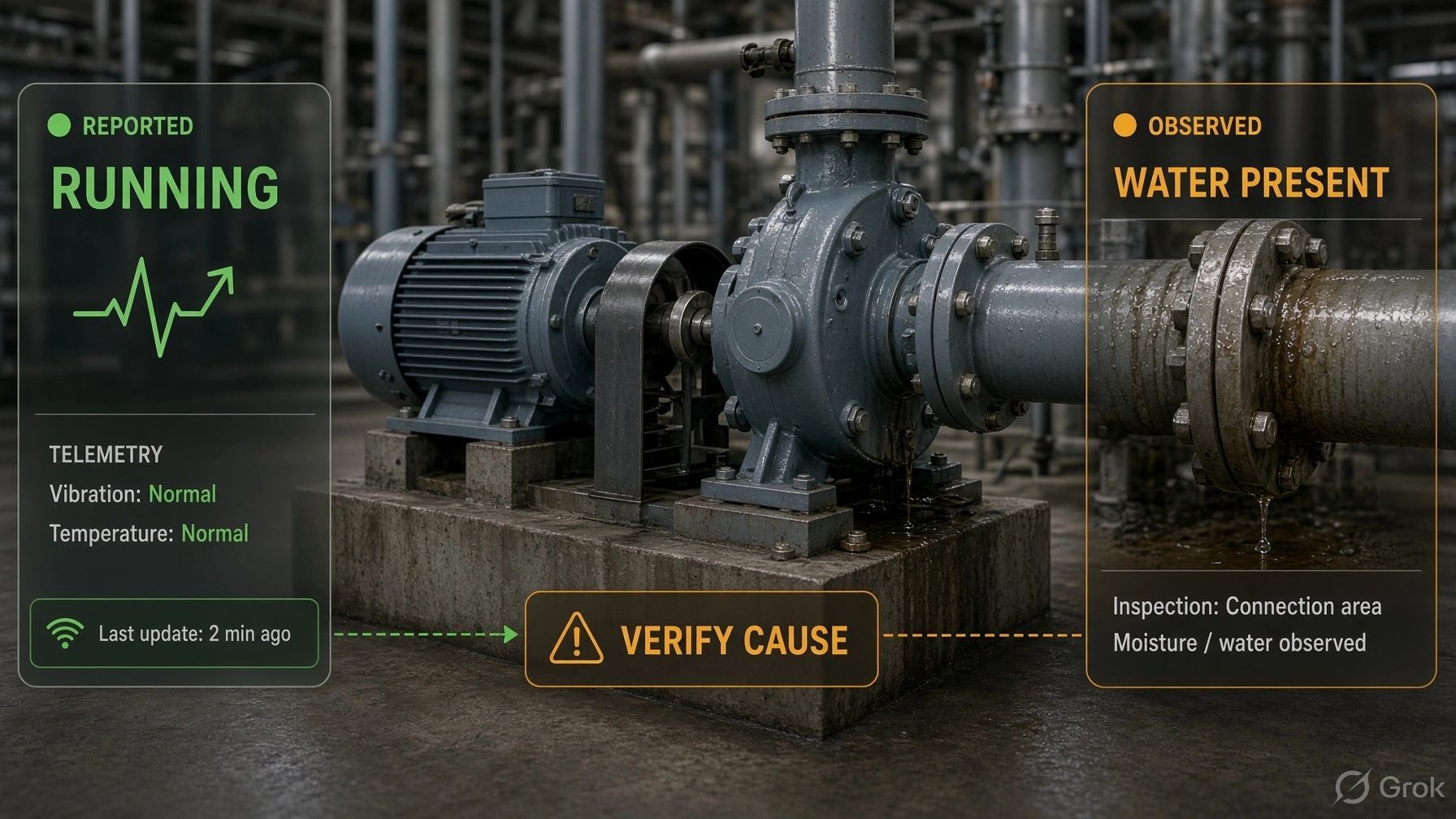
A pump appears green on the dashboard.
Its controller reports that it is running. Motor current sits within the expected range. No alarm has been triggered.
Then an inspection image shows water collecting around the installation.
Should the operator trust the dashboard, the image, or neither?
For an infrastructure owner, this is a maintenance decision. For a digital-twin team, it is also a test of how the system handles conflicting evidence.
A useful digital twin should preserve that disagreement and help someone resolve it.
“Running” is a narrower claim than “working correctly”
Consider this illustrative pump scenario.
The controller may be reporting its status correctly. The motor is running. Yet a downstream connection could be leaking, a valve could be restricting delivery, or the system could be producing less useful output than expected.
The image also has limits. Visible water could come from rainfall, cleaning or another nearby asset.
Both observations could be accurate. Neither, by itself, establishes the full operating condition.
The problem begins when a platform translates a narrow signal, “motor running” into a broad conclusion: “asset healthy.”
That translation carries an assumption.
If the assumption remains hidden, the dashboard can look reassuring while the operational question remains unanswered.
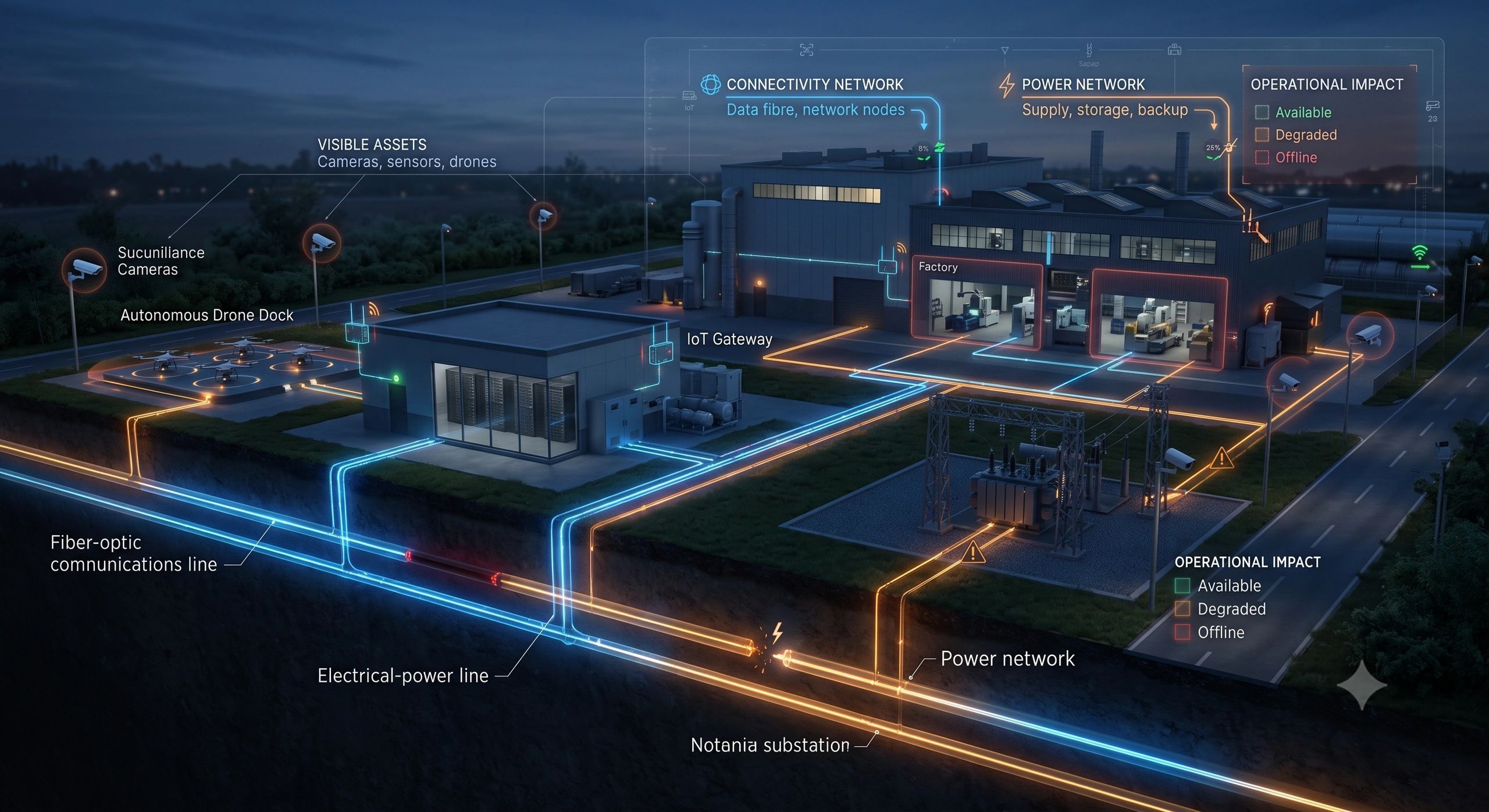
This distinction matters across water networks, factories, solar installations, buildings and transport infrastructure. Equipment status, physical condition and delivered service describe different things.
A useful lesson from satellite inspection
The September 23 briefing highlighted HEO’s satellite-inspection work as a useful analogy.
HEO uses external imagery to support spacecraft inspection, including verification of deployment, orientation and stability. Its satellite-operator offering explicitly positions visual verification as useful even when communications drop.
The infrastructure lesson is straightforward: an asset’s telemetry and an external observation provide different views of its condition.
A building-management system might report that cooling equipment is available while measurements in a served space indicate inadequate cooling.
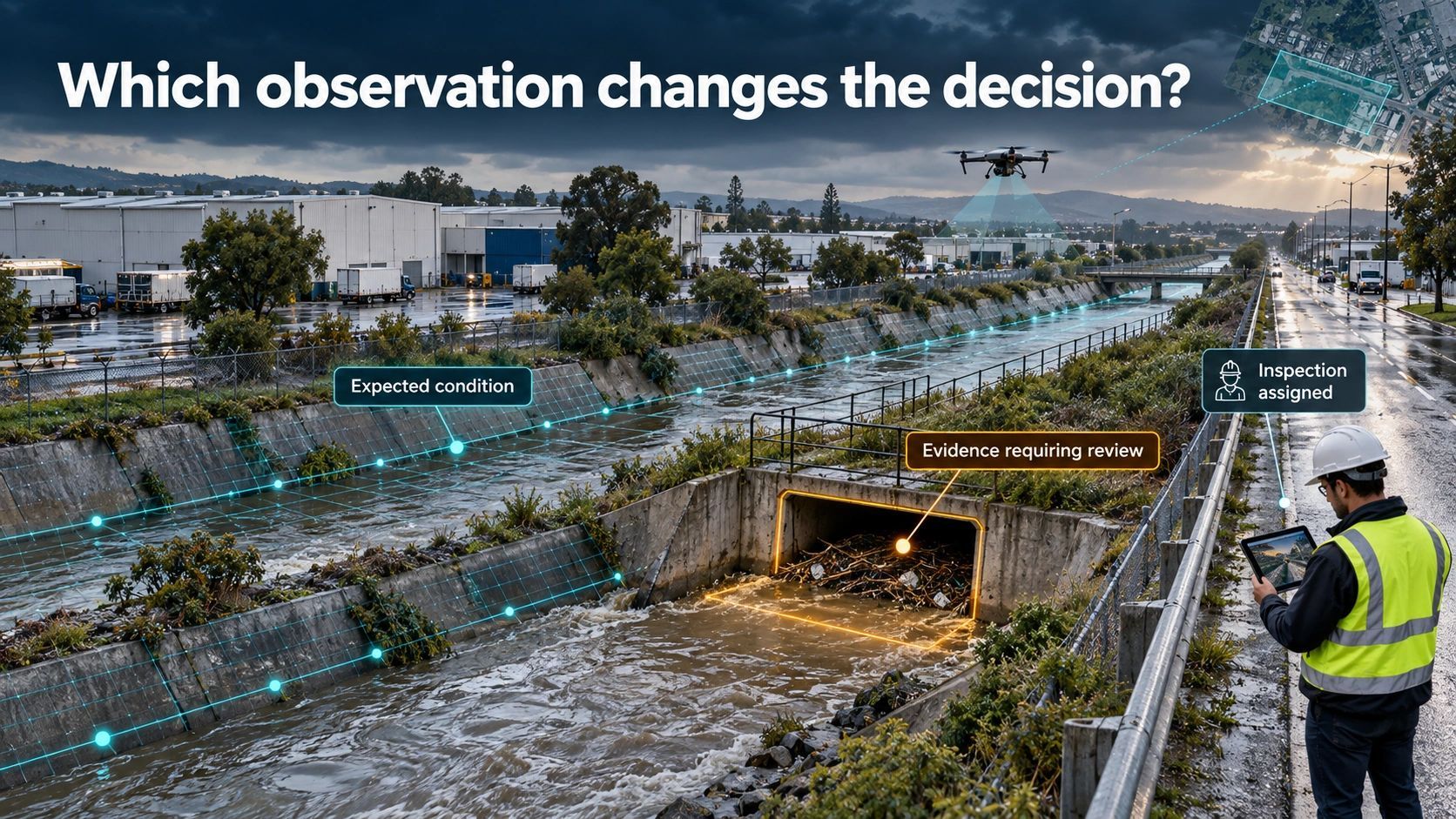
A solar inverter might report operation while inspection imagery identifies a condition requiring closer examination.
A construction record might show an installation as complete while a site scan suggests that its location or configuration differs from the approved model.
These are illustrative applications, rather than claims about particular deployments.
The common question is: what does each source establish, and what remains unresolved?
Agreement can also be misleading
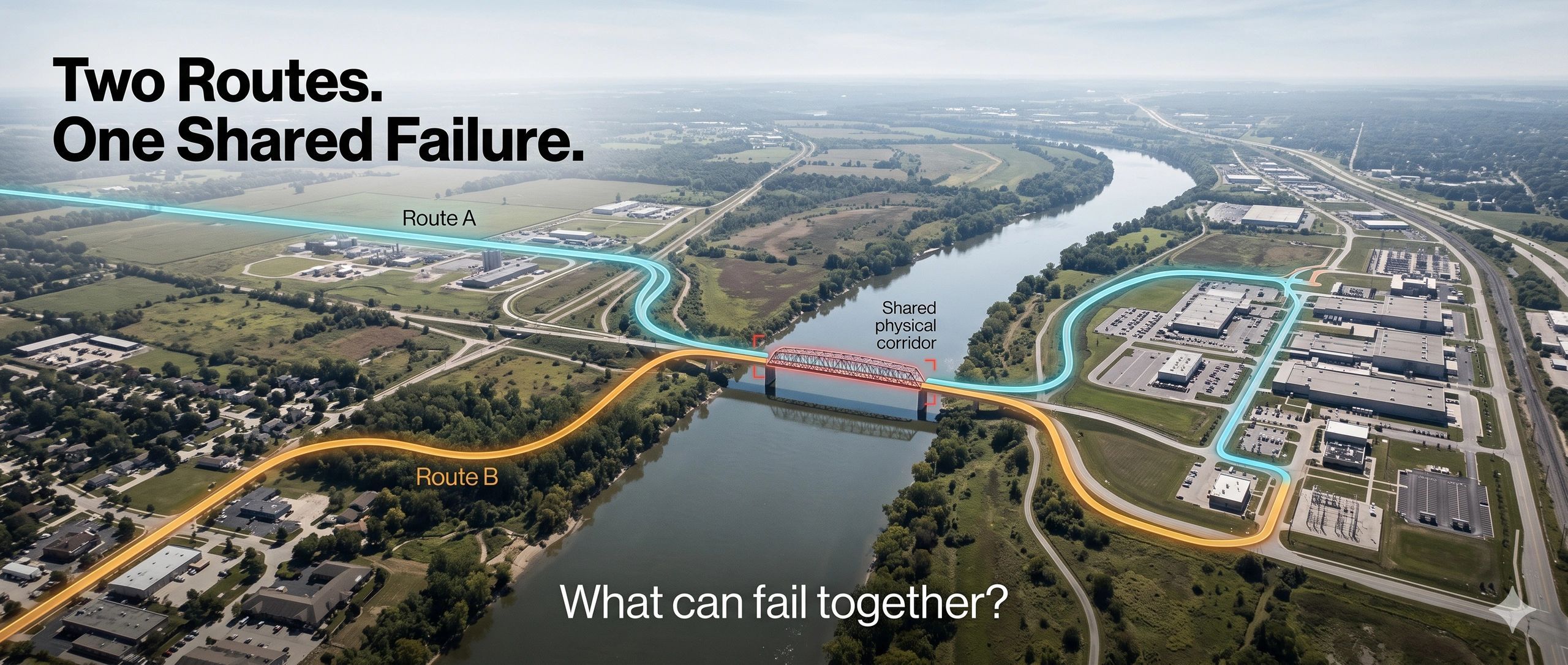
Adding more sources does not automatically create independent verification.
Two dashboards may display the same underlying sensor feed. A maintenance report may repeat the controller’s status. An AI assistant may summarize both and make the agreement appear stronger than it is.
Three matching statements can still originate from one measurement.
Independent evidence requires attention to how the information was produced.
Even a separate camera can carry its own limitations: an obstructed view, an incorrect asset association, poor lighting or an old capture.
A sound evidence architecture should therefore retain the source, method, capture time and limitations of each observation.
The goal is to understand how much support a conclusion actually has.
Before declaring a conflict, check the comparison
Some disagreements reveal a physical problem. Others reveal a data problem.
An image captured yesterday cannot establish that a repair completed this morning has failed. A reading from an adjacent pipe cannot verify the condition of the intended asset.
Before comparing evidence, teams should check:
- Identity: Are both records associated with the same asset?
- Time: Do they describe a comparable operating period?
- Meaning: Are they measuring the same condition or related conditions?
- Quality: Are calibration, visibility and measurement limitations understood?
- Context: Was the equipment under comparable load or operating mode?
Spatial information is essential here.
GIS supplies location and network context. BIM can supply equipment identity, installation relationships and design intent. IoT contributes operating measurements. Reality capture provides observations of physical conditions.
Their combination becomes useful when those relationships remain traceable.
Without that foundation, a platform may generate an impressive alert about two records that should never have been compared.
Preserve, compare, resolve
A practical approach has three stages.
Preserve the evidence.
Retain the original reading or observation alongside its interpretation. Record when it was captured and when it arrived.
That distinction matters when field devices work offline. A delayed upload should not silently become the latest physical condition simply because it arrived last.
Compare explicit claims.
“Motor running” and “water visible nearby” are not direct opposites.
The meaningful question may be whether the available evidence supports “normal delivery without leakage.”
Comparison rules should reflect asset behavior, expected relationships and operating context. Where AI helps identify a possible inconsistency, its explanation should remain distinguishable from the measurements supporting it.
Resolve through an accountable workflow.
Create a discrepancy record with the evidence, potential consequence, next verification step and responsible person.
The resolution might be a site inspection, calibration check, additional measurement or correction to an asset association.
The record should show what was concluded, who accepted it and which evidence justified closing the issue.
A discrepancy should change the next step
Recording every mismatch without prioritization would overwhelm an operations team.
The response should depend on consequence, evidence quality, persistence and the asset’s role in the wider system.
A brief mismatch on a non-critical device may warrant observation. A persistent mismatch affecting water delivery or cooling for critical equipment may require prompt investigation.
Established protective controls must continue to operate according to their own requirements. An unresolved evidence conflict should not become a reason to delay a necessary protective response.
Human accountability also needs to be explicit.
Who can accept an explanation? Who can change the operating status? Who can close the discrepancy? When is further inspection required?
A digital twin becomes more useful when it connects evidence to those responsibilities.
The commercial value is in faster resolution
The business case should focus on outcomes teams can measure:
Time from discrepancy detection to verification. Avoidable maintenance visits. Repeated false alarms. Service interruptions. Issues closed with adequate supporting evidence.
An organization could pilot this approach on one asset class, establish a baseline, and test whether combining telemetry with independent observations improves decisions.
Resolved discrepancies could also become useful AI evaluation examples, provided the investigation establishes a credible outcome. The disagreement itself is not ground truth.
The next maturity step for digital twins may be their ability to make unresolved conditions visible.
A green dashboard is useful only when the organization understands what that green status actually proves.
That makes the first implementation question practical: where does your current workflow lose conflicting evidence?