A smart asset can have advanced sensors, AI-driven analytics and a detailed digital twin and still become operationally useless when its power or connectivity fails.
A camera without a communications path cannot transmit evidence.
An IoT gateway without electricity cannot report field conditions.
An autonomous drone dock without reliable power cannot recharge the aircraft.
A digital twin without live data may continue displaying an asset long after it has lost contact with reality.
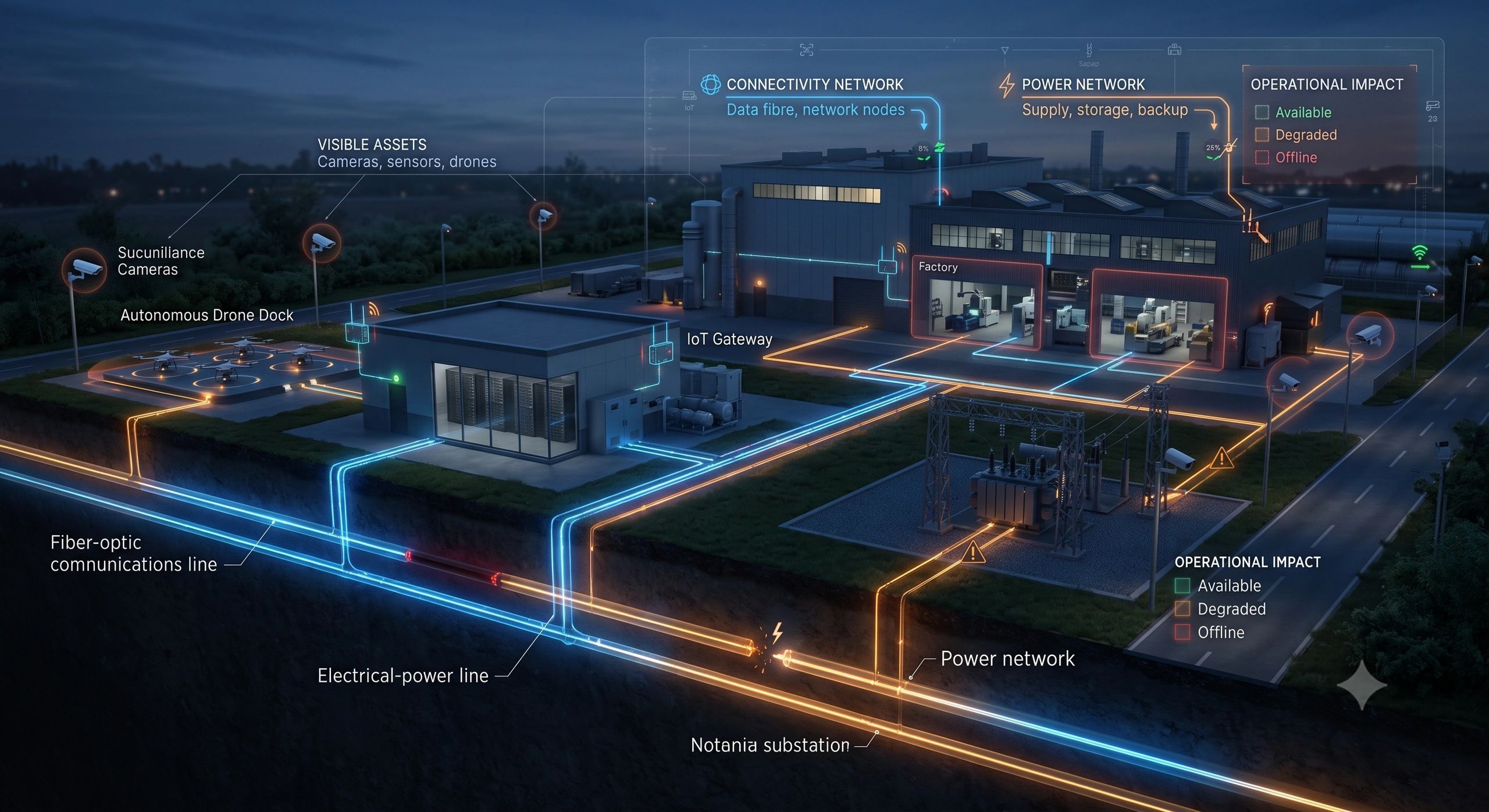
We often design these systems around the visible asset: the camera, machine, vehicle, building, substation or drone. But their ability to operate depends on two less visible networks working behind them:
Power and connectivity.
As infrastructure becomes more automated, these networks should no longer remain hidden assumptions. They need to become part of the operational model.
Smart does not necessarily mean resilient
The construction of new optical-fiber and battery-energy-storage manufacturing facilities in Madhya Pradesh illustrates a wider shift.
Connectivity and energy storage are being developed alongside smart cities, data centers, 5G, broadband, industrial automation and other digital infrastructure.
That pairing matters.
A smart-city platform may monitor thousands of cameras, traffic signals and environmental sensors. An industrial campus may depend on connected machines, edge devices and automated safety systems. A logistics park may use location intelligence, video analytics and IoT data to coordinate movement across the site.
Each system may appear to be a separate application.
Operationally, however, they may depend on the same fiber route, network node, substation, battery system or backup generator.
A single failure below the application layer can therefore interrupt several services at once.
Yet many digital twins describe the end assets without showing these enabling relationships.
They answer:
- Where is the device?
- What is its condition?
- What data is it producing?
But they may not answer:
- Which power source keeps it operating?
- Which communications route carries its data?
- What happens when either connection fails?
- What backup capacity is available?
- Which services will be affected?
- Who is responsible for restoring them?
This is a significant gap between asset visibility and operational readiness.
The missing layer is dependency intelligence
The next stage of smart-asset management is not simply to connect more devices. It is to understand how their dependencies affect service continuity.
Consider a surveillance camera at an industrial site.
Its operational chain may include:
Camera → local power circuit → distribution panel → substation → backup power
At the same time, its communications chain may include:
Camera → network switch → fiber segment → communications node → control center
The camera may appear healthy in the asset registry. But a failed switch, damaged fiber segment or depleted backup battery can remove it from service.
The operational model should connect all these relationships:
Asset or service → communications path → power source → backup → present availability → operational consequence → restoration owner
That turns a collection of assets into a dependency graph.
When a network component fails, operators can see not only what failed but what the failure means.
Which cameras have stopped transmitting?
Which IoT gateways are unreachable?
Which autonomous systems can no longer receive instructions?
Which safety, mobility or maintenance workflows have been interrupted?
Which critical loads remain protected by storage, and for how long?
These are operational questions. A conventional asset inventory rarely answers them.
A digital twin should reveal failure propagation
Digital twins are often presented as representations of physical assets. That definition is becoming too narrow for connected infrastructure.
A useful operational twin should also represent the systems that allow those assets to function.
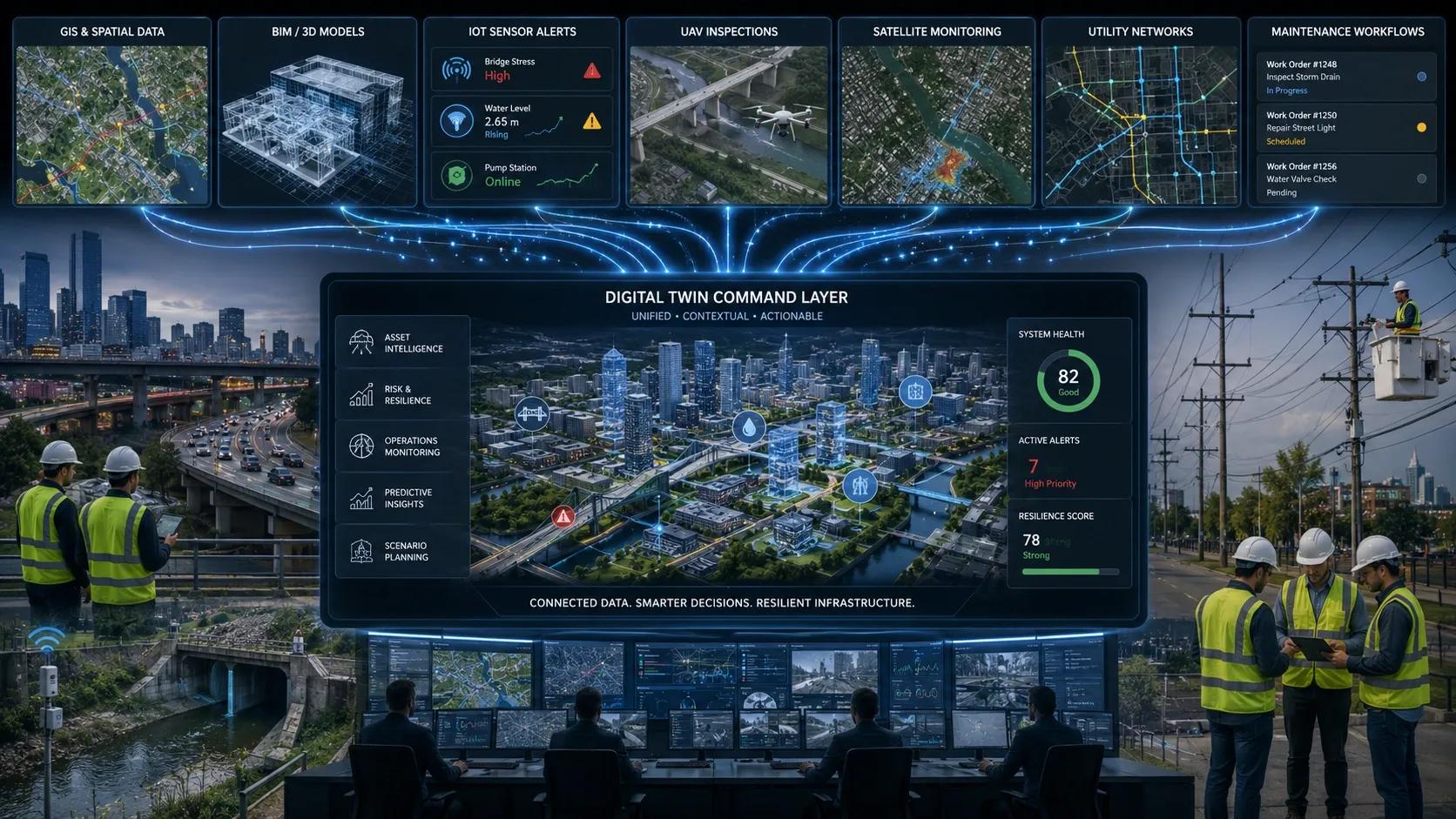
This requires several types of information to work together:
- GIS for network routes, service areas and spatial relationships
- BIM for equipment, spaces and building-level systems
- IoT for live condition and availability
- Network-management systems for connectivity status
- Energy-management systems for supply, storage and backup capacity
- Maintenance platforms for ownership, incidents and restoration activity
The value comes from preserving the relationships between them.
If a fiber route is damaged, the twin should identify the dependent assets and services. If a substation loses supply, it should show which loads move to battery backup, which remain unprotected and when intervention becomes critical.
Without this dependency layer, a twin may show the location of the failed component while leaving operators to determine the consequences manually.
Model the service, not only the equipment
The right starting point is not necessarily a complete model of every cable, circuit and device.
It is the service that must remain available.
For an industrial campus, that service might be worker safety, production monitoring or access control.
For a smart city, it might be traffic management, flood monitoring or emergency response.
For an autonomous drone programme, it might be continuous inspection of a solar plant, pipeline or substation.
Once the critical service is defined, the organization can work backwards:
- Which assets deliver the service?
- What power and communications infrastructure supports them?
- Where are the shared points of failure?
- What fallback paths exist?
- How long can the service operate in a degraded state?
- Who owns detection, escalation and restoration?
This avoids creating an overly complex model that looks complete but does not improve a decision.
Resilience must become measurable
Simply recording that backup power exists is insufficient.
Operators need to know whether it is available, tested and adequate for the service it protects.
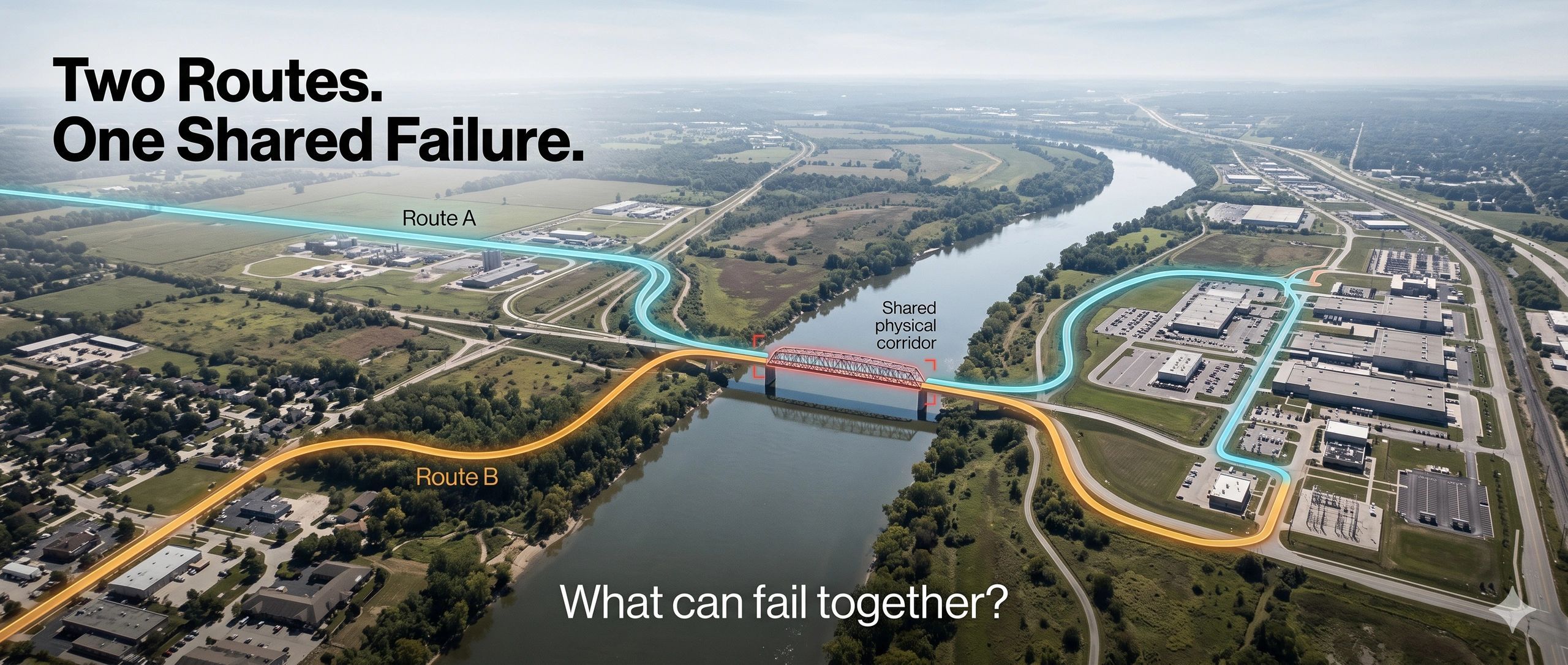
The same applies to communications redundancy. A secondary connection adds limited resilience if it follows the same physical route or depends on the same network node.
A decision-ready dependency model should therefore include:
- current availability
- capacity and remaining backup duration
- redundancy and route diversity
- last inspection or test
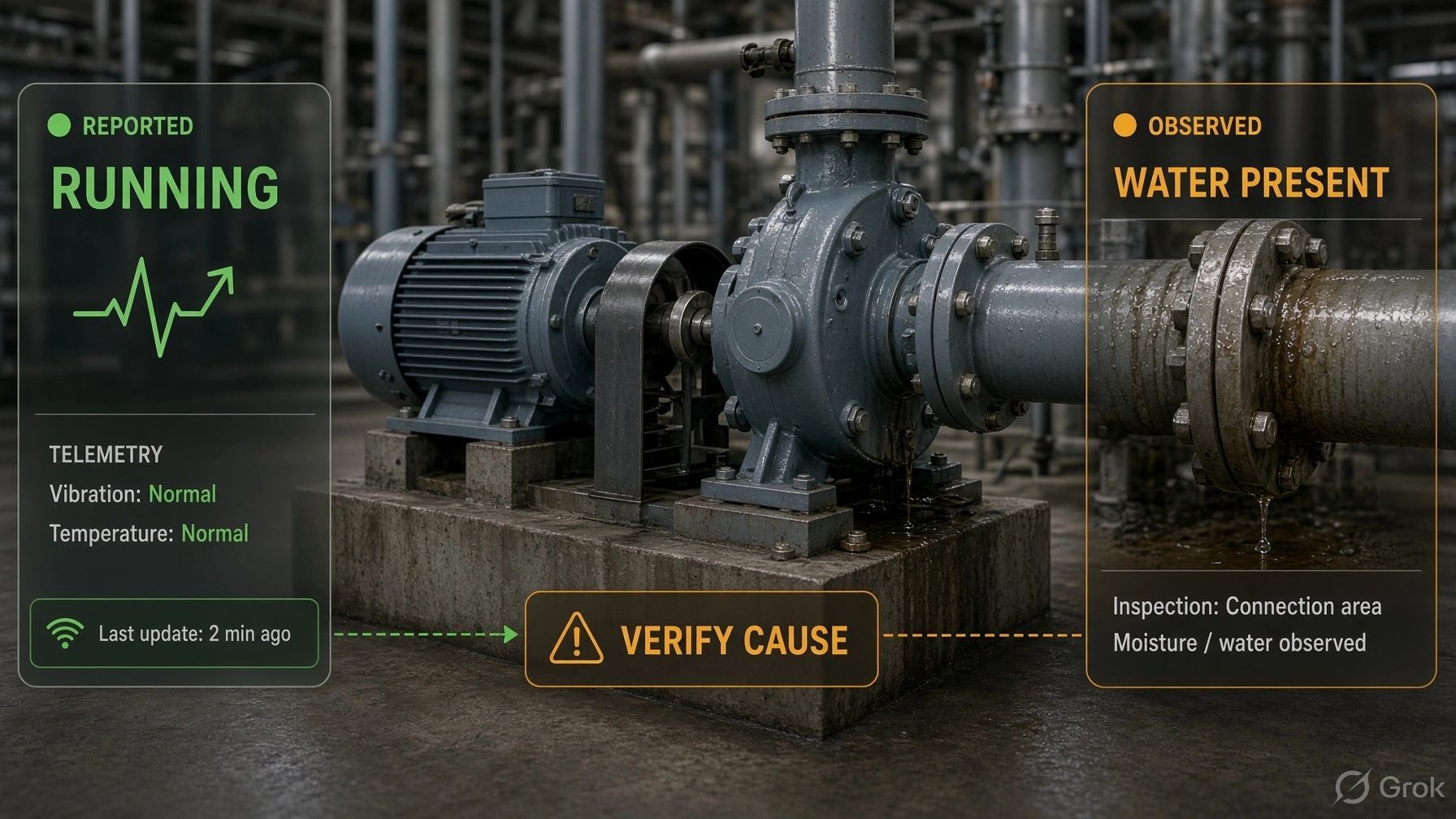
- uncertainty in the reported status
- restoration priority
- responsible team
- service-level consequence
This changes resilience from a design claim into an operational condition.
It also creates clearer performance measures: outage duration, restoration time, backup readiness, affected-service minutes and the number of critical assets exposed to a common failure point.
The business case goes beyond maintenance
Dependency intelligence can support several decisions.
During design, it can reveal concentrated failure risks before infrastructure is built.
During operations, it can improve incident prioritization and field-team deployment.
During investment planning, it can show where additional fiber, storage or backup capacity would protect the most critical services.
During an audit, it can provide evidence that resilience measures exist, are tested and remain connected to the assets they are intended to protect.
It can also reduce fragmented decision-making. The facilities team may manage electricity, IT may manage communications, operations may own the service, and a contractor may maintain the end device. A shared spatial model gives these groups a common view of how their responsibilities intersect.
Smart infrastructure needs an honest operational model
The intelligence of an asset does not reside only in the device or its software.
It also depends on whether energy reaches it, data can move from it and the organization can respond when either path is disrupted.
That is why power and connectivity should become explicit components of digital-twin architecture.
The most useful twin will not simply say:
“This asset exists here.”
It will say:
“This service is operating, these systems enable it, these dependencies are at risk, and this is the action required if one of them fails.”
As infrastructure becomes more connected and autonomous, the invisible networks behind each asset will increasingly determine whether the visible technology delivers value.