Digital Twins have become very good at representing assets.
They can show us where equipment is located, how systems are connected, what sensors are reporting, what changed on site, and how operations are performing.
But representation is not the same as physical understanding.
A Digital Twin may know that a pipeline exists at a particular coordinate. It may know the temperature measured at three sensor locations. It may even visualize flow through the pipe.
Yet that does not necessarily mean the system understands the thermodynamics governing what is happening between those sensors.
That gap is becoming an important frontier in Digital Twin engineering.
One emerging approach is Physics-Informed Machine Learning, including a class of models called Physics-Informed Neural Networks, or PINNs.
And their most important contribution may not be replacing engineering simulation.
It may be helping Digital Twins reason about the physical states that cannot be directly observed.
From Pattern Recognition to Physics-Constrained Learning
Traditional machine learning learns primarily from examples.
Give a model enough historical observations and it may discover relationships between pressure, temperature, vibration, load, flow, weather, degradation, or failure.
But the model does not automatically know Newton’s laws, heat transfer, fluid dynamics, structural mechanics, electromagnetics, or conservation of mass and energy.
PINNs introduce another source of knowledge.
Alongside observations, the learning process incorporates governing physical equations, boundary conditions, initial conditions, and engineering relationships.
Instead of training only against:
What did the sensors observe?
the model is also penalized when its prediction conflicts with:
What should be physically possible?
This distinction matters.
But it is important not to overstate it.
Most PINNs do not mathematically guarantee that every prediction perfectly satisfies physics. Physics is commonly introduced through the model’s loss function, meaning violations are minimized rather than always eliminated.
So “physics-informed” should not be confused with “physics-certified.”
That distinction will become particularly important if these models begin influencing real infrastructure.
The Opportunity Is Between the Sensors
Consider an industrial pipeline.
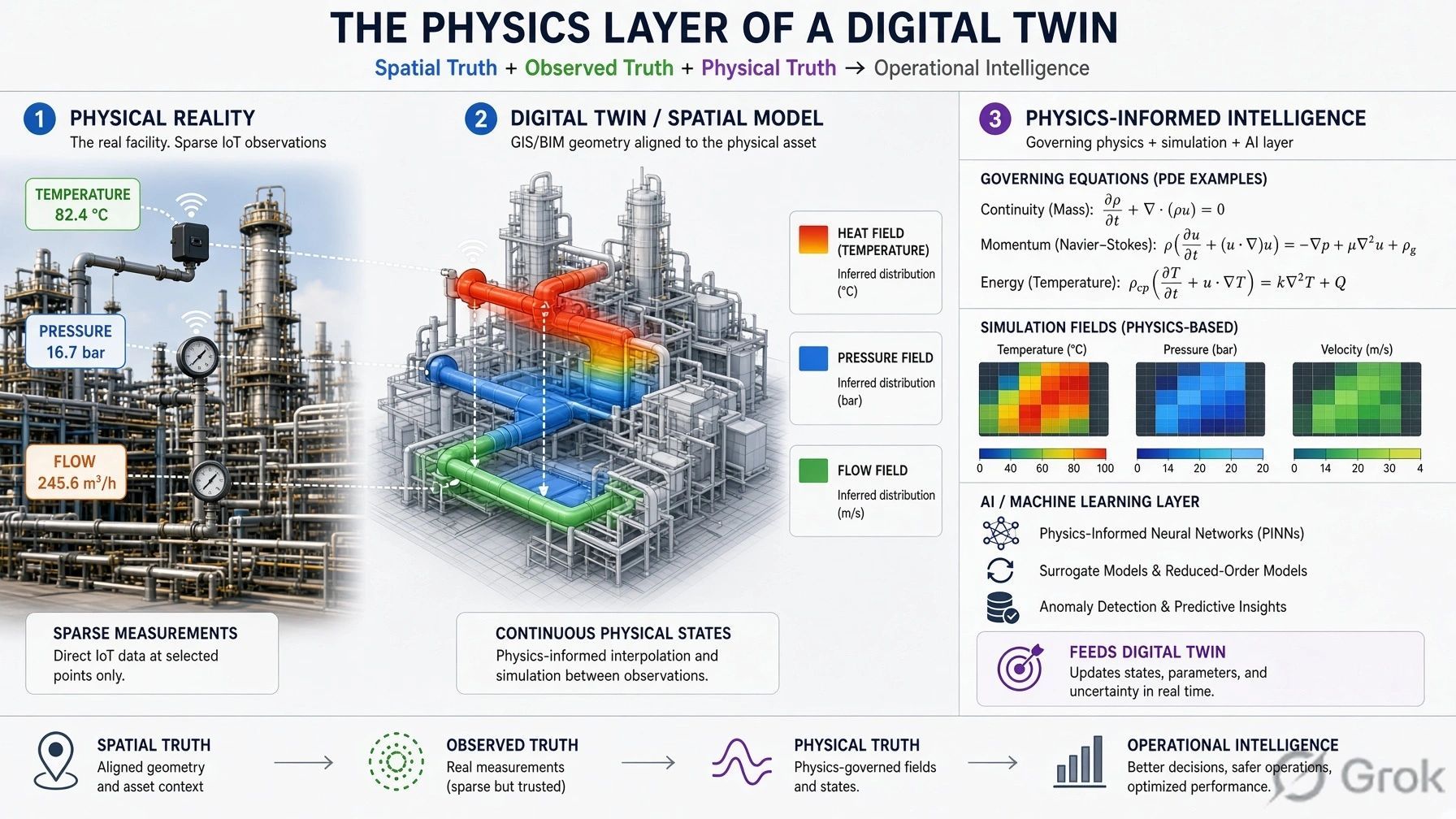
A company may install temperature, pressure, or flow sensors at selected locations.
But instrumenting every meter of a large facility is neither practical nor economical.
This creates a familiar Digital Twin problem.
We know the physical geometry.
We have a limited number of measurements.
But much of the actual physical state remains unobserved.
A physics-informed model can potentially combine:
Sparse sensor data
- asset geometry
- operating conditions
- material properties
- governing physics
to estimate the physical field between those observations.
That does not mean it “perfectly calculates” reality between sensors.
But it can create something very valuable:
a physics-aware estimate of the hidden state of the asset.
This turns sparse sensing into a much richer operational picture.
And that may prove more important than simply adding more dashboards.
Digital Twins Are Moving Toward State Estimation
This introduces an important shift in how we think about Digital Twins.
A conventional twin may answer:
What do my sensors currently report?
A physics-informed twin may begin answering:
What is probably happening where I have no sensor?
That is state estimation.
For example, a system could potentially reconstruct:
- temperature distributions,
- pressure fields,
- stress concentrations,
- fluid velocities,
- deformation,
- heat transfer,
- electromagnetic fields,
- or other physical states.
The Digital Twin therefore moves from being a container of measurements toward becoming an engineering inference system.
That is a much deeper capability.
But PINNs Are Not Replacing CFD or FEA
This is where the current discussion around Physics AI often becomes exaggerated.
High-fidelity Computational Fluid Dynamics and Finite Element Analysis remain extremely powerful engineering methods.
PINNs can also be computationally expensive and difficult to train.
In some benchmark problems, conventional numerical solvers remain faster, more accurate, and easier to validate than PINNs.
So the future is unlikely to be:
PINN replaces CFD.
A more realistic architecture is:
High-fidelity engineering simulation
- field measurements
- physics-informed learning
- reduced-order modelling
- fast surrogate inference
Traditional simulation may still provide trusted engineering truth during design, calibration, or validation.
Physics-informed models can then complement those tools where rapid repeated evaluation is required.
This is especially relevant to operational Digital Twins.
Offline Physics, Online Speed
One useful way to understand this is to separate training from inference.
A sophisticated physics-informed model may require significant computational resources during development.
But once trained and validated, the resulting surrogate may evaluate operating conditions much faster than repeatedly running a full numerical simulation.
That changes what becomes possible operationally.
Imagine an operator changing a valve setting inside a Digital Twin.
Instead of waiting for a full CFD simulation, a validated surrogate could estimate the resulting pressure or temperature response quickly enough to support interactive decision-making.
Similarly, an XR environment could potentially show the approximate consequences of operational changes while someone is inspecting the asset.
The value is therefore not necessarily:
“simulation without computation.”
It is:
moving expensive physical reasoning upstream so that operational inference becomes faster downstream.
The Digital Twin Stack Gains a Physics Layer
This suggests that the architecture of Digital Twins itself may be evolving.
Today we commonly think in layers such as:
Reality Capture
IoT, LiDAR, UAVs, cameras, mobile mapping.
↓
Spatial Context
GIS, BIM, CAD, asset topology, coordinate systems.
↓
Data and Analytics
Telemetry, databases, AI, dashboards.
↓
Operational Decisions
Maintenance, inspection, control, planning.
Physics-informed modelling introduces another important layer between spatial context and operational action:
The Physics Layer
This layer describes how the asset should physically behave.
Thermodynamics.
Fluid mechanics.
Structural mechanics.
Material behavior.
Electromagnetics.
Environmental processes.
The Digital Twin can therefore begin combining three different forms of truth:
Spatial truth: where and what the asset is.
Observed truth: what sensors and reality capture are measuring.
Physical truth: how the system should behave according to governing laws.
The interaction between those three could become one of the most important developments in next-generation Digital Twins.
From Prediction to Parameter Identification
There is another capability that may be even more useful.
Physics-informed models can sometimes work backwards.
Instead of only asking:
Given the system parameters, what will happen?
we can ask:
Given what the sensors are observing, what physical parameter may have changed?
Perhaps insulation performance has degraded.
Perhaps friction has increased.
Perhaps a thermal coefficient is no longer behaving as expected.
Perhaps a component is losing stiffness.
This is known as an inverse problem.
And it fits naturally into the Digital Twin philosophy.
The physical asset generates evidence.
The Digital Twin interprets that evidence.
The physics model tests whether observed behavior still matches expected behavior.
Deviation can then become a signal for inspection, maintenance, or further investigation.
Failure Prediction Needs More Caution
Physics-informed models are also being explored for fracture, fatigue, degradation, and structural failure.
This creates a tempting statement:
“If the AI knows the physics, it can predict failures without historical failure data.”
Sometimes it may help.
But real asset failure depends on far more than a single physical limit.
Corrosion, fatigue, weld condition, manufacturing defects, environmental exposure, residual stresses, material variability, loading history, and maintenance condition can all matter.
Physics therefore does not eliminate the need for evidence.
Instead, it provides another source of evidence.
This principle should guide how engineering organizations adopt Physics AI.
The Future Is Probably Hybrid
PINNs are only one part of a much larger movement.
We are now seeing rapid development in:
- Physics-Informed Neural Networks,
- neural operators,
- reduced-order models,
- graph-based physical models,
- differentiable simulation,
- surrogate modelling,
- data assimilation, and
- hybrid numerical-AI systems.
The winning Digital Twin architecture may therefore not depend on one algorithm.
It may combine multiple approaches depending on the physical problem, accuracy requirement, computational budget, safety criticality, and available observations.
The question is not:
Which AI model replaces engineering simulation?
The better question is:
How do we combine engineering physics, spatial models, observations, and AI so that a Digital Twin can reason about reality faster and more reliably?
The GeoThinking Perspective
For years, Digital Twin discussions have focused heavily on visual fidelity.
Better 3D models.
Higher-resolution reality capture.
More IoT sensors.
More connected data.
Those capabilities remain important.
But the next stage may be less visible.
It may happen inside the computational layer.
A future Digital Twin may not only know where an asset is or what a sensor reported.
It may estimate what is happening where no sensor exists.
It may calculate whether observed behavior remains physically plausible.
It may identify which hidden parameters are changing.
And it may evaluate alternative operating conditions fast enough to support real decisions.
That is a fundamentally different kind of twin.
Not merely a digital representation of physical reality.
But a system increasingly capable of reasoning about physical reality.
And that may be where Physics-Informed AI becomes important.