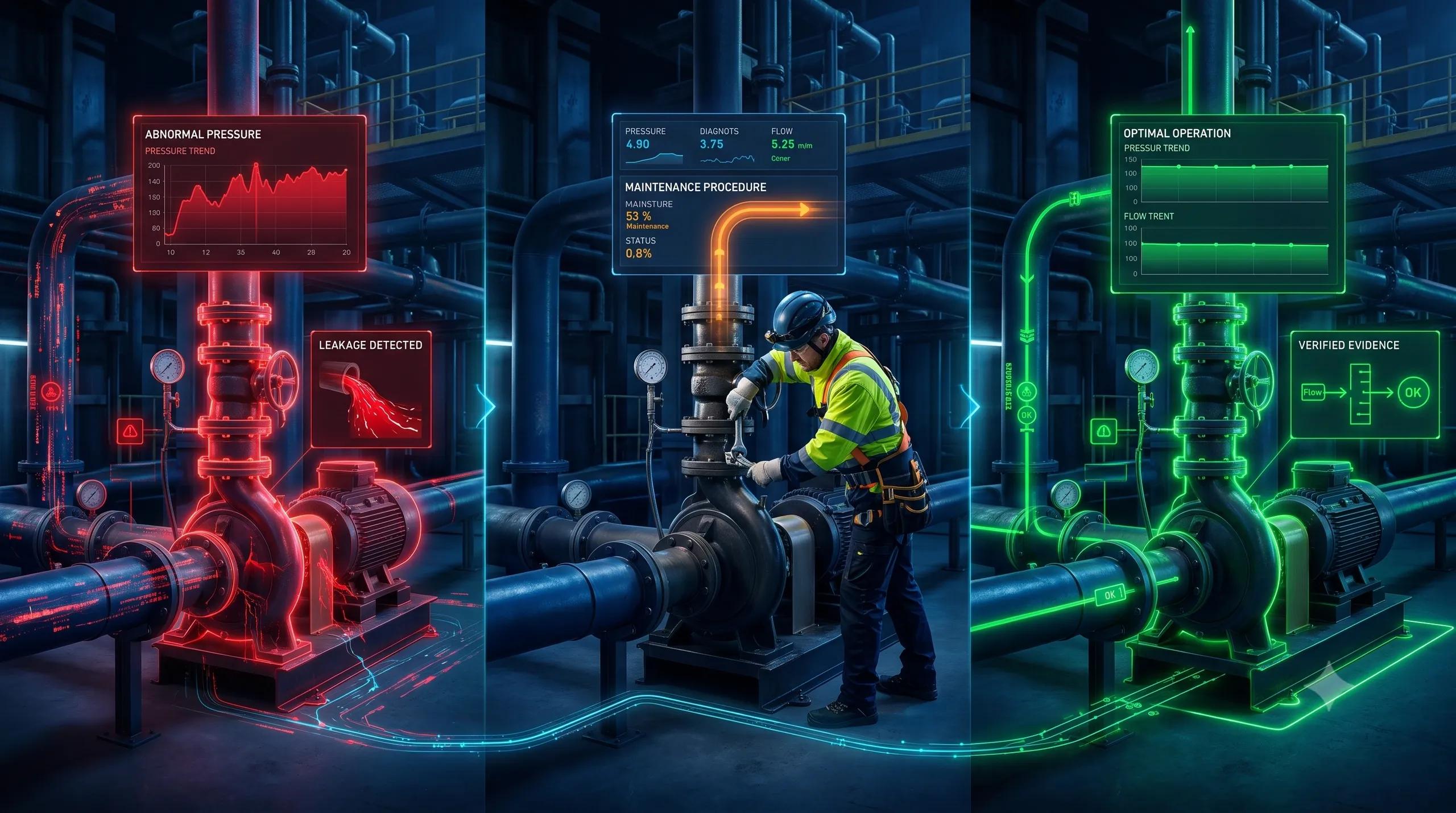

A digital twin displays an alert:
“Pump P17 will fail within 14 days.”
The maintenance team must decide what to do.
Should it stop the pump immediately? Schedule an inspection? Order a replacement bearing? Or continue operating while collecting more information?
The answer depends on more than the prediction.
What was actually measured? How recent is the data? Has the suspected fault been confirmed? What happens if the pump stops unexpectedly and what happens if the team stops it unnecessarily?
A digital twin becomes more useful when it helps people answer those questions. It becomes risky when a forecast starts looking like an established fact.
A prediction can be useful without being confirmed
Imagine that Pump P17 supplies water to a production facility.
A vibration sensor detects a reading above the normal operating range. An analytics model interprets the pattern as possible bearing degradation and predicts a failure within 14 days.
The dashboard turns the pump red.
This is an illustrative scenario, but the decision problem is familiar: several different statements have been compressed into one alert.
- Observed: The sensor recorded elevated vibration.
- Inferred: The vibration pattern may indicate bearing degradation.
- Predicted: The pump may fail within a specified period.
- Verified: A qualified person has assessed the available evidence against defined criteria and confirmed or rejected a particular claim.
These statements are related, but they do not carry the same meaning.
Elevated vibration could result from a bearing problem. It could also have another cause, including a sensor issue or a change in operating conditions. A forecast can provide a reason to investigate, but it does not by itself confirm the cause.
The practical distinction matters because each statement can support a different action.
The cost of treating a forecast as a fact
If the organization treats the prediction as confirmed failure, it may shut down equipment unnecessarily, interrupt production or replace a component that still has useful life.
If it dismisses the prediction because failure has not been confirmed, it may miss an opportunity to inspect the pump before a serious disruption.
The goal is neither to automate every response nor to wait for certainty.
The goal is to match the strength of the action to the strength of the available evidence, the consequences of being wrong and the time available to respond.
For Pump P17, a sensible sequence might be:
- Check the sensor’s recent data, health and operating context.
- Compare the reading with other relevant measurements and maintenance history.
- Ask a qualified engineer to assess the suspected condition.
- Plan an inspection or intervention based on the pump’s criticality and the remaining uncertainty.
If the consequences of failure are severe, an organization may choose to take precautionary action before the diagnosis is confirmed. The record should still say that the action was precautionary, based on a prediction and supporting observations.
That distinction helps the team review the decision later without rewriting what was known at the time.
Give every claim a clear status
Digital twins bring together many kinds of information: BIM models, field observations, IoT measurements, work orders, inspections and AI outputs.
The challenge is preserving what each piece of information actually represents as it moves between systems.
A practical starting point is to label claims according to how they were produced:
Claim status - What it means - Example
Observed - Recorded by a sensor or direct measurement - A vibration reading exceeded a threshold at 10:15 a.m.
Reported - Provided by a person or external system - A contractor reports that a valve was replaced.
Derived - Calculated from one or more inputs - Average energy consumption increased over the past week.
Inferred - Interpreted from available information - The vibration pattern suggests possible bearing degradation.
Predicted - Estimated future condition or event - The pump has an elevated risk of failure in the next 14 days.
Verified - A claim has been assessed and accepted against defined criteria - An engineer confirms bearing damage after inspection.
These labels should not be treated as a single ladder in which one replaces another. Verification is an assessment of a specific claim. A reported replacement can be verified; so can a calculated result, if its inputs and method meet the applicable criteria.
Likewise, an observation is not automatically correct. Sensors can be miscalibrated, readings can be associated with the wrong asset, and measurements can become stale.
The status tells us what kind of claim we are looking at. Its quality depends on the evidence behind it.
Show the evidence alongside the alert
A useful digital twin should allow an operator to move from the red indicator to the reasoning behind it.
For the pump alert, the decision view could show:
- The asset and operating period covered by the prediction.
- The measurements used, including their timestamps and data quality.
- The model version and relevant assumptions.
- The predicted condition and time horizon.
- Known gaps, such as missing temperature data.
- The inspection or other evidence needed to confirm the suspected fault.
- The person authorized to approve the next action.
Where a model provides a probability, the organization should also understand whether that probability has been tested and calibrated for comparable assets and operating conditions. A precise-looking percentage is not useful if nobody knows how reliable it is.
This does not mean every operator needs to study a model report before responding. It means the detail should be available when a decision requires it and the interface should make uncertainty visible without hiding the operational priority.
Verification must answer a specific question
Suppose an engineer inspects Pump P17 and confirms that its bearing is degraded.
What has been verified?
The bearing condition has been assessed at the time of inspection. That does not automatically prove the model was right about a failure occurring within 14 days. The pump may have been repaired before that forecast could be tested.
This matters for improving predictive systems.
An organization should retain the original forecast, the subsequent inspection findings and the action taken. Over time, those records can help teams assess model performance. But they must account for interventions: replacing a component can prevent the event the model predicted, making simple “failure happened or did not happen” scoring misleading.
The digital twin should preserve that history rather than replacing yesterday’s prediction with today’s inspection result.
The same distinction applies beyond maintenance
Consider a construction project.
A contractor reports that a building floor is complete. A drone survey shows visible progress, while a BIM comparison identifies areas that appear unfinished. A project manager reviews the findings against the acceptance criteria.
Those are different contributions to the same decision:
- The contractor’s update is a reported claim.
- The drone imagery is an observation with limits: it may not show concealed work.
- The model comparison is a derived or inferred assessment, depending on the method.
- The accepted milestone is a verified claim against agreed criteria.
The distinction has commercial consequences. A reported milestone may inform scheduling, while payment or handover may require additional evidence and formal acceptance.
The same pattern appears in carbon reporting: electricity may be metered, emissions calculated using an appropriate factor, and future reductions forecast. Each result needs its own provenance and method if someone is going to rely on it.
Design the workflow around the decision
Organizations do not need to label every data point in a digital twin on day one. Start with one consequential decision and work backwards.
For example: Should the maintenance team inspect, stop or continue operating Pump P17?
Then define:
- The claim: What does the system say is happening or may happen?
- The evidence: Which measurements, records and assumptions support that claim?
- The decision: What actions are available, who can approve them, and what evidence does each action require?
This also exposes a useful implementation trade-off. More verification takes time and resources. Less verification can increase the chance of an unnecessary intervention or a missed problem.
The right threshold depends on the consequence, urgency and reversibility of the decision. Ordering an inspection and shutting down a production line do not need identical evidence requirements.
A digital twin should preserve how we know
As AI becomes part of operational workflows, digital twins will increasingly contain forecasts, recommendations and generated explanations alongside measurements and engineering records.
That makes the interface a decision tool and a potential source of confusion.
A trustworthy twin should help people see what is known, what is suspected, what may happen next and what has been independently assessed. It should also retain the evidence and assumptions that made each decision reasonable at the time.
A prediction can be valuable precisely because it arrives before physical confirmation. Its value depends on keeping that distinction visible when someone decides what to do next.