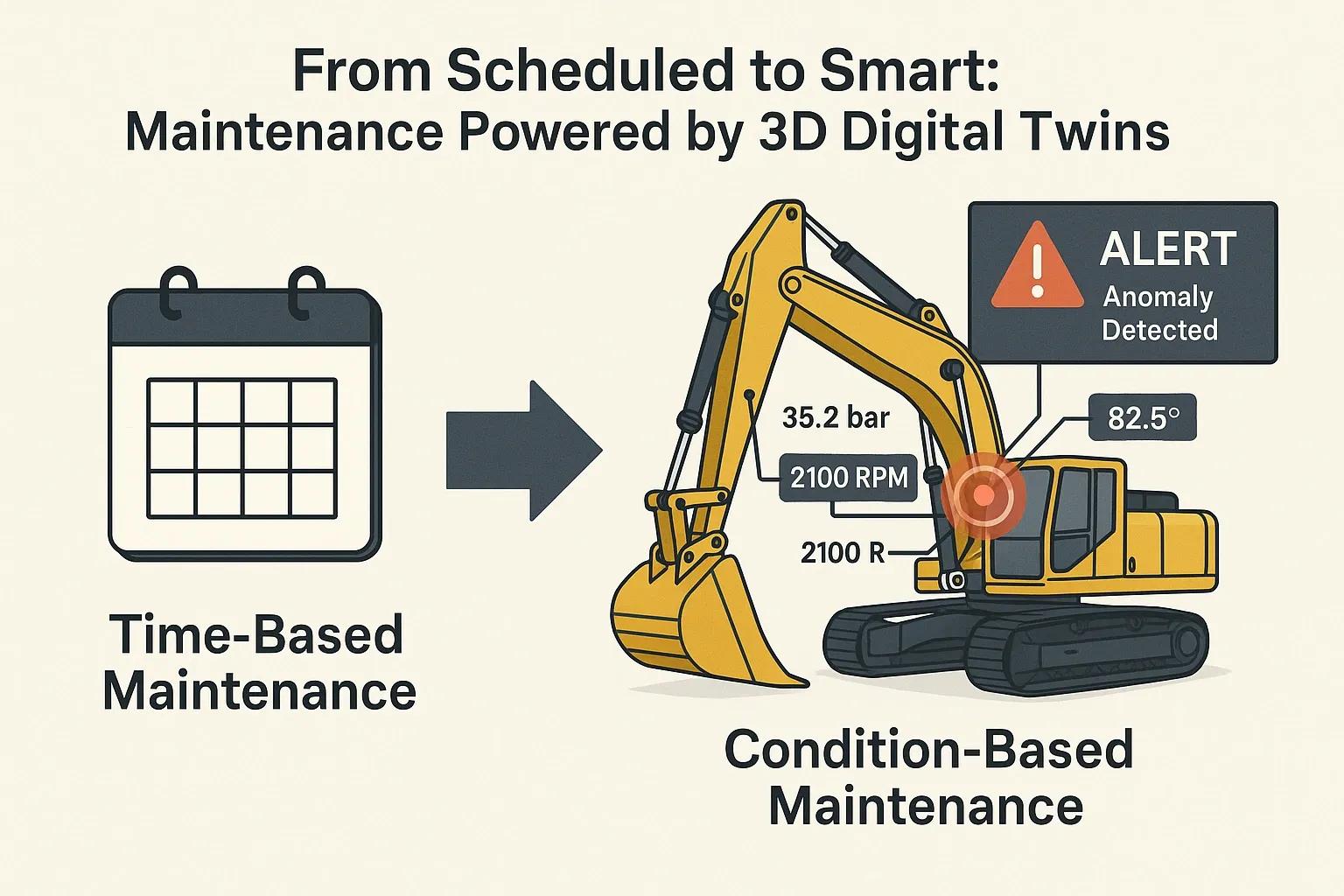
In heavy industries, such as mining, construction, oil & gas, and manufacturing, machinery downtime can result in substantial operational and financial losses. Traditionally, time-based preventive maintenance has been the standard: perform servicing at scheduled intervals, regardless of machine condition. However, this approach can be inefficient, often leading to either unnecessary maintenance or overlooked signs of failure.
Enter the 3D Digital Twin, a real-time, virtual replica of a physical machine that enables predictive, condition-based maintenance (CBM). By integrating sensor data, simulation models, and visual analytics, 3D twin-driven maintenance enables organizations to shift from routine to responsive maintenance strategies, maximizing uptime, extending asset lifespan, and reducing costs.
What is a 3D Digital Twin?
A 3D Digital Twin is more than a 3D model. It is a data-driven, dynamic representation of a machine that integrates:
Geometrical Data : 3D CAD/BIM representations of machinery components.
Sensor Streams : Real-time data from IoT sensors measuring vibration, temperature, pressure, load, etc.
Operational Context : Data from SCADA, ERP, and CMMS systems.
Historical Performance : Past maintenance logs, failure modes, and machine learning predictions.
Together, these elements form a live, interactive simulation of the machine’s health and behavior, accessible via dashboards, VR environments, or mobile apps.
Why Traditional Maintenance Falls Short
Time-based or usage-based maintenance is often imprecise:
Over-maintenance : Servicing components that are still in good condition leads to unnecessary labor and part replacements.
Under-maintenance : Latent failures may go unnoticed until they trigger a breakdown, often leading to cascading issues.
Lack of visibility : Maintenance technicians rely on manual inspections or logs, which may not reflect real-time wear and tear.
This approach is inherently reactive, and when dealing with expensive or mission-critical heavy equipment, the risk is high.
Benefits of 3D Twin-Driven Maintenance
1. Real-Time Condition Monitoring
Sensors embedded in engines, hydraulic systems, gearboxes, and bearings feed live performance data into the digital twin. This enables:
Early detection of anomalies (e.g., rise in vibration or thermal imbalance).
Visual alerts when parameters deviate from normal thresholds.
Monitoring wear patterns over time to forecast part degradation.
2. Predictive Maintenance Using Simulation
The digital twin uses AI/ML models to simulate possible future states. For example:
Predict how a pump will behave under fluctuating loads.
Identify stress accumulation in structural components.
Simulate fluid dynamics under different environmental conditions.
This simulation capability helps in planning interventions before failure occurs.
3. Maintenance Planning with Visual Context
Technicians can interact with the 3D twin to:
Zoom into internal assemblies.
Simulate disassembly for training or planning.
Overlay sensor data (e.g., hotspots) directly on the 3D geometry.
This context-rich interface reduces diagnostic time and ensures the right part is serviced.
4. Reduced Downtime and Costs
By performing maintenance only when needed:
Downtime is minimized due to targeted interventions.
Spare parts inventory is optimized.
Maintenance crews are utilized more efficiently.
Case studies show condition-based strategies can reduce unplanned downtime by 30-50% and maintenance costs by 20-40%.
Key Components of the 3D Twin-Driven Maintenance System
Component - Description
Sensor Network - Vibration, temperature, acoustic, load, fluid flow sensors on key subsystems
Data Aggregation Layer - Edge computing or IoT gateway to preprocess and transmit sensor data
Digital Twin Core - 3D visualization, data fusion engine, and simulation model base
AI/ML Analytics - Predictive models for anomaly detection, RUL (Remaining Useful Life)
User Interface - Dashboard, AR/VR headset interface, mobile diagnostics tools
Integration Layer - Links with ERP, CMMS, SCADA, or MES for work order and asset tracking
Implementation Example: Excavator in Mining Operations
Consider a mining company deploying a 3D digital twin of its excavators:
Sensor Setup : Vibration sensors on swing gear, oil sensors in hydraulic systems, GPS and load sensors on the arm.
3D Model : Built using BIM or CAD tools and calibrated with real machine dimensions.
Data Link : Connected to a central platform via cellular/LTE networks; edge device filters noisy data.
Simulation : AI models predict the probability of bearing failure under current loads and recommend lubrication within 10 hours.
Maintenance Response : A technician views the hot zone on the 3D model, receives a suggested checklist, and confirms action in the mobile app.
As a result, the company avoids a critical failure, saving days of downtime and lakhs in repair costs.
Challenges in Adoption
Despite its potential, the adoption of 3D twin-driven maintenance faces a few roadblocks:
High Initial Setup Cost : Requires investment in sensors, software, integration, and modeling.
Data Quality Issues : Incomplete or noisy sensor data can lead to false positives/negatives.
Workforce Readiness : Maintenance staff need training in digital tools and analytics.
System Integration : Legacy systems (e.g., SCADA or ERP) may not support real-time data exchange.
Organizations must address these challenges through phased adoption, pilot deployments, and strategic upskilling.
Future Outlook
3D twin-driven maintenance is evolving in several directions:
Edge AI : Predictive models deployed closer to the machine for faster response.
AR-enabled Repairs : AR overlays to guide technicians on physical machines based on digital twin insights.
Standardization : Interoperable data formats (like ISO 23247 for digital twins) will reduce integration costs.
Autonomous Maintenance : Robots and drones executing maintenance tasks based on twin-driven diagnostics.
As these technologies mature, we can expect maintenance strategies to move from reactive → preventive → predictive → autonomous.
Conclusion
3D Twin-Driven Maintenance marks a significant leap from static, time-based maintenance routines to dynamic, condition-aware operations. In the heavy machinery sector, where equipment is capital-intensive and downtime is costly, this shift brings measurable benefits in reliability, cost-efficiency, and safety.
As industries move deeper into Industry 4.0, adopting digital twins for maintenance isn’t just an upgrade, it’s a strategic necessity. The organizations that act early will not only reduce operational risks but also build a competitive advantage through smarter asset lifecycle management.