A bridge inspection finds a crack five years after opening. The first question sounds simple: Is it new?
The answer may take weeks. Inspectors can measure the crack today, but the handover records may contain drawings, photographs and defect lists that are difficult to match to that exact location. A design model shows what was intended. It does not necessarily show the condition of the concrete when the owner took responsibility for it.
That gap affects more than bridges. It appears in tunnels, stations, industrial plants and buildings whenever a later inspection must reconstruct the asset’s starting condition.
A digital birth certificate offers a way to close it: a verified record of what was built, where it was, and what condition it was in when responsibility changed hands.
A bridge points to the practical idea
The New Storstrøm Bridge in Denmark provides a useful example. According to a presentation at the 2026 International Cable Supported Bridge Operators Conference, the Danish Road Directorate required a digital “Birth Certificate” before installation of the first offshore span.
Drones recorded concrete surfaces onshore and after placement using high-resolution visual and thermal imagery. The images were processed into 3D reality-capture models. AI-supported analysis, checked by people, helped identify and catalogue surface defects within those models. The resulting record gave the project team a reference for discussing tolerances and repairs with the contractor. The presentation describes plans to compare future drone inspections with that original baseline. 2026 International Cable Supported Bridge ...
The value is easy to understand. If an inspector sees a mark years later, the owner can look for evidence of whether it was present at installation, whether it changed, and what action was previously agreed. The birth record does not make that judgement automatically. It gives the people making it a stronger starting point.
The certificate is more than a 3D model
A detailed model can be persuasive while leaving important questions unanswered. Which part of the structure does an image show? When was it captured? Was the surface visible and clear enough to assess? Who reviewed a suspected defect? Was it repaired before handover?
For a birth certificate to remain useful, I believe it needs three connected parts:
A physical baseline. Georeferenced imagery, surveys and reality capture establish the asset’s observed geometry and condition. Coverage matters: areas that could not be inspected should be recorded as gaps, rather than treated as defect-free.
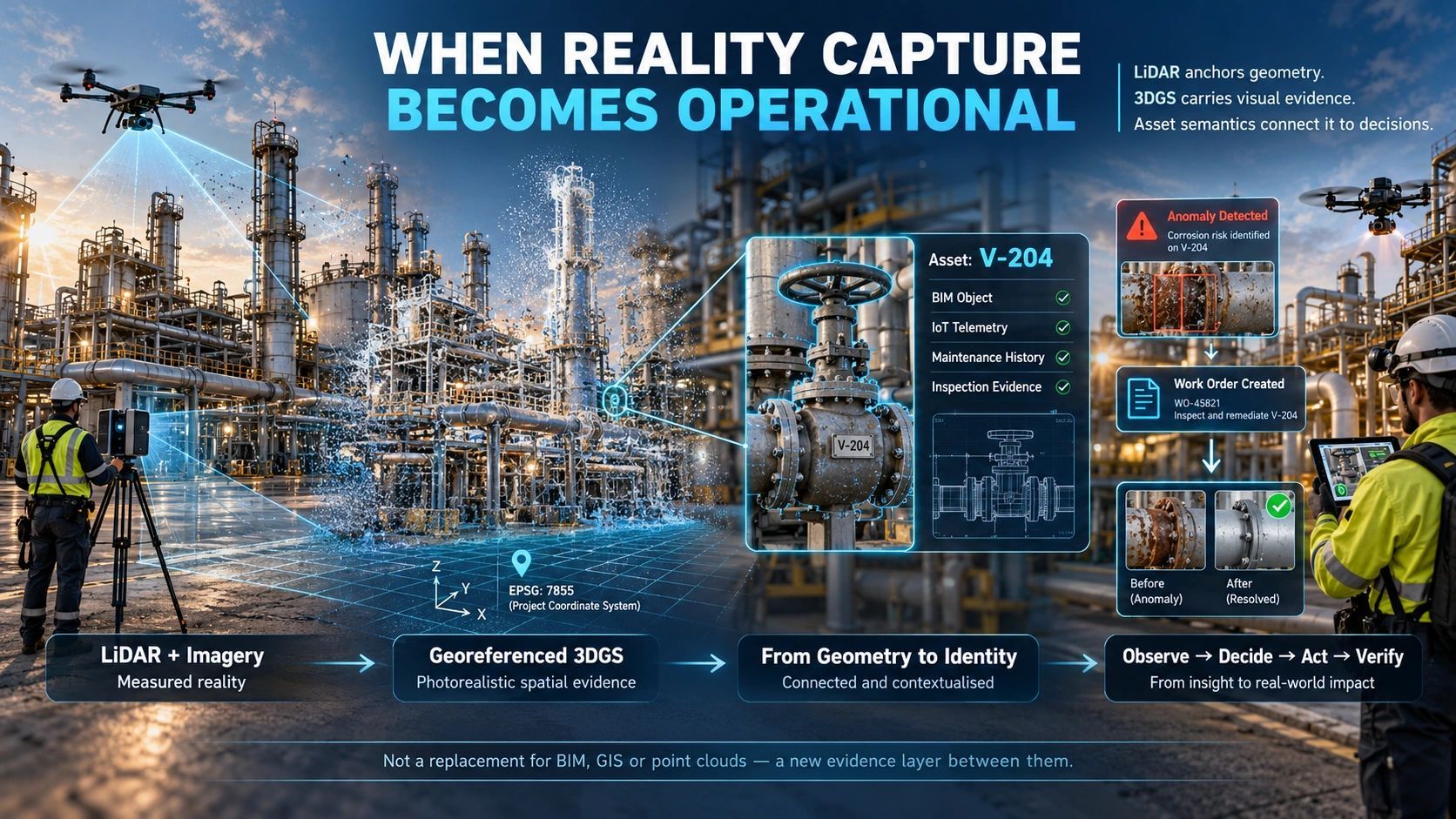
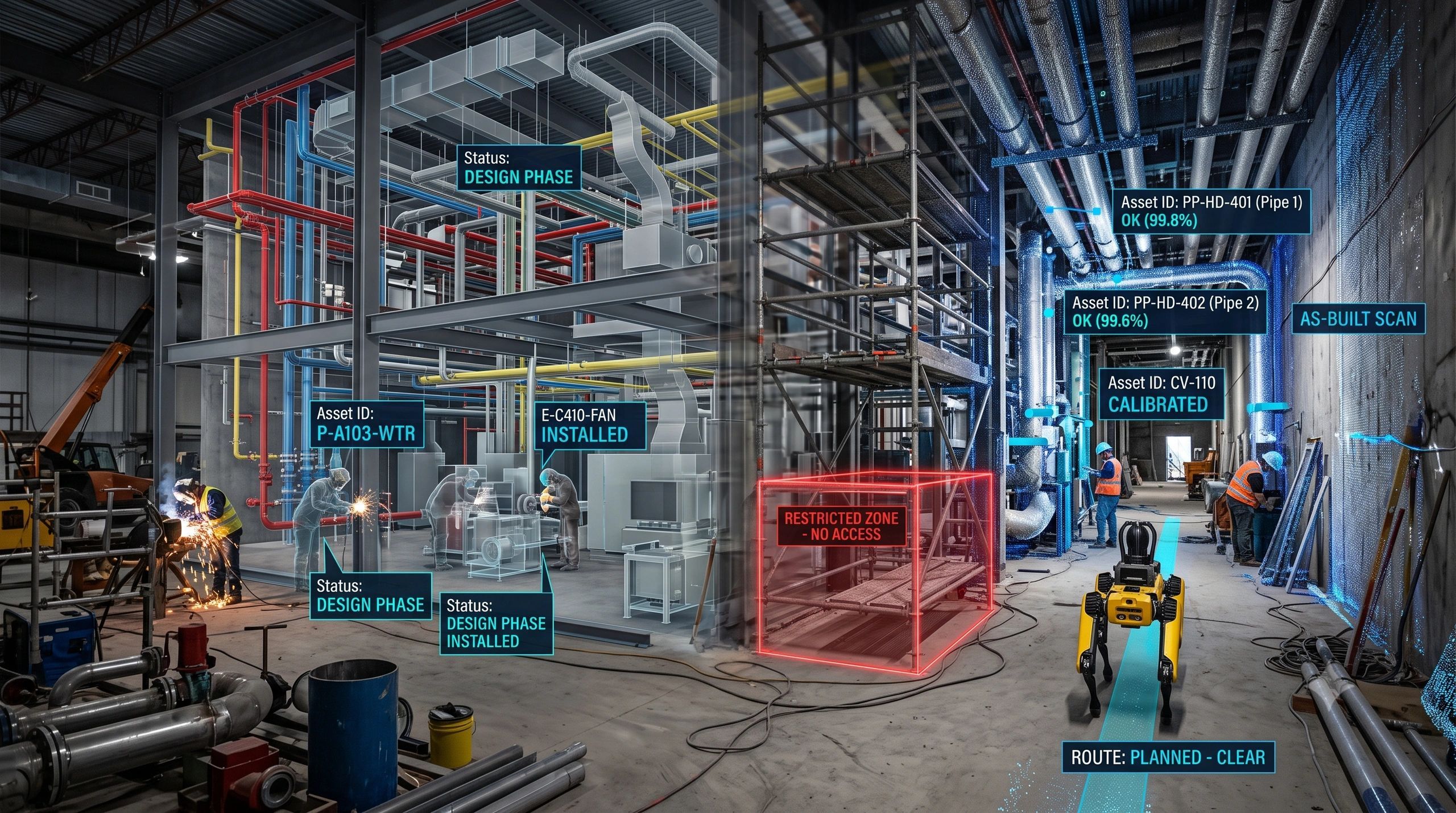
A stable identity. Each maintainable asset needs an identity that can be linked to its BIM object, GIS location, inspection record and maintenance history. Otherwise, the evidence captured during construction becomes difficult to retrieve during operations.
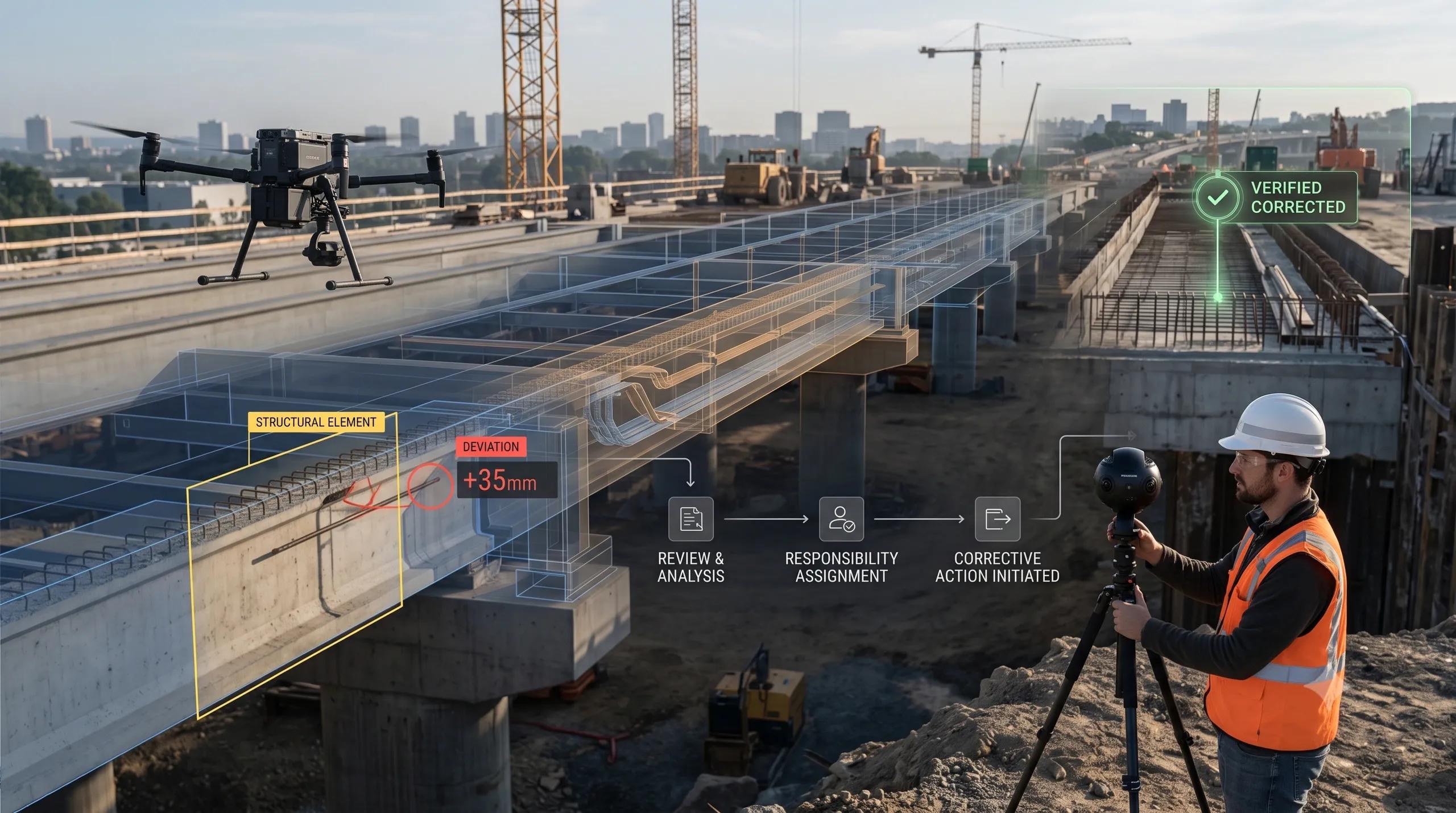
A decision record. Defects, accepted tolerances, repairs, commissioning results and approvals need to show who made each decision and which evidence they used.
That is a larger task than collecting more photographs at handover. It requires the project team and the future operator to agree early on how evidence will be named, located, reviewed and transferred.
What changes after handover?
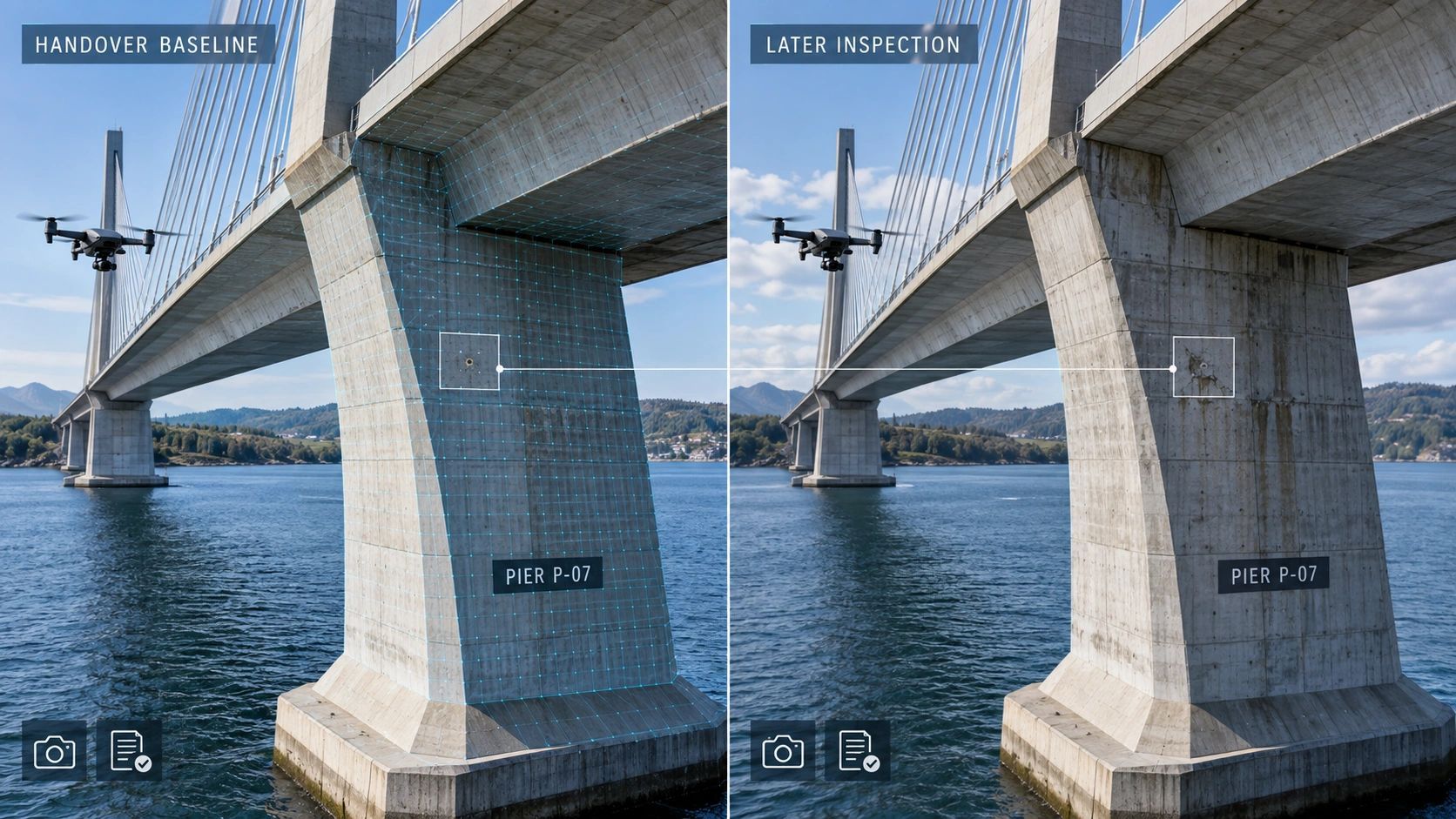
Consider a concrete pier. At handover, its record shows a small surface defect, its precise location, the images used to assess it, and the decision to accept or repair it.
At the next inspection, the team records that same area again. It can compare the observations, examine any change, and decide whether further inspection or maintenance is needed. After a repair, it can add evidence of the completed work.
Over time, the record becomes a history of the physical asset, rather than a collection of separate project files.
This matters to several people for different reasons. An owner can understand the condition it inherited. An operator can plan maintenance against an observed baseline. A contractor can point to the evidence behind a handover decision. An insurer or investigator can trace what was known at a particular time.
None of those benefits depends on a visually impressive digital twin. They depend on being able to find and trust the relevant evidence.
Start with assets where uncertainty is costly
A digital birth certificate need not give every component the same level of detail. For a bridge, critical structural elements and known defects may justify close visual records and rigorous review. For an industrial facility, the priority may be equipment identity, installation condition and commissioning evidence. For a data center, it may be the relationship between physical equipment, tested capacity and the systems that depend on it.
The first decision is therefore practical: Which future questions must the handover record answer?
That question should shape the capture plan. It determines what must be photographed or measured, how precisely it must be located, which records need human verification, and where gaps must be disclosed. It also prevents teams from gathering a large volume of data that nobody can use later.
There is a governance question too. A record that can be silently overwritten will lose value as evidence. Corrections and new observations should add to the history, with dates, sources and reviewers visible. The aim is to preserve what the team knew at handover while allowing the asset record to grow.
Handover can become the first inspection
Infrastructure owners have long received documentation at project close. The opportunity now is to make the observed condition of the asset a deliberate part of that handover.
The New Storstrøm Bridge case shows how drones, reality capture and reviewed defect records can establish such a baseline. The wider application is a proposal, not an automatic result: owners would need to define the evidence standard, connect it to asset identities and maintain the record through later inspections.
If they do, a future inspector can ask a better question than “What does the drawing say should be here?”
They can ask: “What was here when we accepted this asset, what has changed, and what evidence supports our next decision?”