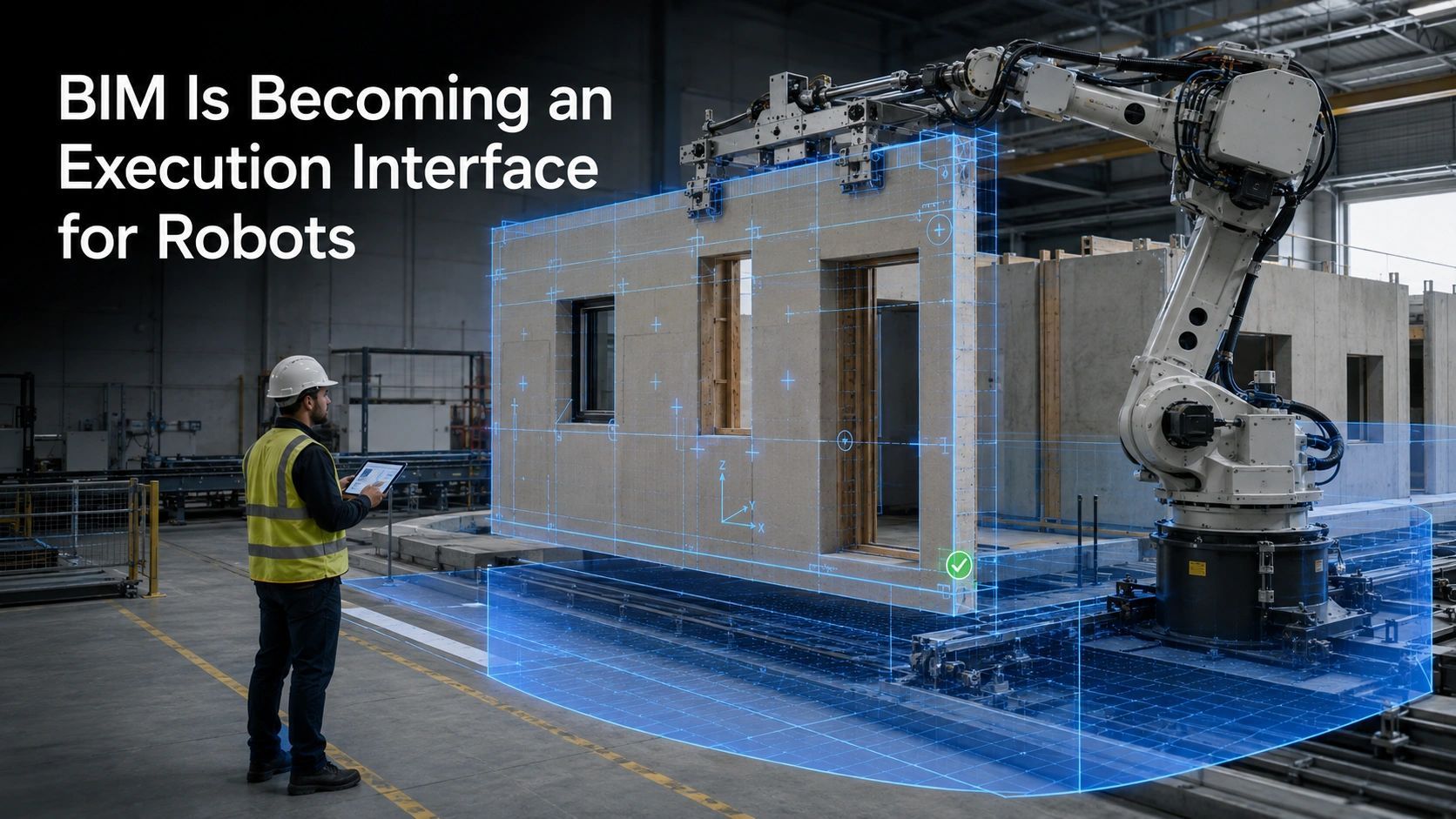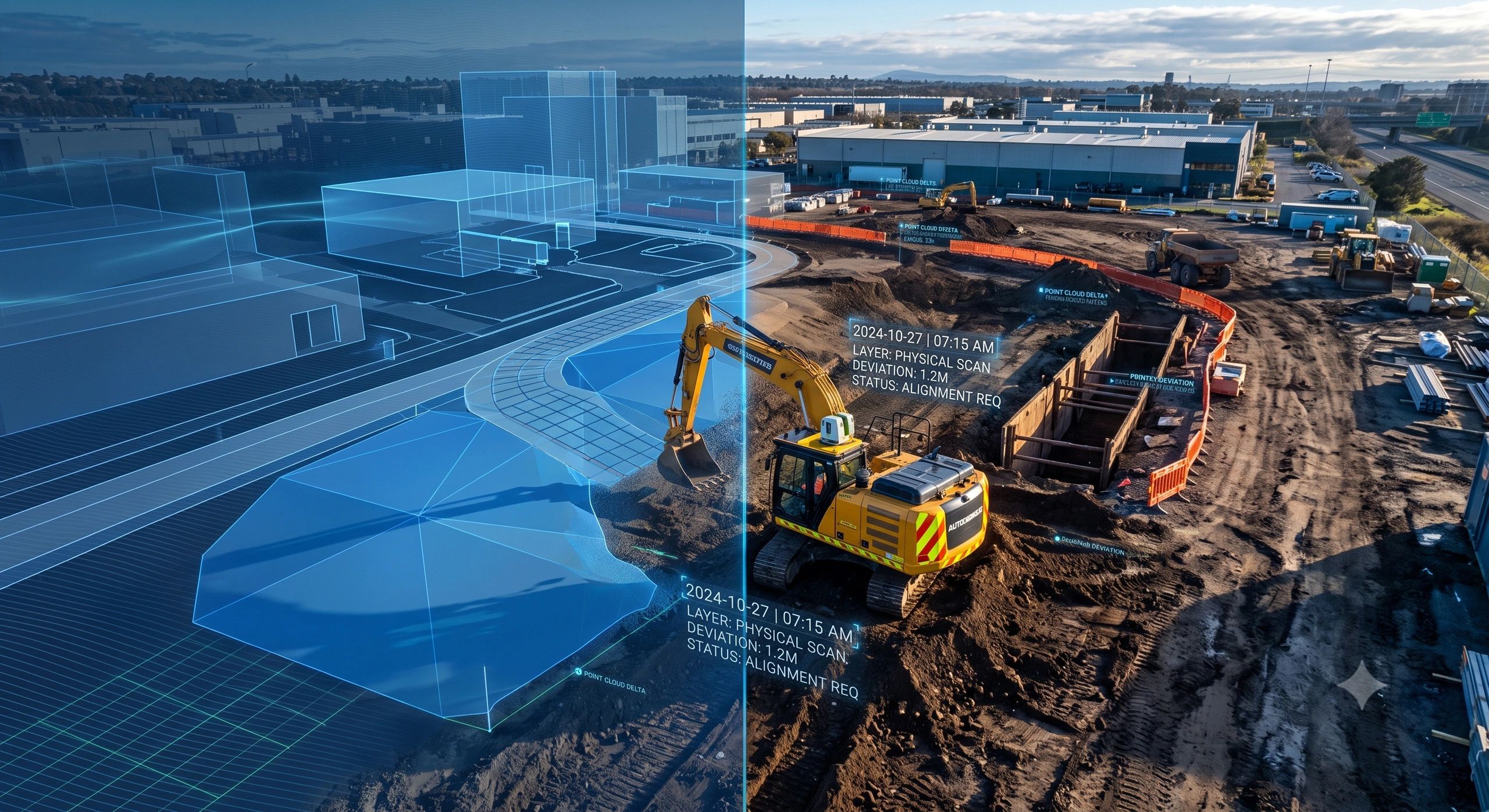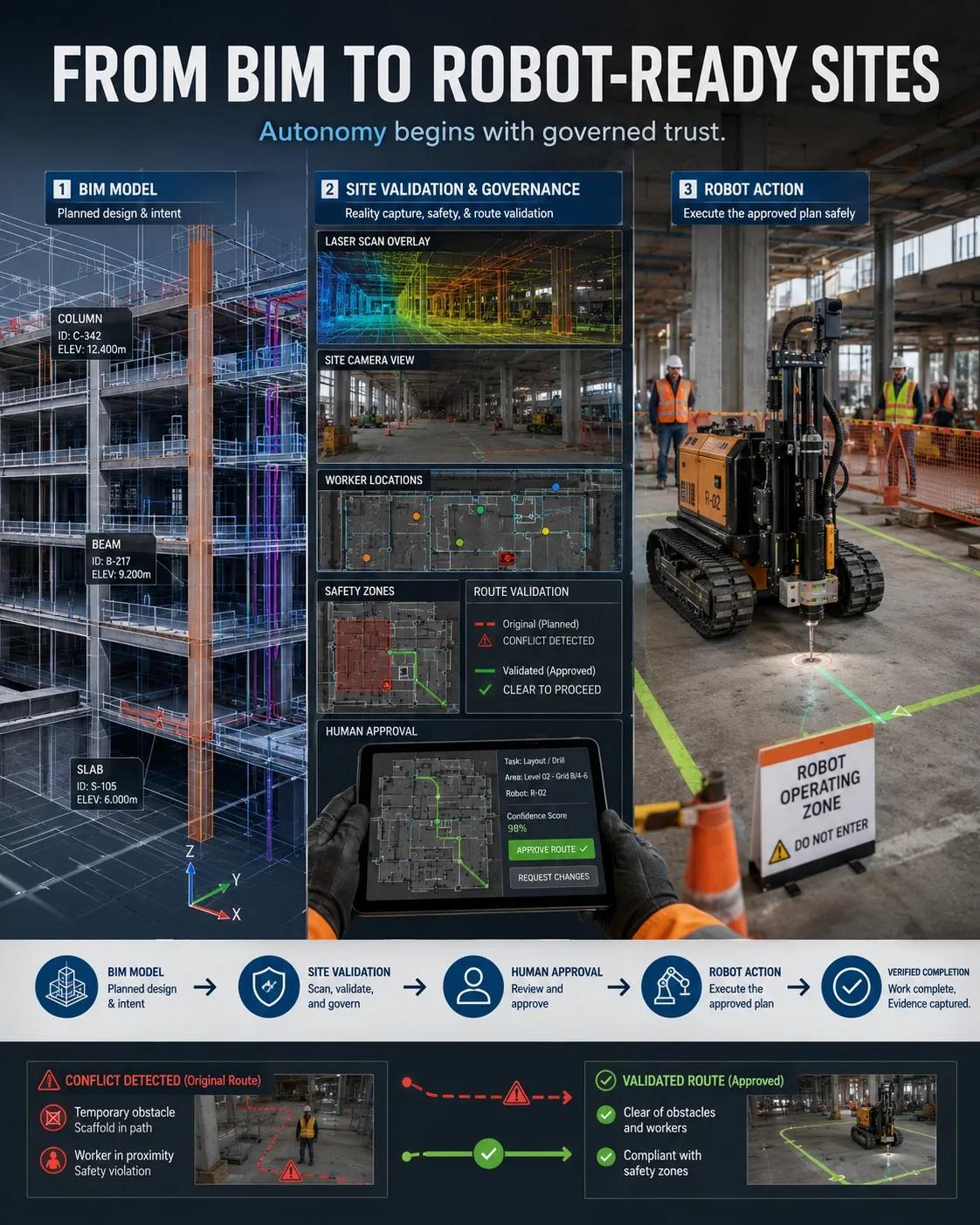
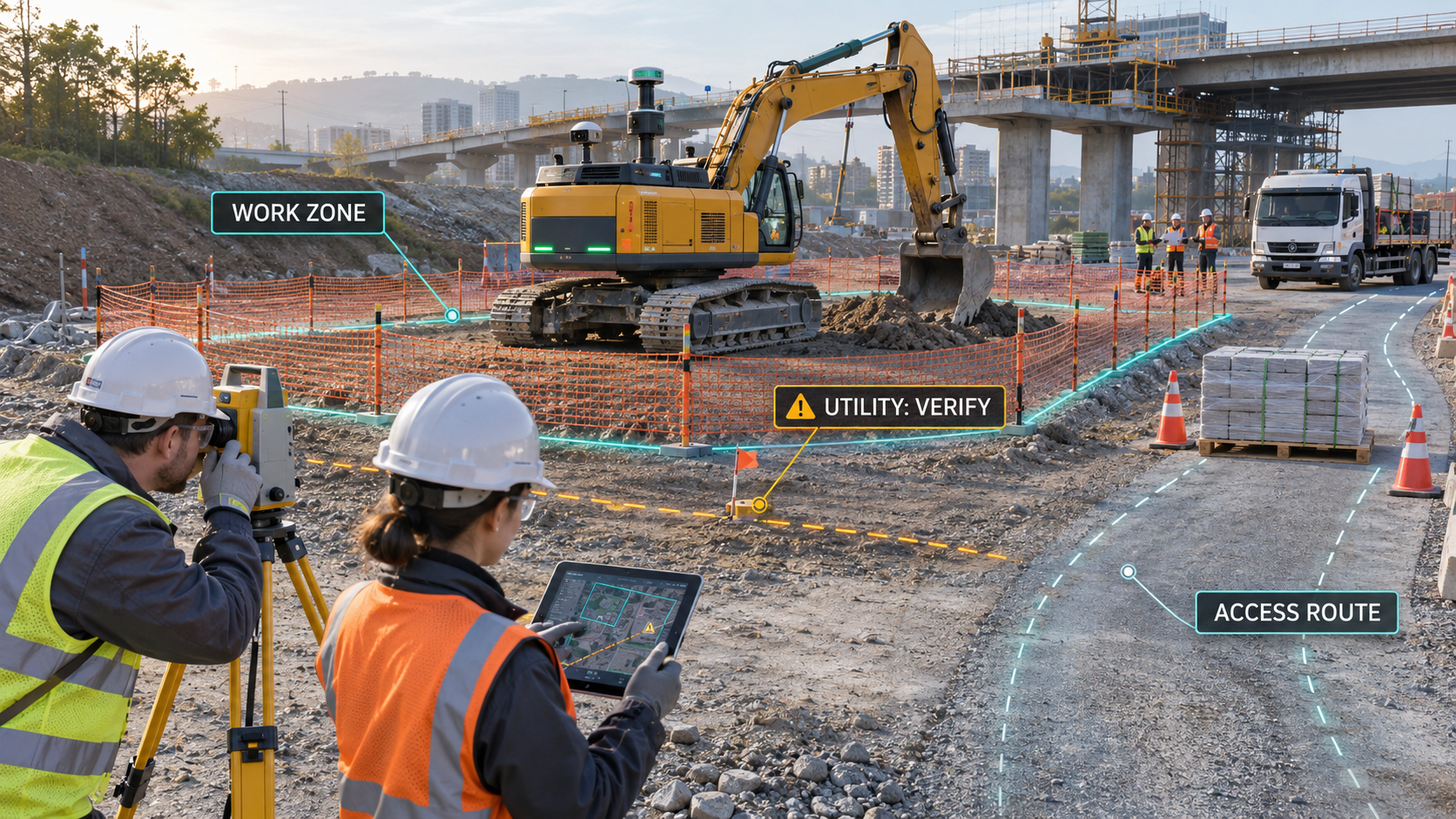
A construction robot arrives ready to work.
The work area looks clear. The digital plan shows where excavation should begin. The machine has been tested and the operator is trained.
But overnight, a subcontractor stored materials along the planned route. A temporary cable now crosses the work zone. An underground utility shown on the drawing has not been independently located.
The robot may be ready. Is the site?
That question deserves more attention as investment in construction robotics accelerates. According to Crunchbase, companies spanning construction and robotics raised approximately $1.6 billion in 2026 through 29 October, compared with $389 million for all of 2025. That is a measure of investor interest not proof that every site is ready for autonomous work. news.crunchbase.com
In October, Bedrock Robotics announced a $600 million funding round and said its autonomous excavators had begun paid work on commercial sites. The company is retrofitting existing construction equipment, starting with excavators. globenewswire.com
These developments point to an important shift. The conversation is moving from whether construction robots can perform a task to whether projects can create the conditions in which those tasks can be performed reliably.
A construction site is a changing environment
Factories can often control the position of equipment, materials and people. Construction sites change as the work progresses.
Ground conditions vary. Temporary structures appear and disappear. Vehicles move through shared routes. Different contractors work in adjacent areas. A survey may be accurate when completed but no longer reflect the conditions around the next task.
Even underground information can carry uncertainty. A utility may be shown on a drawing, but its position, depth or status may need further verification before excavation.
ETH Zurich makes a similar distinction in its discussion of autonomous excavators: outdoor machines must deal with changing ground, terrain, nearby people and equipment, and underground utilities. ETH Zurich
This does not mean robots cannot work on construction sites. It means deployment depends on a wider system of information, coordination and human decisions.
The missing role: preparing the site for the robot
When a contractor evaluates a robot, the discussion often focuses on the machine:
- Can it perform the task accurately?
- How much work can it complete?
- What does it cost?
- What training and maintenance does it need?
Those questions matter. But the project team must also ask:
- Is the work area accurately represented?
- Are the robot’s operating boundaries clear?
- What needs to be checked immediately before work begins?
- Who reports a change in the work zone?
- Who can pause the task and authorize it to resume?
I see an emerging need for robot-ready site intelligence: the information, checks and coordination needed to connect a machine’s capabilities with the actual conditions of a project.
This is not a single software product. It is a shared responsibility across the contractor, survey team, safety team, robot provider and other parties working on site.
A practical framework for robot readiness
The preparation can begin with three connected questions.
1. Does the robot have a trustworthy view of the work area?
A robot needs a representation suited to its task. That might include a survey, a terrain surface, a BIM model, a marked work zone or a combination of these.
Geospatial surveys, drone imagery, LiDAR and field observations can help establish the position of features and reveal differences between plans and current conditions. BIM can provide design intent and relationships between planned elements.
Each source has limits. A drone image may show a newly stored material pile, but it will not confirm the depth of a buried cable. A BIM model may describe the planned position of a structure, while field verification is needed to determine what was actually built.
The useful question is therefore not simply, “Do we have a model?”
It is: “Which information is reliable enough for this task, and what still needs to be checked?”
2. Can the site recognize when conditions have changed?
A site can be ready at the morning briefing and unsuitable an hour later.
Imagine an autonomous excavator working within an approved zone. Another crew needs to move equipment through the same area. The issue is not only whether the excavator can detect an obstacle. The project also needs a process for coordinating the change, stopping work when required and confirming that the area is ready again.
A digital twin or site dashboard could help teams see the work zone, planned activities and reported changes. But its value depends on whether the information is current and whether the people responsible for the work can act on it.
For a pilot, the team could agree on a small set of events that trigger reassessment, for example, a changed access route, a newly identified utility, a loss of positioning confidence or an unplanned entry into the work area.
The response should be defined in advance: continue, pause for review, or stop until the condition is resolved. The appropriate response depends on the task, equipment, site rules and safety assessment.
3. Is responsibility clear when a decision is needed?
Autonomy changes how work is performed. It does not remove the need for accountable decisions.
Before deployment, the project team should agree on who:
- Confirms that the work area is ready.
- Defines and updates the operating boundary.
- Responds to an unexpected condition.
- Can stop the machine or task.
- Investigates an interruption.
- Authorizes work to resume.
The robot provider understands the machine’s capabilities and limitations. The contractor understands the construction sequence and site controls. Surveyors and engineers contribute information about location and design. Safety personnel help define the conditions for work.
None of those perspectives is sufficient on its own. They need a clear handover between them.
What would this look like on a real project?
Consider a proposed pilot for an autonomous excavator on a large infrastructure site.
Before work begins, the team reviews the design and survey information, identifies known utilities, checks the proposed excavation area and agrees on the machine’s operating limits. Unresolved utility uncertainty is referred for the appropriate investigation before excavation proceeds.
During the shift, the site team monitors changes relevant to the task. If another crew needs access to the area, the agreed coordination process is used. If positioning or site conditions fall outside the approved limits, work is paused or stopped according to the operating procedure.
Before work resumes, the responsible people confirm that the issue has been addressed and that the work area remains suitable.
This example is a proposed workflow, not a claim about how every autonomous excavator operates. Different machines and tasks will need different controls.
The principle is consistent: the robot’s task should be connected to a current view of the work area and a clear route for human intervention.
Measure the work around the robot, too
A pilot can report how quickly a robot completes a task and still miss the reasons it may be difficult to scale.
Alongside productivity and quality, project teams should track:
- Time spent preparing and verifying the work area.
- Delays caused by missing or conflicting information.
- Interruptions and the time needed to resolve them.
- Rework or field corrections.
- The effort needed to coordinate people, equipment and access.
These measures help distinguish a machine limitation from a site-preparation problem. They also make it easier to assess the full cost and value of deployment.
For owners and contractors, that is a commercial question as much as a technical one. A capable robot that spends too much time waiting for an area to be prepared may struggle to deliver the expected return.
The opportunity is bigger than the machine
Construction robotics will create demand for more than autonomous equipment. It will also create demand for reliable surveys, usable site models, timely field updates, integration between systems and people who can coordinate work across them.
Geospatial technology and BIM can contribute to this foundation. So can field teams who understand how the site changes and where the records may be incomplete.
The projects that benefit most from robotics may not be those that simply introduce machines first. They may be the ones that learn how to prepare, verify and continually coordinate the environment in which those machines work.
The next investment question is not only which robot to buy. It is who will make the site ready for it and keep it ready as construction moves forward.