A construction dashboard says the work is complete.
The next trade arrives and finds an unfinished opening, missing supports, or an installation that blocks access for maintenance.
The status was updated. The physical condition was never adequately checked.
Now imagine an AI assistant reading that same dashboard, schedule, and daily report. It can produce a confident answer from information that agrees internally while remaining out of step with the site.
That is a practical risk as construction teams introduce AI into progress reporting, coordination, quality review, and handover.
Construction AI needs access to physical evidence and a disciplined way to decide what that evidence establishes.
The site contains information the documents do not
Drawings describe intent. Specifications define requirements. Schedules describe planned sequence. Reports record what someone has observed or declared.
Each is essential. None automatically provides a current account of what has been built.
A change may happen before the model is updated. A component may be delivered but remain uninstalled. A visible installation may still await testing or acceptance.
An AI assistant that treats these states as interchangeable can carry a reporting error into the next decision: releasing a work-front, certifying progress, closing an issue, or preparing a handover package.
The question for a project leader becomes simple:
When AI says “complete,” what evidence supports that answer?
Visual intelligence brings the site into the conversation
OpenSpace’s public material describes a visual-intelligence approach that combines site capture with spatial AI to connect observations to location and building context. Its CEO, Jeevan Kalanithi, has argued that visual intelligence is a major shift for construction technology.
The strategic significance extends beyond any one platform.
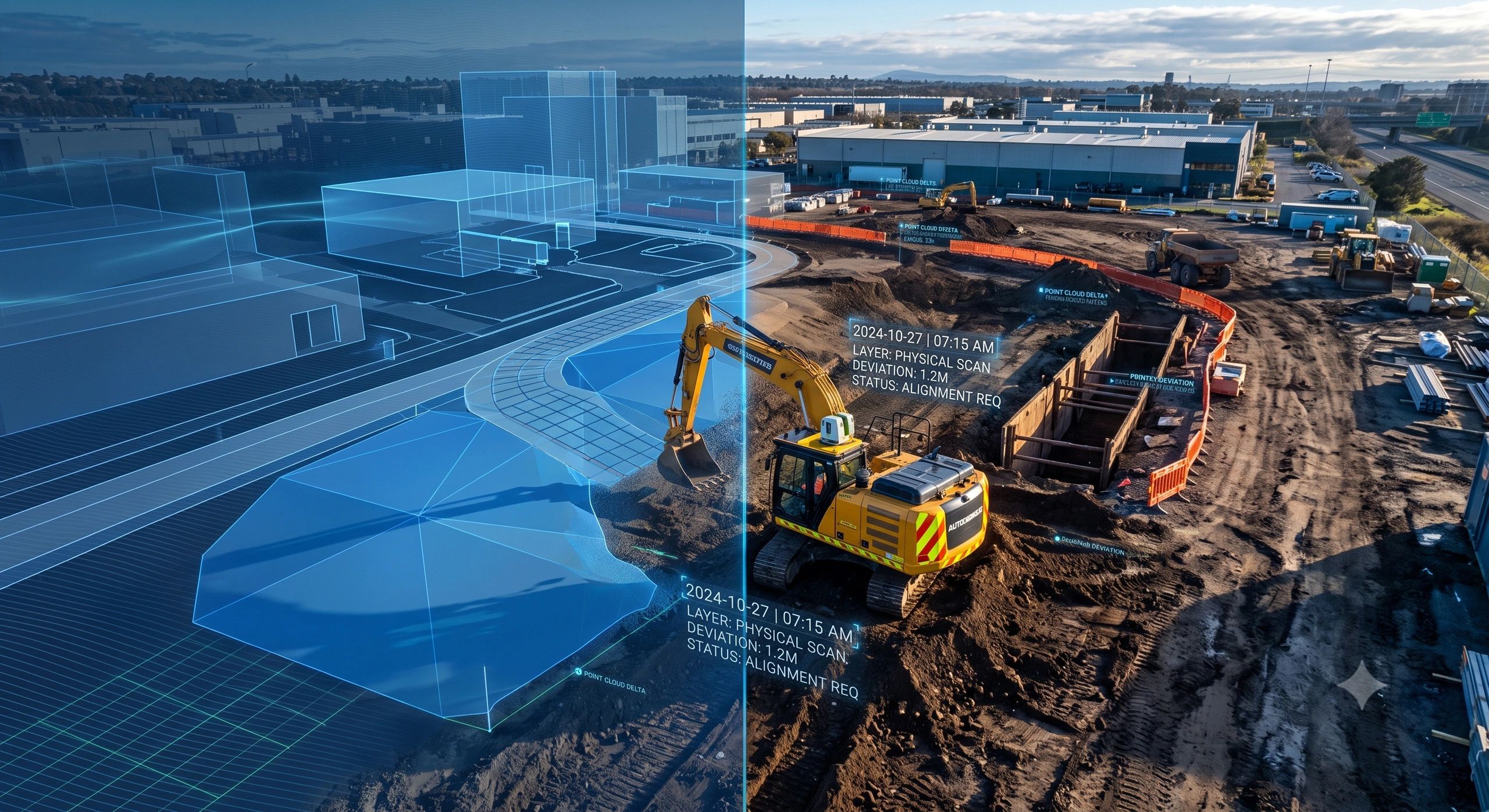
Site photographs, 360-degree walkthroughs, drone imagery, and laser scans can give teams evidence of conditions that text-based systems may miss. Their usefulness increases when the observation is connected to the correct floor, zone, asset, and capture time.
A photograph buried in a folder is difficult to interrogate. An observation linked to a specific installation and requirement can help answer an operational question.
Is the next trade ready to start? Is a discrepancy worth investigating? Was the corrective action physically completed?
This is where reality capture becomes part of a decision workflow.
Seeing an installation is not accepting it
Consider an illustrative mechanical-services scenario.
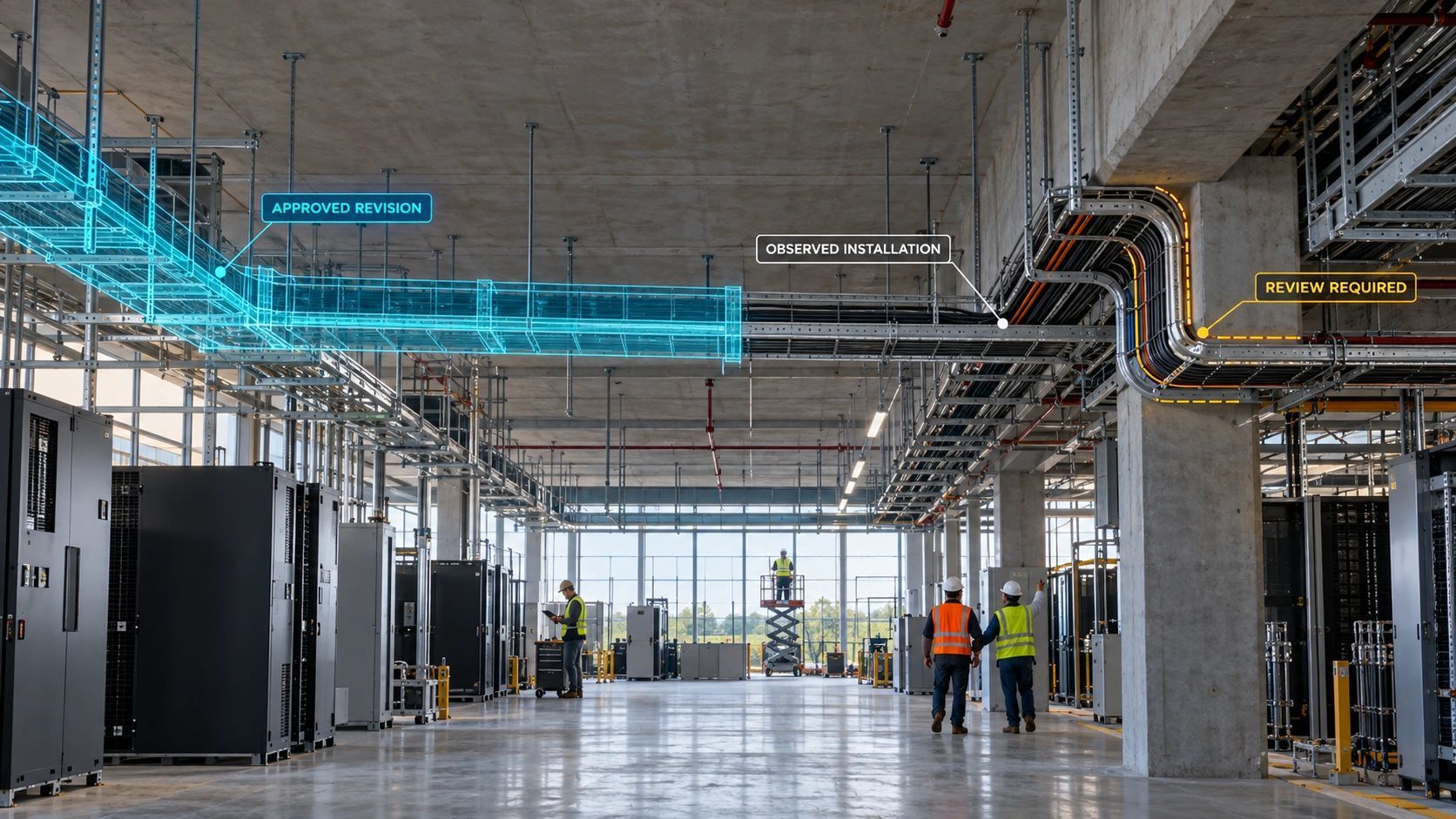
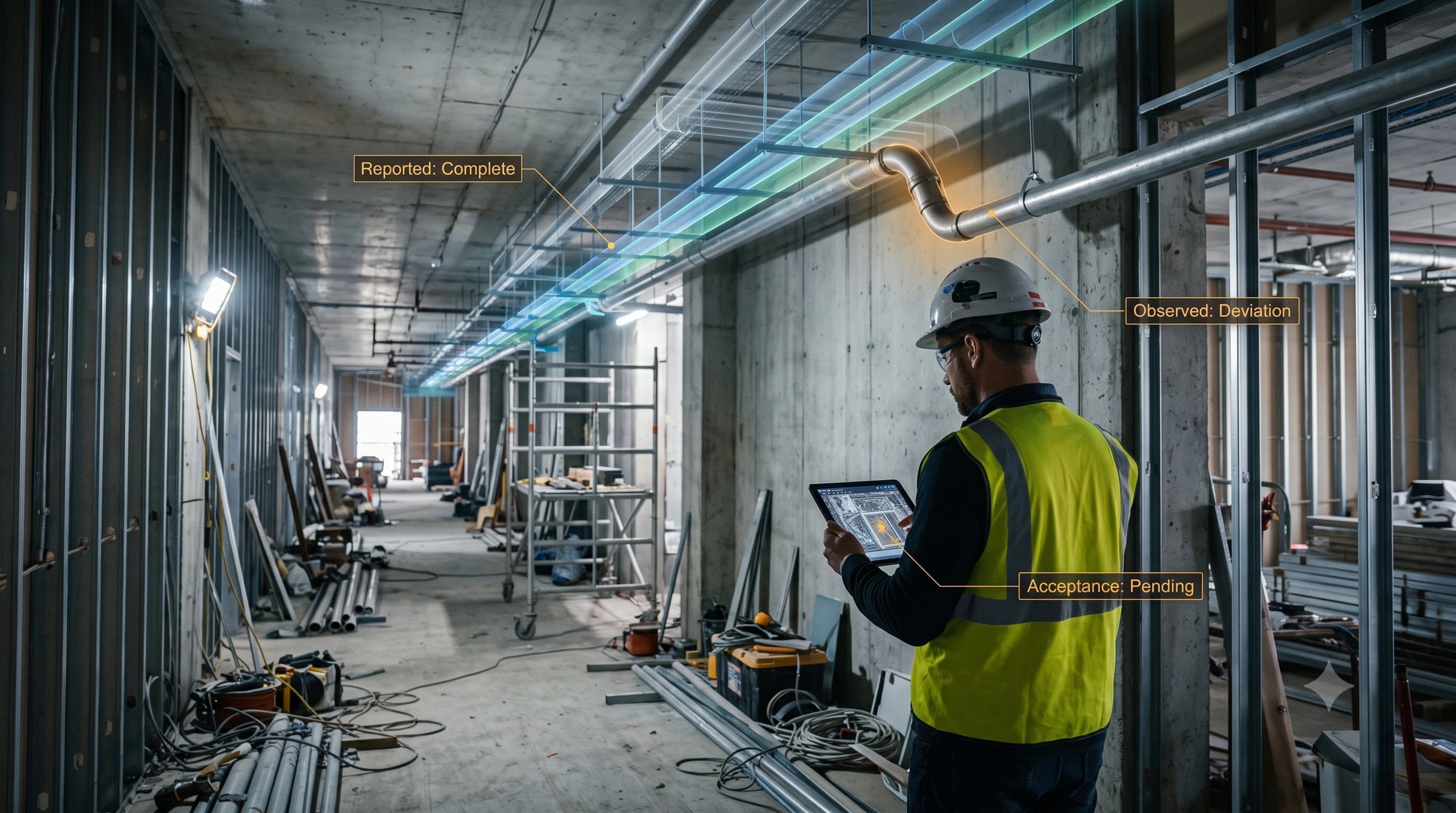
The schedule marks a pipe section complete. A recent walkthrough appears to show it installed. A registered point cloud suggests that its position differs from the approved model. The inspection record remains open.
Those sources may describe different aspects of the same asset rather than simply contradicting one another.
The pipe can be present, incorrectly positioned, untested, and unaccepted at the same time.
AI should preserve those distinctions.
Images can reveal visible conditions. They cannot, by themselves, establish hidden workmanship, material certification, pressure-test results, or engineering acceptance. Even a measured geometric difference needs interpretation against the applicable tolerance and the uncertainty of the survey.
Observed, measured, tested, and accepted are separate states.
A useful system makes those states explicit instead of compressing them into a green completion indicator.
Connect two assurance loops
Construction AI is also developing on the digital side. Pirros describes AI-supported project review against code requirements, firm standards, and project specifications, with workflows for assigning and resolving issues.
That points to two complementary checks.
Digital assurance asks whether the design information satisfies the applicable requirements.
Physical assurance asks whether the observed installation satisfies those verified requirements.
My view is that the opportunity lies in connecting the two.
A model can be coordinated while the installation deviates. An installation can match an outdated model. A compliant detail can be applied to the wrong location.
BIM supplies asset and design context. GIS connects the work to site location and surrounding infrastructure. Reality capture supplies observations. Inspection and testing establish conditions that cameras cannot verify.
Together, they can support a clearer account of readiness, provided identity, versions, and evidence remain traceable.
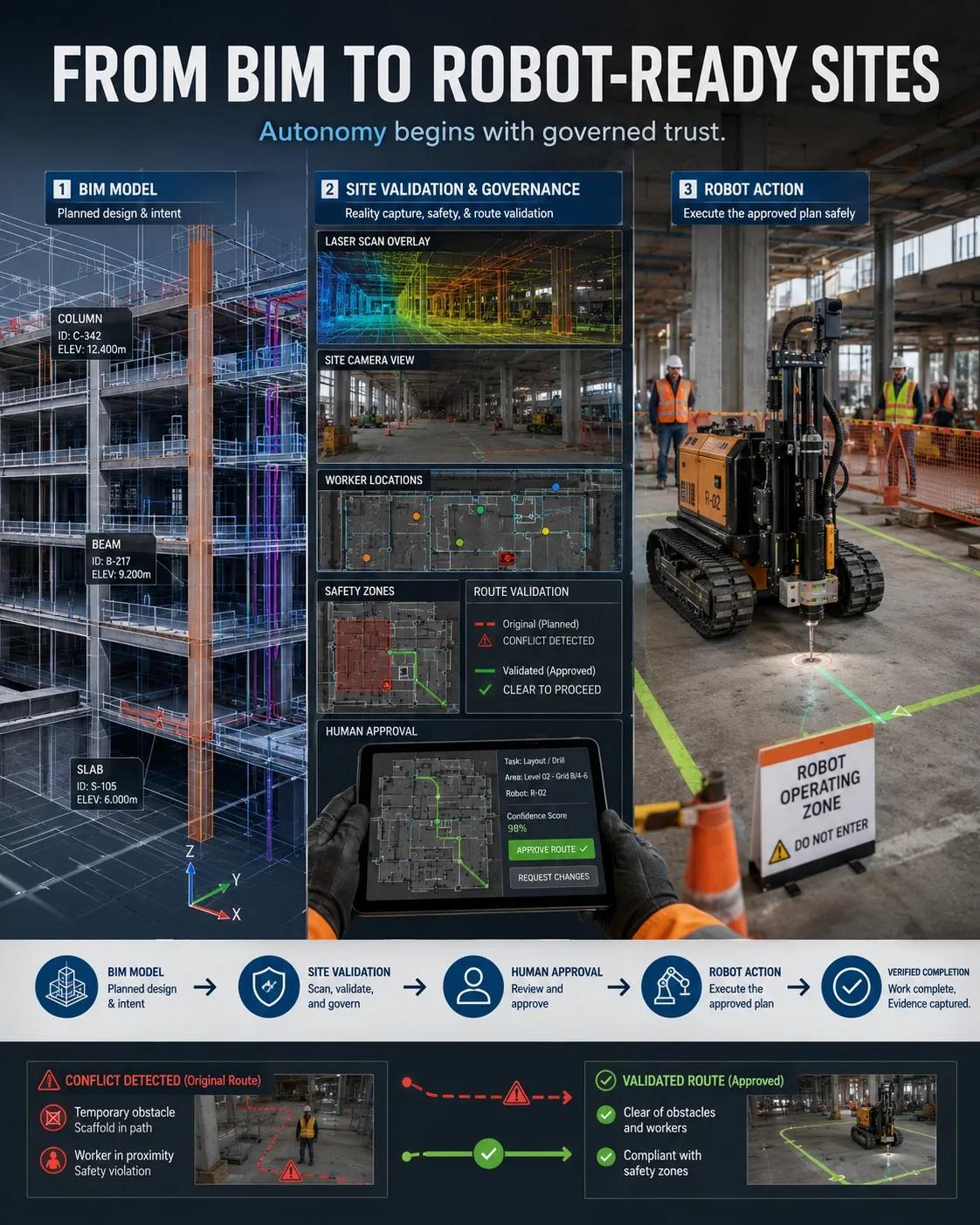
A practical framework: observe, reconcile, authorize
For teams introducing visual AI, I would start with three steps.
1. Observe against a specific question.
Choose the decision before choosing the capture method. A walkthrough may help establish visible installation progress. A dimensional question may require a survey or registered scan. A concealed condition may require evidence collected before closure.
Record the capture time, location, coverage, and limitations. An area outside the camera’s view should remain unknown, rather than being treated as complete.
2. Reconcile evidence with the requirement.
Connect the observation to the correct asset, approved revision, and acceptance criterion. Check whether registration error, occlusion, an outdated model, or an authorized field change could explain an apparent discrepancy.
Preserve the disagreement while it is being investigated. Give it an owner, consequence, and next verification step.
3. Authorize the decision.
Define who can accept the evidence and approve the next action. A progress query and a safety-critical acceptance decision require different levels of assurance.
AI can help find evidence, compare records, and prioritize review. The workflow must still identify the authority responsible for acceptance.
Start where evidence changes the next step
A sensible pilot should focus on one recurring decision: releasing a ceiling zone, confirming readiness for a follow-on trade, or verifying correction of a recorded defect.
Define the requirement, capture the evidence, review exceptions, and preserve the approval trail.
Measure the time from observation to decision, the number of repeat inspections, and whether closed issues reopen. Track capture and review effort too. A process that requires excessive field work will struggle to become routine.
Privacy also belongs in the design. Where workers appear in imagery, teams should define access, retention, and appropriate masking. Asset verification should have a clear purpose and boundaries.
The commercial value is in earlier discovery, clearer accountability, and better-supported decisions. Those outcomes need to be demonstrated in the pilot rather than assumed from the presence of AI.
The next construction copilot needs an evidence boundary
The construction assistant I would trust should distinguish what the documents report, what the site evidence shows, what remains unseen, and what an authorized reviewer has accepted.
It should be able to say: “This installation appears present, but readiness has not been established.”
That answer may be less convenient than a confident completion percentage. It is more useful when another team is about to act on it.
Construction AI needs eyes. It also needs context, verification, and a clear boundary around what it can claim.
The stronger system will help teams know when they have enough evidence to proceed and when they need to look again.