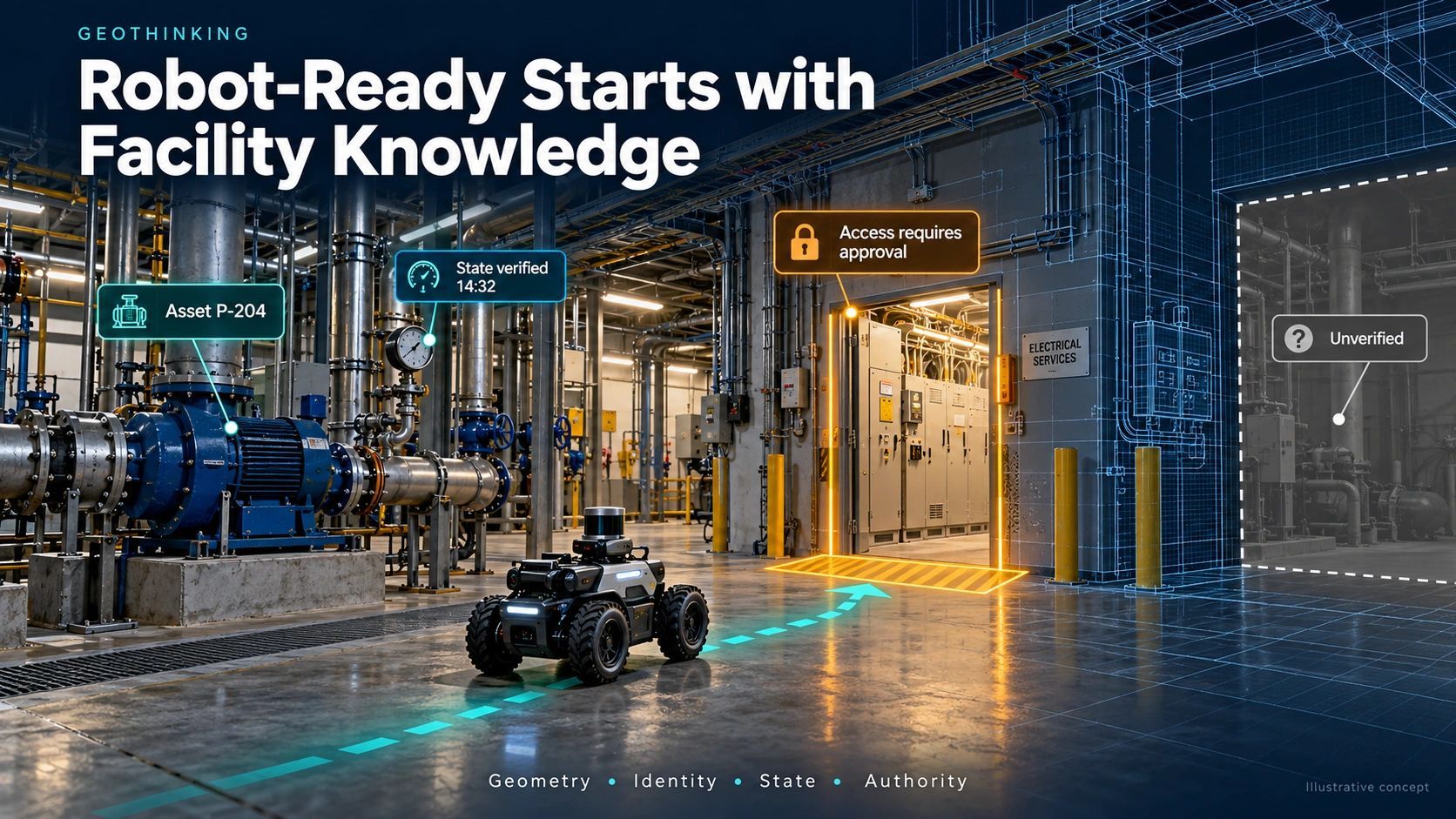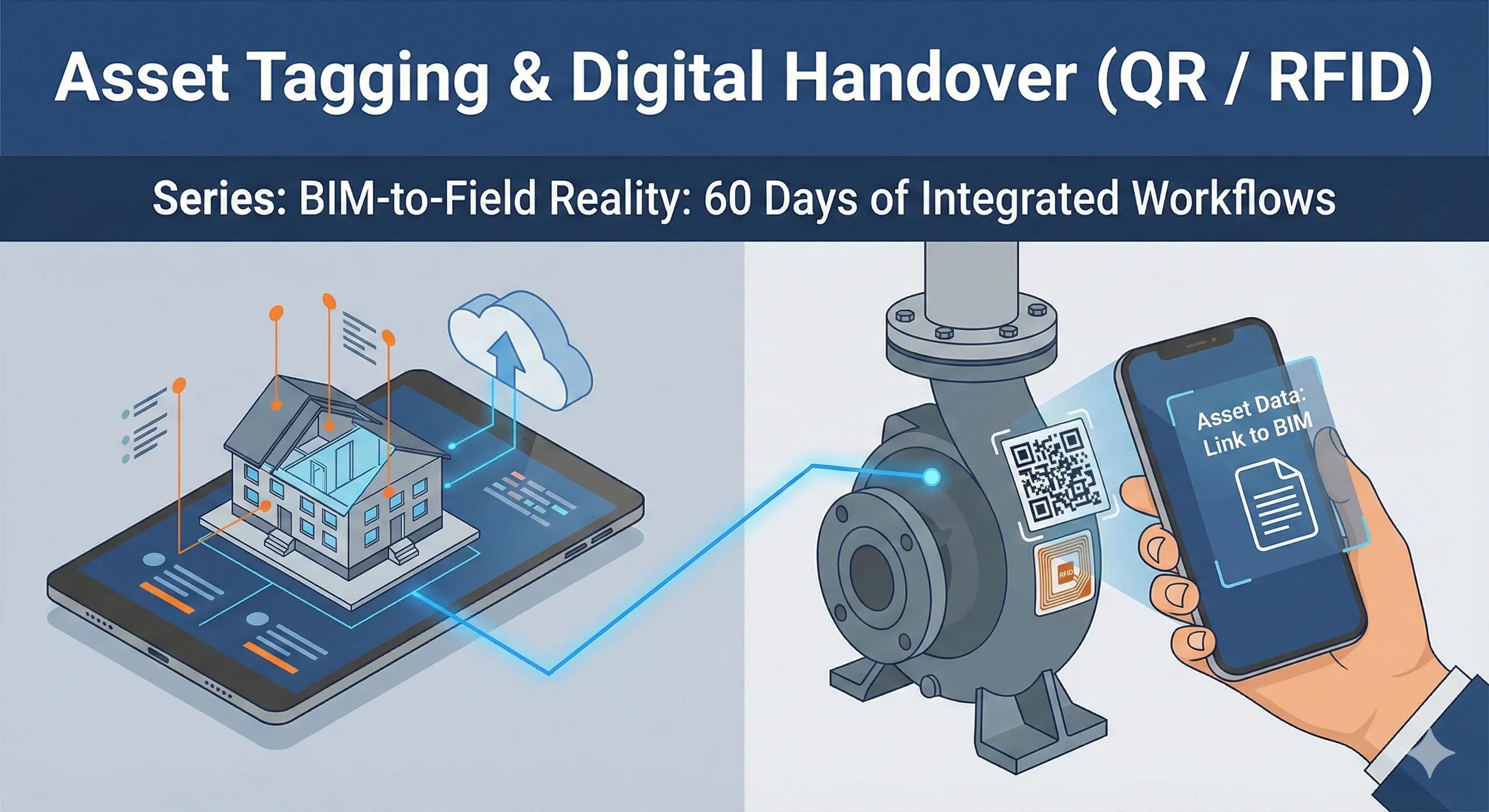

A building can arrive with a detailed BIM model while its maintenance team still struggles to identify the equipment behind an alarm.
The pump is visible in 3D. Its manual sits in a folder. Its sensor appears under another name. Its service history belongs to a separate register.
Someone must establish that all four records refer to the same physical asset before deciding what to do.
That search consumes time precisely when operations need clarity.
For owners investing in BIM and digital twins, this raises a practical question: can the information delivered at handover help someone resolve a real operational problem?
My view is that important BIM assets need to become operationally addressable.
By that, I mean an authorized person or application can reliably identify an asset, retrieve its current context and connect it to the appropriate workflow.
The gap begins between systems
Consider a hypothetical chilled-water pump.
In the design model, it is P-17. The installed unit has a manufacturer’s serial number. The building management system uses a controller point name. The maintenance system assigns an equipment code.
Each identifier serves a purpose. The problem begins when their relationship is unclear, outdated or dependent on one person’s memory.
An alarm might then trigger questions that should already have answers: which installed pump does this point represent? Which spaces does it serve? Was it replaced? Who maintains it?
A clickable object helps locate the pump. Operational addressability helps resolve those questions across systems.
Connected buildings make this more urgent
On 9 October 2026, KONE opened its first Indian Digital Experience Centre in Pune. Its announcement describes experiences spanning design, equipment, lifecycle visibility and real-time service insights, including equipment-status visibility through E-Link.
This is a useful signal of how building equipment is increasingly surrounded by connected services.
My interpretation is that BIM handover must prepare assets to participate in that environment. Owners need dependable connections between installed equipment, operational observations and service responsibilities.
The announcement does not establish that this entire BIM-to-operations chain has been solved. It illustrates why the chain matters.
Identity already exists. Continuity needs work.
This is not a proposal to invent identifiers for BIM.
buildingSMART’s IFC documentation already describes persistent IFC-GUIDs and distinguishes them from file-specific instance references that need not remain stable across exchanges.
The implementation challenge is to preserve and reconcile identities throughout actual delivery and operation.
A model identifier alone cannot establish which device is installed today, whether a sensor mapping remains valid or whether an equipment register reflects a recent replacement.
Those connections need rules, verification and someone responsible for maintaining them.
Three questions make addressability practical
1. Which physical asset is this?
Connect the model object to the installed unit, equipment tag, serial number and verified location. Record who confirmed the relationship and when.
GIS can supply site and network context; BIM can supply building and system context. Their coordinate alignment and asset mappings also need validation.
2. What context belongs to it now?
Link relevant commissioning evidence, sensor observations, maintenance records and system dependencies.
Keep dates and sources visible. An old inspection and a current measurement should remain distinguishable. A modelled connection should not silently become a field-verified connection.
3. What should happen next, and who decides?
Connect the asset to its responsible team, operating rules, escalation path and evidence required for closure.
Reading a record, recommending an inspection and stopping equipment require different permissions. An addressable asset does not automatically become remotely controllable.
Replacement is the test that exposes weak identity
Return to the pump example. Suppose the original unit is removed and a replacement occupies the same position.
The functional role may remain “chilled-water duty pump P-17.” The physical unit has changed.
If every record simply inherits the old identity, the replacement could appear to carry the previous unit’s failures, warranty or commissioning evidence.
A useful approach is to distinguish the functional position from the individual equipment instance.
Retain the position’s service history, retire the removed unit’s active installation relationship and connect the replacement through a dated installation event. Check sensor mappings and commissioning evidence before accepting the new operational state.
This preserves continuity without confusing two physical machines.
Change the handover acceptance test
Owners can make this concrete by testing a small set of important assets before accepting the operational information package.
Select a pump, an air-handling unit and a lift. Ask an operator to start from an alarm or equipment tag and retrieve:
- the verified installed asset and location;
- the applicable commissioning evidence;
- the relevant current observations and their timestamps;
- the service responsibility and maintenance record;
- the connected systems or spaces affected;
- the permitted next step and closure requirements.
Then test a replacement scenario.
Start with assets selected for safety, service continuity or maintenance impact. Define the information needed for those decisions before extending coverage.
Useful pilot measures include time to identify an alarmed asset, unresolved identity matches and the proportion of selected assets with verified operational links. These measures connect information quality to work an operator actually performs.
AI raises the value of reliable connections
An assistant asked, “Why is this area overheating?” may need to connect a space, an air-handling unit, a sensor and a recent maintenance event.
Weak identity can produce a convincing explanation about the wrong equipment.
AI-assisted operations therefore need visible evidence paths, uncertainty and a route to human review when records conflict. The system should be able to say that an asset match remains unverified.
For owners, the commercial opportunity is to reduce repeated searches and reconciliation. For delivery teams, it is to make operational usability part of acceptance.
I would judge a BIM handover by how reliably the next operator can use it to make and verify a decision about the physical asset.
That standard should influence the asset information requirements before modelling begins.