Most handovers fail quietly.
Not because assets aren’t built correctly, but because operations can’t find, trust, or use the information tied to those assets.
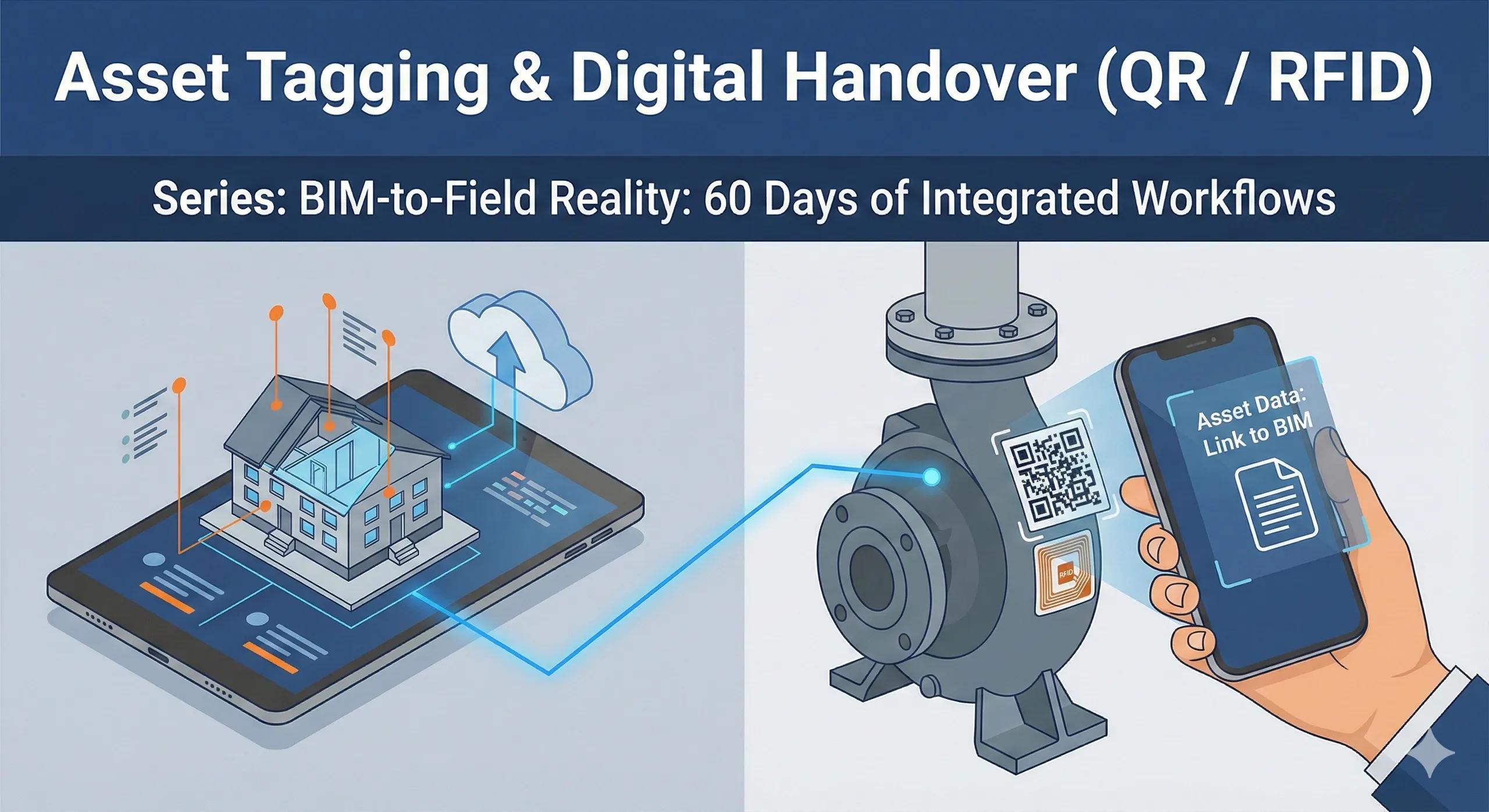
Digital handover using QR codes and RFID , linked to BIM, closes this gap by turning physical assets into addressable, verifiable digital entities from day one of operations.
1. Why Traditional Handovers Lose Value
Conventional handover delivers:
O&M manuals in PDFs
Spreadsheets of asset lists
Disconnected drawings
Operations teams face:
Missing or outdated data
No clear link between asset and document
Heavy dependency on people who built it
Information exists, but it’s not accessible at the point of need .
2. What Asset Tagging Really Enables
Asset tagging means:
Every physical asset has a unique digital identity
That identity links directly to BIM data, documents, and history
Field teams can access asset data instantly on site
QR/RFID bridges the last meter between model and machine .
3. QR Codes vs RFID: Practical Differences
QR Codes Low cost Easy to deploy Ideal for visual access and manual scans
RFID No line-of-sight required Useful for concealed or high-volume assets Supports automated tracking
The choice depends on operational need , not technology preference.
4. What Should Be Linked to Each Asset
Effective digital handover links:
Asset specifications
Commissioning and test results
Maintenance schedules
Warranty information
Replacement history
Sensor data (where applicable)
The asset becomes a living record , not a static label.
5. BIM Is the Backbone of Digital Handover
BIM provides:
Structured asset hierarchy
Spatial context
Consistent naming and classification
Tagging without BIM creates isolated IDs.
Tagging with BIM creates traceable lifecycle intelligence .
6. Field Use Cases That Matter
Digital asset tagging supports:
Faster maintenance response
Reduced asset identification errors
Easier audits and inspections
Better spare parts planning
Faster onboarding of FM teams
Operations become proactive instead of investigative.
7. India Context: Why This Is Critical
In Indian facilities:
Asset documentation quality varies
Staff turnover is common
Paper-based systems still dominate
QR/RFID-based handover:
Reduces dependency on tribal knowledge
Improves continuity
Makes digital twins practical, not theoretical
8. Common Pitfalls to Avoid
Asset tagging fails when:
Tags are added after handover
Asset data is incomplete or inconsistent
BIM is not updated post-construction
FM teams aren’t involved early
Digital handover must be designed , not improvised.
9. From Handover to Operations
Digital handover is not the end of construction data.
It’s the start of operational intelligence .
When assets are digitally addressable:
Maintenance becomes data-driven
Performance can be monitored
Decisions are traceable
10. A Simple Digital Handover Rule
If you can’t scan an asset and immediately understand its status, handover isn’t complete.
Conclusion
Asset tagging with QR/RFID transforms handover from paperwork into operational readiness .
When BIM, commissioning data, and asset tags are aligned:
Information stays accessible
Trust improves
Digital twins survive beyond construction
Handover is not about delivery.
It’s about usability on day one .