An AI data center can have a completed building, installed racks and a strong investment story and still be unable to deliver its planned capacity.
The grid connection may be delayed. Cooling may support only part of the intended load. Commissioning may expose a dependency that several contractors assumed someone else had resolved.
For the owner, these are barriers to putting capital into productive use.
This is why AI infrastructure deserves closer attention from architecture, engineering and construction professionals.
The demand for AI is creating demand for physical systems that must be designed, coordinated, built and verified together. The opportunity extends across land, power, cooling, fiber, civil works and operational handover.
AEC teams increasingly sit between AI ambition and usable AI capacity.
The physical infrastructure behind the AI headline
Two recent announcements illustrate this shift.
Hyundai Engineering & Construction announced a programme to complete the 40 MW Pohang AI Data Center in November 2027, highlighting construction speed and delivery methods as central to the project. AI infrastructure is becoming a substantial engineering and construction assignment.
Schneider Electric has introduced a coolant distribution unit with cooling capacity of up to 3.5 MW, designed to integrate with hybrid air and liquid cooling architectures. The specification shows the scale at which thermal infrastructure is being developed for high-density AI facilities.
These announcements concern different parts of the same challenge.
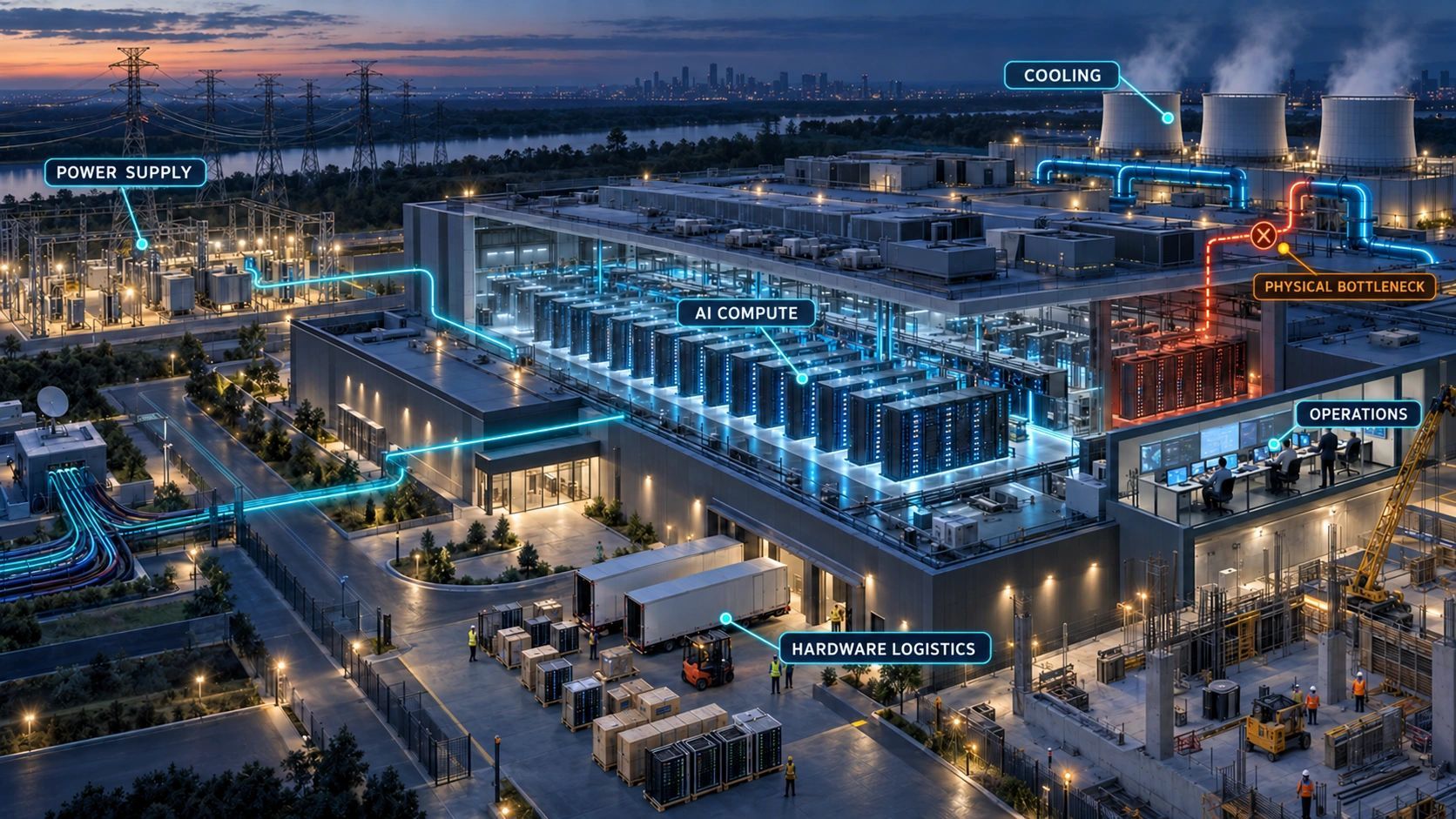
A construction team must deliver the facility. Electrical systems must supply it. Cooling systems must manage its heat. Controls and commissioning must establish that the combined system works under the required conditions.
My reading is that the commercial opportunity will increasingly center on coordinating these dependencies and proving their readiness.
A completed asset does not establish ready capacity
Consider an illustrative project approaching handover.
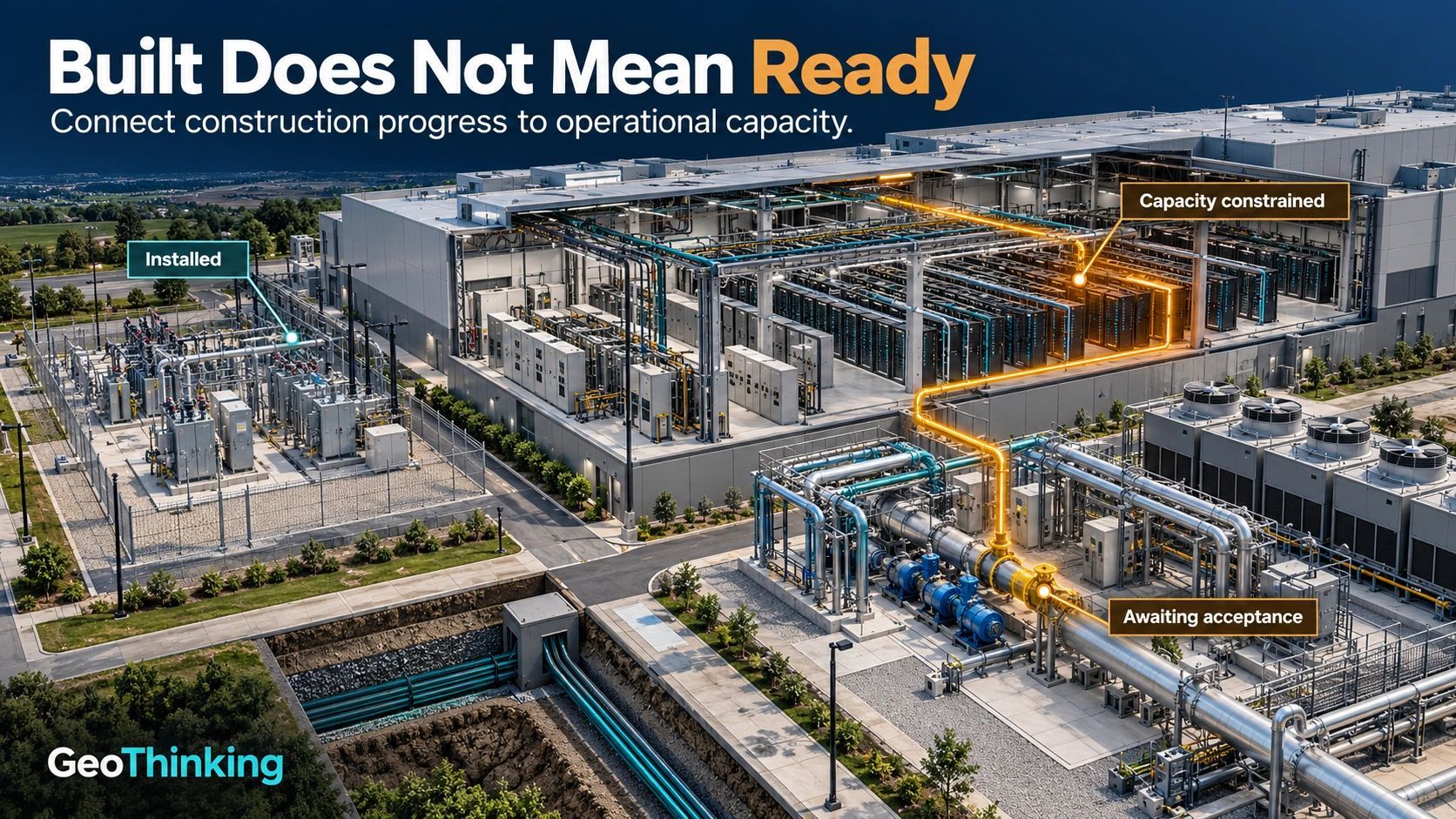
The building is complete. Transformers are installed. Cooling equipment has arrived. Fiber routes are recorded. The construction dashboard shows strong progress.
Yet one cooling loop has not passed testing, an electrical protection issue remains open, and a network connection awaits acceptance.
How much capacity can the operator safely release?
An overall completion percentage cannot answer that question.
Neither can a list of installed assets.
The answer requires a connection between each unresolved issue and the function it constrains. It also requires clarity about redundancy, operating conditions and the evidence needed to clear the constraint.
For delivery teams, this changes the reporting objective.
Progress reporting should help explain what the project can deliver now, what prevents the next release, and who must resolve it.
Geospatial intelligence starts before the building
AI infrastructure begins with a location decision.
A site may offer suitable land while facing constraints in grid access, flood exposure, fiber connectivity, access roads or resource availability.
Each condition can influence cost, schedule and operating resilience.
Geospatial analysis can bring these conditions into a shared decision environment. It can help teams compare locations, understand external dependencies and examine how a proposed development interacts with its surroundings.
The important question is what each spatial condition means for delivery.
Does a transmission route introduce an approval dependency? Could flooding affect access or critical equipment? Does the proposed cooling approach fit local resource conditions?
A useful site model makes those consequences visible early enough to influence design and investment decisions.
BIM must connect design to acceptance
BIM provides a structured representation of the intended facility.
It supports coordination across architecture, structures, electrical systems, mechanical systems and other disciplines. For AI infrastructure, that coordination must also preserve the relationships needed for commissioning and operations.
A cooling unit should connect to the loop it serves, the zones that depend on that loop, and the tests required for acceptance.
An electrical asset should connect to its downstream loads, protection arrangements and commissioning records.
These relationships make handover information useful to the people who must operate the facility.
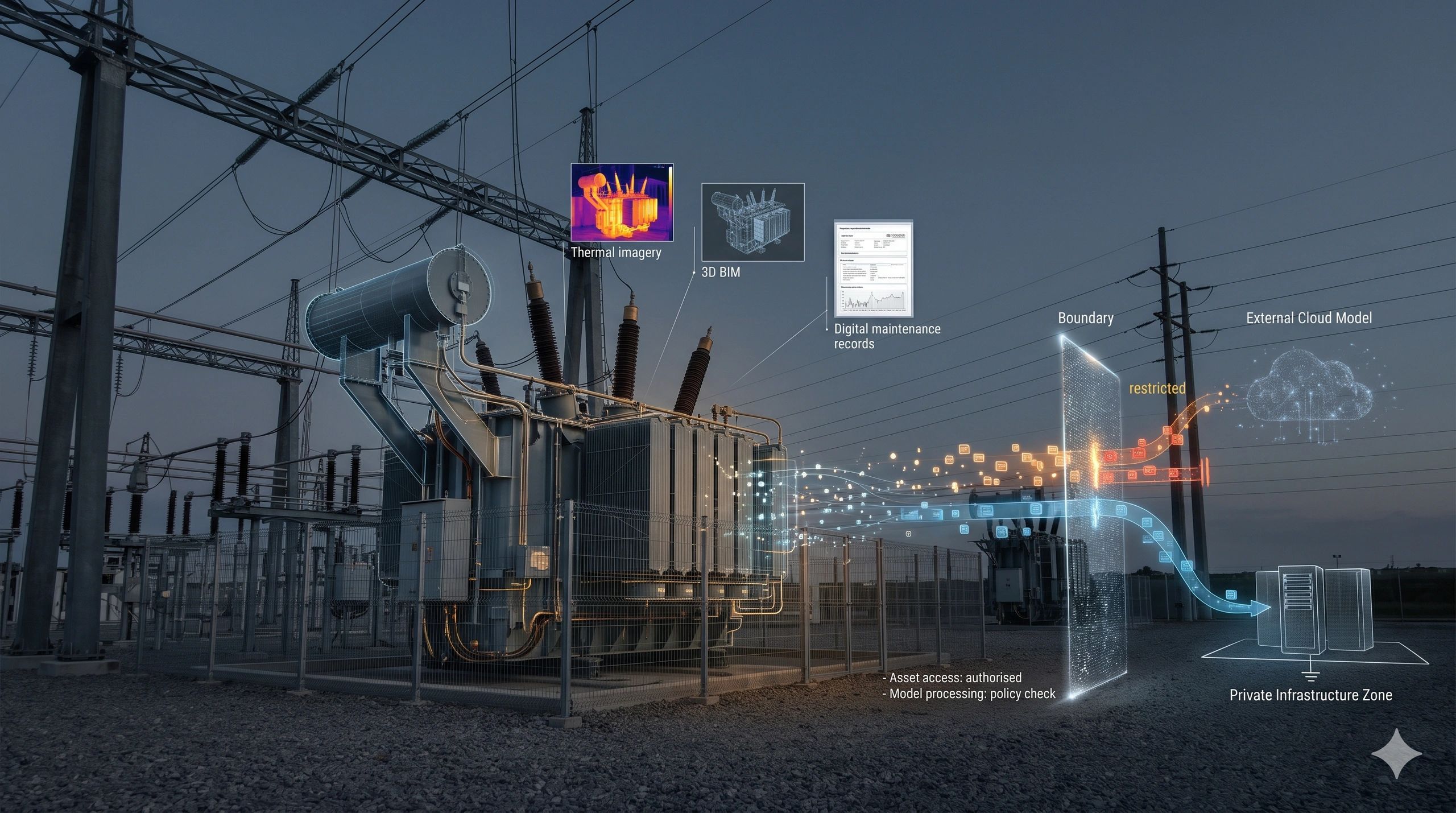
Asset identity matters here. If the design model, field record, test certificate and maintenance system refer to the same equipment differently, teams must reconcile them before trusting the information.
That is a delivery problem with operational consequences.
Reality capture answers a different question
BIM describes what should exist. Reality capture helps establish what was physically present at a particular time.
Point clouds, site photographs and UAV observations can support checks on installation, location, access and construction progress.
Their value grows when observations connect to specific assets and acceptance criteria.
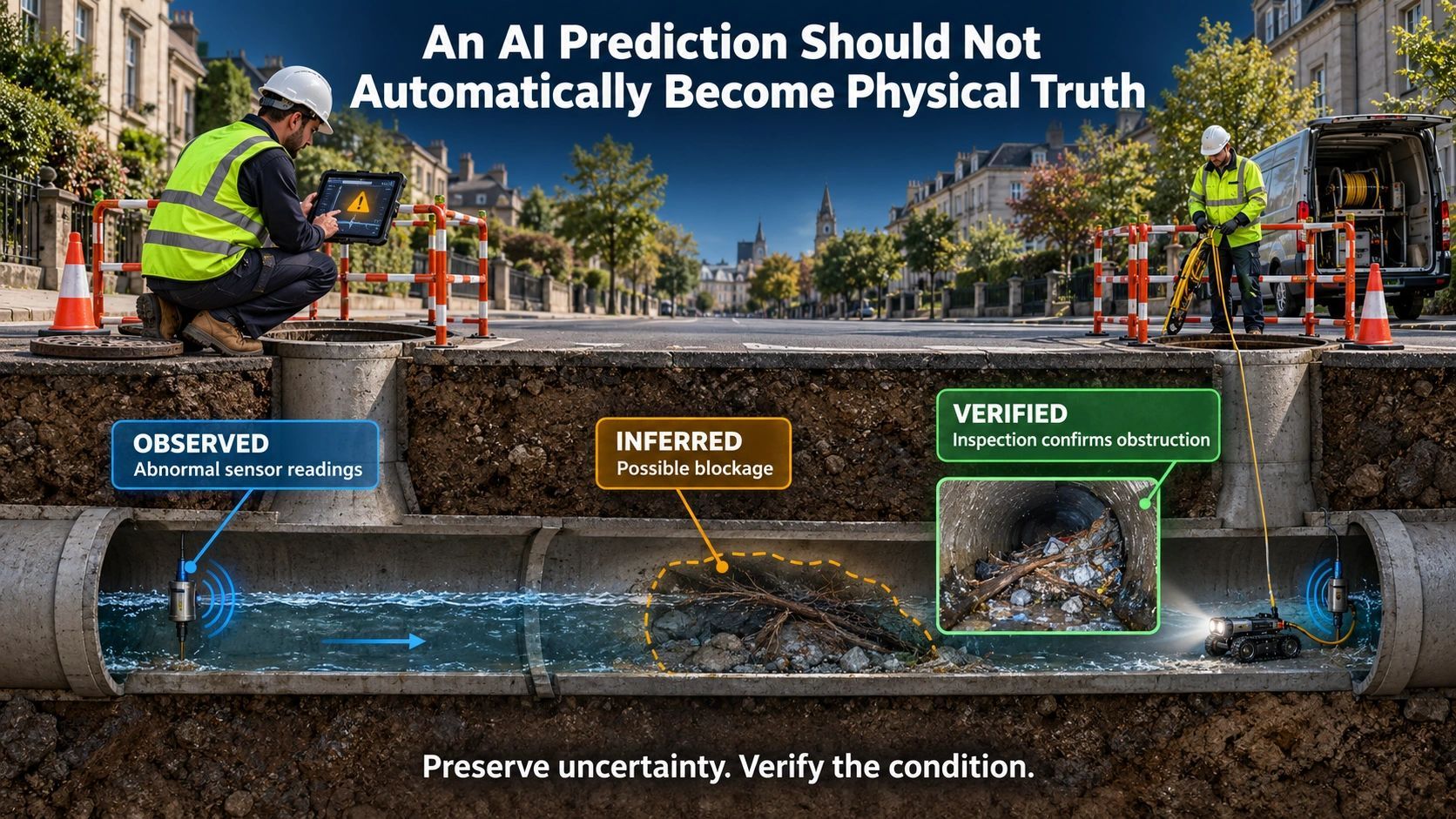
For example, evidence may show that equipment is installed in its designated position. That does not establish that it has passed electrical testing, achieved the required flow, or been accepted for operation.
Visual verification and functional testing answer different questions. A dependable workflow retains both, with their dates, scope and limitations.
This prevents a convincing site model from becoming a substitute for commissioning evidence.
Three questions for infrastructure readiness
I would organize the delivery conversation around three questions:
1. What is physically complete? Connect field observations to the relevant design objects and work packages.
2. What is functionally ready? Check whether installed systems have passed the tests and approvals required for their intended service.
3. What capacity can be released? Identify the operating envelope supported by accepted power, cooling, connectivity and other critical dependencies.
The third question requires engineering judgement. Cooling ratings cannot be treated as equivalent to usable IT capacity. Equipment specifications alone cannot establish whole-facility readiness.
The framework helps organize that judgement and its supporting evidence.
The opportunity includes people and interfaces
AEC firms entering this market will need more than modelling capability.
They need people who understand multidisciplinary coordination, asset information, commissioning workflows and evidence quality.
They also need clear ownership at the interfaces between contractors, equipment suppliers, utilities and operators.
An unresolved issue should have an owner, an affected function, a next action and a defined acceptance condition. Otherwise, it can remain visible on a dashboard while continuing to delay delivery.
For firms working across geospatial, BIM, reality capture and digital twins, this creates a practical role: connecting fragmented project information so qualified teams can make better readiness decisions.
A different measure of delivery value
From my geospatial perspective, the most useful shift is from representing infrastructure to explaining its constraints.
A digital twin becomes more valuable when an owner can use it to understand which dependency is holding back capacity, what evidence is missing, and which intervention could unlock the next operating stage.
That can help prioritise work, improve handover and make uncertainty easier to manage.
AI infrastructure will continue to attract attention through chips, models and investment announcements. Its delivery will depend on engineers, construction teams, commissioning specialists and operators resolving physical constraints together.
AEC firms that can connect construction progress to evidenced operational readiness will have a stronger proposition in this market.
The building is a major milestone. The commercial outcome is capacity that can be used.