An AI system flags a possible blockage in a drainage network.
Within seconds, the dashboard marks the pipe as blocked. A maintenance ticket is created. Another system adjusts its operating plan.
Nobody has confirmed the blockage.
The problem began when “possible” disappeared between systems.
As AI enters infrastructure operations, that small change in language can become a significant change in authority.
A prediction can help an organization decide what to investigate. It should not silently become the organization’s accepted description of the physical world.
One network, several possible explanations
Consider an illustrative drainage scenario.
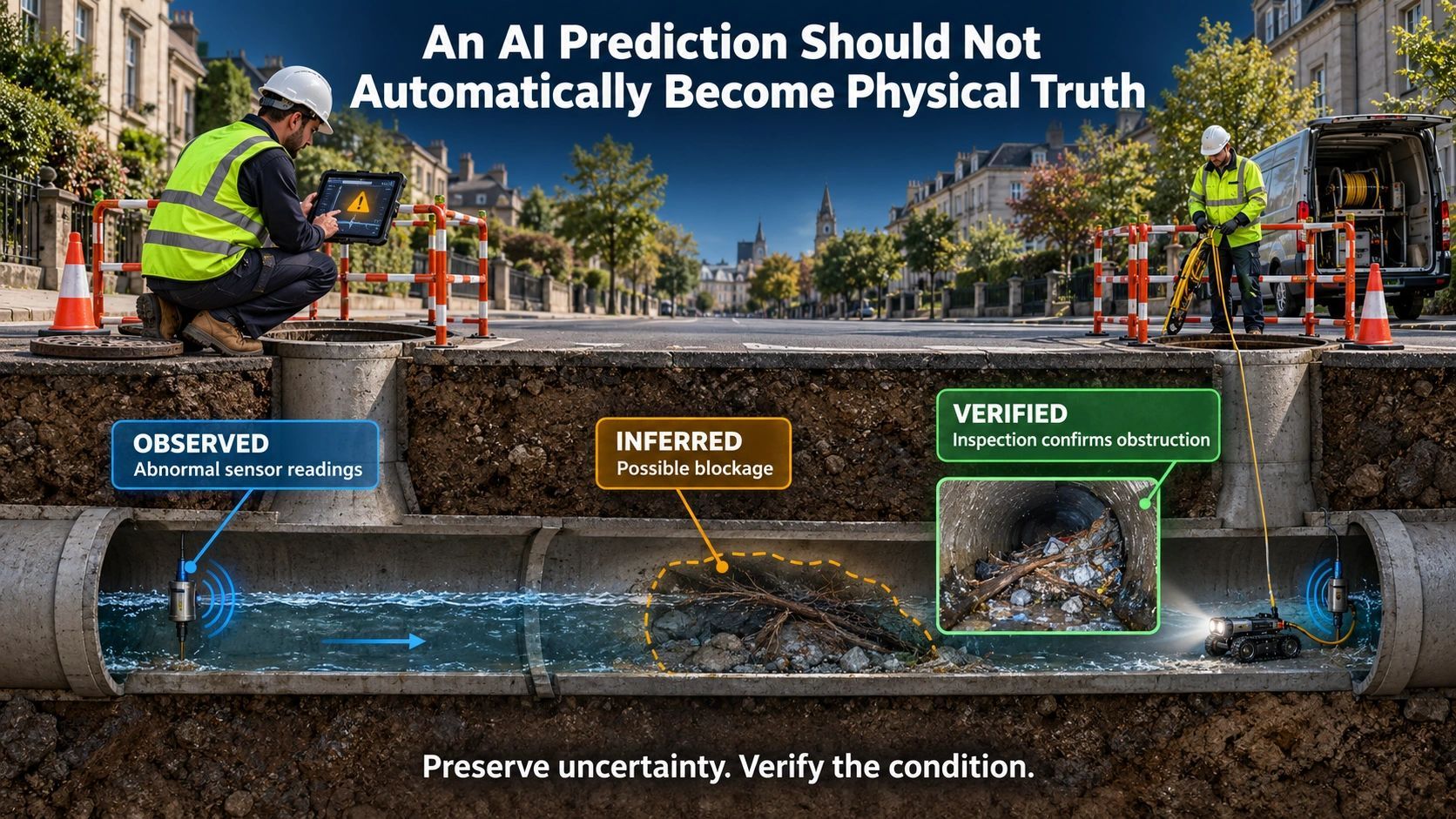
An upstream sensor records rising water levels. A downstream sensor reports lower flow. Rainfall data shows no recent increase.
AI interprets the pattern as a probable blockage.
That is a useful hypothesis. But other explanations remain possible: a faulty sensor, a pump operating change, an unrecorded discharge, or incorrect mapping of the network connections.
A drone might identify debris near an access point. That adds context, but does not necessarily establish an obstruction inside the pipe.
A suitable inspection could confirm the cause.
Each step changes what the organization knows. The platform should preserve those differences.
If every source feeds a single “blocked” label, the organization loses the ability to distinguish a measurement, an interpretation and a verified condition.
Three layers that should remain visible
I would structure this around three connected layers.
Observation: what a source recorded.
A sensor measured a water level. A satellite captured surface-water extent. A UAV photographed an access point.
An observation needs its source, location, time, units and quality information. Measurements can be wrong, delayed or attached to the wrong asset.
Inference: what the evidence suggests.
A model identifies a possible blockage, leak, encroachment or construction deviation.
The inference should retain the supporting observations, model version, assumptions and uncertainty. Alternative explanations should remain available where relevant.
Accepted operational state: what the organization currently treats as established for a defined purpose.
This might be “blockage confirmed by inspection” or “suspected restriction; inspection pending.”
Acceptance requires a defined rule and accountable authority. It also needs a time boundary: a condition verified yesterday may have changed today.
“Accepted” does not mean permanently or universally true. It means sufficiently supported for a specified use, with its limitations recorded.
The foundations already exist
This distinction builds on established practices.
The OGC SensorThings API provides a structured observation model that connects results with sensors, observed properties, features of interest and timestamps. It also supports result-quality information. That helps preserve the context behind a reading.
NIST’s AI Risk Management Framework calls for AI outputs to be interpreted in context and for organizations to define roles and responsibilities for human oversight.
Neither establishes the complete operational workflow proposed here.
My argument is that infrastructure platforms should connect these foundations to explicit rules for accepting, challenging and revising asset conditions.
The architecture needs to make uncertainty visible throughout that process.
Confidence does not grant authority
A model can produce a high confidence score while operating on stale imagery, poorly calibrated sensors or an incorrect network map.
A displayed score also needs interpretation. Unless it has been calibrated and validated for the relevant conditions, “95% confidence” should not be read as a guaranteed 95% probability that the physical condition exists.
Even a reliable prediction does not answer every operational question.
Is the evidence current enough?
Does it refer to the correct asset?
What happens if the prediction is wrong?
Who may authorize the proposed response?
Sending an inspection team, changing a pump setting and closing a public road involve different consequences.
The acceptance threshold should reflect those consequences.
Acting before confirmation can be necessary
This does not mean every action must wait for a field visit.
An organization may need to respond before the cause is certain. A suspected slope failure, for example, could justify temporarily restricting access while further evidence is collected.
The system should record two separate things:
The physical condition remains suspected.
A precautionary restriction has been authorized.
That distinction allows timely action without overstating what is known.
Low-consequence tasks may be automated under validated rules. More consequential interventions need stronger evidence, additional checks or designated approval.
Human review is useful when the reviewer has the evidence, competence and authority to challenge the output. A confirmation button alone adds little assurance.
More sources do not always mean more evidence
Multimodal systems introduce another subtle problem.
A dashboard alert, an AI summary and a work-order recommendation may all originate from the same sensor reading.
They are three outputs, but only one underlying observation.
Similarly, two models analyzing the same UAV image may share the same blind spot. Agreement between them does not necessarily provide independent confirmation.
A trustworthy platform should preserve evidence lineage: where each conclusion came from and which sources genuinely add information.
It should also retain disagreement. A normal downstream reading should not disappear because it conflicts with the preferred explanation.
Conflicting evidence is often the reason to investigate further.
What this changes for digital twins
A digital twin should show the status of its claims alongside geometry and measurements.
An operator should be able to distinguish:
- A measured condition.
- A model-estimated condition.
- A condition awaiting verification.
- A verified condition with its supporting record.
- A condition whose evidence has become outdated.
For owners and operators, that makes the next step clearer. For delivery teams, it reduces ambiguity about what remains unresolved. For management, it makes decisions easier to review.
A practical starting point is one asset class, one recurring event and a small set of acceptance rules.
Define what evidence is required, who can accept the condition, what actions are permitted before confirmation, and how the record changes when new evidence arrives.
Then measure inspection yield, time to resolution, unnecessary interventions and unresolved alerts.
The value lies in improving decisions, not merely producing more predictions.
The boundary worth protecting
AI will become increasingly useful at identifying patterns that people would otherwise miss.
The operational responsibility is to preserve what those patterns actually establish.
A prediction should retain its uncertainty until evidence and defined acceptance rules support a change in status. An authorized precaution should remain distinguishable from a confirmed diagnosis.
The most useful infrastructure platform may be the one that can explain what it observed, what it inferred, and why the organization accepted the next decision.
As spatial intelligence moves closer to physical operations, this boundary becomes part of the product’s value.