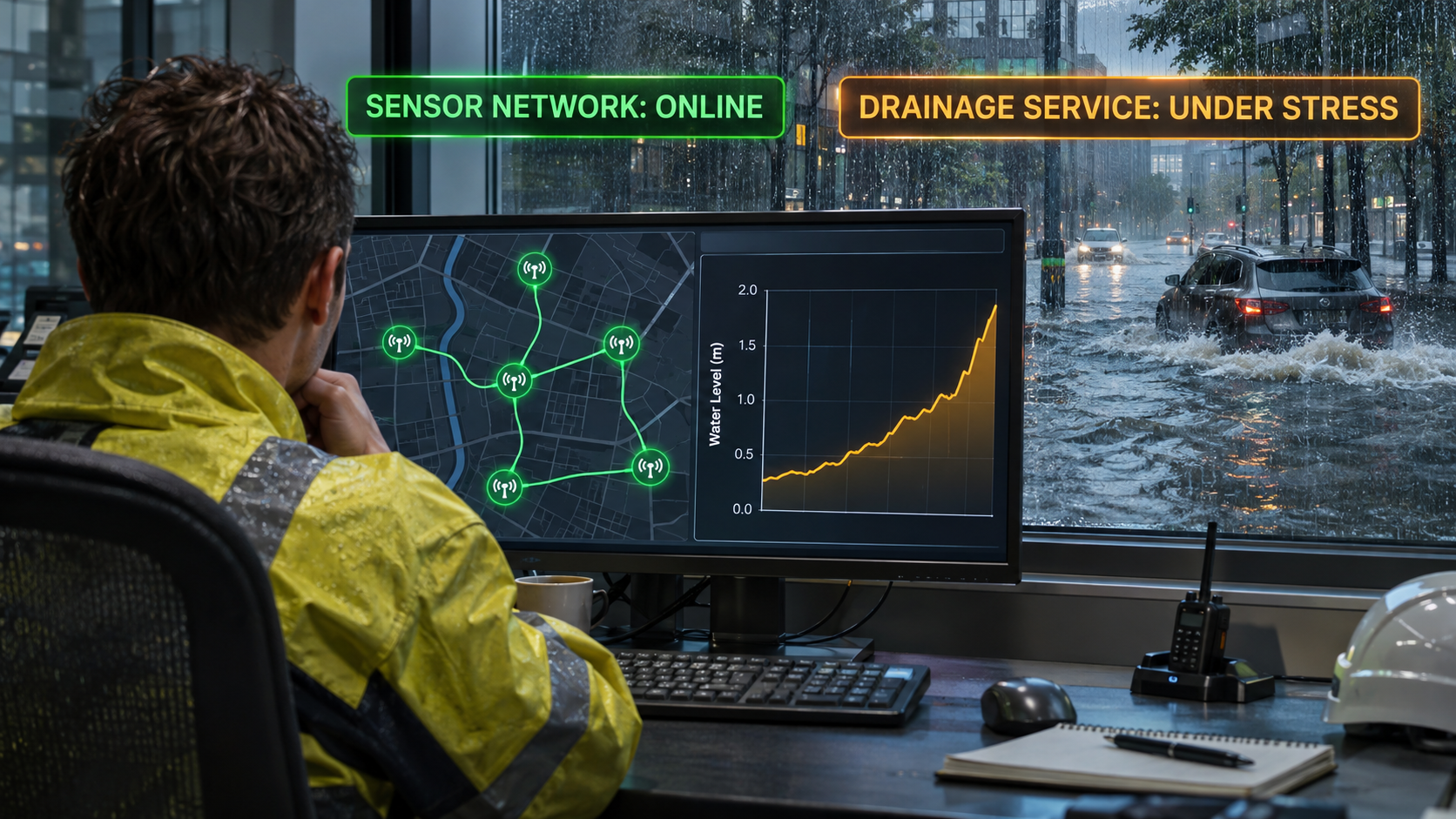
At 8:30 a.m., a city’s drainage monitoring dashboard is green.
The sensors are online. The gateway is connected. Data is arriving on schedule.
By 9:00 a.m., a road is flooded.
The monitoring network did its job. The drainage service did not.
This is an illustrative scenario, but it exposes a question that every infrastructure operator should ask: What does a green status actually tell us?
If it tells us only that devices and communications are working, it says little about whether the physical service is performing as intended.
Connected devices are not the same as functioning services
Consider a drainage chamber fitted with a water-level sensor.
The sensor reports every five minutes. Its battery is healthy, its signal is strong, and its readings pass the platform’s basic validation checks.
Those readings also show that water levels are rising rapidly.
A device-health dashboard may correctly show the sensor as operational. But if that green status dominates the operator’s view, it can create a misleading impression of the wider system.
The distinction matters because the two assessments answer different questions:
- Network health: Are devices, power supplies, gateways and communications functioning?
- Physical condition: What do the available observations tell us about the infrastructure?
- Service performance: Is the infrastructure delivering the outcome people depend on?
A healthy sensor can report a dangerous condition. A disconnected sensor can sit beside infrastructure that is functioning normally. And even a current, valid reading may not be enough to establish whether the service is meeting its intended purpose.
These states should be visible separately.
The missing link: from measurement to service
A sensor measures a particular condition at a particular place and time. A service depends on more than that single measurement.
A drainage sensor may measure water level in one chamber. The service depends on water moving through a connected network with enough capacity to manage the current conditions.
A level reading can indicate a problem, but it may not reveal its cause. A high level could be associated with intense rainfall, downstream restriction, a pump issue or another condition. Establishing which one applies may require additional measurements or an inspection.
The same distinction appears elsewhere:
- A water-pressure sensor can be online while pressure at another location is below the required level.
- A pump-monitoring system can report that equipment is running while the required flow is not being delivered.
- A building’s temperature sensors can be connected while occupied areas remain outside acceptable conditions.
- An industrial utility dashboard can receive data from every device while a production line experiences an interruption.
In each case, the equipment may provide valuable information. The design challenge is connecting that information to a clearly defined service outcome.
Define the service before designing the dashboard
A useful monitoring programme begins with the decision the operator must make.
For a drainage network, that might be: Which locations need intervention before water affects a critical road?
For a water utility, it might be: Which service zones are experiencing pressure below the agreed operating range?
For an industrial facility, it could be: Can this utility continue supporting the production process under current conditions?
Each decision then needs an evidence plan:
- What outcome matters? Define the service, its location and the performance threshold.
- What observations support the assessment? Identify measurements, their coverage, freshness and quality requirements.
- What action follows? Specify who reviews an exception, what additional evidence may be needed and who can authorize intervention.
This changes the dashboard’s purpose. Instead of simply showing whether devices are communicating, it helps an operator understand whether a service is performing, where confidence is limited and what needs attention.
A green sensor does not guarantee complete evidence
Even when every sensor is online, there may be important gaps.
Sensors are installed at selected locations. A blockage may develop between them. A reading may be valid but too old for a fast-changing situation. A device may be reporting correctly while measuring a condition that is only indirectly related to the service outcome.
This is why coverage and relevance matter alongside connectivity.
For example, a chamber-level sensor may provide strong evidence about water depth at that chamber. It does not automatically establish flow throughout the network or prove that a nearby road will remain passable.
A digital twin can make these relationships clearer by connecting:
Sensor → observation → infrastructure asset → service area → operational decision
The connection should also record the limits of the observation. Which part of the network does it represent? When was it collected? What other evidence is needed before the operator can reach a conclusion?
A map helps locate the sensor. The decision context explains why its reading matters.
Make uncertainty visible
There is a second situation operators must be able to recognize: the monitoring system itself loses visibility.
Suppose a shared gateway stops communicating during heavy rainfall. Five sensors disappear from the dashboard.
The operator should not conclude that the drainage network has failed merely because the gateway has failed. Equally, the last readings should not continue to appear as though they describe current conditions.
The platform should make the loss of visibility explicit:
- Which sensors and infrastructure assets are affected?
- When was each last valid observation received?
- Which service assessments depend on those observations?
- What alternative evidence is available?
- Who needs to review the situation?
Depending on the site, alternative evidence could include another measurement point, a field team, operational records or a targeted inspection. The right choice depends on the urgency of the decision and the quality of the available alternatives.
Until sufficient evidence is available, unknown is a legitimate operational state.
Measure what the monitoring system helps the organization achieve
Device availability remains important. A sensor network that frequently loses data will struggle to support reliable decisions.
But a monitoring programme should also be assessed against service outcomes. Depending on the application, useful measures could include:
- Time between a developing condition and operator awareness.
- Time taken to verify and respond to an alert.
- Duration and location of service interruptions.
- Proportion of critical service areas with sufficient current evidence.
- Number of decisions delayed because essential evidence was unavailable.
These measures shift the discussion from “How many devices are connected?” to “How effectively can we understand and manage the service?”
They also help reveal where another sensor is useful and where the more valuable investment may be a better workflow, clearer ownership or faster field verification.
The digital twin should support two conversations
Infrastructure teams need a clear view of the monitoring network: devices, batteries, gateways, data quality and communication failures.
Service owners need a clear view of performance: affected areas, operating conditions, emerging risks and decisions requiring attention.
The two views must be connected, but they should not be collapsed into one status.
A digital twin becomes more useful when it can say:
“The sensors are reporting normally. The evidence indicates that this part of the service may be under stress.”
Or:
“The service condition cannot currently be assessed because the observations required for this decision are unavailable.”
Those statements lead to different actions. One may require operational intervention; the other may require an alternative observation before a reliable decision can be made.
The strongest monitoring systems do more than keep devices online. They show what the organization can establish about the service, what remains uncertain and what should happen next.