Carbon reporting is becoming an operational issue, not only a sustainability exercise.
As India’s Carbon Credit Trading Scheme moves toward implementation, industrial organizations will face growing pressure to produce emission figures that regulators, auditors, investors and customers can trust.
A calculated total may look precise.
But precision is not the same as traceability.
If a carbon number cannot be connected to the facility, process, production period, meter reading, source record and calculation method behind it, the organization has reported a claim, not created reliable evidence.
The problem begins below the carbon dashboard
Most carbon platforms present information at the reporting layer:
- total emissions;
- emissions by facility;
- emissions intensity;
- reduction against a baseline;
- progress toward targets.
These outputs are useful. But they can hide weaknesses underneath.
A reported number may combine energy bills, production records, manually entered spreadsheets, sensor readings, fuel purchases and emission factors. These inputs may originate from different systems, use different time periods and refer to assets through inconsistent names.
The sustainability system may recognize “Kiln Line 2.”
The maintenance system may call it “KL-02.”
The IoT platform may identify its meter as “EM_2047.”
The ERP may allocate its production under a cost center rather than a physical asset.
A calculation can proceed despite these differences. Traceability cannot.
The question is therefore not simply:
What is the carbon value?
It is:
Which physical operation produced it, what evidence supports it, and what changed when the value changed?
Carbon accounting needs an evidence chain
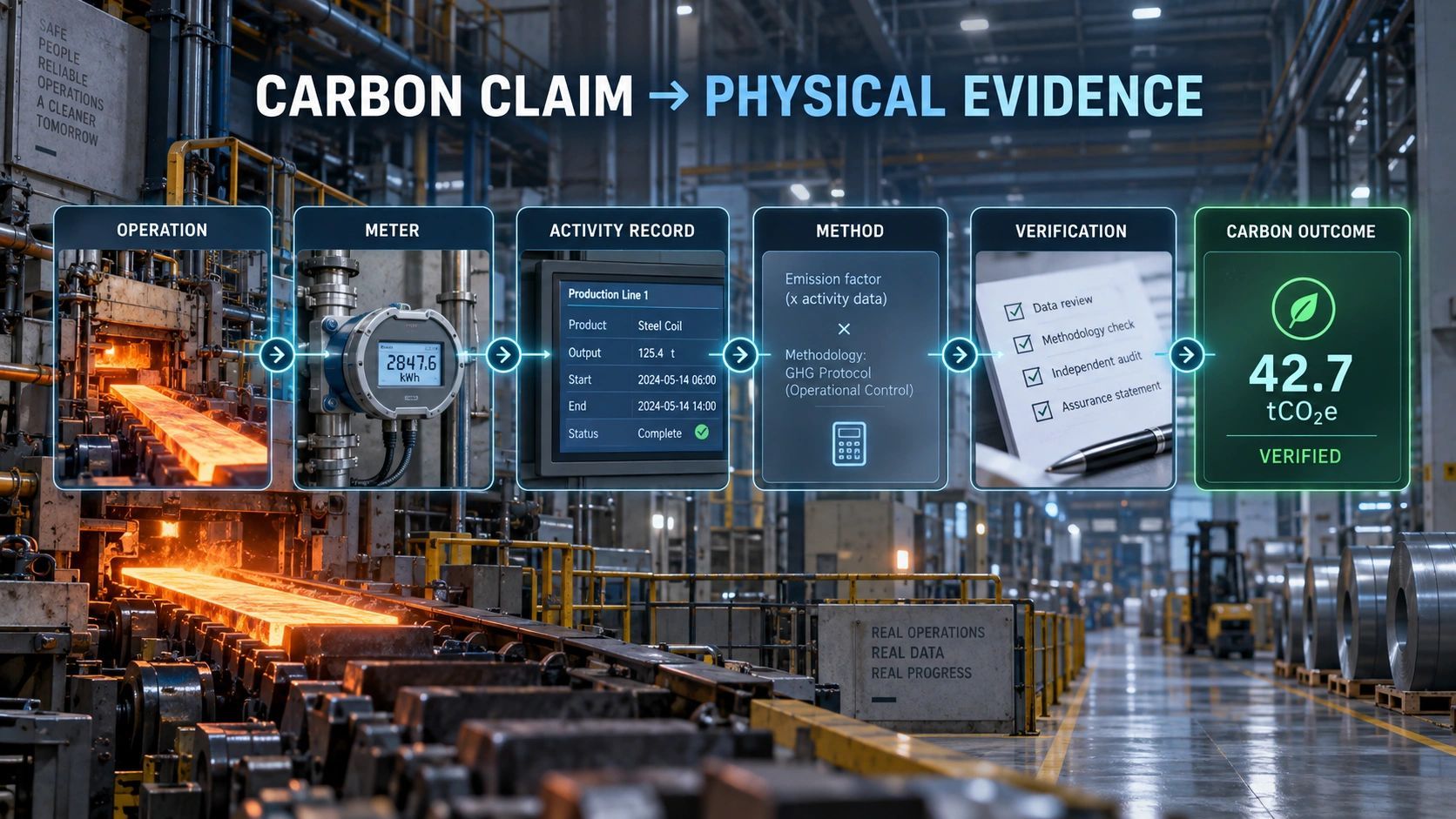
A defensible industrial carbon record should connect the reported outcome to the operations that created it.
The chain might look like this:
Facility → production line → process or equipment → reporting period → production output → energy or material activity → source evidence → emission factor and calculation → verification → submitted carbon outcome
Each connection matters.
If electricity consumption rises, the system should identify the relevant meter, time interval and operating assets.
If emissions intensity falls, it should show whether the change came from improved efficiency, altered production volume, a cleaner energy source or a revised calculation factor.
If a facility replaces a boiler, installs renewable generation or changes a production process, the carbon record should preserve when that intervention became operational and which subsequent measurements support its claimed effect.
Without this chain, organizations can struggle to distinguish a genuine operational improvement from a reporting adjustment.
Location gives carbon evidence operational context
Carbon data is usually organized by company, facility or reporting category. Physical operations are more detailed.
An industrial site may contain several production units, substations, boilers, storage areas, treatment plants, generators and utility networks. Some meters serve individual assets. Others serve zones or multiple processes. Mobile equipment may operate across several locations.
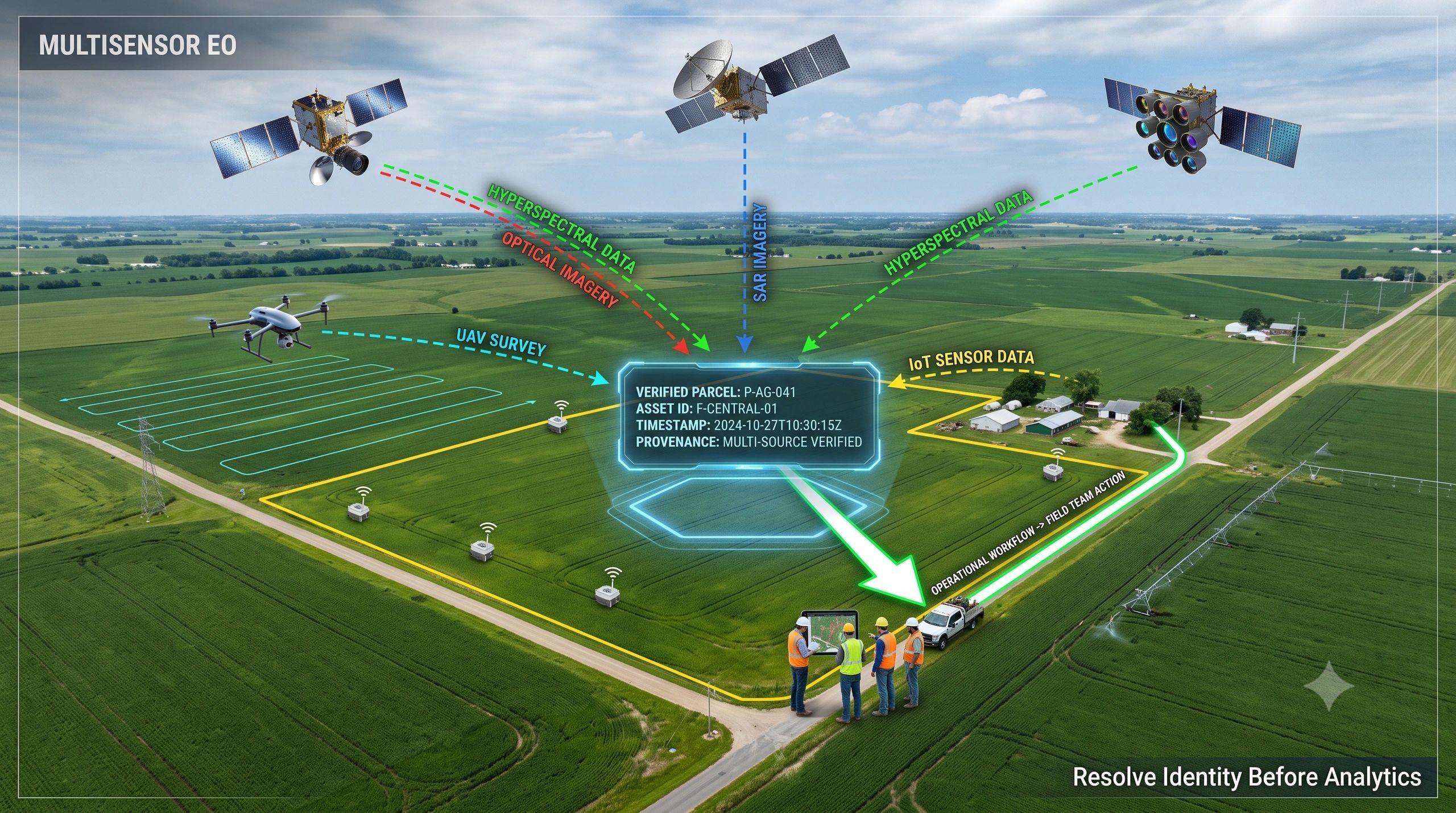
This is where geospatial intelligence and facility models can add value.
A spatially structured evidence layer can connect:
- meters to the equipment or areas they measure;
- fuel use to storage and consumption points;
- production records to specific lines;
- process changes to their affected assets;
- renewable generation to connected loads;
- maintenance events to periods of unusual consumption;
- emission-reduction projects to verified physical interventions.
The purpose is not to place every carbon figure on a map.
It is to preserve the physical context needed to explain that figure.
Time is as important as location
A meter may be connected to the correct asset and still produce misleading evidence if its time context is wrong.
Production data may be recorded by shift. Electricity data may arrive every 15 minutes. Fuel consumption may be reconciled monthly. Maintenance systems may record only the date an activity was closed, not when the equipment returned to operation.
These records cannot be treated as automatically aligned.
A trustworthy evidence architecture should retain:
- measurement time;
- reporting period;
- data-ingestion time;
- equipment operating state;
- calibration validity;
- methodology version;
- correction or restatement history.
This becomes important whenever an organization needs to explain why a number changed.
The answer should not be limited to “the dashboard was updated.”
The system should reveal whether the source reading changed, a missing record arrived, an emission factor was revised, a boundary was redefined or an operational intervention produced a measurable result.
From carbon inventory to industrial evidence graph
One practical approach is to create an Industrial Carbon Evidence Graph.
The graph would not replace ERP, MES, IoT, energy-management or carbon-accounting systems. It would connect the identities and relationships distributed across them.
Its core objects could include:
- organizations and reporting entities;
- facilities and operational boundaries;
- assets, processes and production lines;
- meters, sensors and source documents;
- materials, fuels and energy flows;
- production batches and reporting periods;
- calculation methods and emission factors;
- interventions, inspections and maintenance events;
- verifications, approvals and submissions.
Every reported number could then retain a navigable path back to its supporting evidence.
This also makes exceptions easier to identify.
The system could flag a carbon value when:
- its source meter is not mapped to an asset;
- the measurement period does not match the production period;
- a manual record replaced an automated reading;
- the emission factor changed without an approved version;
- a sensor was outside its calibration period;
- two systems assign different identities to the same equipment;
- the operational boundary changed during the reporting cycle.
These are not merely data-quality problems. They are assurance risks.
AI should examine the evidence, not invent confidence
AI can help reconcile asset names, detect abnormal consumption, identify missing records and explain changes across reporting periods.
But AI should not conceal weak evidence behind a confident narrative.
Its role should be bounded.
An AI-supported carbon workflow should be able to say:
- which source records were used;
- which relationships were inferred;
- where identities remain unresolved;
- which method and factor version were applied;
- whether the evidence passed defined quality checks;
- when human review is required.
Confidence becomes useful only when it changes the workflow: accept, investigate, correct or collect more evidence.
This distinction will matter as organizations introduce GenAI assistants into sustainability and operational systems. A well-written explanation cannot compensate for an incomplete evidence chain.
The implementation model should remain collaborative
No single platform needs to own the entire carbon process.
A stronger model brings together:
- carbon consultants and accredited verifiers for regulatory interpretation and assurance;
- ERP, MES and industrial IoT systems for operational and activity data;
- geospatial, BIM and facility models for physical identity and context;
- an evidence layer for provenance, relationships and version history;
- workflow systems for review, approval and submission.
This separation is useful because regulatory methodologies will evolve. Physical evidence should remain reusable even when calculations, factors or reporting requirements change.
The durable asset is not only the submitted carbon total.
It is the governed record connecting that total to the operation that produced it.
Traceability can improve operations as well as reporting
A well-designed carbon evidence architecture does more than prepare an audit trail.
It can show which assets drive energy and emission intensity, identify unexplained variations, compare similar production lines and help teams verify whether an intervention delivered its expected result.
That shifts carbon management from retrospective disclosure toward operational improvement.
Plant managers can investigate a deviation.
Engineering teams can evaluate an equipment upgrade.
Finance teams can assess the basis of an efficiency investment.
Executives can distinguish reported progress from verified physical change.
Verifiers can review the evidence without rebuilding the entire chain manually.
As carbon markets mature, organizations will need more than increasingly polished sustainability dashboards. They will need records that survive technical, financial and regulatory scrutiny.
A credible carbon number should not end at a report.
It should lead back, clearly and consistently, to the physical operation that created it.