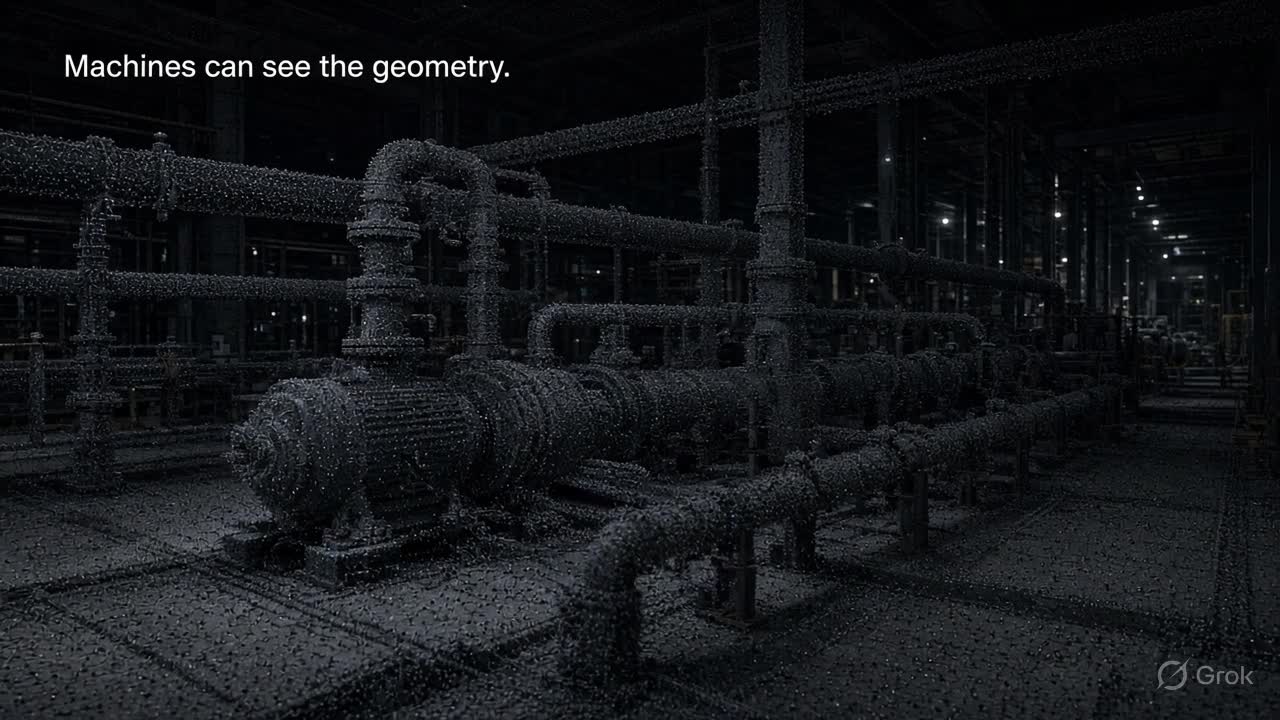
A point cloud can tell us where millions of points exist.
A BIM model can tell us what designers intended those points to become.
An IoT system can tell us that a sensor attached somewhere in that environment is reporting an abnormal condition.
But none of these, by themselves, necessarily understands something much more important:
How everything is related.
Which valve belongs to which system?
Which pipe feeds which pump?
Which room contains the affected equipment?
Which structural element supports the component showing deformation?
Which route should a robot take to reach it?
And what else could be affected if that asset fails?
This is where Hierarchical 3D Scene Graphs (3DSGs) become interesting.
Not because they create a better-looking digital twin.
But because they may help transform spatial environments into structures that machines can actually reason over.
From geometry to relationships
Most digital representations of the physical world are still heavily geometry-centric.
Reality capture gives us point clouds, meshes, imagery and increasingly neural representations of environments.
BIM gives us structured design objects.
GIS gives us geographic context.
IoT gives us continuous observations.
Individually, each can be extremely valuable.
The challenge begins when an operational question crosses those boundaries.
Consider:
“Inspect the safety bypass valve nearest the high-pressure manifold.”
A human familiar with the plant may understand immediately what that means.
A robot does not.
Coordinates alone are not enough.
The machine needs to understand that one object is a valve, another is a manifold, that the valve belongs to a particular system, that it occupies a particular physical location, that a navigable route exists between the robot and the asset, and perhaps that certain zones along that route are restricted.
That requires something closer to a relational model of reality.
A 3D Scene Graph provides one possible architecture.
Instead of representing the environment only as geometry, it organizes it into layers.
Raw geometry may sit at the bottom.
Above that are identifiable objects and assets.
Above those are relationships such as:
connected to contained in adjacent to supports located within
These can then connect upward into rooms, operational zones, systems, facilities and ultimately geographic coordinates.
The result is not merely a model of where things are.
It begins to describe what they are, how they relate and what they belong to.
This matters because physical AI needs context
We are moving toward environments populated by increasingly capable autonomous systems.
Inspection drones.
Quadruped robots.
Mobile manipulators.
AI maintenance agents.
Autonomous construction equipment.
But giving a machine perception does not automatically give it understanding.
A robot may recognize a pump visually.
That does not mean it knows whether the pump belongs to the chilled-water network, whether another pump is redundant to it, which electrical panel powers it, or what downstream assets depend on it.
This distinction becomes important as AI moves from perception toward intervention.
Physical AI cannot safely operate only from “I see an object.”
It increasingly needs something closer to:
I see this object. I know which asset it is. I know where it sits in the facility hierarchy. I know what it connects to. I know its current operational state. And I understand the consequences of acting on it.
The 3D Scene Graph can become part of that translation layer.
The operational digital twin becomes a graph
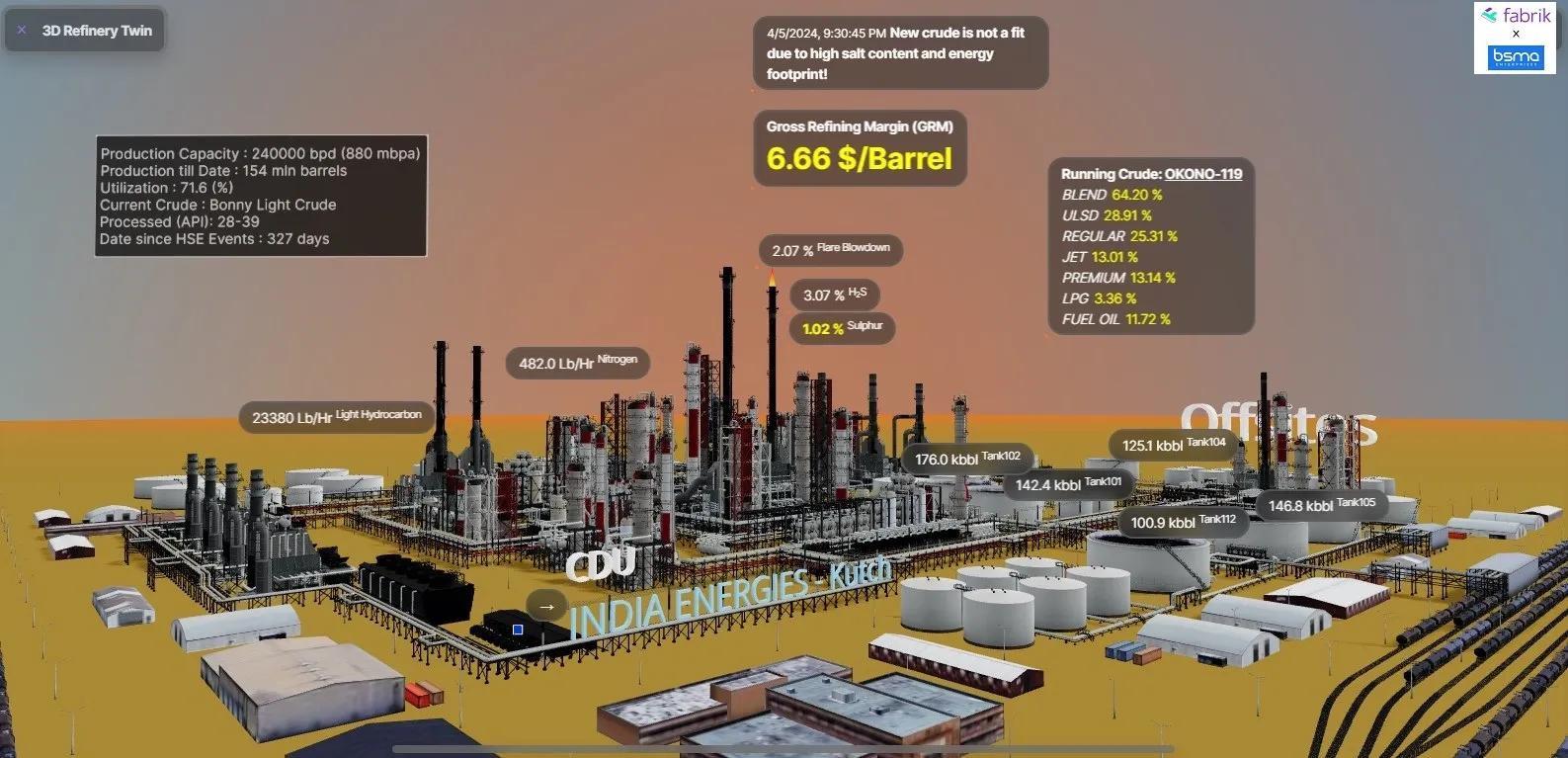
Imagine an overheating pump inside an industrial facility.
A conventional monitoring system might generate an alarm.
A richer digital twin might show the pump's location and live temperature.
A graph-based operational twin could potentially go further.
The pump node might connect to:
its physical geometry,
its BIM identifier,
its IoT telemetry,
the room containing it,
the pipe network connected to it,
upstream and downstream equipment,
maintenance history,
inspection records,
and navigable paths through the facility.
Now the question changes from:
“Where is the overheating pump?”
to:
“What does this condition affect?”
A graph query could identify connected downstream assets.
An operations agent could prioritize inspection.
A technician or robot could be routed to the correct component.
After repair, another scan could verify the physical state and update the graph.
This creates an operational cycle:
Observe → Understand → Prioritize → Decide → Act → Verify
That loop is more important than the graph itself.
Because the real value does not come from creating another spatial database.
It comes from connecting observation to action and action back to verified reality.
How mature is this?
This is not purely theoretical.
Research systems have already demonstrated important pieces of the architecture.
Frameworks such as ConceptGraphs and Hydra explore real-time or open-vocabulary 3D scene-graph generation by combining visual foundation models, semantic understanding and spatial mapping.
Research into BIM-to-point-cloud alignment is also progressing, using graph-based methods to associate scanned environments with existing design elements.
Robotic research is demonstrating scene-graph extraction on increasingly constrained platforms.
So several building blocks already exist.
But that does not mean enterprise-scale operational 3DSGs are mature.
Important gaps remain.
One is time.
A factory today is not the same factory six months from now.
Assets move.
Temporary structures appear.
Components are replaced.
Maintenance changes conditions.
For an operational graph to remain trustworthy, relationships must evolve without destroying historical state.
Another challenge is sensor ingestion.
Connecting thousands of dynamic observations to persistent spatial objects at enterprise scale is very different from demonstrating scene understanding in a research environment.
And perhaps the most important challenge is provenance.
If an AI agent claims that Valve V-104 belongs to Line P-17, where did that relationship come from?
The BIM model?
A scan?
An inference?
A maintenance record?
A human correction?
And when was it last verified?
For operational use, those distinctions matter.
The graph should not become the new reality
This brings us to a deeper GeoThinking question.
Every new spatial abstraction creates the temptation to confuse the representation with the world itself.
We did it with maps.
We can do it with BIM models.
We can do it with digital twins.
And we can certainly do it with scene graphs.
A beautifully connected graph may still contain outdated geometry, incorrect asset identities or inferred relationships that were never physically verified.
So the goal should not be to make the graph authoritative simply because it is structured.
The goal should be to make its relationship with physical reality traceable, updateable and verifiable.
The graph is still the finger.
The physical world remains the moon.
The deeper shift
3D Scene Graphs may therefore matter for reasons beyond robotics.
They point toward a different architecture for spatial computing.
Today we often integrate systems by moving data between applications.
Tomorrow we may increasingly integrate them around a shared model of entities, relationships, location, state and evidence.
Reality capture provides observation.
BIM provides engineered intent.
GIS provides geographic context.
IoT provides state.
Enterprise systems provide identity and history.
AI provides reasoning.
Robotics provides action.
The 3D Scene Graph could become one of the layers through which these worlds begin to understand each other.
And that may be the more important transition.
The future digital twin may not simply be something humans open on a screen.
It may become part of the contextual infrastructure through which machines understand the physical world.
Not just:
“What am I looking at?”
But:
“What is this connected to, what does it affect, what can I do here and what evidence tells me that my understanding is still correct?”
That is when spatial intelligence begins moving from representation toward operational reasoning.
And when digital twins start becoming less like digital replicas and more like machine-readable models of how the physical world works.