An infrastructure operator asks an AI assistant to find assets within 500 meters of a flood zone.
The assistant launches a reasoning workflow, retrieves documents, calls a powerful model and produces a confident explanation.
But the core task is a spatial database query.
The organization has paid for intelligence where a reliable calculation would have done the job.
Now consider the reverse: an assistant recommends shutting down equipment using an outdated inspection record. A more capable model might explain its recommendation beautifully. The missing evidence still makes the decision unreliable.
Both situations expose the same design problem.
We are choosing the intelligence before defining what the decision requires.
For organizations building GeoAI, digital twins and operational AI, that sequence deserves to change.
Model capability is only one part of system performance
Model comparisons help us understand capabilities. They tell us much less about whether a complete workflow will deliver a useful result at an acceptable cost.
An operational system also depends on current information, correct asset identity, reliable tools, clear permissions and a way to verify what happened.
A powerful model cannot compensate for a sensor attached to the wrong asset. It cannot establish that yesterday’s clearance measurement remains valid after a storm. It cannot grant itself permission to dispatch a crew.
This is why I find the decision architecture more interesting than the model leaderboard.
Anthropic’s engineering guidance recommends starting with the simplest approach that meets the task, adding agentic complexity when its performance benefits justify the additional cost and latency. anthropic.com
The practical implication extends beyond software: every additional model call, observation and review step should have a clear purpose.
Route the work according to its requirements
Consider the range of requests that might reach a geospatial assistant:
“Find substations within this flood boundary.”
“Extract inspection dates from these reports.”
“Identify vegetation in this image.”
“Explain conflicting evidence about this asset.”
These are different tasks. They should not automatically follow the same computational path.
A spatial database can perform the geographic calculation. A language model can interpret a request and explain the result. A specialist vision model can analyze imagery. A more capable reasoning model may help investigate conflicting records.
Microsoft’s model-router documentation describes selecting models according to request characteristics and configured quality–cost preferences. Its evaluation guidance also stresses testing against the actual workload, including quality, cost, latency and policy requirements. Microsoft Learn
For physical-world systems, I would extend that routing principle to include evidence and authority.
Choose the combination of tools, observations, models and human review that meets the decision’s requirements.
One transmission line, several different decisions
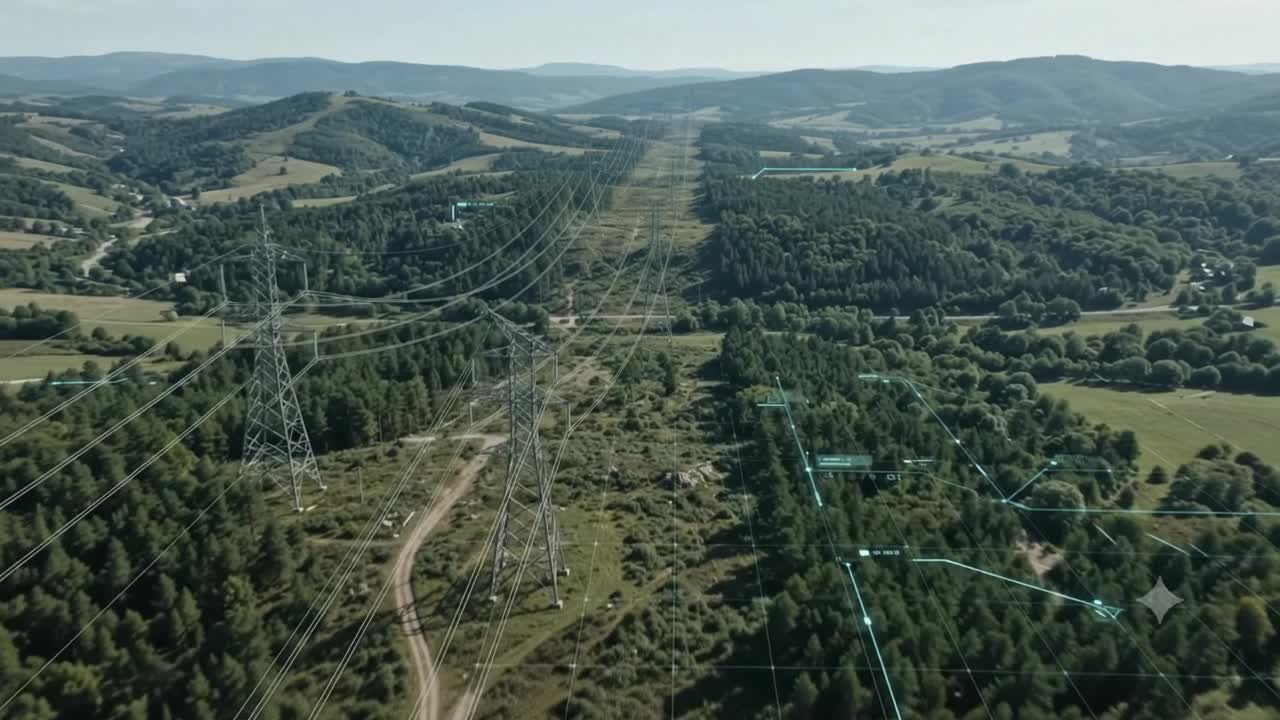
Imagine a hypothetical transmission-line inspection workflow.
A satellite observation indicates vegetation near a corridor.
That may justify further investigation. Depending on resolution, observation date and positional uncertainty, it may be insufficient to establish a clearance violation.
The next step could be a targeted UAV inspection, subject to access and operating permissions. It could also be a field inspection if imagery cannot resolve the uncertainty.
Suppose the inspection confirms inadequate clearance.
The system can now prepare a maintenance task with the affected asset, location, supporting evidence and urgency.
An operational shutdown is a separate decision. It requires the relevant operating rules and authorized personnel.
Notice what changed at each stage.
The question moved from “Where should we look?” to “What needs maintenance?” to “Who may authorize an intervention?”
The required evidence, intelligence and authority changed with it.
Sending every stage to the strongest model would not establish those boundaries.
Define sufficiency before optimizing cost
“Use the cheapest sufficient intelligence” is a useful principle only when sufficient has a testable meaning.
For an operational workflow, I would establish three gates.
1. Evidence fitness
Does the information identify the right asset, cover the relevant area and represent conditions recently enough? Are uncertainty, missing coverage and conflicting records visible?
2. Task performance
Has the selected tool or model met the acceptance criteria on representative cases, including difficult examples? A model’s stated confidence alone should not determine whether a result passes.
3. Action authority
Is the proposed action permitted for this user, system and operating condition? Does it require approval, and is that approval still valid?
These gates work together. Additional reasoning cannot repair missing measurements. Additional measurements cannot grant operating authority.
When a gate fails, the workflow needs a defined response: collect evidence, escalate, request approval or stop.
The cheapest model can produce an expensive workflow
A low inference bill can conceal substantial operating costs.
A smaller model may require repeated retries. An elaborate agent may make unnecessary tool calls. A weak recommendation may consume engineering review time or trigger an avoidable site visit.
The useful economic measure is therefore cost per accepted outcome.
For an inspection workflow, that means considering data acquisition, processing, model calls, human review, field mobilization and rework together.
A more capable model may be economical if it reliably reduces those downstream costs. A simpler approach may win when the task is well defined and easy to validate.
The comparison needs evidence from the complete workflow.
It should also track missed issues and false alarms. A cheaper system that quietly overlooks important defects has failed the acceptance criteria.
Start with one workflow and measure the route
For a platform such as Dhineu, I would begin with a narrow workflow: investigate a suspected asset anomaly and prepare an evidence-supported maintenance recommendation.
Define the asset information required, the permissible evidence sources, the acceptance criteria and the approval boundary.
Then compare alternative routes using representative cases.
Record which tools and models were used, why escalation occurred, how much review was needed and whether the final recommendation was accepted.
Keep the evidence and decision history when a model changes. Re-evaluate the route when data conditions, tools or models change.
That creates a foundation for improving the system without making one model the permanent center of the architecture.
It also gives clients a clearer basis for judging value: reliable decisions, review effort, turnaround and verified outcomes.
The strongest model should remain available where its contribution justifies its use.
The best AI system earns trust by knowing what each decision needs and recognizing when it does not yet have enough.