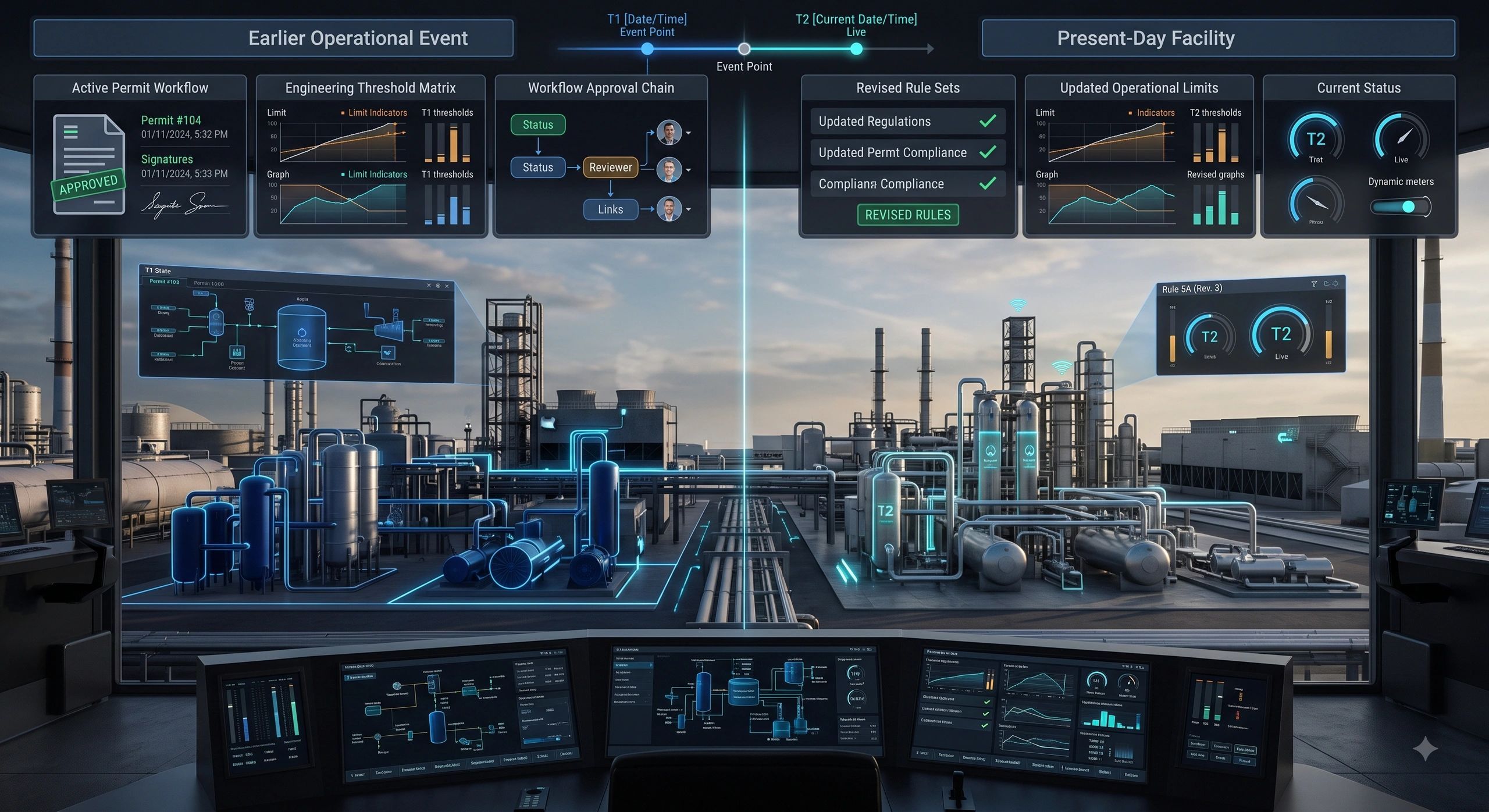
A facility can comply with a regulation today and still be unable to explain a decision made six months ago.
The asset data may be available. The sensor history may be intact. The maintenance record may show what happened.
But the rule that governed the decision may have changed.
A reporting deadline may have been postponed. A permit condition may have been revised. An engineering standard may have been replaced. A carbon-accounting methodology may have moved to a new version.
If the digital twin displays only the latest rule, it silently rewrites the context of the earlier decision.
That makes it a useful operational dashboard but an unreliable historical record.
Physical history alone is not enough
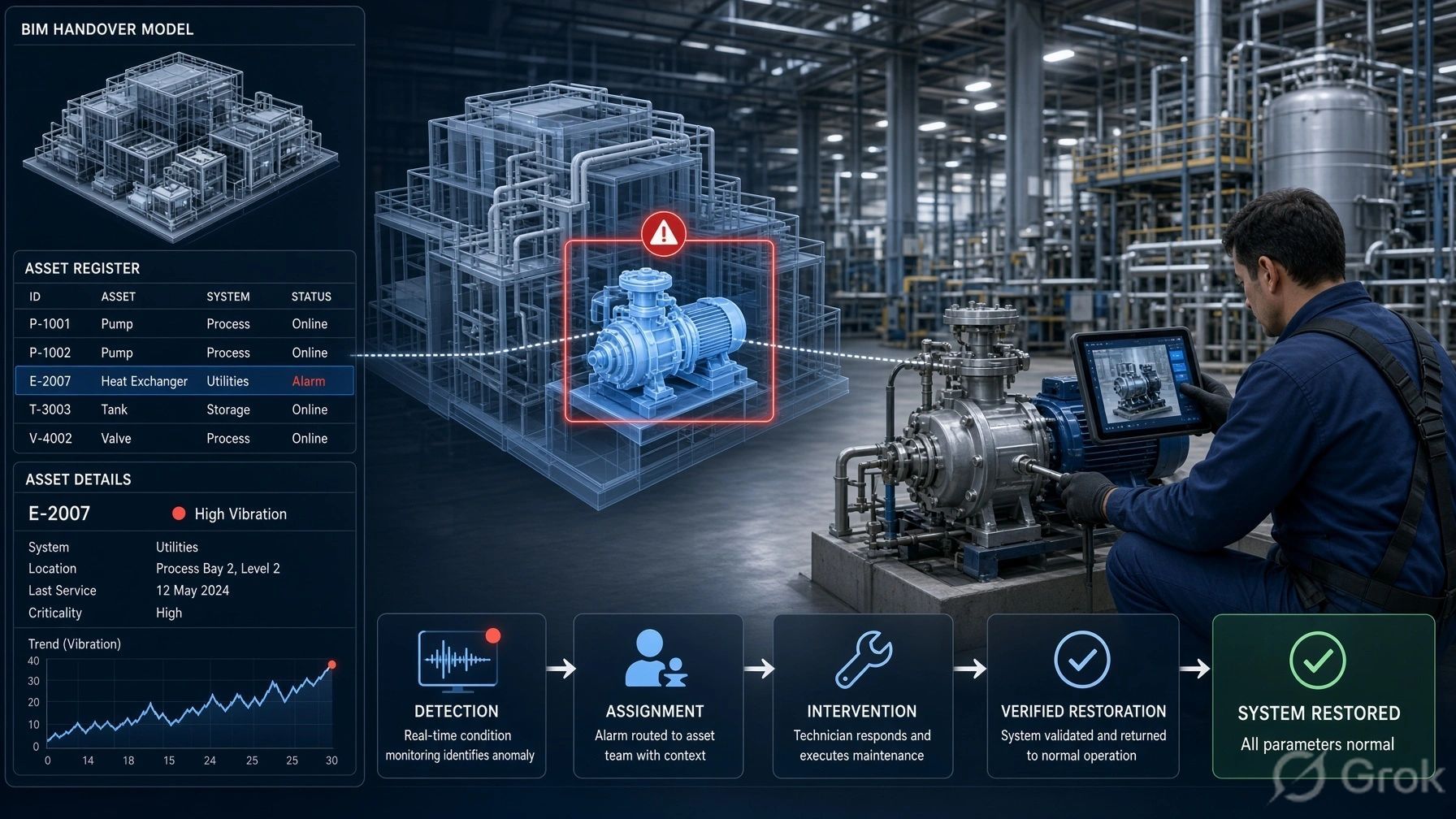
Most digital twins are designed to preserve changes in physical state:
- when a component failed;
- when an inspection was completed;
- when a sensor crossed a threshold;
- when equipment was replaced;
- when a facility returned to service.
This history helps reconstruct what happened to the asset.
However, operational decisions are rarely based on physical conditions alone. They are also shaped by regulations, permits, contracts, engineering standards, safety procedures and organizational authority.
Consider a pressure reading from an industrial asset.
The reading itself may not change. But the action it requires could depend on:
- the operating limit applicable on that date;
- the version of the safety procedure then in force;
- the asset’s permit conditions;
- the maintenance contract;
- the authorized decision-maker;
- temporary restrictions introduced after an incident.
A later user should be able to see more than the pressure reading and resulting work order.
They should be able to determine why that action was considered correct at that particular time.
The latest rule can erase yesterday’s reasoning
A recent climate-reporting example illustrates the problem.
A corporate greenhouse-gas reporting deadline in California was initially set for August 2026 and later moved to November. A platform showing only the revised deadline would present November as the current truth.
But that would not explain actions taken while the August deadline was still considered applicable.
Teams may already have commissioned assurance work, collected evidence, approved budgets or accelerated submissions based on the earlier requirement.
Neither deadline should simply overwrite the other.
The system needs to preserve:
- what was announced;
- when it was announced;
- when it was expected to take effect;
- when it was revised;
- which organizations were affected;
- what decisions were made before the revision;
- whether those decisions were later changed.
This is not merely document version control. It is the preservation of decision context.
Rules have their own lifecycle
A rule does not move directly from “absent” to “applicable.”
It may pass through several states:
Proposed → published → effective → amended → superseded → withdrawn
These states matter.
A draft regulation may influence planning without creating a legal obligation. A published standard may allow a transition period. An expired permit condition may still be relevant to an investigation covering the period when it was active.
A decision-ready twin must therefore distinguish between two timelines:
The rule timeline: When was the rule valid in the real world?
The system timeline: When did the organization learn, record, interpret or update it?
This distinction becomes important when information arrives late.
Suppose a permit amendment becomes effective on 1 June but is entered into the platform on 10 June. The twin should not pretend that the organization knew about it on 1 June. It should preserve both dates.
That difference can reveal a compliance gap, a communication failure or a delay in updating an operating procedure.
Applicability is as important as version
Knowing that a rule existed is not enough. The platform must determine what it applied to.
The same regulation may affect one facility but not another. A technical standard may apply only to assets installed after a certain date. A contract clause may govern one contractor, service zone or category of failure. A permit condition may become active only during particular operating circumstances.
The digital twin therefore needs to connect each rule to:
- jurisdiction;
- organization;
- facility;
- asset or system;
- activity;
- operating condition;
- effective period;
- responsible party;
- required evidence;
- approval authority.
This creates a temporal applicability layer around the physical twin.
The twin can then answer a more useful question than, “What is the current requirement?”
It can answer:
“Which requirement applied to this asset, under these conditions, when this decision was made?”
From a digital twin to a decision record
Preserving time-valid rules changes the architecture of the twin.
A maintenance event, environmental submission or operational approval should carry a traceable decision chain:
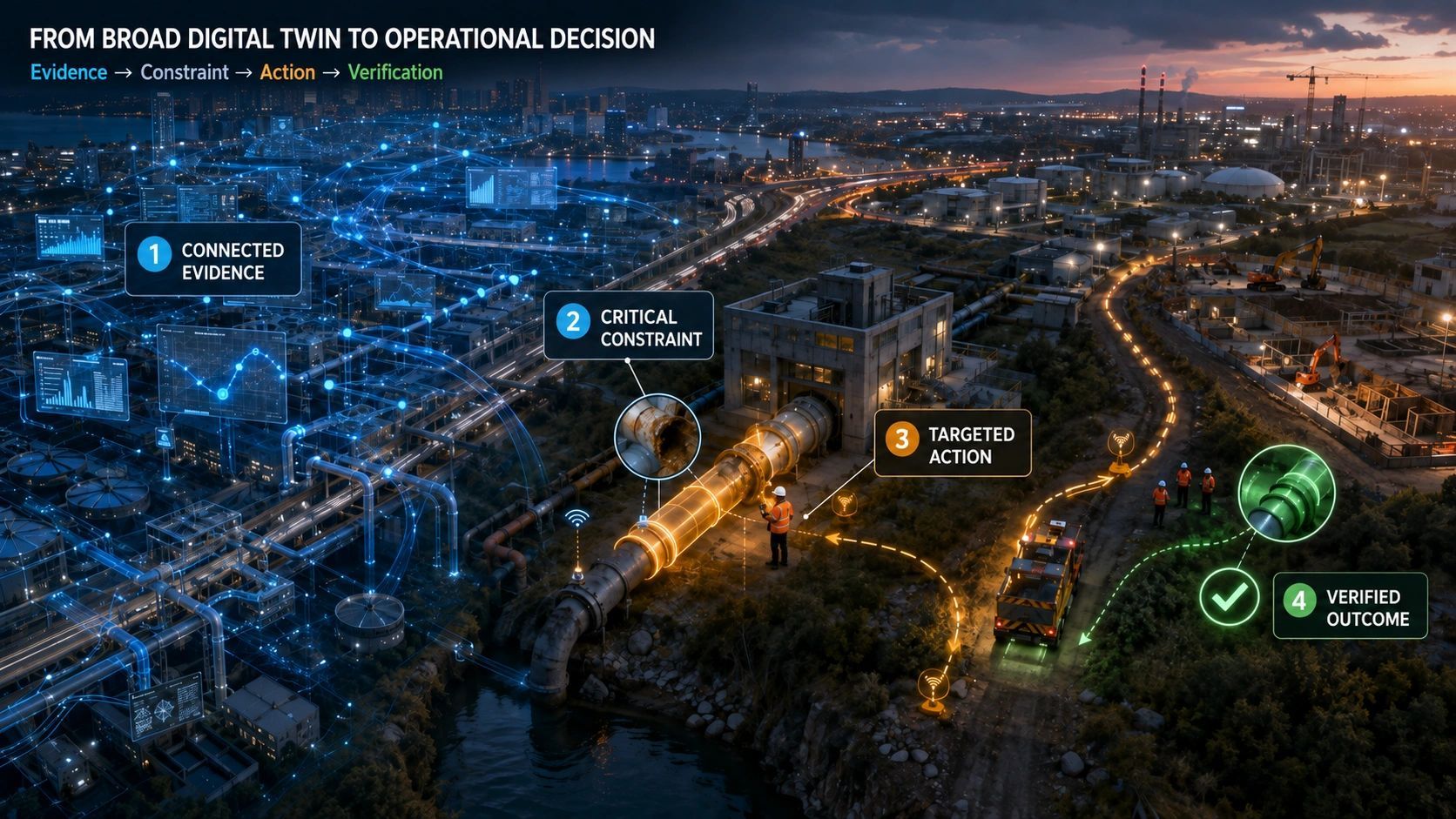
Condition observed → applicable rule identified → interpretation recorded → responsible authority confirmed → action approved → evidence collected → outcome verified → record preserved
Each step should retain its own timestamp, source, status and responsible party.
The system should also separate the source rule from its interpretation. Regulations and standards often require professional or legal judgement. A technology platform should not silently present its interpretation as definitive authority.
It should record:
- the original source;
- the applicable version;
- the interpretation used;
- who provided that interpretation;
- who approved the resulting decision;
- any uncertainty or exception;
- subsequent amendments.
The twin does not replace regulators, engineers, auditors or legal advisers. It gives their decisions a structured operational context.
The same requirement appears across sectors
This architecture extends well beyond climate disclosure.
In infrastructure, it can preserve the engineering standard used when an asset was inspected or repaired.
In buildings, it can show which fire, energy or accessibility requirement governed a design approval.
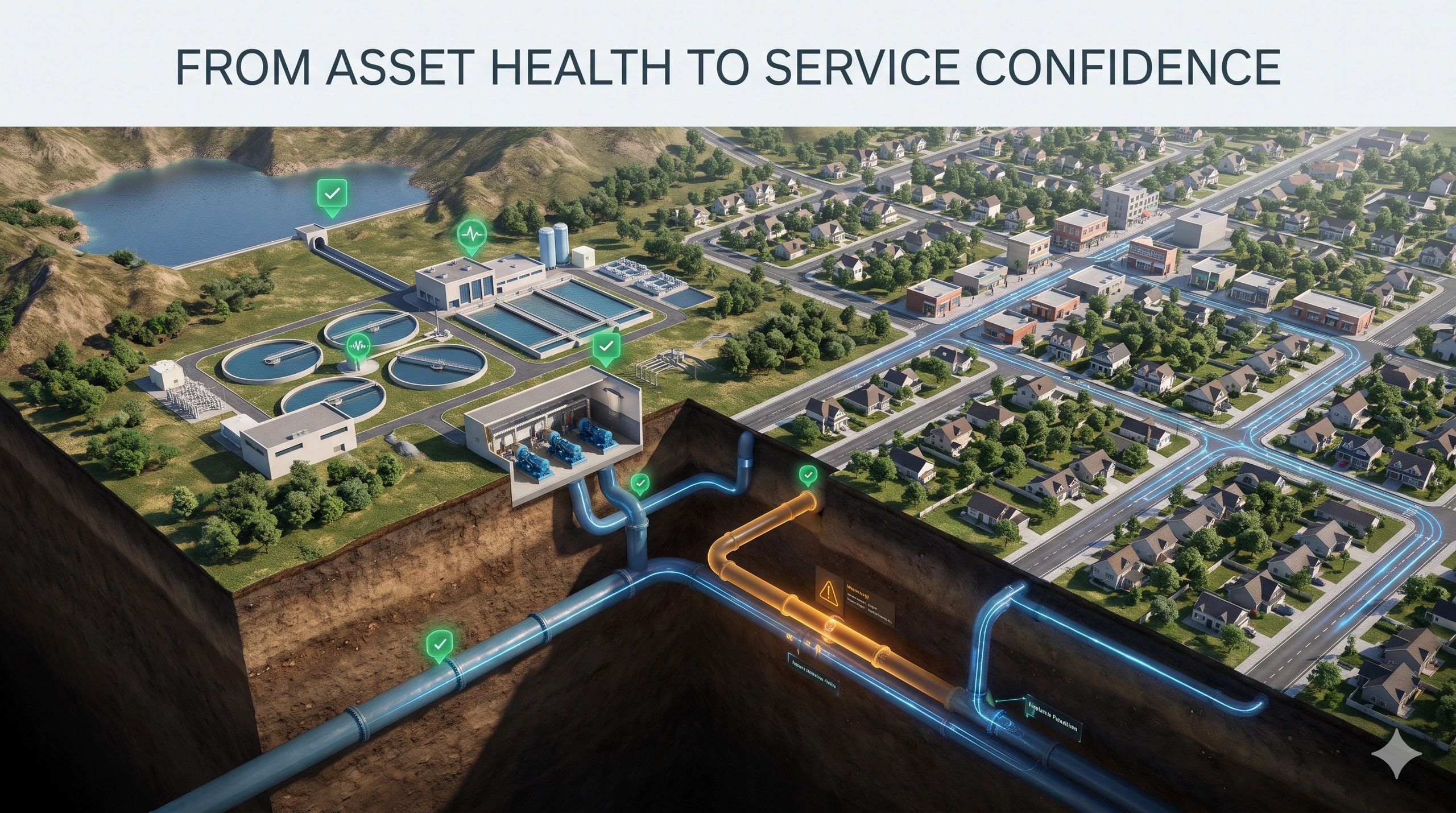
In utilities, it can connect an operational event to the service standard and contractual responsibility active at the time.
In UAV operations, it can preserve the permissions, airspace restrictions and operating conditions governing a particular flight.
In environmental management, it can relate a discharge, emission or land-use event to the permit threshold then in force.
In carbon MRV, it can preserve the methodology, reporting boundary, emission factors and evidence requirements used for each submitted figure.
Without this temporal context, a digital twin may show an accurate physical history while providing an incomplete account of accountability.
What this means for implementation
Organizations do not need to model every regulation from the beginning.
A practical starting point is to select one high-consequence workflow, such as emissions reporting, safety inspection, permit compliance or maintenance authorization and identify:
- Which rules influence the decision?
- Who determines their applicability?
- How are changes communicated?
- Which version is used in each transaction?
- What evidence proves compliance?
- Can the earlier decision be reconstructed after the rule changes?
The goal is not to turn the digital twin into a legal database.
The goal is to connect changing obligations to the assets, locations, events, people and evidence they govern.
The next stage of digital-twin trust
Digital twins are moving from visual representations toward operating systems that influence real decisions.
As their authority grows, current-state accuracy will not be sufficient.
A trusted twin must preserve what was known, what was applicable, who interpreted it and why an action was authorized at that moment.
Otherwise, it may tell us what the asset looked like but not whether the decision around it was valid.
The next digital twin must preserve physical state, operational action and governing context together.
Because the rule that matters in an audit, dispute or investigation is not necessarily the rule displayed today.
It is the rule that was true at the time.