
Opening Reflection
Digital transformation is often presented as a software journey.
We talk about Artificial Intelligence, Digital Twins, autonomous systems, predictive maintenance and real-time operational intelligence. But every one of these systems depends on something much more physical: the ability to continuously sense what is happening in the real world.
Buildings need to report strain and moisture.
Agricultural fields need to communicate soil conditions.
Supply chains need to track temperature and humidity.
Cities need to observe infrastructure, assets and environmental change.
The problem is not always the sensor itself. The problem is keeping millions of sensors alive.
Wiring them is often impractical. Batteries eventually fail. Replacing those batteries across factories, farms, bridges, warehouses and urban infrastructure creates a maintenance burden that can undermine the entire business case.
This creates an uncomfortable question:
What happens when the intelligence layer of our physical infrastructure becomes limited by something as basic as battery replacement?
Ambient Backscatter Communication offers a different answer.
Instead of designing sensors that consume less power, it asks whether they need their own power source at all.
The Technological Shift: From Active Transmission to Ambient Reflection
Traditional wireless devices generate their own radio signals.
A sensor takes a measurement, processes it and transmits the information using energy stored in a battery or supplied through a wired connection.
Ambient Backscatter Communication, or AmBC, works differently.
The environment around us is already filled with radio-frequency signals from Wi-Fi routers, television broadcasts, cellular networks and other communication infrastructure.
An ambient backscatter device does not create a new radio wave. It uses the radio waves already present.
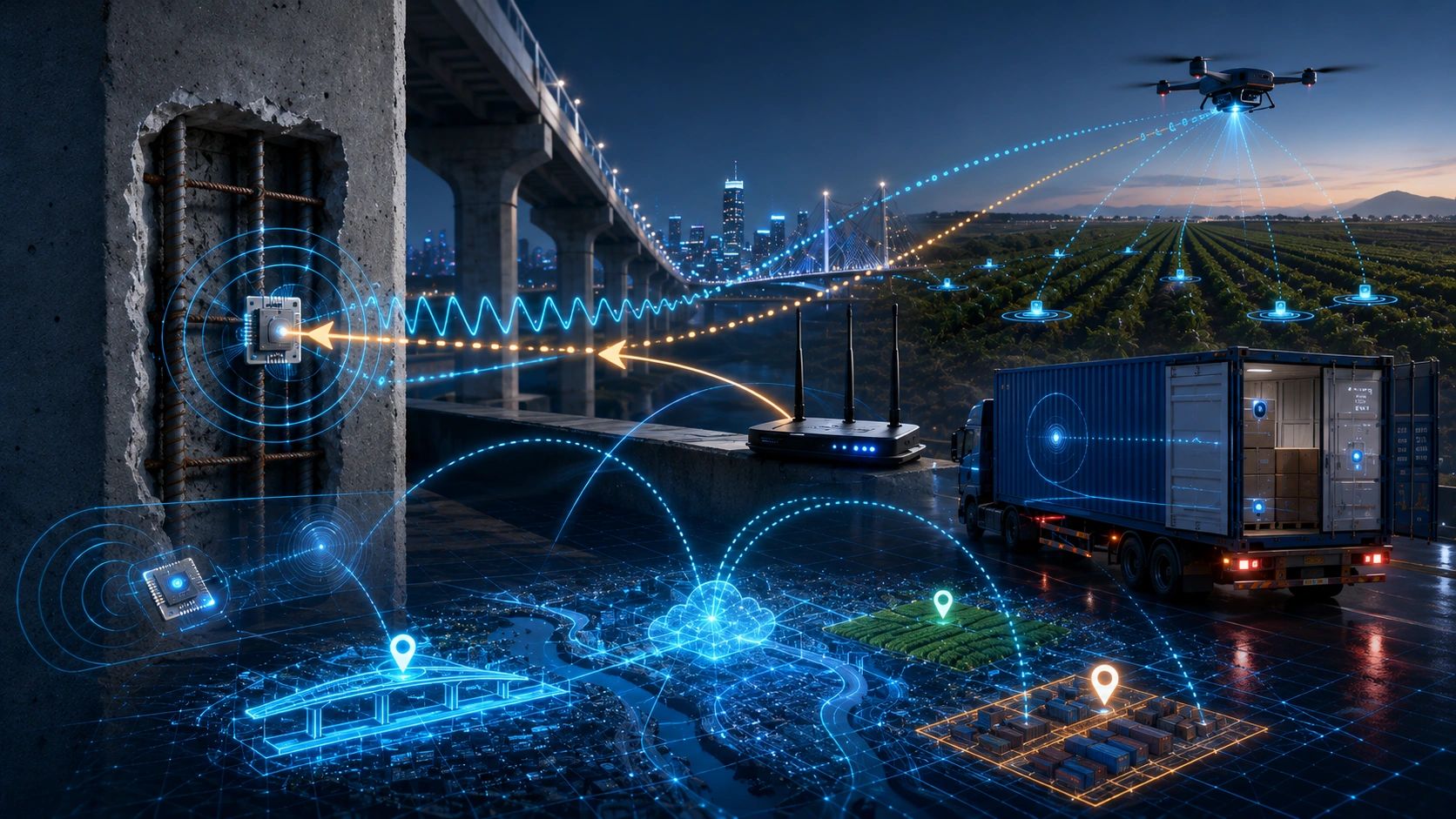
The sensor harvests a small amount of energy from the surrounding signal to activate its microchip, take a measurement and modify the reflected signal. This reflected, or backscattered, wave carries the sensor’s data to a nearby receiver.
The sensor effectively behaves like an intelligent mirror.
It does not need to shout across the network. It changes the reflection of a signal that is already passing through its environment.
This approach introduces the possibility of Zero-Power IoT: connected devices that operate without conventional batteries and can remain in place for long periods with little or no routine power maintenance.
The shift may appear technical, but its consequences are strategic.
The cost of sensing is no longer determined only by the price of the sensor. It is also shaped by installation, wiring, battery replacement, site access, labor, downtime and the operational risk of devices silently going offline.
Remove the battery, and the economics of large-scale sensing begin to change.
The Deeper Question: Can Infrastructure Become Permanently Observable?
Most Digital Twins are limited by the frequency and reliability of their physical data.
A model may be visually detailed and analytically sophisticated, but it cannot remain operationally accurate if its sensors fail, lose power or become too expensive to maintain.
This is why many Digital Twin projects begin with high expectations and gradually lose value.
Sensors stop reporting.
Maintenance teams delay replacements.
Data gaps increase.
The twin remains visible on the screen, but its connection to physical reality becomes weaker.
Zero-Power IoT changes the question from:
“How frequently can we maintain the sensing network?”
to:
“How densely and permanently can we instrument the physical world?”
That is a major change in thinking.
A Digital Twin supported by battery-dependent sensors is still connected to a maintenance calendar. A twin supported by embedded, battery-less sensing could remain connected to the asset throughout its useful life.
The digital representation would no longer depend only on periodic inspections or scheduled data collection. It could receive continuous or event-based evidence from sensors that were designed to remain with the asset from construction to decommissioning.
The Spatial Intelligence Perspective
Zero-Power IoT becomes especially valuable when combined with spatial intelligence.
A sensor reading without location has limited meaning.
Moisture is not simply detected. It exists inside a particular wall, column, soil zone, shipment container or infrastructure component.
Temperature is not merely high. It is high at a specific point within a supply chain.
Structural strain is not an isolated number. It relates to a particular component, load condition, maintenance history and surrounding environment.
Geospatial systems and Digital Twins provide the context required to transform these readings into decisions.
Each battery-less sensor can be associated with a physical coordinate, asset ID, BIM element, agricultural management zone or logistics unit.
The resulting architecture connects three layers:
The sensor observes a condition.
The spatial model explains where that condition exists.
The intelligence layer determines what it means and what should happen next.
This is where Zero-Power IoT moves beyond being a communication technology. It becomes part of a wider spatial decision system.
Real-World Implication: From Buildings to Fields and Supply Chains
Consider a concrete column in a large building.
Sensors could be embedded during construction to observe internal moisture, micro-strain or other structural conditions. Once the concrete is poured, accessing those sensors becomes difficult.
A conventional battery creates a predictable point of failure.
A zero-power sensor, however, could remain embedded for decades, providing information across the building’s operational life. Within the BIM or Digital Twin environment, the sensor reading could be linked directly to the relevant structural component.
The building would not simply have a digital model. Parts of the building could continue communicating their internal condition.
Agriculture presents another powerful use case.
Thousands of small sensors could be distributed across a large field to capture local soil conditions. Maintaining batteries across such a wide area would be expensive and operationally difficult.
A UAV could provide the temporary radio-frequency energy required to activate the sensors while flying over the field. It could collect the backscattered readings, geotag them and update the agricultural Digital Twin.
The same UAV would therefore perform three functions: provide the communication opportunity, collect the data and map the observations spatially.
Supply chains offer a third example.
Sensitive cargo may need temperature and humidity monitoring across warehouses, containers and transportation environments. Battery-less devices could harvest available radio-frequency energy and communicate changing conditions without depending on regular charging or battery replacement.
Instead of using a tag only to identify the shipment, the tag could become a lightweight condition-monitoring node.
The supply chain would gain not only traceability, but contextual evidence about what the shipment experienced along its journey.
Strategic Insight: “Deploy and Forget” Changes the Business Model
The largest cost in an IoT deployment is not always the initial installation.
It is often the long-term effort required to keep the system functioning.
Every battery introduces a future task.
Someone must identify the failure, access the device, replace the battery, test the sensor and confirm that communication has resumed.
Multiply this process across tens of thousands of devices, and an apparently smart infrastructure project becomes a recurring maintenance programme.
Zero-Power IoT changes this operational equation.
It makes highly dense sensing networks more realistic. It allows sensors to be placed in inaccessible or embedded locations. It reduces the number of maintenance interventions needed simply to preserve data continuity.
This can strengthen the business case for smart infrastructure, precision agriculture, industrial monitoring and large-scale Digital Twins.
But the strategic value goes beyond cost reduction.
A long-lived sensing layer creates a longer-lived evidence layer.
When physical conditions can be observed across years or decades, organizations gain a historical record of how assets age, how environments change and how interventions affect performance.
AI models can learn from this continuity.
Digital Twins can compare current conditions with long-term patterns.
Maintenance decisions can become more evidence-based.
The value is therefore not only that the sensor survives without a battery. The value is that organizational intelligence no longer disappears when the battery dies.
Closing Reflection
The future of IoT may not be defined by more powerful devices.
It may be defined by devices that demand almost nothing from us.
No charging schedule.
No battery replacement programme.
No routine site visit simply to keep the sensor alive.
Ambient Backscatter Communication introduces the possibility of a sensing layer that quietly remains within buildings, landscapes, infrastructure and supply chains, observing conditions and reflecting information whenever communication becomes possible.
For Digital Twins, this could close one of the most persistent gaps between digital ambition and physical operation.
A twin cannot remain intelligent if the physical world stops speaking to it.
Zero-Power IoT gives that physical world a way to keep communicating.
And when sensors no longer need batteries, the question is no longer how many devices we can maintain.
The question becomes how much of the physical world we are prepared to make permanently observable.