
Opening Reflection
A city rarely fails one asset at a time.
A pressure drop in one pipe affects another. A traffic accident at one junction changes movement across several neighborhoods. A sudden fall in solar generation forces decisions elsewhere in the power network.
Yet many digital systems still observe these events as isolated signals.
They can show where something happened and when a value changed, but often struggle to understand how an event travels through a connected physical system over time.
What changes when artificial intelligence begins to understand both the geometry of infrastructure and the timing of its behavior?
Context: The Technological Shift
Digital Twins are becoming richer. GIS provides geographic context. BIM describes physical assets and relationships. IoT sensors stream operational data. AI identifies patterns and anomalies.
But these technologies do not automatically create connected intelligence.
Computer-vision models work well with regular grids such as satellite-image pixels. Time-series models can study how an individual sensor changes. Real infrastructure, however, is neither a flat image nor a collection of independent sensors.
It is a network.
Pumps connect to pipes. Roads connect to intersections. Power relays connect to feeders. HVAC equipment connects to ducts, rooms and controls.
What happens at one point may affect another after a delay shaped by distance, flow, capacity and operating conditions.
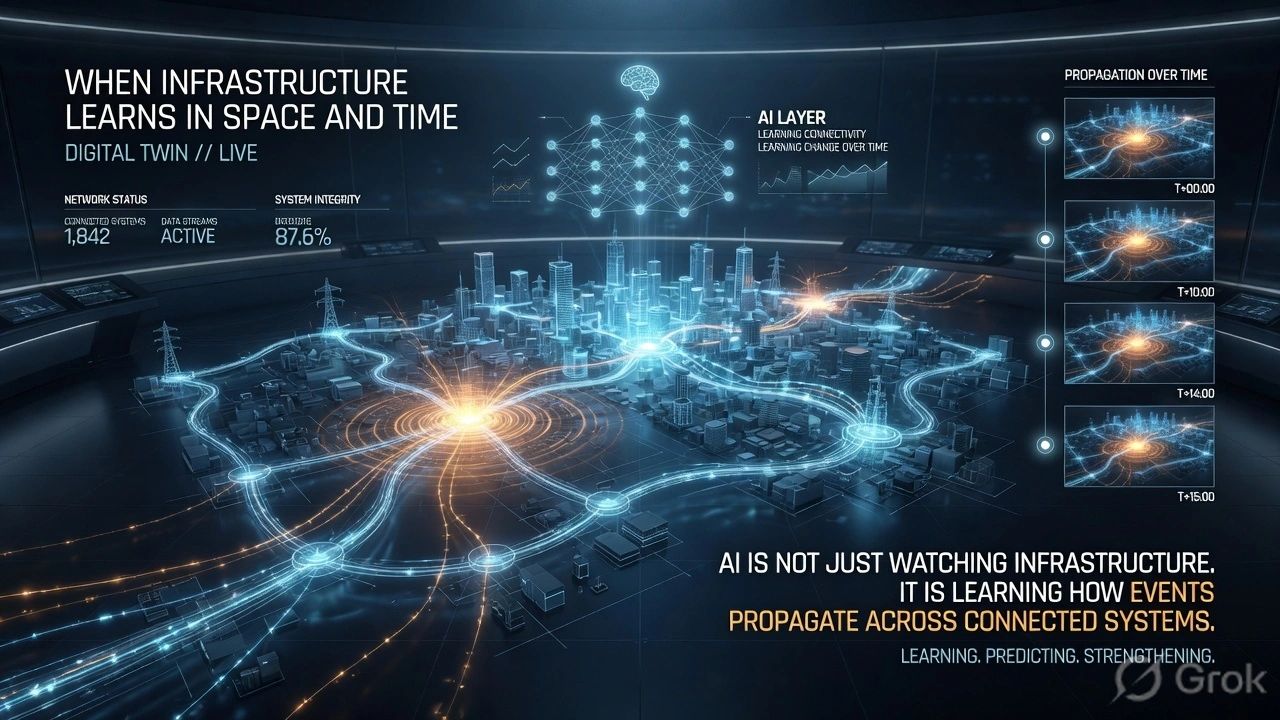
Spatiotemporal Graph Neural Networks, or STGNNs, are designed for this problem.
They process information across space and time. Assets become nodes, while physical or functional connections become edges. Real-time observations are attached to those nodes, allowing the model to learn how conditions propagate through the network.
An STGNN does not only ask:
“What is happening at Valve A?”
It also asks:
“What is Valve A connected to, how quickly can its condition influence Pipe B, and what is likely to happen next?”
The Deeper Question
This introduces a more important question than prediction:
Does understanding a network’s behavior mean understanding the system?
A model may identify that a disruption will spread. But infrastructure is not only physical. It is also operational, social and institutional.
A water network serves communities. A road network carries emergency vehicles, workers and goods. An electrical grid supports hospitals, homes and factories.
Two failures with the same technical severity may therefore have very different human consequences.
STGNNs can reveal how risk moves across a network. They cannot, by themselves, decide which consequences matter most.
That depends on safety, fairness, public value and accountability.
This is where GeoThinking becomes important.
Spatial intelligence should not only predict the movement of pressure, traffic or electricity. It should help us connect technical relationships to human outcomes.
Spatial Intelligence Perspective
Geospatial systems have traditionally focused on position:
Where is the asset?
Where did the incident occur?
Which area is affected?
The next stage is relational:
What is connected to the asset?
Which dependencies are upstream or downstream?
How does influence move through the system?
At what speed?
Who or what will be affected next?
STGNNs bring this relational and temporal reasoning into the Digital Twin.
GIS provides network and geographic context. BIM or asset models provide physical structure. IoT supplies changing conditions. The neural network studies the graph and learns how anomalies, demand or failures ripple through it over time. The concept positions this as the layer that moves a Digital Twin beyond monitoring towards prediction.
A conventional dashboard shows the present state.
A spatiotemporal model begins to estimate the next state.
The value is not a more advanced visualization. It is the ability to turn connected spatial data into foresight.
Real-World Implication
Consider a smart water network.
A traditional platform may alert an operator after pressure falls below a threshold. An STGNN can examine pressure across the connected topology, estimate how the disturbance may spread and indicate which downstream components face greater risk.
This can support a planned sequence of valve operations to reduce water loss and service disruption.
In an urban traffic network, intersections become nodes and roads become edges. A collision at one location can create congestion elsewhere after different delays.
By learning these patterns, an STGNN can forecast the likely cascade and support earlier rerouting of public transport, emergency response, delivery fleets or UAV operations.
In an energy network, the model can connect changing solar generation, weather observations, local demand and grid topology.
Instead of reacting after instability appears, operators may anticipate where load stress will emerge and rebalance the network earlier.
The same logic can apply to buildings and industrial plants, where temperature, airflow, occupancy, equipment condition and control actions interact across connected systems.
Across these examples, the core capability is the same:
An event has a location, a history, a direction and a path of influence.
Insight: The GeoThinking Perspective
The deeper significance of STGNNs is not simply that they make Digital Twins “smarter.”
They challenge us to stop treating space as a static background and time as a simple timestamp.
Space defines relationships.
Time reveals change.
Together, they begin to describe causality.
But this intelligence is only as reliable as the graph beneath it.
Missing connections, outdated asset records, poor sensor coverage or incorrect assumptions about flow can produce misleading predictions.
A highly advanced model operating on an incomplete representation of reality may still produce confident but unreliable recommendations.
The future of predictive Digital Twins will therefore depend on more than algorithms.
It will require trustworthy spatial models, persistent asset identity, good sensor governance, explainable outputs and clear human authority over operational decisions.
The goal should not be to create an automated oracle.
It should be to create a system that helps people see emerging consequences early enough to act responsibly.
Closing Reflection
Infrastructure is not a collection of objects.
It is a living network of dependencies.
A pump matters because of what it supplies. An intersection matters because of the movement it enables. A power relay matters because of the services that depend on it.
STGNNs offer a way for machines to learn these connected behaviours across space and time.
Their promise is not merely better prediction. It is a more realistic form of spatial intelligence, one that recognizes that change travels and every local event belongs to a wider system.
The next generation of Digital Twins may not be defined by how accurately they reproduce the visible world.
They may be defined by how well they understand what the world is connected to, how it is changing and what those changes mean for the people who depend on it.