
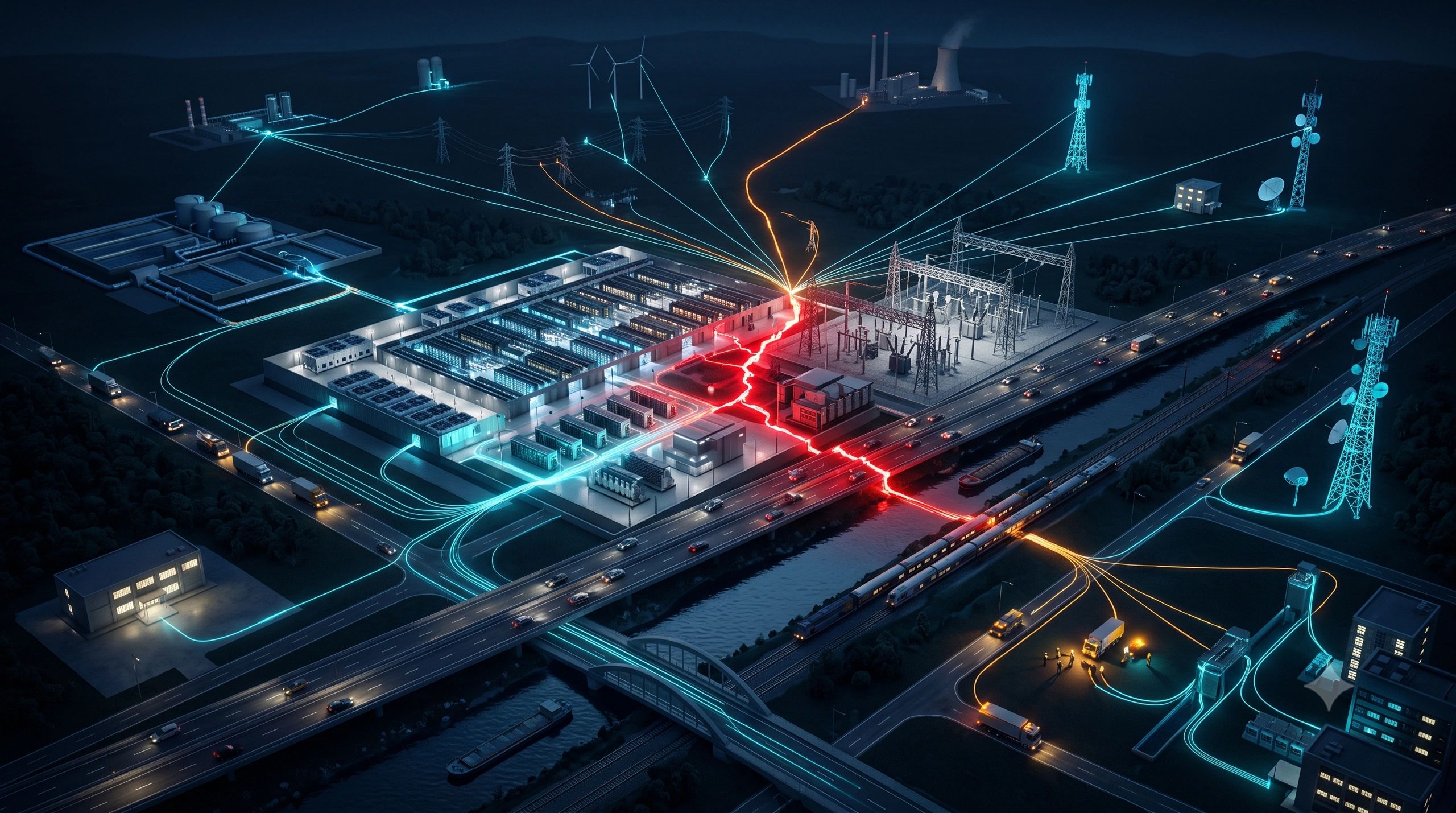
A data center may appear fully operational in its digital twin while the substation supplying it is approaching capacity.
A transmission tower may be structurally sound but unreachable because flooding has cut off its access road.
A smart traffic signal may have no physical defect, yet remain unavailable because its communications service, software license, or maintenance contract has expired.
In each case, the asset is visible. The operational risk is not.
Most digital twins are designed around assets: buildings, machines, roads, pipelines, substations, equipment and other physical objects. They describe location, geometry, condition and performance.
That remains useful. But infrastructure does not operate as a collection of independent assets. It operates through dependencies.
The next generation of digital twins must therefore answer a harder question:
What must continue working around this asset for it to deliver its intended outcome?
An asset rarely fails alone
A data center depends on electricity, water, cooling equipment, fiber connectivity, permits, software, suppliers and specialist maintenance teams.
A renewable-energy project depends on grid connectivity, land rights, weather data, equipment availability and power-purchase obligations.
A transmission corridor depends on towers and conductors, but also on access routes, vegetation control, communications, inspection capacity and replacement materials.
Even a carbon-reduction claim has dependencies. It may rely on installed equipment, production records, emission factors, supplier data, sensor readings and verification evidence.
This means an operational problem may originate outside the asset being monitored.
A pump can be healthy while its electricity supply is unstable. A building can be complete while its occupancy approval remains pending. A solar installation can be generating power while its expected emissions reduction cannot be verified because the baseline data is incomplete.
An asset-centric twin may report all three assets as operational.
A dependency-aware twin would reveal the wider risk.
From asset register to dependency register
Traditional asset registers document what an organization owns or operates. A spatial dependency register would document what each asset relies on.
For every critical asset, it could connect:
- Physical and digital dependencies
- Responsible organizations and individuals
- Utility capacity and service conditions
- Contracts, permits and commitments
- Suppliers and specialist resources
- Operational milestones
- Evidence sources
- Current risks and exceptions
- Recovery and closure records
Consider a developer committing to fund the grid infrastructure required for a major data-center development.
Recording the commitment in a report is not enough. It needs to be connected to the affected substation, expected load growth, capacity milestones, funding responsibility, cost allocation and evidence that the promised upgrade was completed.
If a milestone is missed, the organization should be able to see which assets, communities, customers and delivery schedules are affected.
The digital twin then becomes more than a model of infrastructure. It becomes a way of tracing obligations and consequences across infrastructure.
Dependencies cross organizational boundaries
Many critical dependencies are not controlled by the asset owner.
A data-center operator may depend on a public utility. A construction project may depend on government approvals. A transport operator may depend on a telecommunications provider. A utility may depend on external weather, satellite or Earth-observation services.
This creates a governance challenge.
Who owns the dependency?
Who is responsible for monitoring it?
What service level or contractual condition applies?
What evidence is acceptable when the dependency is restored?
These questions cannot be answered by geometry or sensor data alone. They require the twin to connect spatial information with contracts, workflows, documents, enterprise systems and field evidence.
That is why interoperability is becoming central to digital-twin value.
The twin does not need to replace enterprise resource planning, asset management, service management, document control or contractor platforms. It needs to preserve spatial and operational context as information moves between them.
A spatial event must become an operational workflow
Recent developments in enterprise GIS show a clear direction: location intelligence is moving into service-management and real-time operational environments.
This matters because detecting a problem is only the beginning.
A flood alert affecting a transmission corridor must become an assessment task. Satellite radar detection must be linked to the correct tower or line. Access conditions must be checked. A UAV or field inspection may need to be assigned. An engineer must review the evidence. Repairs must be prioritized, and restoration must be verified.
The operational chain could be:
Hazard → exposed dependency → affected asset → responsible team → controlled intervention → recovery evidence
Without this workflow, the digital twin may show where something happened but still fail to help the organization resolve it.
A decision-ready twin should show not only the affected asset, but also which upstream and downstream services are at risk, who has authority to intervene and what evidence is required before closure.
Dependencies also include external intelligence
Infrastructure is increasingly dependent on data sources that sit outside conventional asset-management systems.
Power-grid operators may use weather forecasts, satellite imagery, vegetation intelligence and geomagnetic-risk information. Ports depend on tides, weather, logistics systems and navigation services. Construction teams depend on BIM models, schedules, approvals, supplier information and field observations.
These external sources introduce their own questions:
- Is the information current?
- Which asset or operational area does it affect?
- What confidence level does it carry?
- What decision can be made from it?
- Is additional verification required?
For example, synthetic-aperture radar can provide wide-area evidence of possible grid damage after storms, floods or landslides, even when clouds, hazardous conditions or blocked roads prevent immediate inspection.
However, detection becomes useful only when it connects to asset identity, engineering review, field verification, repair priority and restoration tracking.
The external data source is therefore not merely an additional layer on a map. It is part of the operational dependency chain.
A practical dependency model
Organizations do not need to map every possible relationship at once. They can begin with one high-value service, facility or infrastructure corridor.
A practical implementation can follow five steps:
1. Define the operational outcome
Identify the service that must remain available, such as power delivery, water supply, building operation or transport movement.
2. Map critical dependencies
Connect the assets to utilities, systems, suppliers, contracts, permits, data sources and specialist teams needed to sustain that outcome.
3. Assign ownership and thresholds
Establish who monitors each dependency, what acceptable performance looks like and when escalation is required.
4. Connect events to workflows
Convert dependency failures into incidents, inspections, field assignments, approvals and corrective actions.
5. Preserve recovery evidence
Record what was done, who authorized it and whether the intervention restored the expected performance.
The result is not simply a more detailed digital model. It is a clearer operating system for resilience.
The strategic shift
Digital twins have spent years improving the representation of assets. The next competitive advantage will come from representing the relationships that allow those assets to function.
This changes how resilience is understood.
Resilience is not only the condition of a bridge, building, grid or factory. It is the continued availability of the connected services, people, permissions, information and obligations surrounding it.
A dependency-aware twin helps organizations see where a local disruption could become a wider operational failure. It also shows where intervention will produce the greatest value.
The future digital twin will still map assets.
But its real intelligence will come from mapping what those assets cannot operate without.