
For years, the digital-twin conversation has been driven by an ambitious idea:
Build one complete virtual representation of a city, factory, airport, utility network or infrastructure system.
The model would contain every asset, sensor, process, document and operational dependency. It would provide a single interface through which teams could understand and manage the entire physical environment.
The vision is attractive.
But in practice, trying to build one enormous digital twin often creates another monolithic enterprise system—expensive to implement, difficult to maintain and too complex to adapt when operational priorities change.
The future may follow a different path.
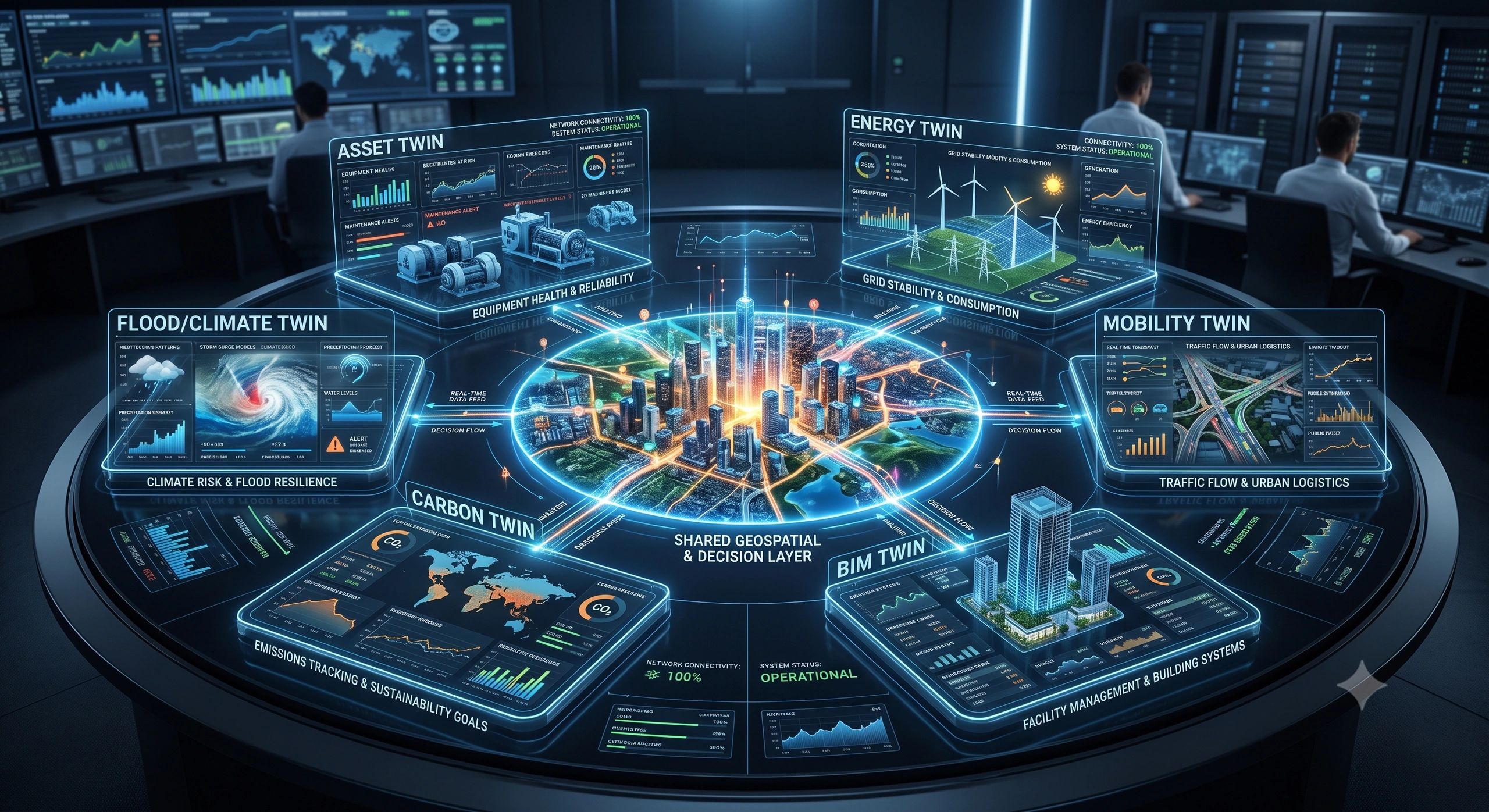
Instead of one digital twin containing everything, organizations may operate a federation of smaller, purpose-built twins that work together when a decision crosses domains.
The future of digital twins is composable, not monolithic.
One organization, many operational realities
Consider a large airport.
Its engineering team needs to understand buildings, utilities and equipment.
Its energy team needs to monitor consumption, peak demand and renewable-energy availability.
Its operations team needs visibility into passenger movement, baggage flow, ground vehicles and turnaround times.
Its sustainability team needs evidence on energy, water, waste and carbon emissions.
Its emergency team needs to understand access routes, affected assets and response resources.
These teams may operate within the same physical environment, but they do not need exactly the same digital twin.
They need different intelligence systems designed around different decisions.
An asset twin may track equipment condition and maintenance history.
An energy twin may forecast power demand.
A logistics twin may monitor the movement of vehicles, materials or baggage.
A BIM twin may identify the physical location and technical properties of affected components.
A carbon twin may calculate the emissions impact of an operational change.
A mobility twin may simulate passenger or vehicle movement.
The value appears when these twins can exchange trusted context and support a coordinated decision.
Composable does not mean disconnected
A composable digital-twin architecture is not simply a collection of separate dashboards.
The individual twins must share a common operational foundation.
That foundation begins with identity.
A transformer represented in the energy twin must be recognizable as the same transformer represented in the maintenance system, GIS platform, BIM model and carbon inventory.
A road segment used by a flood model must correspond to the same road segment used by the traffic, maintenance and emergency-response systems.
Without persistent asset and location identities, the organization creates multiple digital versions of the same physical object. Each system may describe it differently, update it at a different time and apply different assumptions.
The result is not composability. It is fragmentation.
The second requirement is a shared geospatial foundation.
Location provides the context through which different domains connect. Buildings, networks, equipment, environmental conditions, communities and operational events all exist somewhere.
Geospatial logic allows an organization to ask questions such as:
Which assets are located inside the projected flood zone?
Which facilities depend on a transformer approaching its capacity limit?
Which maintenance activities will affect road access, power supply or production?
Which communities are exposed if an industrial process exceeds an environmental threshold?
Geography becomes the joining layer between otherwise separate twins.
Decisions rarely remain inside one domain
Most operational problems begin in one system but quickly cross into others.
Imagine that an extreme-rainfall forecast indicates possible flooding near an industrial facility.
The flood twin estimates the likely depth and extent.
The geospatial layer identifies the buildings, roads and utilities within the affected area.
The BIM twin locates critical equipment inside those buildings.
The asset twin provides condition, ownership and maintenance information.
The energy twin estimates the effect of shutting down or isolating equipment.
The logistics twin identifies alternative access routes.
The carbon twin calculates whether backup generators or changed production schedules will affect emissions targets.
The organization does not need one giant model running all these functions continuously.
It needs specialized twins that can be composed around the decision being made.
This changes the objective of digital-twin architecture.
The goal is no longer to place every available dataset inside one platform.
The goal is to enable the required systems to assemble the right context, at the right time, for a specific operational decision.
Start with a decision, not a digital replica
The composable model also offers a more practical implementation path.
Many digital-twin programmes struggle because they begin with an excessively broad objective: replicate the entire facility, network or city.
This creates large data requirements, integration complexity and long implementation timelines before the organization sees measurable value.
A composable approach allows the organization to begin with one high-value use case.
A utility might start with transformer-health monitoring.
A city might begin with flood exposure for one vulnerable corridor.
A factory might connect production assets with energy consumption.
An airport might focus on ground-equipment movement and turnaround delays.
A data-center developer might combine site suitability, grid capacity, water stress and construction carbon.
Once the first twin produces a useful operational outcome, another domain can be connected.
The architecture expands through proven value rather than through an attempt to model everything in advance.
This reduces implementation risk and creates a clearer business case for each new component.
The role of governance and provenance
Composable twins also require strong governance.
When several systems contribute to a decision, users must be able to understand:
Where did the data originate?
When was it captured?
Which model processed it?
What assumptions were applied?
Which assets and locations were affected?
What action was recommended?
Who approved the action?
What happened after implementation?
Without this chain of evidence, composability may increase technical connectivity without increasing trust.
This is especially important when digital twins support infrastructure investment, environmental reporting, safety, regulatory compliance or automated operations.
The decision layer must preserve provenance, not simply display the latest output.
A digital twin should therefore be understood as more than a 3D environment.
It is a traceable connection between physical evidence, analytical models, operational rules and human decisions.
Interoperability becomes the competitive advantage
The shift toward composable twins will also reshape the digital-twin market.
Organizations will continue to purchase specialized technologies from different providers:
satellite and SAR analytics, UAV inspections, IoT sensors, computer-vision models, BIM platforms, simulation engines, carbon-accounting tools and enterprise software.
Few organizations will replace all these systems with one vendor.
Their larger challenge will be making the systems work together without losing identity, provenance or operational context.
This creates an important role for geospatial workflow orchestration.
Such a layer can ingest physical-world data, identify affected assets, trigger analysis, assign field inspections, retain processing history and push verified outcomes into ERP, maintenance, compliance or command systems.
The most valuable platform may therefore not be the one that claims to contain the entire twin.
It may be the one that allows specialized twins, models and workflows to cooperate.
From digital twins to a decision ecosystem
The monolithic digital twin assumes that completeness creates intelligence.
The composable digital twin assumes that coordination creates intelligence.
That distinction matters.
A city does not need every dataset inside one enormous urban model. It needs its mobility, drainage, energy, building and climate systems to work together when a decision affects more than one of them.
A factory does not need one platform to replace every operational system. It needs production, quality, energy, maintenance and inventory intelligence to exchange context.
An airport does not need a digital replica for its own sake. It needs coordinated decisions across assets, people, logistics, safety and sustainability.
The next phase of digital twins will therefore be less about creating bigger models and more about designing better relationships between models.
Smaller twins can be developed independently.
They can evolve at different speeds.
They can use the most suitable technology for each domain.
They can be replaced without rebuilding the entire environment.
Most importantly, they can be composed around real decisions.
The next digital-twin challenge is not creating a larger model.
It is making smaller intelligence systems work together without losing identity, provenance or decision context.