
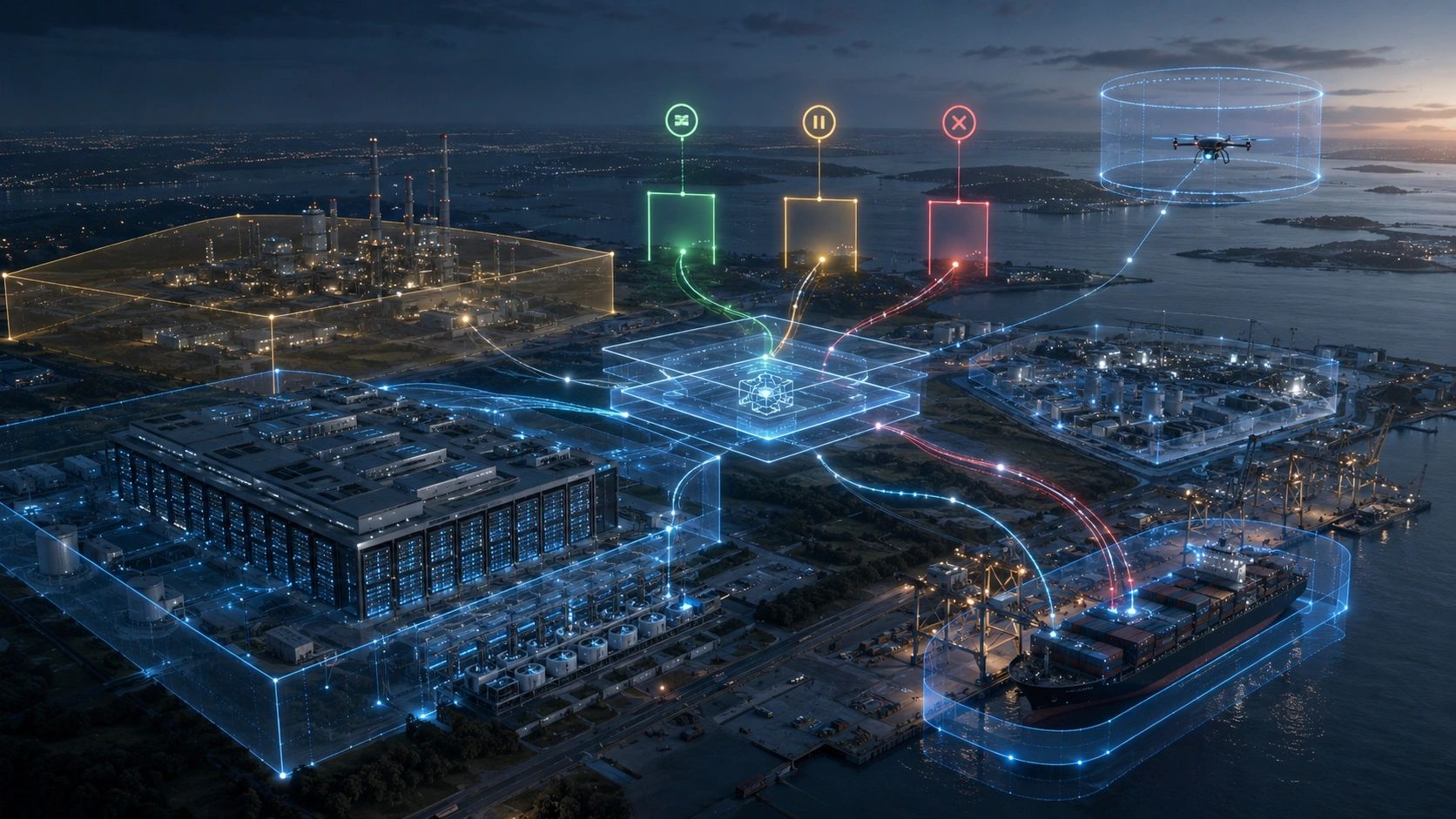
A digital twin may show that a data center is approaching its cooling limit.
It may identify an unregistered drone entering restricted airspace.
It may calculate the emissions produced during a ship’s voyage.
It may even confirm that an infrastructure project has reached a construction milestone.
But none of these observations, by themselves, determines what should happen next.
The next action depends on a different layer of information: operating boundaries.
These boundaries define what is permitted, required, funded, safe or commercially justified. They may come from physical capacity, regulations, contracts, access rights, financial thresholds or approval policies.
Most digital twins represent operating conditions well. Far fewer represent the boundaries within which decisions must be made.
That is the gap the next generation of digital twins must close.
A condition is not yet a decision
Conventional digital twins commonly answer three questions:
- What is happening?
- Where is it happening?
- Is the asset performing normally?
These are important questions, but an operational decision requires more context.
Suppose an AI facility is experiencing a sharp increase in computing demand. A monitoring system may know the available processing capacity, electrical load, cooling performance and current equipment health.
Yet workload placement must also consider:
- the maximum power available at each location;
- carbon intensity at that time;
- data-sovereignty requirements;
- service-level commitments;
- security classifications;
- whether the workload can legally or technically be moved.
The digital twin therefore needs to understand more than the condition of the infrastructure. It needs to represent the rules governing how that infrastructure can be used.
The same distinction appears across sectors.
A drone can be detected accurately but may be authorized to fly in that location. A facility can consume energy, but the meter may not fall within the reporting boundary of the company preparing an emissions disclosure. A ship can record fuel use, but the applicable emissions obligation depends on its route, vessel category, port calls and regulatory coverage.
The observation is only the beginning. The boundary determines the response.
Operating boundaries come in several forms
A decision-ready digital twin should represent at least five types of boundaries.
1. Physical boundaries
These describe what the system can safely support.
They include equipment capacity, grid availability, cooling limits, storage volume, network bandwidth and environmental tolerances.
These boundaries are often monitored already, but they are usually treated as isolated engineering values. A more useful twin connects them directly to operational decisions.
If additional computing demand would exceed the cooling capacity of one facility, for example, the twin should show which alternative locations remain feasible and what constraints apply there.
2. Regulatory boundaries
Regulations determine which actions, assets, emissions, locations and reporting periods fall within a legal obligation.
Consider corporate greenhouse-gas reporting. An emissions figure is meaningful only when the reporting system can connect:
organization → facility → meter and energy source → reporting boundary → source record → calculation method → reviewed disclosure.
Without this chain, a company may calculate emissions accurately while still being unable to demonstrate that the correct facilities, time periods and energy sources were included.
The digital twin does not replace the carbon-accounting or assurance platform. It maintains the relationship between the reported number and the physical operations behind it.
3. Contractual and funding boundaries
Large infrastructure programmes are increasingly delivered through consortia, special-purpose entities and networks of contractors.
No single organization controls the whole operating environment.
A milestone may be physically complete, but payment may depend on inspection, documentation and approval. A utility connection may be technically available, but its use may be governed by an agreement with another consortium member. A publicly funded programme may have sustainability, security or local-development conditions attached to its financing.
A programme twin should therefore connect:
commitment → responsible organization → asset or site → dependency → funded milestone → supporting evidence → approval or exception.
This makes the twin useful not only for monitoring delivery but also for coordinating responsibility across organizational boundaries.
4. Permission and authority boundaries
Knowing that an event occurred does not establish who is authorized to respond.
This is especially important in security operations.
A counter-drone system may identify an aircraft, estimate its flight path and assign a high confidence to the detection. The operational question is not simply whether the drone exists. The system must also determine:
- whether its identity is known;
- whether the flight is authorized;
- whether it has entered a restricted zone;
- which facility or asset is exposed;
- who has authority to initiate a response;
- what evidence must be preserved.
The digital twin’s role is not to replace detection hardware or security command systems. It provides the site, asset, zone and authority context needed to interpret the detected event.
5. Financial boundaries
Not every technically possible intervention is economically justified.
Maintenance budgets, insurance deductibles, energy prices, carbon costs, contractual penalties and expected asset downtime can all change the preferred action.
A pump may be operating outside its normal range, but shutting it down could interrupt a critical process. A workload may be movable, but transferring it could breach a performance commitment. A vessel may reduce emissions through a route change, but the additional sailing time may create another commercial consequence.
A mature twin should expose these trade-offs rather than presenting one technically optimal answer as the operational decision.
Boundaries must be machine-readable
Operating boundaries often exist today, but in disconnected forms.
They may be recorded in contracts, spreadsheets, permits, compliance manuals, lease agreements, funding documents, identity systems or the knowledge of experienced employees.
This makes them difficult to use in real-time operations.
The next digital-twin challenge is not simply to attach more documents to assets. It is to translate relevant conditions into structured relationships that systems and people can evaluate.
For example:
- this workload may run only in approved jurisdictions;
- this meter belongs to a leased facility included in the reporting boundary;
- this drone flight is permitted within this zone until a defined time;
- this milestone requires approval from a named authority;
- this intervention needs escalation when its cost exceeds a threshold.
These rules must also retain their source, effective dates, responsible owner and approval history. Otherwise, the twin may apply a boundary without being able to explain where it came from.
The twin should support decisions, not make every decision
Representing operating boundaries does not mean automating all actions.
Some conditions may support automatic control. Others should trigger a review, request approval or collect more evidence.
A practical decision model is:
Observe → identify applicable boundary → test compliance → determine authority → recommend or execute → preserve evidence.
This model separates detection from authority.
It also creates a record of why an action was taken, delayed, escalated or rejected. That becomes important when operations cross regulatory, organizational or commercial boundaries.
Human oversight remains necessary where rules conflict, evidence is incomplete or consequences are significant.
From asset model to operating constitution
A digital twin has traditionally been treated as a model of an asset or process.
That definition is becoming too narrow.
Modern operations depend on interconnected facilities, suppliers, regulators, funders, software systems, energy networks and service providers. The physical state of the asset is only one part of the decision environment.
The more valuable twin will act as an operating constitution: a structured representation of what the system can do, what it may do, who can authorize it and what evidence must remain afterward.
That shift changes the central question.
It is no longer enough to ask:
What is happening to the asset?
The stronger question is:
Given what is happening, within which physical, regulatory, contractual and financial boundaries can the organization act?
A digital twin becomes decision-ready when it can answer both.