
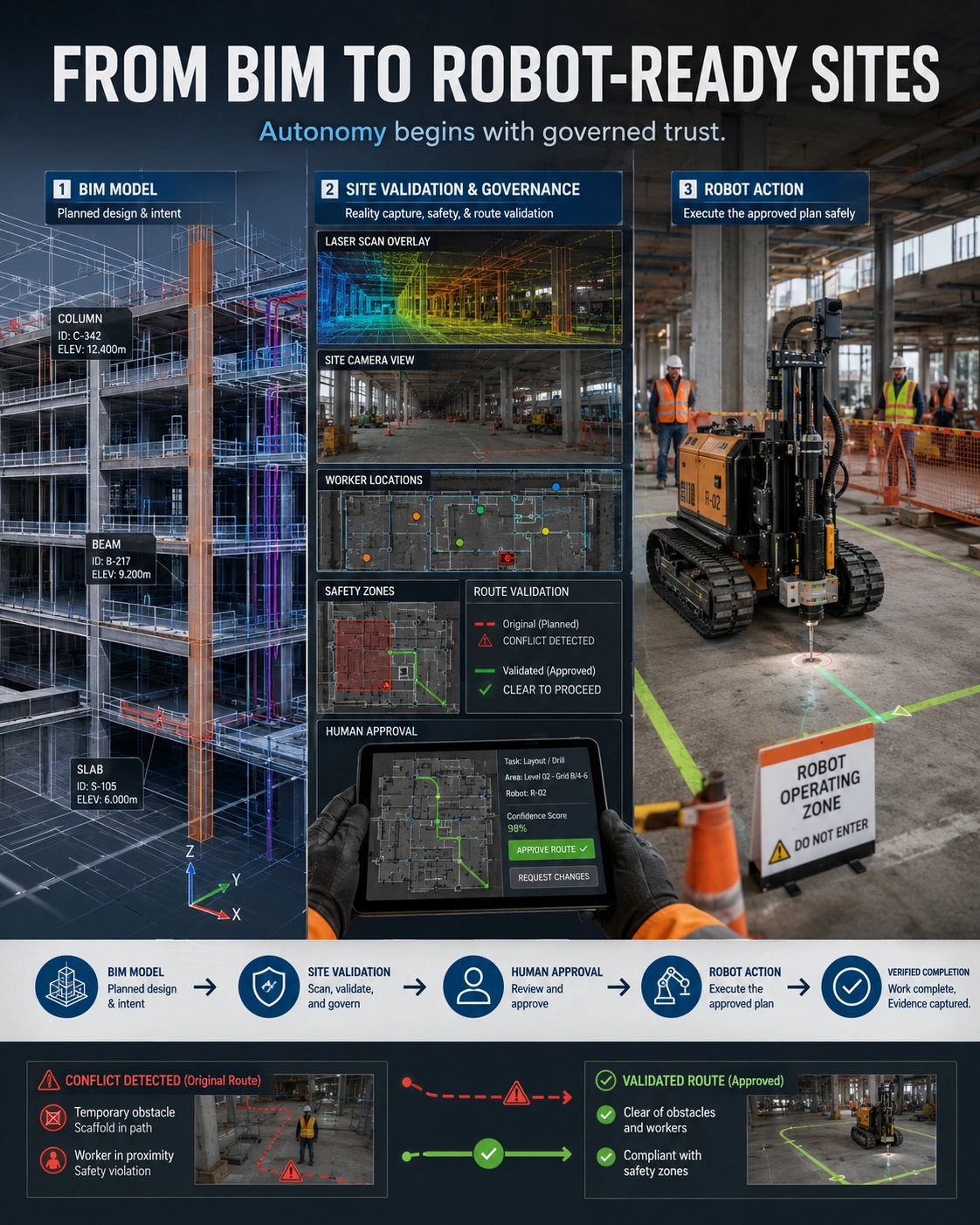
Construction automation will not fail because robots lack intelligence.
It will fail when machines are asked to act on BIM data that is outdated, misaligned with the physical site or unclear about what the robot is authorized to do.
The construction industry is moving steadily from digital design towards autonomous execution.
Robots can already support layout marking, scanning, drilling, welding, material movement, progress capture and inspection. Autonomous equipment is also becoming more capable of navigating active sites and adapting its work as conditions change.
But connecting a robot to a BIM model does not automatically create a robot-ready construction site.
A robot-ready site needs a governed digital connection between design intent, present site conditions, safety rules and machine action.
That is a much harder problem than model conversion.
BIM is becoming an operational control layer
For many projects, BIM still acts primarily as a design, coordination and documentation environment.
Construction autonomy changes that role.
A robot may use BIM geometry to identify a wall, locate an installation point, calculate a route or determine where an activity should happen. BIM semantics may tell the machine what an object is, what task is associated with it and which construction sequence applies.
The model is no longer only informing a person.
It is influencing a physical action.
That raises the standard of trust required.
A misplaced object in a coordination model might create a review comment. The same error in a machine-readable instruction could cause rework, equipment damage or a safety incident.
Before BIM becomes machine-executable, organizations must govern what the model represents, how recently it was validated and which decisions it is allowed to influence.
The robot must know where the real site is
A construction site changes continuously.
Temporary materials appear. Access routes close. Equipment moves. Work areas are handed over. Installed components differ from the planned sequence. Workers enter and leave operating zones.
A BIM model may accurately represent the design while still being wrong about the present physical environment.
Robot-ready construction therefore depends on continuous alignment between the model and reality.
This can involve:
- laser scanning and photogrammetry;
- fixed cameras and mobile vision systems;
- UAV and robotic inspections;
- equipment and worker-location data;
- IoT safety and environmental sensors;
- AI-assisted registration of physical observations with BIM.
The objective is not to create another attractive progress visualization.
It is to answer operational questions:
Is the planned route still open?
Has the workface changed since the last mission?
Is the target object installed in its expected location?
Are people, equipment or temporary obstructions inside the operating zone?
Does the difference between BIM and reality exceed the tolerance for automated work?
A robot should not assume that yesterday’s site state remains valid today.
Geometry alone is not enough
A model can be geometrically detailed and still be unsuitable for automation.
Robots need consistent object classifications, persistent identifiers, tolerances, task relationships and status information. They also need to distinguish between permanent assets, temporary works, exclusion zones, access paths and incomplete installations.
This makes BIM semantic quality as important as geometric accuracy.
For every object involved in an automated task, the system may need to know:
- what the object is;
- where it should be;
- its current construction status;
- which task applies to it;
- what tolerance is acceptable;
- which evidence confirms readiness;
- who approved the task;
- what conditions require the robot to stop.
A visually correct model is not necessarily a machine-ready model.
Site coordinates must be treated as critical infrastructure
Many BIM–field problems begin with inconsistent coordinate systems, survey controls and model origins.
Humans can sometimes recognize and correct a small alignment problem. A machine may follow the coordinates exactly.
Robot-ready sites require a controlled spatial reference framework across BIM, GIS, survey data, reality capture, equipment-positioning systems and robotic platforms.
This means governing:
- project coordinate standards;
- survey-control ownership;
- transformation rules;
- model-registration procedures;
- accuracy requirements by task;
- validation frequency;
- responsibility for approving alignment.
The required accuracy will also vary.
A progress-inspection robot may tolerate a larger positional difference than a drilling, cutting or component-installation robot. Readiness should therefore be assessed against the intended action, not through one general accuracy statement.
Automation requires permission boundaries
Construction autonomy should not mean that every detected condition immediately triggers a machine action.
Different activities carry different levels of risk.
A robot may be allowed to scan an area automatically. It may need supervisor approval before entering a shared work zone. It may be prohibited from continuing when workers, vehicles or temporary structures are detected nearby.
Projects need explicit authority rules covering:
- which missions can start automatically;
- which require human approval;
- who can modify a robot’s task;
- who can override a stop condition;
- which safety zones are absolute;
- what happens when communication is lost;
- how the system responds to uncertain information.
Human oversight must be designed into the operating architecture rather than added after deployment.
Every machine action needs an evidence trail
When an autonomous system changes the physical site, the project must be able to reconstruct what happened.
That evidence chain should connect:
BIM version → site observation → alignment result → safety check → task instruction → approval → machine action → completion evidence → model update.
This record becomes important for quality control, dispute resolution, safety review and regulatory compliance.
It also supports learning. When a mission fails or requires intervention, teams can determine whether the problem came from the model, site conditions, positioning, software, equipment or approval logic.
Without traceability, organizations may know that something went wrong but not why.
The weakest sensor can weaken the entire workflow
Robot-ready construction twins will depend on cameras, location systems, environmental sensors, proximity detectors and connected equipment.
These devices cannot be treated as anonymous data feeds.
Their identity, calibration, firmware, health status, permissions and maintenance history affect the trustworthiness of the operational twin.
A compromised or poorly calibrated sensor could incorrectly report that an area is clear. A failed positioning device could distort machine location. An outdated site image could be mistaken for current evidence.
Device security and data quality are therefore part of construction safety.
A digital twin cannot become decision-ready, or robot-ready, when its sensing layer is not trustworthy.
Start with readiness, not robotics
In more than 27 years around geospatial and infrastructure workflows, I have repeatedly seen organizations focus first on the visible technology.
The model, dashboard, drone or robot receives attention.
The less visible foundations, coordinate control, ownership, update responsibility, approval rules and evidence quality, are often addressed later.
Autonomous construction will make this approach increasingly risky.
Before selecting a robot, a project should assess whether its site information and governance are ready to support machine action.
A practical Robot-Ready Site Twin assessment should examine seven areas:
- BIM geometry and semantic quality.
- Coordinate alignment and survey control.
- Reality-capture and site-update frequency.
- Asset, worker and equipment identity.
- Safety zones and machine permissions.
- Exception, approval and stop-work rules.
- Auditability of instructions and actions.
The result may show that full autonomy is premature.
That is not failure.
It allows organizations to begin with supervised or semi-autonomous workflows while strengthening the evidence and governance needed for greater automation.
Autonomous construction begins with governed trust
The next stage of BIM will not be defined only by richer models or more advanced robots.
It will be defined by whether machines can safely interpret the site, understand their authority, recognize uncertainty and stop when conditions fall outside approved limits.
Robot-ready construction is therefore not simply a robotics programme.
It is a BIM, geospatial, safety, cybersecurity and operational-governance programme.
Before asking machines to build more, we must decide what they are allowed to trust.
Which part of today’s construction environment is least ready for autonomy: model quality, real-time site alignment, safety permissions or auditability?