
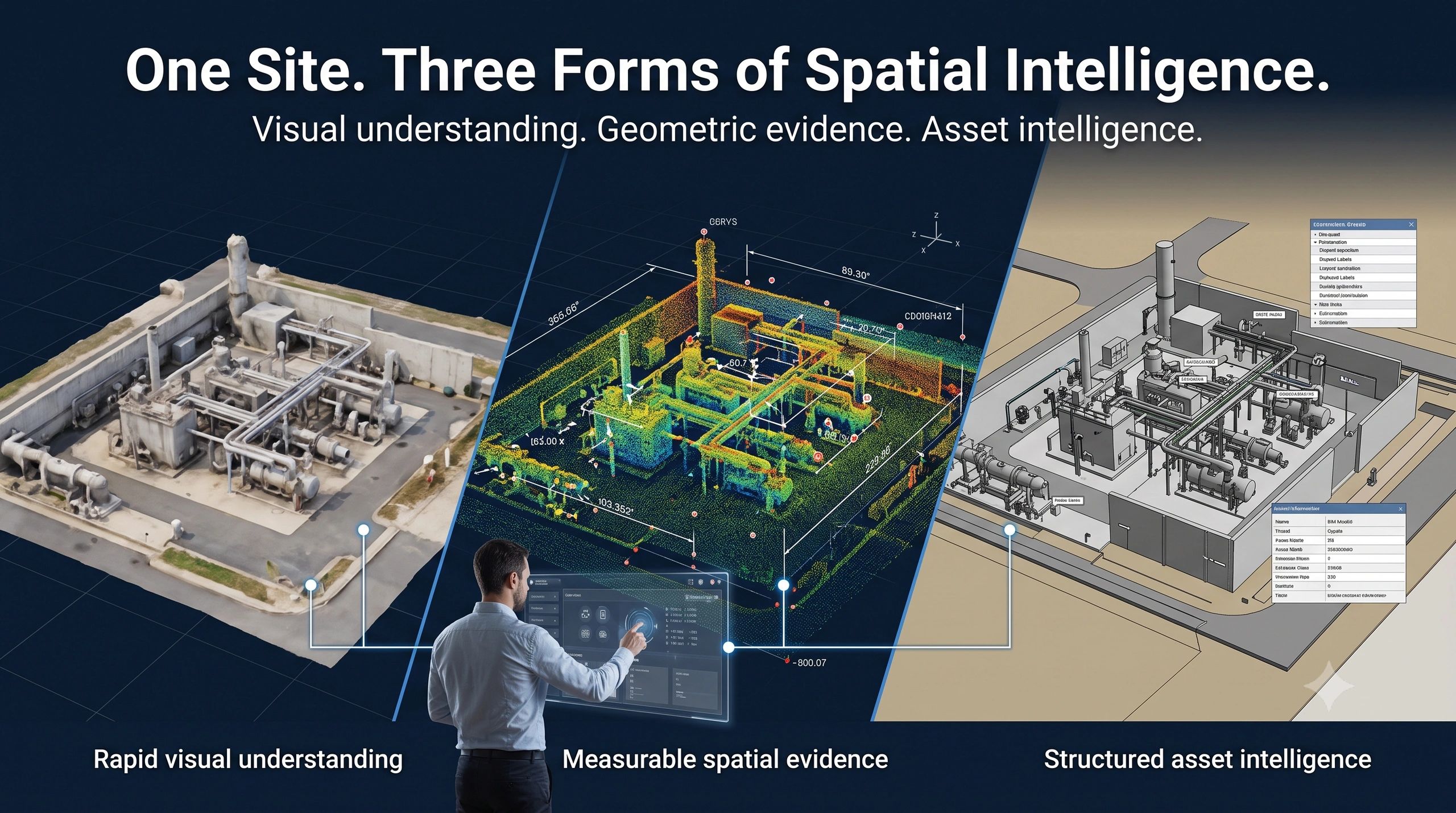
A photorealistic 3D model can make a site feel completely understandable.
You can move through it, inspect equipment, view inaccessible areas and discuss site conditions with people located hundreds of kilometres away.
But can an engineer measure from it?
Can a contractor use it to validate quantities?
Can an asset owner connect it to inspection records, work orders and maintenance history?
This is where the growing discussion around Gaussian splatting, point clouds and BIM often becomes confused.
All three can represent the physical world.
But they do not represent it for the same purpose.
The right question is not:
Which 3D technology is best?
The better question is:
Which representation is suitable for the decision being made?
Gaussian splatting is changing the speed of visual reconstruction
Gaussian splatting has attracted attention because it can transform captured imagery into a highly realistic and navigable 3D environment.
For construction, infrastructure and industrial sites, this can shorten the time between field capture and stakeholder understanding.
A project team may be able to review:
- construction progress;
- site access conditions;
- installation sequences;
- visible defects;
- safety concerns;
- equipment locations;
- areas requiring follow-up inspection.
Its strength is not simply that it looks impressive.
Its real value is that it can make complex site conditions easier to communicate.
A project manager, client, designer or remote expert may not be comfortable navigating a dense point cloud. They may also not want to wait for a detailed BIM model to be produced.
A splat-based environment can give them fast visual context.
It compresses the journey from capture to understanding.
But visual realism should not automatically be interpreted as engineering accuracy.
A scene can look complete while still containing gaps, distortions, uncertain scale or insufficient survey control.
That does not make Gaussian splatting unsuitable.
It means its role must be defined correctly.
Point clouds provide geometric evidence
Point clouds solve a different problem.
They contain millions or billions of measured spatial points representing surfaces, structures, equipment and terrain.
When captured and controlled properly, they provide measurable evidence of existing conditions.
This makes point clouds valuable for:
- dimensional verification;
- clearance analysis;
- deformation monitoring;
- alignment checks;
- volume calculations;
- surface comparison;
- change detection;
- scan-to-BIM production;
- as-built documentation.
A point cloud may not always provide the most intuitive visual experience for a non-technical stakeholder.
But it can preserve the geometry required for technical analysis.
This difference matters.
A facility manager may need a realistic environment to explain a maintenance problem.
An engineer may need accurate coordinates and dimensions to redesign the affected area.
Both are reviewing the same physical asset, but their information requirements are different.
The first needs fast situational understanding.
The second needs controlled geometric evidence.
BIM adds structure, meaning and relationships
BIM is sometimes described as a cleaner or simplified version of a point cloud.
That description misses its real value.
A BIM model does not merely represent shapes.
It represents objects and relationships.
A pipe can have a diameter, material, system classification and maintenance requirement.
A wall can have a fire rating, construction type and associated space.
A piece of equipment can have a manufacturer, serial number, operating capacity, inspection history and replacement schedule.
This semantic structure makes BIM useful for:
- design coordination;
- quantity take-off;
- clash detection;
- fabrication;
- construction sequencing;
- asset handover;
- maintenance planning;
- facility management;
- lifecycle information management.
However, BIM requires decisions about what should be modelled, to what level of detail and for which operational purpose.
Creating every visible feature as a BIM object can be expensive and unnecessary.
A detailed model also loses value quickly when no process exists to keep it updated.
BIM therefore delivers the greatest value when its information requirements are linked to actual business and engineering decisions.
Visual truth, geometric truth and asset intelligence are not the same
These three technologies can be understood through three different forms of value.
Gaussian splatting provides visual truth.
It helps people see, navigate and understand captured site conditions.
Point clouds provide geometric evidence.
They support measurement, comparison and spatial verification.
BIM provides structured asset intelligence.
It connects geometry with classification, attributes, systems and lifecycle information.
These capabilities overlap, but they are not interchangeable.
A photorealistic scene may not contain reliable dimensions.
A survey-grade point cloud may not contain asset names or maintenance attributes.
A BIM model may contain detailed information but fail to reflect recent site changes.
Trust therefore does not come from the visual quality of the model alone.
It comes from knowing:
- how the data was captured;
- when it was captured;
- what level of accuracy was achieved;
- which elements were validated;
- what information is missing;
- how changes will be recorded;
- which decisions the model is authorised to support.
The future is a two-speed reality-capture workflow
Instead of forcing one model to meet every need, organisations can adopt a two-speed approach.
Track 1: Rapid visual site twin
Capture the site and create a navigable visual environment for:
- daily collaboration;
- remote inspection;
- progress communication;
- stakeholder review;
- issue identification;
- site familiarisation.
The goal is speed and accessibility.
Track 2: Controlled engineering workflow
Use survey control, point clouds and selective BIM modelling for:
- design decisions;
- measurement;
- quality verification;
- quantities;
- contractual evidence;
- asset registration;
- maintenance integration.
The goal is accuracy, traceability and structured information.
These tracks should not compete.
They should support each other.
The visual environment helps teams identify where attention is required.
The point cloud provides the measurable evidence.
BIM converts the required elements into structured engineering and asset information.
Business use should determine the output
Before commissioning a 3D deliverable, asset owners should define the decision it must support.
Do we need a same-day remote site review?
Do we need millimetre- or centimetre-level measurements?
Do we need to calculate quantities?
Do we need asset attributes for operations and maintenance?
Do we need contractual verification?
Do we need frequent updates, or a controlled milestone record?
The answer may be a Gaussian splat, a point cloud, a BIM model or a connected combination of all three.
The mistake is not choosing one technology over another.
The mistake is buying a 3D output without defining its business purpose.
None of them is automatically a digital twin
A Gaussian splat is not automatically a digital twin.
Neither is a point cloud.
Neither is a BIM model.
They become part of a digital-twin environment when they are connected to persistent asset identity, operational data, inspection history, change records and decision workflows.
The future of reality capture will not depend on creating one perfect model.
It will depend on creating the right representation, at the right speed, with the right level of trust, for the decision that must be made.
Because the fastest 3D model is not always the most trustworthy one.
And the most detailed model is not always the most useful.