
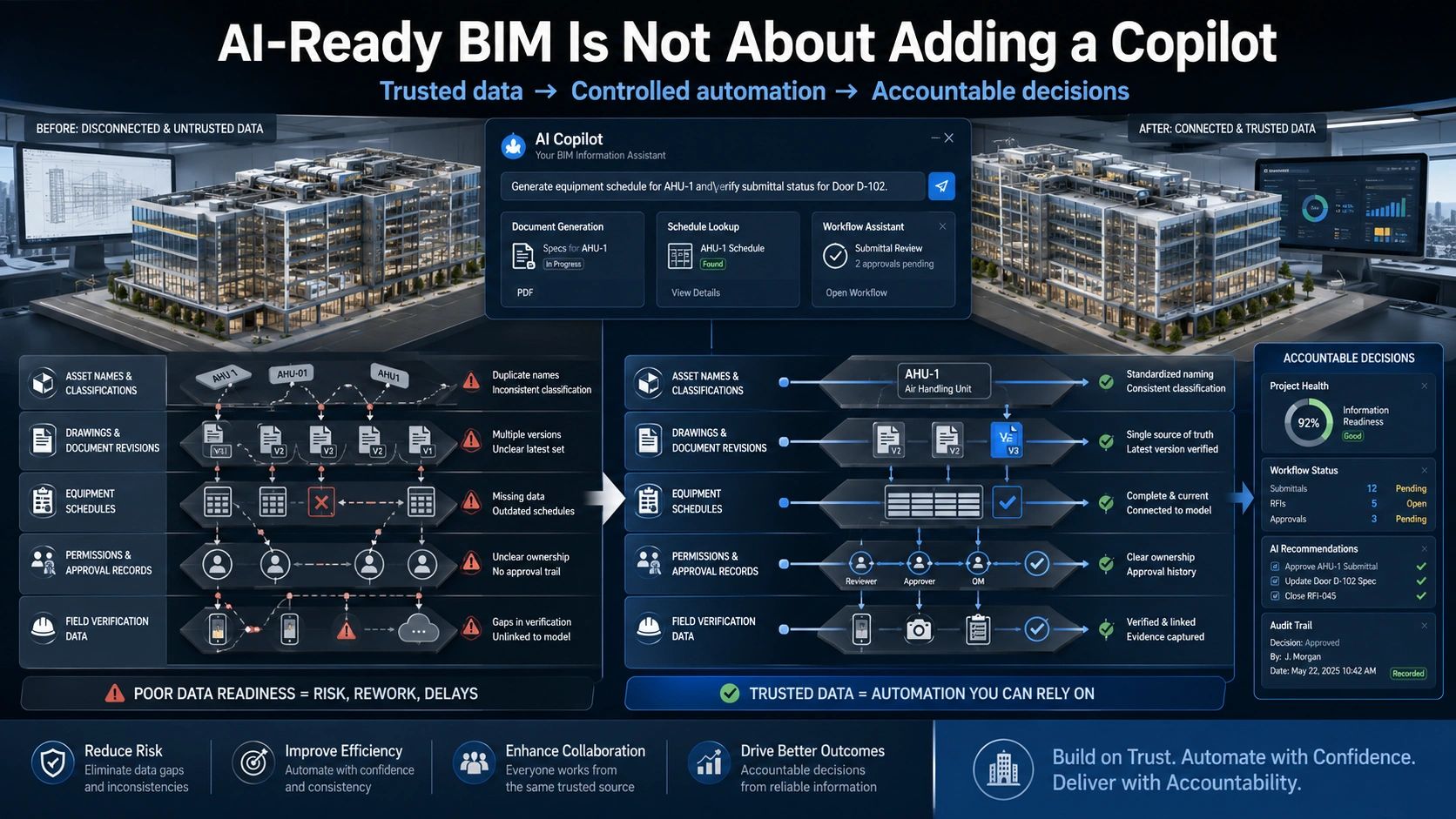
AI-ready BIM does not begin with a copilot.
It begins with a more basic question:
Can the model, documents and approval process be trusted enough for AI to act on them?
Across the AEC industry, new AI tools can search specifications, generate documentation, retrieve project information, automate repetitive modelling and support design decisions.
These capabilities are useful. But they can also create a false sense of readiness.
An AI assistant may produce an answer in seconds. That does not mean the underlying information is complete, current or approved.
When project data is inconsistent, AI does not remove the problem. It processes the inconsistency faster.
A Copilot Cannot Repair Weak BIM Foundations
Consider a typical project environment.
The same asset may have different names in the BIM model, equipment schedule, procurement system and maintenance database.
Some objects may contain detailed attributes, while others contain only geometry.
Drawings may have multiple revisions stored across email, shared folders and common data environments.
Responsibilities for reviewing generated outputs may be unclear.
In this situation, adding an AI interface creates convenient access to fragmented information. It does not create trusted intelligence.
A copilot cannot automatically determine:
- whether an asset name is correct;
- which document revision is authoritative;
- whether a missing attribute means “not applicable” or “not entered”;
- whether a model element reflects design intent or actual site conditions;
- who is accountable for approving an AI-generated output.
My research identified this as a growing commercial and operational issue. AEC organizations may purchase AI tools before their BIM data, naming conventions, document structures, access controls and approval processes are ready.
The Real Readiness Gap Is Not Software
Industry attention often focuses on model detail, platform features and software integration.
But AI readiness is more dependent on information discipline.
One industry analysis referenced in the research found that only 22% of surveyed AEC firms considered themselves fully prepared for AI. Data quality, governance and security remained major concerns.
This points to a wider problem.
Many organizations are trying to introduce automation into workflows that were never designed for machine-supported decisions.
A BIM model may be technically advanced but operationally unreliable.
A common data environment may store thousands of documents but still make it difficult to identify the approved source.
A detailed asset model may contain millions of objects but lack the classifications required for automated checking.
The question is therefore not:
“Can AI connect to our BIM platform?”
It is:
“Which project decisions can safely be supported or automated using the information we currently have?”
That is a very different starting point.
AI-Ready BIM Is Workflow-Ready BIM
The industry needs to move from model-centric AI thinking to workflow-centric AI thinking.
Instead of adding AI to an entire BIM environment, organizations should identify a defined task.
For example:
- checking whether required asset attributes are complete;
- comparing equipment schedules with model objects;
- identifying drawing and model inconsistencies;
- retrieving approved specifications;
- generating draft inspection reports;
- classifying model issues;
- preparing handover documentation;
- detecting changes between design and as-built information.
Each workflow should then be examined from beginning to end.
What information enters the process?
Where does it come from?
Who owns it?
What rules should the AI follow?
What happens when data is missing?
Which outputs can be accepted automatically?
Which require professional review?
How will corrections be recorded?
This is where AI readiness becomes measurable rather than aspirational.
The Human Review Boundary Must Be Designed
AEC decisions carry engineering, contractual, financial and safety consequences.
For that reason, AI-ready BIM cannot mean fully autonomous BIM.
It must include a clearly defined human review boundary.
An AI system might identify that a fire damper is missing from a model. But a qualified professional must determine whether the issue represents a modelling omission, a design change or an installation problem.
AI may generate a quantity comparison. A commercial team still needs to confirm measurement rules, exclusions and contractual relevance.
AI may summarize an inspection report. A project manager must verify whether the summary reflects the evidence and current project status.
This is not a limitation of AI adoption.
It is part of responsible workflow design.
The most valuable AI systems will not simply generate outputs. They will show:
- which information was used;
- which rules were applied;
- what assumptions were made;
- where uncertainty remains;
- who reviewed the result;
- what action followed.
In other words, the output must be auditable.
A Practical AI-Ready BIM Assessment
Before implementing a copilot, an AEC organization should assess six areas.
1. Model and document quality
Are models complete enough for the intended workflow? Are documents properly versioned? Can the approved information be identified?
2. Asset and classification standards
Are naming conventions consistent? Are assets classified using agreed standards? Are required attributes available in a machine-readable form?
3. Automation suitability
Which repetitive tasks consume time but follow predictable rules? Which tasks involve professional judgement that cannot be reduced to a simple workflow?
4. Access and permissions
Can the AI access only the information appropriate to the user, project and role? Are commercial, personal or security-sensitive records protected?
5. Review and accountability
Who reviews generated results? Who approves them? Who is responsible when the AI output conflicts with the model, document or field condition?
6. Performance baseline
How much time does the current process take? What is the error rate? How many rework cycles occur? Without a baseline, productivity claims cannot be verified.
The briefing recommends an AI-Ready BIM Workflow Assessment built around these areas, including error handling, auditability, permissions and measurable productivity.
Start With One Controlled Workflow
From my experience across geospatial, BIM and digital transformation projects, organizations often begin with the platform rather than the decision.
They select software, demonstrate a copilot and then search for a business process that justifies it.
The stronger approach is the reverse.
Choose one costly, repetitive or error-prone workflow.
Define the required inputs.
Clean and structure the relevant information.
Set clear rules for automation and review.
Measure the present performance.
Run the workflow with a limited user group.
Then compare time, quality, traceability and rework.
This approach may appear less ambitious than launching an enterprise-wide AI programme.
But it is more likely to produce evidence, adoption and measurable return.
It also prevents a common failure pattern: an impressive demonstration that cannot survive real project conditions.
The Competitive Advantage Will Be Trust
The next stage of BIM automation will not be won by the organization with the most AI buttons.
It will be won by organizations that can connect trusted project information to controlled automation and accountable decisions.
That requires less attention to the appearance of intelligence and more attention to the structure underneath it.
AI can make BIM faster.
But governance, standards, review responsibility and evidence determine whether it makes BIM better.
The firms that gain the most from AI will not be those with the most detailed models, but those with the clearest connection between trusted data, automated tasks and accountable decisions.