
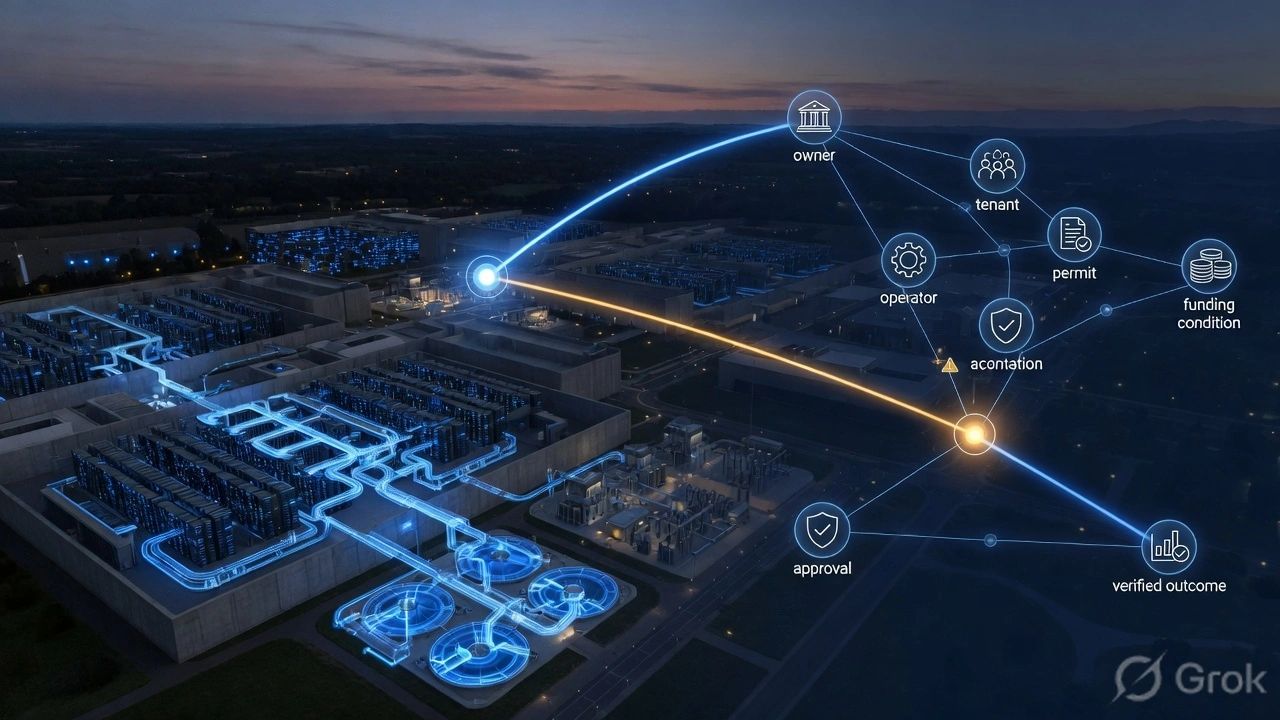
The operating system for AI infrastructure must record not only what the facility is doing, but why a decision was made, who was authorized to make it, which obligation applied and whether the intended result occurred.
Europe is preparing to build some of the world’s most complex AI infrastructure. The scale is measured in advanced processors, power demand, cooling capacity and billions of euros. But the harder challenge will not be making these facilities visible. It will be making their decisions accountable.
A facility twin can show buildings, racks, substations, chillers, network paths and asset status. It can simulate demand, detect anomalies and support maintenance. All of that matters.
Yet an AI gigafactory is more than a facility. It is also a public-private investment vehicle, a shared compute environment, a regulated operating system, an energy and water consumer, a security domain and a platform serving many tenants.
That combination creates a different requirement: a governance twin.
The scale of compute is changing the management problem
On 30 July 2026, the European Commission opened a call to establish up to seven AI Gigafactories. The programme combines up to €10 billion in EU and national support with an ambition to mobilize at least €20 billion in private investment. These facilities are intended to expand access to large-scale compute for industry, start-ups, researchers and public authorities.
This is not simply a larger data-center programme. Each project must coordinate land, construction, grid capacity, cooling, high-performance computing assets, network security, tenants, suppliers, public funding conditions and environmental commitments.
At the same time, important EU AI Act transparency rules took effect on 2 August 2026, with enforcement involving national market-surveillance authorities, the European AI Office and, for EU institutions, the European Data Protection Supervisor. The law does not require a governance twin. But the timing exposes the operational gap: Europe is scaling the physical capacity for AI while also raising expectations around transparency and accountability.
A dashboard for facility performance cannot close that gap on its own.
A facility twin answers what. A governance twin answers why and who.
Consider a power constraint during peak compute demand. The facility twin may identify the affected cluster, forecast thermal risk and recommend workload shifting. But several questions remain:
- Which tenant’s workload can be moved, and under what service agreement?
- Who has authority to approve the change?
- Does the action conflict with a security, sovereignty or funding condition?
- What evidence supported the recommendation?
- Was the intervention effective, and did it create another operational risk?
The same problem appears in cooling, maintenance, capacity allocation, cyber response and environmental reporting. Detection is only the beginning. The system must connect an event to the applicable obligation, the responsible party, the authorized decision and the verified outcome.
The governance twin needs four connected records
The term should not mean a decorative compliance layer beside the operational twin. It should mean a live relationship between four records:
1. Physical record: the state of sites, buildings, power, cooling, networks, compute equipment and construction progress.
2. Commercial record: tenant allocations, service commitments, supplier obligations, investment conditions and performance thresholds.
3. Decision record: the data and model used, confidence and limitations, the recommendation produced, the reviewer and the authorized action.
4. Outcome record: what changed after intervention, whether performance recovered, what collateral effects appeared and what the organization learned.
These records already exist in fragments: BIM and GIS models, BMS and DCIM platforms, contracts, permits, ticketing systems, model registries, audit logs and sustainability reports. The challenge is not to replace them with one giant application. It is to preserve identity and decision context as information moves across them.
The twin should govern action, not merely document it
A weak governance twin becomes an archive updated after decisions are made. A useful one changes the workflow before action occurs.
For a high-impact event, it should establish whether the evidence is sufficient, identify the active rule or obligation, route the case to the correct authority and retain the approval. After execution, it should compare the intended result with the observed result.
The operating chain becomes:
event → operational impact → obligation → responsible authority → approved intervention → verified outcome
This matters because an AI system may correctly detect a condition and still have no standing to decide what happens next. Model confidence cannot grant contractual authority. A digital twin cannot convert a recommendation into an approved action merely because the visualization is convincing.
This is also a commercial operating model
Public and private capital will expect more than technical uptime. Investors will need evidence that delivery conditions were met. Tenants will need confidence that capacity and service commitments were honored. Regulators and communities will ask about security, transparency, energy, water and environmental performance.
A governance twin can make those dependencies visible without pretending that every decision can be automated. It can reduce the time spent locating the correct contract, permit, owner or approval path. It can also distinguish three very different states: safe to execute automatically, requires authorized human review, or lacks enough evidence to proceed.
That distinction is where governance becomes operational value. It limits avoidable delay, reduces unearned automation and creates a defensible record when decisions are challenged.
The opportunity for spatial intelligence
Geospatial platforms, BIM, IoT and digital twins are well placed to provide the physical and relational context. But the strongest role is not to become the legal authority or build every AI model. It is to connect trusted data, governed intelligence, authorized action and measurable results across the infrastructure lifecycle.
For platforms such as NeuSpatial, this suggests a practical architecture: a common asset and location layer; connectors to operational systems; an assurance record for model-supported outputs; responsibility and approval routing; and outcome verification.
The first market may not be the hyperscaler. More reachable entry points are data-center advisers, infrastructure funds, energy companies, EPC firms and operators that must coordinate delivery across several organizations.
The next twin must show more than performance
AI infrastructure will be judged by compute delivered, energy consumed, service maintained, obligations met and trust preserved. These outcomes sit across technical, commercial and regulatory boundaries.
A facility twin can tell an operator that a system changed. A governance twin should show whether the response was permitted, supported by evidence, executed by the right party and proven to work.
As AI infrastructure scales, the competitive advantage will come from making technical performance, commercial responsibility and regulatory evidence visible in one operational system.
If you are planning an AI campus, data-center programme or other multi-party infrastructure environment, BSMA Enterprises and Dhineu can support governance-readiness, spatial architecture and digital-twin workflow design, from trusted data through authorized action and outcome evidence.