
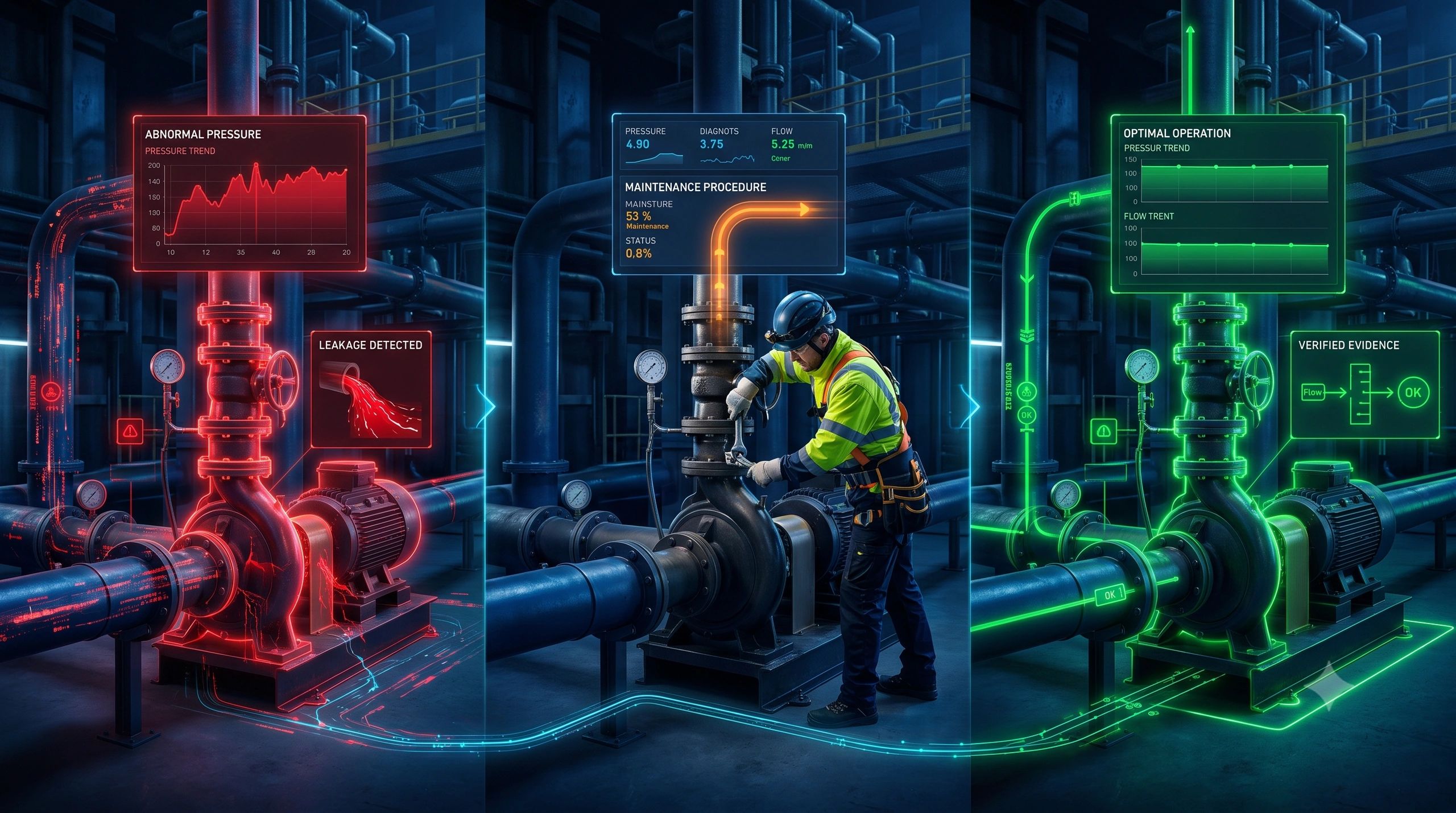
A digital twin detects abnormal pressure in a water network.
A maintenance team receives an alert, finds a leak and completes the repair. The work order is closed.
But did the repair reduce water loss?
Did pressure return to the expected range?
Was the underlying cause corrected or was only the visible damage addressed?
Most digital-twin workflows become surprisingly weak at this point. They are designed to detect conditions, visualize assets and initiate action. Once a work order is marked complete, the twin moves on.
That creates a serious gap between work completed and performance restored.
A decision-ready digital twin should not stop when an intervention is recorded. It should continue observing the asset, compare results against the expected outcome and preserve evidence that the intervention worked.
Closing the task is not the same as solving the problem
Operational systems are good at recording activity:
- an inspection was conducted;
- a component was replaced;
- a contractor attended the site;
- a repair order was completed;
- an equipment upgrade was installed.
These records confirm that something happened. They do not necessarily confirm that the desired result was achieved.
Consider a cooling system in a data center. New equipment may have been installed to reduce water and energy consumption. Installation records, invoices and photographs can confirm delivery.
The operational question is different:
Did water use actually decline under comparable conditions?
Did energy efficiency improve?
Did the intervention introduce another constraint elsewhere?
The same distinction applies across infrastructure.
A road may be repaired, but surface deterioration may return after the next rainfall.
A pump may be replaced, but energy consumption may remain unusually high.
A transmission tower may be restored after a storm, but its surrounding access route may still be unstable.
A building control system may be recalibrated, but indoor comfort complaints may continue.
The twin must therefore track not only the intervention but also the resulting change in physical performance.
Every intervention begins with a claim
An intervention is based on an expectation:
If we take this action, a measurable condition should improve.
That expectation should be made explicit before work begins.
For example:
- replacing a damaged valve should stabilize pressure;
- repairing a roof section should stop moisture ingress;
- cleaning solar panels should increase power output;
- adjusting irrigation should reduce water stress;
- installing efficient cooling should lower energy or water intensity;
- strengthening a slope should reduce detected movement;
- repairing a power line should restore stable service.
Without a defined expected outcome, intervention verification becomes subjective. A team may confirm that the assigned work was completed without knowing which operational signal should change or by how much.
A digital twin can provide the structure needed to connect:
observed condition → diagnosed cause → authorized intervention → expected result → measured outcome
This changes the twin from a monitoring interface into an operational learning system.
The twin needs both before and after evidence
To prove effectiveness, the twin must preserve the condition that existed before the intervention.
That evidence may include:
- sensor readings;
- imagery or point clouds;
- inspection observations;
- BIM or GIS changes;
- equipment alarms;
- energy or water consumption;
- production performance;
- environmental measurements;
- maintenance history;
- photographs and field reports.
After the intervention, the same indicators should be measured again under conditions that allow a meaningful comparison.
This is important because performance can appear to improve for unrelated reasons.
A reduction in building energy use may result from lower occupancy rather than an equipment upgrade. Reduced irrigation demand may be caused by rainfall rather than a new control strategy. Lower road traffic may temporarily reduce vibration around a structure.
The twin should retain enough context to distinguish intervention effects from normal operating variation. Relevant context might include weather, demand, occupancy, production level, season, asset loading and adjacent maintenance activities.
The goal is not to claim perfect causality in every case. It is to make the evidence and remaining uncertainty visible.
Verification requires more than one status field
Many systems use a simple sequence:
Open → In progress → Closed
This is convenient for managing tasks but inadequate for managing outcomes.
A stronger intervention workflow would separate at least five states:
- Action completed The physical work has been performed.
- Evidence submitted Required photographs, measurements, documents and field observations are available.
- Performance monitored The relevant asset indicators are observed for a defined period.
- Outcome verified The evidence shows that the expected operational result has been achieved.
- Exception or recurrence detected Performance did not improve, improvement was temporary or the problem returned.
The verification period will depend on the intervention. Some outcomes can be confirmed immediately. Others require days, seasons or several operating cycles.
The twin should reflect this difference rather than treating every completed work order as a successful resolution.
Verification should influence what happens next
Outcome evidence becomes valuable when it changes the next decision.
The system may:
- close the intervention as verified;
- continue monitoring;
- request an engineering review;
- reopen the work order;
- trigger a warranty claim;
- escalate the contractor issue;
- revise the maintenance strategy;
- update the asset-risk score;
- adjust the predicted remaining life;
- recommend a different intervention.
This feedback loop is especially important for AI-supported maintenance.
An AI model may recommend a specific action based on previous conditions. If the organization records only whether the recommendation was accepted, it learns little about effectiveness.
The more useful feedback is whether the action produced the predicted result.
Over time, this evidence can reveal which interventions work best for particular asset types, operating conditions, locations and failure modes. It can also expose recurring temporary fixes that create activity without improving performance.
The evidence must connect across systems
The data required to prove an outcome rarely exists in one platform.
Asset identity may sit in GIS or BIM. Sensor readings may come from an IoT platform. Work orders may be managed in an EAM or CMMS. Contractor records may exist in another application. Photographs may arrive through a field app. Costs may be stored in ERP. Compliance evidence may be held in a document-management system.
The digital twin does not need to replace all these systems.
Its role is to maintain the operational relationship between them:
- Which asset was affected?
- What condition triggered action?
- Which intervention was approved?
- Who performed it?
- What evidence was submitted?
- Which performance indicators were expected to change?
- Did those indicators improve?
- Who verified the outcome?
- What uncertainty or exception remains?
Persistent asset identity, timestamps, provenance and clear responsibility are essential. Without them, the organization may have plenty of data but no defensible chain connecting the original problem to the final result.
This changes the business case for digital twins
Digital-twin value is often justified through faster detection, improved visualization or predictive maintenance.
Those benefits matter, but outcome verification provides a more direct route to measurable value.
It allows an organization to assess:
- which maintenance actions reduce recurring failures;
- which contractors consistently restore performance;
- which capital upgrades deliver the promised efficiency;
- which resilience measures work during real events;
- which sustainability interventions create measurable reductions;
- which AI recommendations deserve greater operational trust.
It also strengthens accountability. A contractor cannot rely only on a completion report when agreed performance has not returned. A technology supplier cannot claim success based solely on installation. An asset owner can distinguish expenditure from actual improvement.
The digital twin should remember what worked
A mature digital twin should become an evidence-based memory of the asset.
It should record not only how the asset changed, but why it changed, what action was taken and what happened afterward.
That operational memory makes future decisions more reliable. Teams can compare similar failures, identify effective responses and avoid repeating interventions that previously underperformed.
The next stage of digital-twin maturity is therefore not simply better detection.
It is verified recovery.
A twin becomes truly operational when it can answer three connected questions:
What happened? What was done? Did it work?
Until the third question is answered, the intervention is not fully closed.