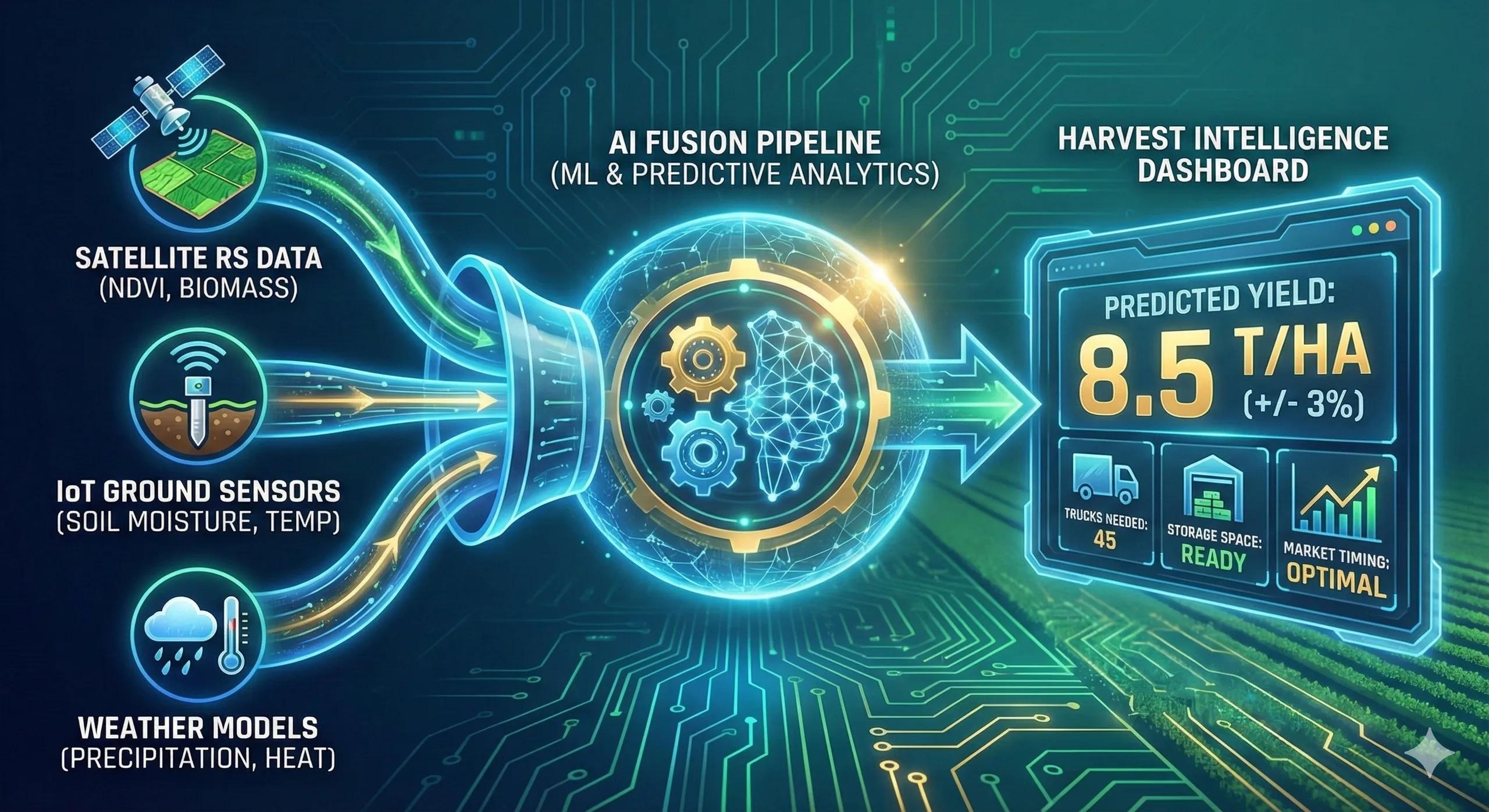
What if yield could be estimated weeks before harvest, not by guesswork, but by fused signals from satellites, sensors, and field models?
Yield estimation (predictive harvest) has traditionally relied on crop-cutting experiments, farmer recall, or post-harvest reporting, all accurate but too late for decision-making.
Today, we can estimate yield during the season , field by field , using fusion pipelines that combine:
Remote Sensing (RS)
IoT sensors (soil moisture, canopy microclimate)
Weather data
Crop growth models
Machine learning
This turns yield into a predictive operational layer for agriculture, procurement, insurance, carbon markets, and food security planning.
1️⃣ Why Fusion Is Necessary for Yield Estimation
No single dataset can explain yield.
This is because yield is driven by multiple interacting factors:
crop vigor
soil moisture
nutrients
rainfall patterns
temperature stress
irrigation timing
management practices
pests and diseases
RS captures canopy status , IoT captures soil and microclimate , and weather/crop models capture process dynamics .
Yield requires all three .
2️⃣ Remote Sensing: The Canopy Intelligence Layer
RS provides spatially continuous, season-long signals:
A. Vegetation Indices
NDVI
EVI
NDRE
Red-edge derivatives
These map biomass buildup , one of the strongest correlates to yield.
B. SAR Backscatter (Sentinel-1)
moisture
canopy structure
lodging detection
sowing/harvest signals
SAR is critical during monsoon and cloudy months.
C. Time-Series Metrics
peak NDVI
cumulative NDVI
rate-of-rise
duration of green-up
These become powerful yield predictors.
3️⃣ IoT Sensors: The Ground-Truth Layer
IoT brings context that satellites cannot see.
Key sensor inputs:
soil moisture
soil temperature
canopy temperature
VPD (vapor pressure deficit)
PAR/light intensity
leaf wetness
micro-weather (rainfall, humidity)
These enrich the fusion pipeline by showing plant-water stress , microclimate extremes , and management variations .
Why IoT matters:
A crop can have similar NDVI values but differ in yield due to:
nitrogen deficiency
heat stress
irrigation gap
pest attack
IoT signals capture these effects early.
4️⃣ Weather & Climate Inputs
Weather drives crop growth. Fusion pipelines integrate:
rainfall (IMD, IMERG)
temperature extremes
ET (evapotranspiration)
humidity and wind
heatwave & coldwave stress days
These become key variables in the yield model.
5️⃣ Crop Growth Models (Process-Based Layer)
Process-based models simulate how crops grow under different conditions:
DSSAT
WOFOST
AquaCrop
APSIM
Inputs include:
soil type
weather
crop variety
management practices
Outputs:
LAI
biomass
grain yield
phenology stage
When RS is fused with these models, the result is hybrid, highly accurate yield estimation .
6️⃣ The Yield Fusion Pipeline (Step-by-Step)
A typical operational pipeline looks like this:
STEP 1, Preprocessing
cloud masking
SAR speckle filtering
radiometric calibration
time-series smoothing
STEP 2, Feature Extraction
NDVI/EVI/NDRE curves
SAR VH/VV ratio
peak biomass metrics
moisture anomalies
canopy thermal stress
STEP 3, IoT Integration
daily soil moisture
canopy temperature
microclimate-based stress scores
STEP 4, Weather Fusion
rainfall cumulative
ET deficit
degree days
stress-day counts
STEP 5, Machine Learning Models
Random Forest
XGBoost
CatBoost
LSTM for sequential data
STEP 6, Calibration with CCEs/Field Data
district-level
mandal-level
field samples
combine with past-year yields
STEP 7, Final Yield Maps
field-level yield
village-level aggregation
district summaries
uncertainty quantification
This produces spatial yield intelligence weeks before harvest.
7️⃣ India: Why Yield Intelligence Is Urgent
India’s agricultural system needs real-time yield insights for:
MSP procurement planning
mandi logistics
FCI storage optimization
crop insurance payouts
drought declarations
carbon market baselines
food security forecasts
digital agriculture mission (DADM)
state crop planning
Fusion-based yield estimation can support decisions across agriculture, finance, and disaster management.
8️⃣ Toward a Yield Digital Twin
A Yield Digital Twin integrates:
RS canopy monitoring
IoT stress indicators
weather-driven crop models
soil moisture & carbon
irrigation logs
sowing/harvest detection
disease alerts
market expectations
This twin becomes a season-long operational system for yield forecasting.
Governments, FPOs, insurance companies, and agri-tech firms can run simulations like:
“What if rainfall is 20% below normal?”
“What if irrigation is delayed by 4 days?”
“What if heat stress peaks in week 7?”
Yield becomes a predictive variable , not a post-event statistic.
Conclusion
Yield is not just the outcome of a season, it is the story written by water, climate, canopy health, soil, and farmer decisions.
Fusion pipelines combine RS, IoT, and crop models to decode that story long before harvest.
This transforms yield estimation from manual forecasting to data-driven agricultural intelligence .
We can now estimate yield with clarity, not assumptions.