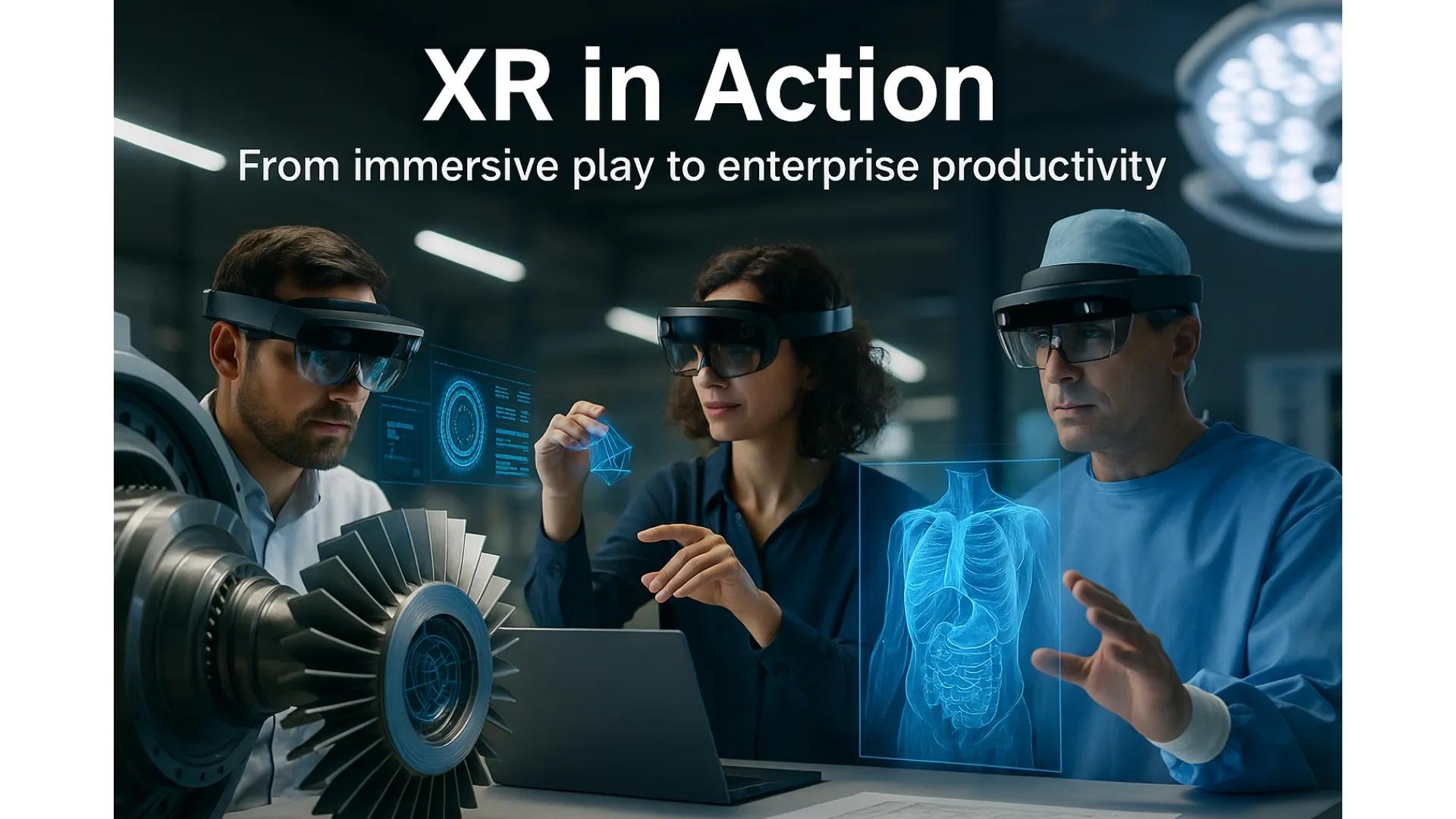
Extended Reality (XR) is rapidly transitioning from an entertainment technology to a core enabler of enterprise innovation. Once seen as a tool for immersive gaming, XR, an umbrella term for Virtual Reality (VR), Augmented Reality (AR), and Mixed Reality (MR), is now redefining how businesses train employees, design products, visualize data, and connect remote teams across industries. The convergence of hardware advances, spatial computing, and AI integration is driving XR’s transformation from gaming → to business-critical utility.
According to PwC , XR technologies are expected to contribute $1.5 trillion to the global economy by 2030 , up from just $46.4 billion in 2019. Similarly, Statista projects that the enterprise XR market will grow from $39 billion in 2024 to over $120 billion by 2030 . With enterprises adopting XR to improve collaboration, cut costs, and enhance productivity, the technology is rapidly becoming part of the digital transformation stack alongside AI, IoT, and digital twins.
1. From Immersive Play to Immersive Productivity
Gaming served as XR’s initial proving ground, but enterprise adoption is now leading the charge. The same immersive principles that kept gamers engaged are being used to train workers, simulate operations, and visualize complex data .
Training & Simulation: Boeing uses VR to train aircraft technicians, reducing training time by 75%. Walmart implemented 17,000 Oculus VR headsets for employee training, leading to a 10–15% improvement in retention and performance.
Design & Prototyping: Automotive companies like Ford Motor Company and BMW Group use XR for digital prototyping, allowing engineers to collaborate on 3D models in real time before physical manufacturing begins. This shift from physical mockups → virtual prototypes cuts design iteration costs by up to 30%.
Remote Collaboration: AR platforms such as Microsoft HoloLens and Meta Quest for Business are transforming hybrid work. Engineers at Siemens Energy use AR headsets for on-site troubleshooting with remote experts, reducing travel costs and downtime.
The core advantage lies in spatial understanding , XR provides a three-dimensional workspace where complex data and designs can be understood intuitively. When an architect visualizes a BIM model in AR or an operations team simulates a plant floor in VR, decision-making becomes faster, contextual, and error-free.
2. XR Across Key Sectors
Manufacturing and Industrial Operations
In manufacturing, XR is transforming maintenance, inspection, and production workflows. Airbus leverages AR for assembly guidance, achieving up to a 30% reduction in time spent per task. XR-enabled “digital work instructions” replace traditional manuals with real-time, hands-free visual guidance. By linking these systems with IoT data, operators can visualize live equipment status and predictive alerts in their field of view, driving a proactive maintenance culture.
Construction and Real Estate
The construction industry, traditionally risk-prone and cost-sensitive, is adopting XR to improve project visualization. Integrating XR with BIM allows project stakeholders to walk through virtual buildings before construction begins. Companies like Skanska and Turner Construction use VR-based coordination sessions to detect design clashes early, reducing rework by nearly 40%. For real estate developers, AR walkthroughs are now standard marketing tools, buyers can visualize interiors and customizations before purchase.
Healthcare and Education
In healthcare, XR is enabling both surgical precision and patient empathy . Johns Hopkins surgeons successfully used AR for a spinal fusion procedure, improving accuracy by 98%. Medical students use VR-based anatomy simulations for safe, repeatable practice. Similarly, educational institutions like the University of Maryland use XR classrooms where students interact with immersive learning content, significantly improving knowledge retention compared to traditional methods.
3. Integration with Digital Twins and AI
The next evolution of XR lies in its integration with digital twins and AI analytics . Digital twins, virtual replicas of physical assets, are enhanced by XR visualization, enabling real-time interaction with live data.
For example:
Siemens and NVIDIA’s Omniverse collaboration integrates industrial digital twins with XR visualization for smart factory operations.
AECOM uses XR to visualize infrastructure digital twins, helping clients simulate the impact of design and environmental changes.
AI further amplifies XR’s capabilities. Natural language interfaces, gesture recognition, and intelligent assistants are making XR interactions more intuitive. An operator in a factory can ask, “Show me yesterday’s machine performance anomalies,” and the system visually highlights data hotspots in 3D space.
This convergence is shifting enterprises from reactive workflows → predictive and interactive environments , a leap that directly enhances operational efficiency and business resilience.
Implications and Outlook
The enterprise XR ecosystem is maturing fast. By 2028, over 60% of industrial enterprises are expected to deploy XR for training, maintenance, and collaboration (IDC). The implications are multi-fold:
Workforce Transformation: XR lowers skill barriers through guided learning and real-time support, enabling faster onboarding and reskilling.
Operational Efficiency: Enterprises adopting XR report 25–50% reductions in errors and rework.
Sustainability: Virtual prototyping and remote inspections reduce material waste and travel emissions.
Data Convergence: XR, when connected to digital twins and IoT, creates a unified data visualization layer, turning analytics into action.
However, challenges persist, hardware cost, motion sickness, and data security need continued attention. Edge computing and 5G are expected to address latency issues, while cloud-based XR platforms are making scalability easier for enterprises of all sizes.
The Road Ahead
As XR matures, enterprises must look beyond novelty and focus on value orchestration , embedding XR into daily workflows, not treating it as a standalone tool. The shift from pilot projects to production-scale deployments will depend on clear ROI measurement and process integration.
The urgency is real but manageable. Companies that delay XR adoption risk falling behind in productivity, innovation, and employee engagement. The ones that act now, integrating XR with data, AI, and human expertise, will lead the next phase of digital transformation.
The business case is clear: XR is no longer about entertainment. It’s about enabling enterprises to see, simulate, and succeed in ways that were previously impossible.