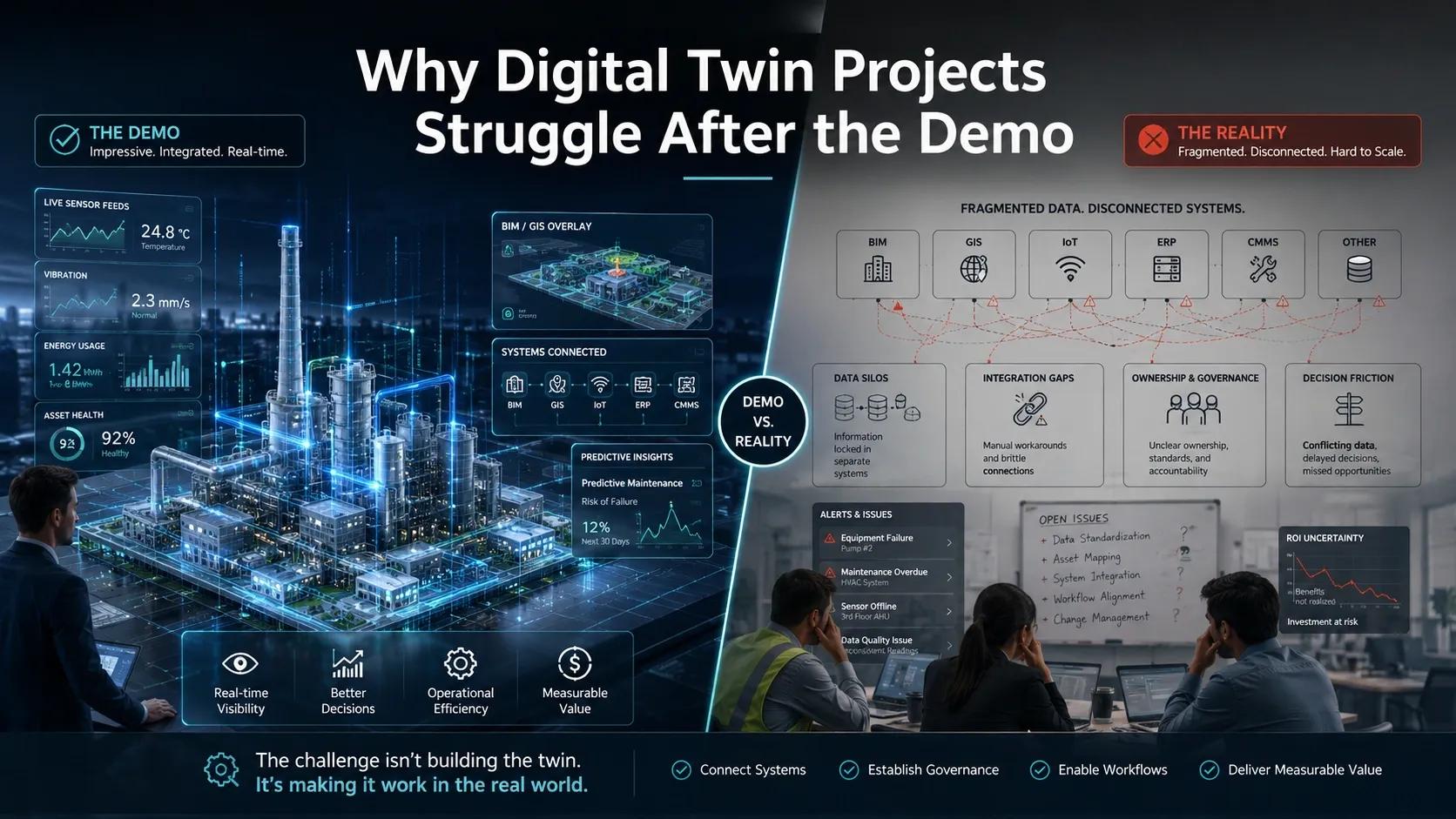
A Digital Twin demo is often impressive.
A 3D model appears on screen. Assets are visualized. Sensor data flows into dashboards. Users can zoom, rotate, monitor, and present the system to leadership.
For a moment, it feels like the future has arrived.
But after the demo, many Digital Twin projects slow down. Some remain as visualization tools. Some become isolated dashboards. Some fail to move beyond a pilot. Others struggle because the business teams do not know how to use them in daily decisions.
This is where the real challenge begins.
The problem is not that Digital Twin technology is weak. The problem is that many projects are planned as technology demonstrations, not as operational transformation programs.
The Demo Is Not the Destination
A demo usually answers one question:
Can this be shown?
But an enterprise Digital Twin must answer a different question:
Can this improve decisions, reduce cost, improve reliability, and create measurable value?
That shift is critical.
A Digital Twin should not be treated as a 3D viewer, dashboard, or one-time innovation showcase. It should become a decision-support system that connects physical assets, operational data, people, workflows, and business outcomes.
When that connection is missing, the project looks good but does not deliver enough value.
Why Digital Twin Projects Struggle
1. The Use Case Is Not Clearly Defined
Many organizations begin with a broad statement:
“We want to build a Digital Twin.”
But this is too generic.
A better starting point is:
“What operational decision do we want to improve?”
For example:
Can we reduce unplanned equipment downtime?
Can we improve energy performance?
Can we monitor asset health in real time?
Can we reduce inspection time?
Can we improve safety response?
Can we optimize space, manpower, or maintenance planning?
Without a clear use case, the Digital Twin becomes a technology layer without a business anchor.
A good Digital Twin project should begin with a specific pain point, not with software selection.
2. The Data Foundation Is Weak
A Digital Twin depends on data. But in many organizations, asset data is scattered across drawings, Excel sheets, ERP systems, maintenance records, BIM models, GIS layers, IoT platforms, and manual registers.
The result is a fragmented data environment.
In some cases:
asset registers are incomplete,
location data is missing,
BIM models are not updated,
GIS data is not connected,
sensor data is not standardized,
maintenance records are not structured,
real-time data has no business context.
When the data foundation is weak, even the best Digital Twin platform cannot deliver reliable insights.
The Digital Twin may still look good visually, but its intelligence remains limited.
3. BIM, GIS, IoT, and Business Systems Are Not Integrated
A Digital Twin is not just a model. It is an integrated ecosystem.
BIM gives asset-level detail.
GIS gives location and spatial context.
IoT gives real-time operational signals.
AI gives prediction and pattern recognition.
ERP, CMMS, and enterprise systems give business and workflow context.
When these systems remain disconnected, the Digital Twin becomes another isolated platform.
This is one of the biggest reasons projects struggle after the demo.
The real value comes when the Digital Twin can answer practical questions such as:
Where is the asset?
What is its condition?
Who is responsible for it?
What is the risk?
What action is required?
What will it cost?
What happens if we delay action?
That requires integration, not just visualization.
4. The Project Is Led Only by Technology Teams
Digital Twin projects often begin with innovation, IT, or digital transformation teams. That is useful, but not enough.
Operations, maintenance, engineering, finance, safety, sustainability, and leadership teams must also be involved.
Why?
Because these teams know the real pain points.
They know where delays happen.
They know where data is unreliable.
They know which decisions are repeated every day.
They know where cost leakage occurs.
They know which workflows need improvement.
If the Digital Twin is not connected to their daily work, adoption becomes difficult.
A successful Digital Twin is not only a technology implementation. It is a change in how the organization understands and manages its physical assets.
5. ROI Is Not Defined Early
Many Digital Twin projects struggle because ROI is discussed too late.
The business case should be defined before implementation begins.
ROI may come from:
reduced downtime,
faster inspections,
better maintenance planning,
lower energy consumption,
improved asset utilization,
reduced site visits,
better safety monitoring,
faster decision-making,
improved compliance reporting,
reduced rework,
better capital planning.
Every Digital Twin project should identify the value levers upfront.
Otherwise, the project may be appreciated as an innovation but questioned as an investment.
6. The Pilot Is Too Broad
Another common mistake is trying to build everything in the first phase.
Organizations may want 3D visualization, IoT integration, AI prediction, mobile apps, dashboards, alerts, reporting, simulations, and enterprise integration from day one.
This increases cost, complexity, and delivery risk.
A better approach is to start with a focused pilot.
Select one asset class, one facility, one process, or one operational decision.
For example:
energy monitoring for one building,
predictive maintenance for one equipment category,
road condition monitoring for one corridor,
warehouse visibility for one operational zone,
flood impact simulation for one sample area,
production quality monitoring for one line.
The first pilot should prove value, not cover everything.
Once the value is demonstrated, the model can be scaled.
7. There Is No Ownership After Implementation
Many projects fail after deployment because ownership is unclear.
Who maintains the data?
Who updates the model?
Who validates sensor accuracy?
Who monitors alerts?
Who acts on insights?
Who measures benefits?
Who manages platform improvements?
If these questions are not answered, the Digital Twin becomes outdated.
A living system needs living governance.
Digital Twin success depends on roles, responsibilities, workflows, and continuous improvement.
What Should Organizations Do Differently?
The right approach is to move from a demo-first mindset to a decision-first mindset.
Before starting a Digital Twin project, organizations should ask:
What decision are we trying to improve?
Which assets or processes are involved?
What data is already available?
What data is missing?
Which systems need to be integrated?
Who will use the system?
What action will the system trigger?
How will ROI be measured?
What is the smallest pilot that can prove value?
How will the solution scale after the pilot?
These questions create clarity.
They also prevent organizations from investing in attractive but low-impact solutions.
The Real Purpose of a Digital Twin
The aim should not be to build a Digital Twin.
The aim should be to build a system that adds value to the ecosystem we are working in.
For a factory, that may mean better production quality and less downtime.
For a port, it may mean better asset visibility and faster operations.
For a city, it may mean better infrastructure planning and emergency response.
For a utility, it may mean faster fault detection and improved service reliability.
For a building, it may mean lower energy consumption and smarter facility management.
A Digital Twin becomes valuable only when it improves the way decisions are made.
Closing Thought
Most Digital Twin projects do not fail because the technology is not ready.
They struggle because the business problem, data foundation, integration strategy, ownership model, and ROI pathway are not clearly defined.
The demo creates excitement.
But the real value begins after the demo, when the Digital Twin becomes part of daily operations, decision-making, and measurable business improvement.