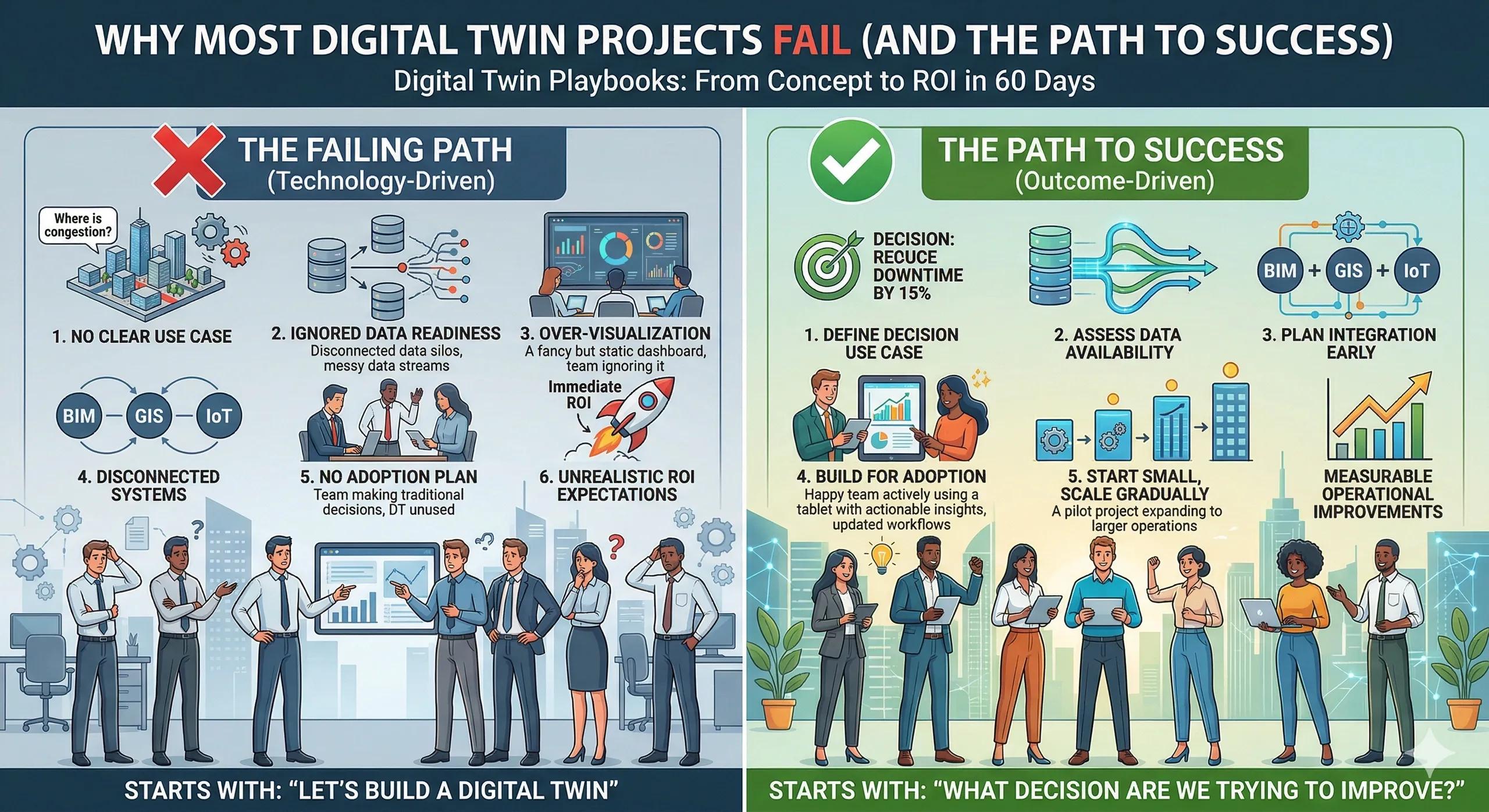
Why do so many Digital Twin projects fail, even before they deliver a single measurable outcome?
Because the failure doesn’t happen during implementation.
It happens at the starting point .
Introduction
Digital Twins are often seen as advanced, high-impact systems.
Organizations invest in tools, platforms, and data collection.
Yet many projects:
Stall at pilot stage
Fail to scale
Or never move beyond dashboards
The issue is rarely technology.
It is the approach taken before the project even begins .
The Real Problem: Starting with the Wrong Question
Most initiatives begin with:
❌ “Let’s build a Digital Twin”
Instead of:
✅ “What decision are we trying to improve?”
This leads to:
Technology-first thinking
Unclear outcomes
Misaligned expectations
Failure Point 1: No Clear Use Case
Without a defined use case:
Teams build generic systems
Data is collected without purpose
Outputs are not actionable
Example: A city builds a 3D model of infrastructure …but cannot answer:
Where congestion will occur
Which assets need maintenance
👉 Result: High investment, low impact
Failure Point 2: Ignoring Data Readiness
Many projects assume data will “come together” during implementation.
In reality:
Data is incomplete
Stored in silos
Not structured for real-time use
👉 Without clean, connected data: A Digital Twin cannot function effectively
Failure Point 3: Over-Focus on Visualization
This is one of the most common issues.
High-quality 3D models
Interactive dashboards
Impressive demos
But no change in:
Operations
Decisions
Outcomes
👉 The system becomes a presentation layer , not a decision system
Failure Point 4: Lack of Integration Strategy
Organizations often deploy:
BIM systems
GIS platforms
IoT sensors
But without:
Defined integration architecture
Interoperability standards
👉 Systems remain disconnected
Failure Point 5: No Ownership or Adoption Plan
Even well-built systems fail when:
No team is responsible for using it
Workflows are not updated
Decisions are still made traditionally
👉 If it is not used daily, it does not deliver value
Failure Point 6: Expecting Immediate ROI
Digital Twins are often expected to:
Deliver instant results
Replace existing systems immediately
But in reality:
They require phased implementation
Value builds over time
👉 Unrealistic expectations lead to early abandonment
Ask Yourself
Are you starting your Digital Twin journey with a clear decision problem, or just a technology ambition?
Practical Example
Scenario: Industrial Facility
A company invests in:
Sensors across equipment
Real-time dashboards
But:
No predictive models
No maintenance workflow integration
Result:
Data is visible
But maintenance remains reactive
👉 The project is seen as “unsuccessful”, even though the technology is working
What a Better Approach Looks Like
Successful Digital Twin projects start with:
1. Define a Decision Use Case
Example: Reduce downtime by 15%
2. Assess Data Availability
What exists? What is missing?
3. Plan Integration Early
BIM + GIS + IoT alignment
4. Build for Adoption
Align with real workflows
5. Start Small, Scale Gradually
Pilot → Validate → Expand
Indian Context
With increasing investments in:
Infrastructure
Smart Cities
Industrial automation
There is strong potential.
But success depends on: 👉 Moving from technology-driven initiatives to outcome-driven systems
Benefits of Getting It Right
Faster ROI realization
Higher adoption across teams
Scalable implementation
Measurable operational improvements
Conclusion
Digital Twin projects do not fail because of complexity.
They fail because:
They start without clarity
They focus on tools instead of outcomes
The shift is simple:
From “Let’s build a Digital Twin”
To “Let’s improve how we make decisions”
That is where success begins.