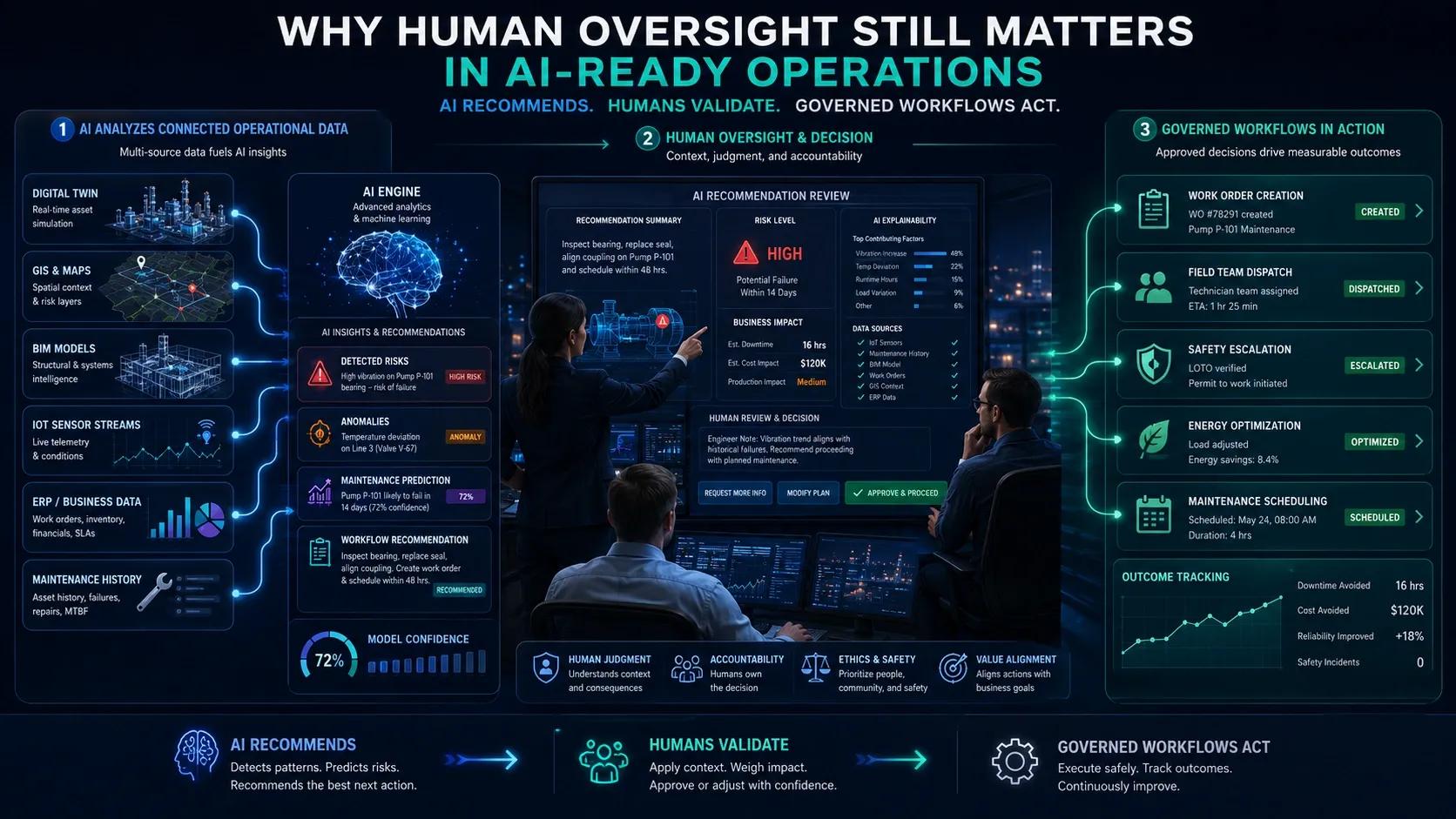
Artificial Intelligence is becoming more capable every day.
It can detect anomalies.
It can predict asset failures.
It can analyze images.
It can optimize energy usage.
It can summarize operational reports.
It can recommend actions.
It can support faster decisions.
As enterprises move toward AI-ready operations, it is natural to ask:
Will AI eventually run operations on its own?
In some cases, AI will automate routine decisions.
In some workflows, AI will reduce manual effort.
In some environments, AI will help teams respond faster.
In some systems, AI will continuously monitor conditions and recommend action.
But in real enterprise operations, one principle remains important:
Human oversight still matters.
AI can support decisions.
But accountability, judgment, ethics, safety, and business responsibility cannot be fully delegated to algorithms.
This is especially true in infrastructure, manufacturing, utilities, construction, buildings, ports, logistics, smart cities, and other asset-heavy environments where decisions affect people, assets, cost, compliance, and safety.
AI Can Assist, But Humans Remain Accountable
AI may recommend an action.
But the organization remains responsible for the outcome.
If an AI system recommends delaying maintenance and the asset fails, who is accountable?
If AI prioritizes one location over another and service is affected, who explains the decision?
If AI flags a safety risk incorrectly, who validates the escalation?
If AI recommends a cost-saving action that affects compliance, who approves it?
If an automated workflow impacts customers, who takes responsibility?
These questions are not technical questions alone.
They are governance questions.
In operations, accountability matters.
AI can provide intelligence, but human oversight ensures responsibility.
This is why AI-ready operations must be designed with clear human roles, review points, approval mechanisms, and escalation rules.
Why Operations Are Different from General AI Use Cases
AI can be used in many ways.
It can draft documents.
It can summarize meetings.
It can generate code.
It can answer questions.
It can prepare reports.
These use cases are valuable, but operational AI is different.
Operational AI supports decisions in real environments.
A building may adjust energy settings.
A utility may dispatch a field crew.
A factory may schedule maintenance.
A road agency may prioritize repairs.
A port may change equipment allocation.
A city may respond to flooding or traffic risk.
These decisions affect physical assets, people, budgets, safety, and service delivery.
The risk profile is higher.
This is why human oversight becomes more important.
In operational settings, AI should not only be accurate. It should be explainable, governed, auditable, and aligned with real-world constraints.
AI Does Not Always Understand Exceptions
Operations are full of exceptions.
A sensor may fail.
A field condition may change.
A maintenance record may be incomplete.
A road may be inaccessible.
A building zone may be occupied unexpectedly.
A contractor may be delayed.
A spare part may not be available.
A local team may know something the system does not.
A safety rule may override a cost optimization.
AI models work best when the context is structured, reliable, and complete.
But operational reality is not always clean.
Human experts understand exceptions, constraints, and field realities that may not be fully captured in the data.
This is why human oversight is needed.
It helps ensure that AI recommendations are reviewed against practical reality before action is taken.
Human Oversight Builds Trust
Trust is one of the biggest barriers to AI adoption in operations.
Teams may ask:
Can I trust this recommendation?
Why did the AI suggest this action?
What data was used?
What assumptions were made?
What confidence level is attached?
What happens if the recommendation is wrong?
Can I override it?
Who approved it?
If people do not trust AI outputs, they will not use them.
Human oversight helps build trust by making AI part of a transparent decision process.
A good AI-ready operational system should show:
the recommendation,
the reason behind it,
the data used,
the confidence level,
the expected impact,
the risk of inaction,
the human reviewer,
the final decision,
the action taken,
the outcome measured.
This turns AI from a black box into a decision-support system.
The Role of Explainability
Explainability is essential in AI-ready operations.
It is not enough for AI to say:
“Asset risk is high.”
The system should explain:
Which asset is affected?
Where is it located?
What sensor trend triggered the alert?
What historical pattern supports the prediction?
What maintenance record is relevant?
What business impact is expected?
What action is recommended?
How confident is the model?
What alternatives are available?
This explanation allows human experts to validate the recommendation.
It also supports audit, compliance, and accountability.
In asset-heavy sectors, explainability is not optional.
It is part of responsible operations.
Human Oversight Prevents Blind Automation
Automation can create value.
It can reduce repetitive work.
It can speed up response.
It can standardize workflows.
It can reduce manual errors.
It can improve efficiency.
But blind automation can create risk.
If every AI recommendation automatically triggers action without review, the organization may face unintended consequences.
For example:
An AI system may automatically raise too many work orders.
An energy optimization algorithm may reduce comfort.
A maintenance model may miss a safety-critical condition.
A traffic system may redirect congestion to another area.
A resource optimization model may ignore field constraints.
A cost model may recommend an action that conflicts with compliance.
Human oversight ensures that automation is applied responsibly.
The goal is not to stop automation.
The goal is to define where automation is safe, where approval is needed, and where human judgment must remain central.
Different Levels of Human Oversight
Not every AI-supported decision needs the same level of human review.
Oversight can be designed in levels.
1. Human-in-the-Loop
AI recommends, but a human must approve before action is taken.
This is useful for high-risk decisions, safety-critical actions, budget approvals, compliance-sensitive workflows, and major operational changes.
2. Human-on-the-Loop
AI acts within defined limits, while humans monitor performance and intervene when needed.
This is useful for routine decisions, threshold-based actions, and controlled automation.
3. Human-over-the-Loop
AI handles repetitive workflows, but humans define policies, governance, escalation rules, and audit mechanisms.
This is useful when operations are mature and risks are well understood.
The right model depends on risk, maturity, use case, regulation, and business impact.
AI-ready operations should not apply the same oversight model everywhere.
Digital Twins Can Support Better Oversight
Digital Twins can make human oversight more effective.
They provide a connected view of assets, location, real-time data, engineering context, workflows, and business impact.
When AI generates a recommendation, the Digital Twin can help the human reviewer understand the full context.
For example:
AI may predict equipment failure.
The Digital Twin can show asset location, condition, maintenance history, system dependency, spare availability, downtime impact, and recommended action.
AI may detect flood risk.
The Digital Twin can show terrain, drainage capacity, vulnerable zones, road access, emergency routes, and response priorities.
AI may recommend energy optimization.
The Digital Twin can show occupancy, HVAC zones, comfort constraints, weather, tariff, and control logic.
This makes human oversight faster, better informed, and more consistent.
Governance Is the Foundation
Human oversight must be supported by governance.
Without governance, oversight becomes informal and inconsistent.
AI-ready operations need clear rules around:
data quality,
model validation,
access control,
cybersecurity,
decision rights,
approval workflows,
escalation paths,
audit trails,
override permissions,
accountability,
compliance,
performance monitoring.
Governance defines how AI is used responsibly.
It also defines when humans must be involved.
This is especially important as organizations move from AI pilots to operational scale.
Human Oversight Helps Measure Value
AI should not be measured only by model accuracy.
It should be measured by operational value.
Did the recommendation improve response time?
Did it reduce downtime?
Did it avoid cost?
Did it improve safety?
Did it reduce risk?
Did users adopt it?
Did workflows become faster?
Did decisions improve?
Did outcomes match expectations?
Human oversight helps evaluate whether AI is creating real value.
Operational teams can provide feedback on recommendations.
They can identify false alerts.
They can refine thresholds.
They can validate outcomes.
They can improve workflows.
They can help train future models.
This feedback loop is essential.
AI-ready operations should continuously learn from human judgment and operational outcomes.
The Risk of Removing Humans Too Early
Many organizations want automation quickly.
But moving too fast can create risk.
If AI systems are scaled before data is ready, workflows are defined, and oversight is clear, organizations may face problems.
Recommendations may be ignored.
Users may lose trust.
Errors may spread.
Automated actions may conflict with field reality.
Compliance concerns may arise.
Operational teams may resist adoption.
Removing humans too early can damage the credibility of the entire initiative.
A better approach is gradual maturity.
Start with decision support.
Introduce assisted workflows.
Build trust.
Measure outcomes.
Define governance.
Automate routine actions where risk is low.
Keep humans involved where judgment matters.
This is how AI-ready operations can scale responsibly.
Sector Examples
In manufacturing, AI can predict machine failures, detect quality defects, and optimize production. Human oversight ensures that maintenance priorities, safety constraints, production schedules, and quality decisions are reviewed responsibly.
In utilities, AI can support outage prediction, asset risk scoring, and crew dispatch. Human oversight ensures that service impact, regulatory obligations, customer priority, and field conditions are considered.
In buildings and campuses, AI can optimize energy and comfort. Human oversight ensures that occupant experience, safety, maintenance constraints, and operational policies are respected.
In construction, AI can identify progress delays, safety risks, and rework patterns. Human oversight ensures that site realities, contract obligations, design changes, and stakeholder decisions are considered.
In smart cities, AI can support traffic management, flood response, public safety, and citizen services. Human oversight ensures that public impact, ethics, transparency, and multi-agency coordination are maintained.
In ports and logistics, AI can optimize berth planning, equipment allocation, yard movement, and cargo flow. Human oversight ensures that safety, compliance, operational constraints, and commercial priorities are balanced.
Across sectors, the principle is the same.
AI should improve human decision-making, not bypass responsibility.
What Enterprises Should Ask
Before scaling AI-ready operations, enterprises should ask:
Which AI-supported decisions require human approval?
Which decisions can be automated safely?
Who is accountable for AI-assisted decisions?
Can AI recommendations be explained?
Is the data reliable enough for operational use?
Are escalation paths clearly defined?
Can humans override AI recommendations?
Is there an audit trail for decisions and actions?
How will outcomes be measured?
How will human feedback improve the system?
Are safety, compliance, and ethics considered?
Is governance strong enough to scale?
These questions help organizations design responsible AI-ready operations.
The Future Is Human-AI Collaboration
The future of operations is not purely human.
It is not purely automated either.
It is human-AI collaboration.
AI can process large volumes of data.
Digital Twins can organize operational context.
Geospatial intelligence can show where action matters.
Workflows can trigger response.
Humans can provide judgment, accountability, ethics, and real-world validation.
Together, they create stronger operational intelligence.
This is the real opportunity.
Not replacing people with AI.
But giving people better intelligence to make faster, safer, and more confident decisions.
Closing Thought
AI-ready operations are not about removing human oversight.
They are about making human oversight smarter.
AI can detect patterns.
Digital Twins can provide context.
Geospatial intelligence can show location and impact.
Workflows can guide action.
Governance can create trust.
But humans remain essential for accountability, judgment, ethics, and responsibility.
The organizations that succeed with AI will not be the ones that automate everything blindly.
They will be the ones that know where AI should recommend, where humans should approve, and where automation can safely act.
Because in real operations, intelligence is not only about faster decisions.
It is about trusted decisions.
And trust still needs human oversight.