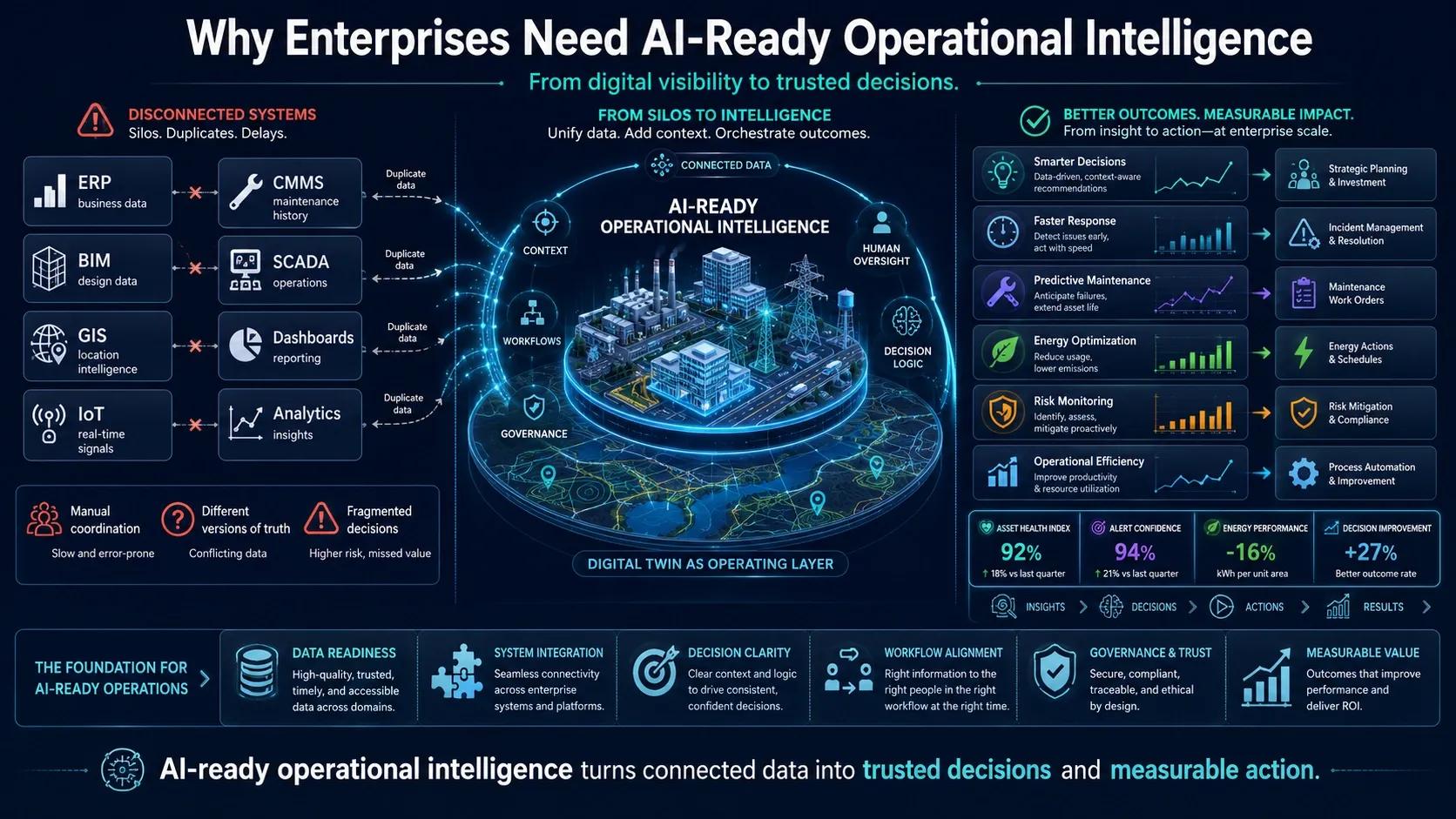
Every enterprise today is surrounded by technology.
ERP systems manage business transactions.
BIM models carry design and construction data.
GIS platforms bring location intelligence.
IoT sensors capture real-time signals.
Dashboards present operational performance.
AI tools are being tested for prediction, automation, and decision support.
Yet many organizations still struggle with the same core problem:
They have digital systems, but not always digital intelligence.
Data exists. Dashboards exist. Platforms exist. But decisions are still delayed, manual, fragmented, and dependent on people searching across disconnected systems.
This is where the next shift begins.
Enterprises now need AI-ready operational intelligence .
From Digital Visibility to Operational Intelligence
For the last decade, many organizations focused on visibility.
They digitized records.
They built dashboards.
They deployed sensors.
They adopted cloud platforms.
They created 3D models.
They integrated some systems.
This improved access to information.
But visibility alone is not enough.
A dashboard may show that a machine is underperforming.
A GIS map may show where an asset is located.
A BIM model may show the asset’s physical and engineering context.
An IoT sensor may show a live reading.
An ERP system may show cost and procurement data.
A CMMS may show maintenance history.
But the real business question is different:
What decision should be made now?
Should the asset be repaired or replaced?
Should maintenance be advanced or delayed?
Should energy load be shifted?
Should a field team be deployed?
Should a risk alert be escalated?
Should investment be prioritized in one location over another?
This is the difference between digital visibility and operational intelligence.
Visibility helps teams see.
Operational intelligence helps teams decide.
What Is AI-Ready Operational Intelligence?
AI-ready operational intelligence is the connected enterprise capability that turns data from assets, systems, locations, workflows, and people into trusted decisions, measurable actions, and future-ready automation.
It is not just about adopting AI.
It is about preparing the organization so AI can work with meaningful context.
For AI to support operations, it needs more than raw data.
It needs:
reliable asset information,
spatial and operational context,
clean and usable data pipelines,
integration across systems,
workflow alignment,
governance,
human oversight,
measurable outcomes.
Without these foundations, AI may produce outputs, but those outputs may not be trusted, actionable, or useful for operations.
This is why operational intelligence must come before large-scale AI adoption.
Why Enterprises Cannot Depend Only on Dashboards
Dashboards are useful.
They summarize performance, highlight trends, and provide visibility.
But dashboards often stop at reporting.
They tell teams what happened or what is happening. They may not always explain why it happened, what may happen next, or what action should be taken.
In many organizations, dashboards still depend on people to interpret the information manually.
A manager looks at a dashboard.
An engineer checks another system.
A planner downloads a spreadsheet.
A maintenance team confirms with field staff.
A finance team checks cost impact.
A decision is made after multiple follow-ups.
This process is slow.
The problem is not the dashboard itself. The problem is that the dashboard is not connected deeply enough to decisions and workflows.
AI-ready operational intelligence goes beyond dashboards.
It connects data, context, prediction, workflows, and action.
The Problem with Disconnected Enterprise Systems
Most enterprises already have several digital systems.
But these systems are often designed for specific departments.
Finance uses ERP.
Engineering uses CAD or BIM.
Operations uses SCADA or IoT platforms.
Maintenance uses CMMS.
Planning teams use GIS.
Leadership uses dashboards and reports.
Each system may be valuable on its own.
But when they are disconnected, the organization faces a major challenge.
Data gets duplicated.
Asset IDs do not match.
Location context is missing.
Workflows remain manual.
Reports are delayed.
Teams work with different versions of truth.
AI models lack context.
Decision-making remains fragmented.
This is one of the biggest barriers to enterprise intelligence.
An organization cannot become AI-ready if its operational data is locked inside disconnected systems.
Why AI Needs Operational Context
AI is powerful, but it is not magic.
AI needs context to be useful.
For example, if a sensor shows high vibration in a machine, AI can detect anomaly. But the organization still needs to know:
Which asset is affected?
Where is it located?
How critical is it?
What is its maintenance history?
What production line does it support?
What happens if it fails?
Who should respond?
What spare parts are available?
What is the cost of downtime?
What action should be taken?
This is operational context.
Without this context, AI may only generate an alert.
With this context, AI can support a decision.
That is why enterprises need to connect AI with asset intelligence, geospatial context, engineering data, operational systems, and business workflows.
The Role of Digital Twins
Digital Twins can play a central role in AI-ready operational intelligence.
A Digital Twin connects the physical asset, digital data, and operational decision-making environment.
It can bring together:
asset information,
BIM and engineering models,
GIS and location intelligence,
IoT and real-time data,
maintenance records,
operational workflows,
analytics,
simulation,
AI models,
dashboards,
decision logic.
But a Digital Twin should not be seen only as a 3D model or visualization layer.
Its real value is in becoming an operating layer for decisions.
When designed correctly, a Digital Twin can help answer:
What is happening?
Where is it happening?
Why is it happening?
What may happen next?
What action should be taken?
Who should act?
What value will it create?
This makes Digital Twins an important foundation for AI-ready operations.
The Role of Geospatial Intelligence
Geospatial intelligence gives enterprise AI a sense of location.
This is especially important for infrastructure, utilities, ports, roads, campuses, smart cities, energy networks, agriculture, mining, logistics, and large facilities.
Many operational problems are location-dependent.
A flood risk is spatial.
A road defect is spatial.
A pipeline leak is spatial.
A utility outage is spatial.
A warehouse movement issue is spatial.
A construction delay is spatial.
An energy demand pattern is spatial.
A safety incident is spatial.
If AI does not understand location, proximity, network relationships, terrain, accessibility, and spatial risk, its recommendations may be incomplete.
Geospatial intelligence adds this missing layer.
It helps AI understand not only what is happening, but where it matters most.
What Makes an Enterprise AI-Ready?
An enterprise becomes AI-ready when its data, systems, workflows, and decision processes are prepared for intelligent operations.
This requires several foundations.
1. Data Readiness
Data must be accessible, reliable, structured, and usable.
This includes asset registers, BIM models, GIS layers, sensor feeds, maintenance history, engineering records, operational reports, and business data.
The goal is not perfect data.
The goal is use-case-ready data.
2. System Integration
AI-ready operations require connected systems.
ERP, BIM, GIS, IoT, CMMS, SCADA, cloud platforms, analytics tools, and mobile applications must be able to exchange data in a meaningful way.
Without integration, AI remains limited.
3. Decision Clarity
The organization must know which decisions it wants to improve.
AI should not be added randomly.
It should be linked to clear operational questions, such as maintenance prioritization, energy optimization, risk monitoring, quality control, site planning, or asset performance.
4. Workflow Alignment
Insights must lead to action.
If AI generates recommendations but workflows do not change, value will remain limited.
The organization must define who receives insights, who acts, how actions are tracked, and how outcomes are measured.
5. Governance and Trust
AI-ready operations need governance.
Data quality, model reliability, access control, cybersecurity, accountability, and human oversight must be clearly defined.
Trust is essential.
If teams do not trust the data or AI outputs, they will not use them.
6. Measurable Value
AI-ready operational intelligence must be connected to business outcomes.
These may include reduced downtime, faster inspections, lower energy use, better asset utilization, improved safety, reduced rework, faster reporting, or better compliance.
AI should not be measured only by technical performance.
It should be measured by operational impact.
Why This Matters Now
Enterprises are entering a new phase of digital transformation.
Earlier, the focus was digitization.
Then it moved to dashboards and analytics.
Now, the shift is toward AI-assisted and semi-automated decision-making.
But AI cannot deliver meaningful value if the operational foundation is weak.
Many organizations are eager to adopt AI, but they still struggle with fragmented data, unclear ownership, disconnected workflows, poor asset information, and limited integration.
This creates a risk.
AI may become another isolated technology layer.
To avoid this, organizations must first build AI-ready operational intelligence.
Sector Examples
In manufacturing, AI-ready operational intelligence can help connect machine data, quality inspection, maintenance history, production schedules, and energy consumption to reduce downtime and improve output.
In construction, it can connect BIM, project schedules, site progress, procurement data, safety observations, and geospatial context to reduce rework, delays, and handover gaps.
In utilities, it can connect network assets, IoT sensors, GIS layers, maintenance records, outage data, and field workflows to improve reliability and response.
In ports, it can connect berth operations, yard movement, equipment health, cargo flow, emissions data, and spatial intelligence to improve planning and asset utilization.
In smart cities, it can connect roads, utilities, buildings, environment, mobility, emergency response, and citizen services into better decision systems.
In each case, the goal is not only to collect more data.
The goal is to convert data into decisions.
Closing Thought
The future enterprise will not be judged by how many systems it has.
It will be judged by how intelligently those systems work together.
AI-ready operational intelligence is not about replacing people with algorithms. It is about giving people better context, better predictions, better workflows, and better decision support.
The real opportunity is not just AI adoption.
The real opportunity is building an enterprise foundation where AI can operate responsibly, contextually, and measurably.
Because the next stage of digital transformation will not be about who has the most dashboards.
It will be about who can turn connected data into trusted decisions and measurable action.