Artificial Intelligence is moving rapidly into enterprise operations.
Organizations are exploring AI for predictive maintenance, energy optimization, quality inspection, risk monitoring, automated reporting, resource planning, and decision support.
The ambition is clear.
AI should help enterprises move faster, reduce uncertainty, improve efficiency, and make better decisions.
But there is one important challenge.
AI needs context.
It needs to understand assets, locations, workflows, operating conditions, historical records, engineering logic, risk factors, and business impact.
Without this context, AI may generate outputs, but those outputs may not be trusted or actionable.
This is where Digital Twins are becoming important.
A Digital Twin can become the operating layer that gives AI the physical, spatial, engineering, and operational context it needs to support real enterprise decisions.
AI Cannot Work Well in Isolation
AI is powerful when it has the right data and context.
But in many organizations, enterprise data is still fragmented.
Asset information may sit in spreadsheets.
Design information may sit in BIM models.
Location information may sit in GIS platforms.
Real-time signals may come from IoT sensors.
Maintenance history may sit in CMMS.
Business cost and procurement data may sit in ERP.
Operational logic may sit with people and workflows.
If AI is applied only to one isolated dataset, its usefulness becomes limited.
For example, AI may detect that a machine is showing abnormal vibration.
But the organization still needs to know:
Which machine is it?
Where is it located?
How critical is it?
What process does it support?
What is its maintenance history?
What is the cost of failure?
Are spare parts available?
Which team should respond?
What action should be taken?
AI can detect a signal.
But enterprise value comes when that signal is connected to context, action, and outcome.
That is why AI needs an operating layer.
What Do We Mean by an Operating Layer?
An operating layer is the connected environment where data, assets, systems, workflows, and decisions come together.
It does not only display information.
It organizes operational reality in a way that people and AI can understand.
In the context of AI, the operating layer should help answer:
What asset are we talking about?
Where is it located?
What is happening now?
What has happened before?
What systems are connected to it?
What risk does it carry?
What action is possible?
Who is responsible?
What value will the action create?
A Digital Twin can perform this role because it connects the physical world with digital information and operational decision-making.
It becomes the layer where AI can move from prediction to practical use.
Digital Twins Add Physical Context to AI
AI models often work with data.
But operations happen in physical environments.
Factories have machines, lines, utilities, storage areas, safety zones, and production flows. Buildings have floors, rooms, HVAC systems, electrical assets, occupants, and energy behavior.
Cities have roads, drains, utilities, buildings, traffic, citizens, and environmental conditions. Ports have berths, yards, equipment, cargo movement, vessels, emissions, and restricted zones.
Utilities have networks, substations, pipelines, feeders, valves, meters, and service areas.
A Digital Twin gives AI a structured understanding of this physical environment.
It connects assets to their real-world position, condition, relationship, and function.
This is important because many AI outputs become meaningful only when connected to physical context.
An alert is not valuable only because it exists.
It becomes valuable when teams know where it is, what it affects, how urgent it is, and what should be done.
Digital Twins Add Spatial Context to AI
Many enterprise decisions are spatial.
Where is the risk?
Which asset is closest?
Which route is accessible?
Which zone is affected?
Which network segment is vulnerable?
Which site should be prioritized?
Which area has the highest impact?
This is where geospatial intelligence becomes critical.
A Digital Twin can connect AI with GIS, remote sensing, field data, indoor maps, network layers, terrain, mobility patterns, and environmental context.
For example:
In a utility network, AI may predict a failure risk. Geospatial context helps identify the affected service area, nearby assets, customer impact, access route, and field crew deployment.
In road infrastructure, AI may detect pavement defects. Spatial context helps prioritize repair based on location, traffic volume, safety risk, drainage condition, and maintenance history.
In smart cities, AI may identify flood risk. Geospatial context helps connect rainfall, terrain, drainage capacity, road closures, vulnerable zones, and response planning.
AI without location can identify patterns.
AI with geospatial context can support better decisions.
Digital Twins Add Engineering Context to AI
Enterprise assets are not just points on a map.
They have engineering meaning.
A pump has capacity, operating limits, performance curves, dependencies, installation records, and maintenance requirements.
A building system has design intent, equipment hierarchy, zones, loads, control logic, and safety constraints.
A bridge has structural elements, inspection history, load conditions, materials, and deterioration patterns.
A factory line has process flow, equipment sequence, quality parameters, tolerances, and production dependencies.
Digital Twins can connect AI with engineering context through BIM models, CAD drawings, asset registers, technical documents, design records, and as-built information.
This matters because AI recommendations must respect engineering reality.
An AI model may suggest an action, but the action must be feasible, safe, compliant, and aligned with asset behavior.
Digital Twins help preserve this engineering context.
They help AI move from generic prediction to operationally valid recommendation.
Digital Twins Add Workflow Context to AI
AI recommendations are useful only when they lead to action.
If AI predicts a failure but no workflow is triggered, the value is limited.
If AI identifies energy waste but no team is assigned, the insight remains passive.
If AI detects a safety risk but no escalation process exists, the organization remains exposed.
Digital Twins can connect AI outputs to workflows.
They can help define:
Who should receive the alert?
What action should follow?
Which system should create the work order?
What priority should be assigned?
Which team should validate the issue?
How should the outcome be tracked?
How will the benefit be measured?
This is where Digital Twins become more than visualization platforms.
They become operational systems.
They connect AI insights with people, processes, and accountability.
Digital Twins Help AI Become Explainable
Trust is a major issue in enterprise AI.
Teams may not act on AI outputs if they do not understand why a recommendation was made.
A Digital Twin can improve explainability by showing the context behind the AI output.
For example, instead of only saying:
“Asset failure risk is high.”
The Digital Twin can show:
the asset location,
abnormal sensor trend,
maintenance history,
similar past failures,
operating conditions,
downstream impact,
recommended action,
confidence level,
cost of inaction.
This makes the recommendation easier to understand.
It also makes it easier for humans to validate, challenge, or approve the decision.
In asset-heavy industries, explainability is not optional.
It is essential for adoption, safety, compliance, and accountability.
From AI Alerts to AI-Assisted Decisions
Many organizations begin AI adoption with alerts.
Anomaly alert.
Risk alert.
Energy alert.
Maintenance alert.
Quality alert.
Safety alert.
Alerts are useful, but too many alerts can create fatigue.
The next step is AI-assisted decision-making.
This means the system does not only say what is wrong.
It helps decide what should happen next.
For example:
Instead of only detecting a pump anomaly, the Digital Twin can help recommend maintenance priority based on asset criticality, downtime cost, spare availability, work order history, and operating risk.
Instead of only detecting road damage, the Digital Twin can help prioritize repair based on severity, traffic, accident risk, budget, and nearby planned works.
Instead of only detecting energy inefficiency, the Digital Twin can recommend schedule adjustments, control changes, or maintenance actions.
This is where AI becomes more useful.
Not as a separate tool.
But as part of an operational decision layer.
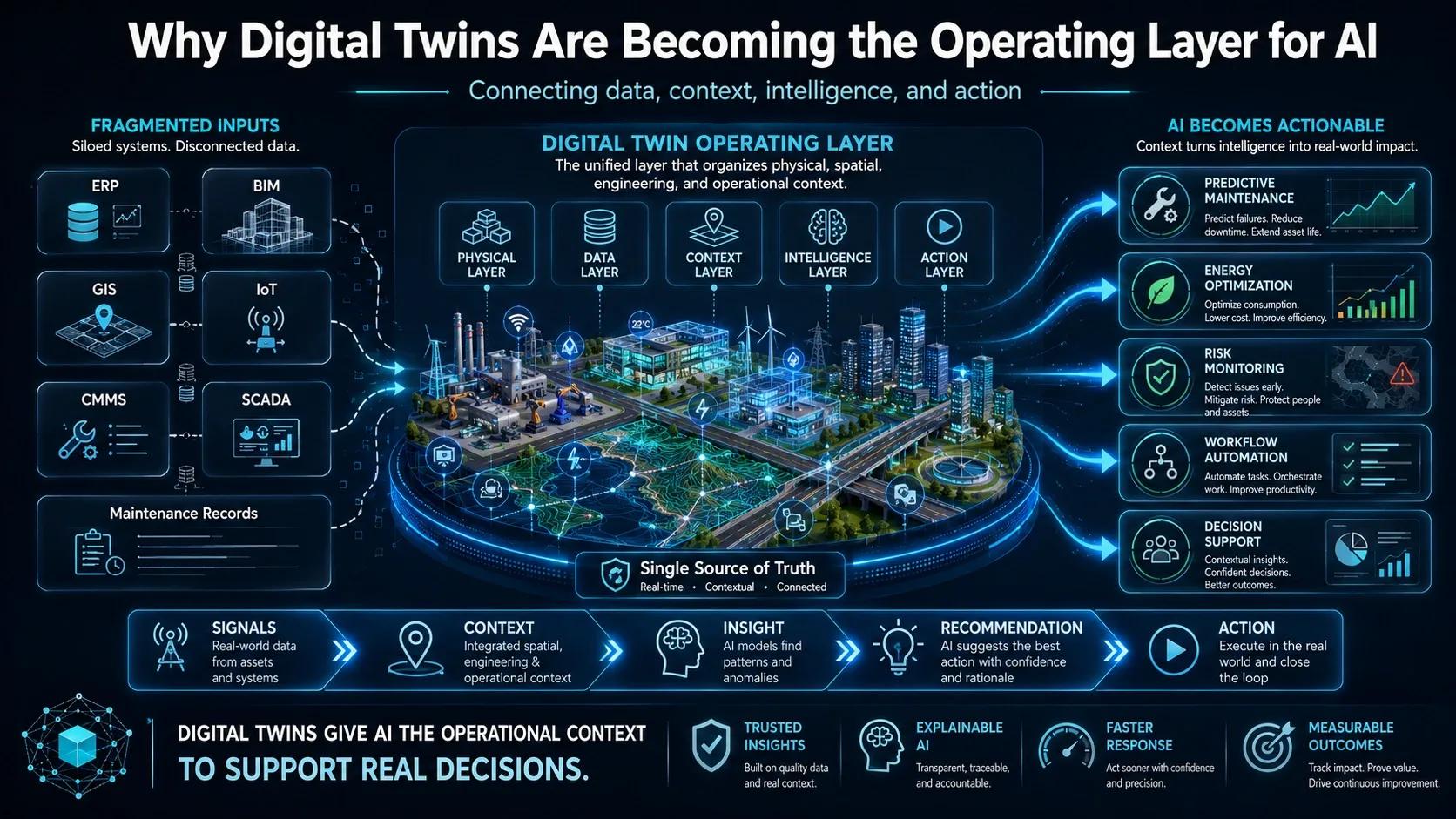
Why Digital Twins Are Becoming the AI Operating Layer
Digital Twins are becoming the operating layer for AI because they can connect five important dimensions.
1. The Physical Layer
Assets, equipment, buildings, roads, utilities, plants, ports, and infrastructure.
2. The Data Layer
Sensor feeds, asset records, BIM models, GIS layers, ERP, CMMS, SCADA, documents, and historical records.
3. The Context Layer
Location, relationships, dependencies, asset criticality, operating limits, risk conditions, and business impact.
4. The Intelligence Layer
AI models, simulations, predictions, anomaly detection, optimization, and decision logic.
5. The Action Layer
Alerts, work orders, workflows, approvals, field response, reporting, and performance measurement.
When these layers are connected, AI becomes more than a model.
It becomes part of how operations are managed.
The Role of Human Oversight
AI-ready Digital Twins should not remove human responsibility.
They should improve human decision-making.
In complex operations, humans are still needed for judgment, validation, prioritization, ethics, exception handling, and accountability.
A Digital Twin can show the recommendation.
AI can support the reasoning.
But humans should remain responsible for critical decisions.
This is especially important in safety, infrastructure, utilities, public systems, construction, and asset management.
The goal is not blind automation.
The goal is responsible intelligence.
A strong Digital Twin operating layer should support human oversight, not bypass it.
What Enterprises Should Prepare
To use Digital Twins as an operating layer for AI, enterprises need preparation.
They should ask:
Are our assets properly identified?
Is asset data reliable and accessible?
Are BIM and GIS layers connected where needed?
Are IoT data streams linked to asset IDs and locations?
Are maintenance and operational records structured?
Are workflows clearly defined?
Are AI outputs explainable?
Who owns the data?
Who validates the recommendations?
How will actions be tracked?
How will value be measured?
These questions are important because AI adoption without operational readiness can create confusion.
The Digital Twin should not only support AI.
It should make AI useful, trusted, and actionable.
Sector Examples
In manufacturing, Digital Twins can help AI connect machine condition, production schedules, quality inspection, energy usage, maintenance history, and downtime cost to improve asset performance and reduce disruption.
In buildings and campuses, Digital Twins can connect HVAC systems, occupancy, energy consumption, indoor spaces, maintenance records, comfort levels, and control strategies to optimize operations.
In infrastructure, Digital Twins can connect roads, bridges, utilities, inspection records, condition data, traffic, safety, and maintenance priorities to support better capital and operational planning.
In ports and logistics, Digital Twins can connect berth planning, yard activity, equipment health, vessel movement, cargo flow, emissions, and safety zones to improve operational decisions.
In smart cities, Digital Twins can connect environmental data, mobility, utilities, land use, public safety, citizen services, and emergency response into a more intelligent urban operating model.
In every sector, the value is not only in predicting what may happen.
The value is in connecting prediction to context, action, and outcome.
Closing Thought
AI is becoming a major force in enterprise operations.
But AI alone is not enough.
For AI to create real operational value, it needs context.
It needs to understand the physical world, spatial relationships, engineering logic, business impact, workflows, and human accountability.
Digital Twins can provide that operating layer.
They can help AI move from isolated prediction to trusted decision support.
The future of enterprise AI will not be defined only by the models organizations deploy.
It will be defined by the operational systems that make those models useful.
That is why Digital Twins are becoming the operating layer for AI.