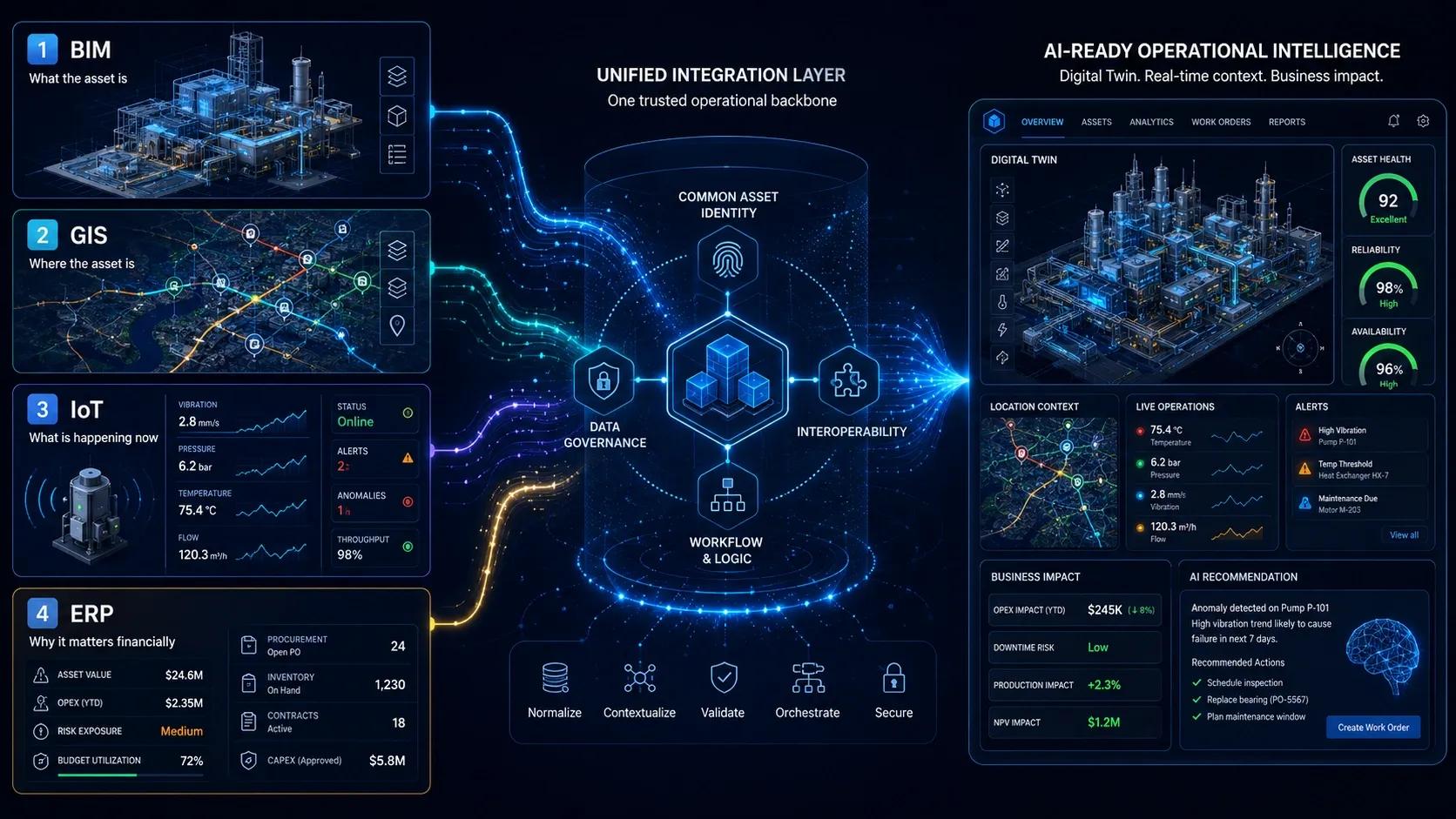
Enterprise operations are becoming more connected, more data-driven, and more dependent on intelligent decision-making.
Organizations are investing in Digital Twins, AI, automation, dashboards, sensor networks, asset platforms, and operational analytics.
But many of these initiatives face the same challenge.
The required data already exists, but it is distributed across different systems.
BIM holds engineering and asset detail.
GIS holds location and network context.
IoT provides live operational signals.
ERP connects business, finance, procurement, and cost data.
Each system is valuable.
But when they remain disconnected, the enterprise struggles to convert data into decisions.
This is why BIM, GIS, IoT, and ERP must converge.
Not because convergence is a technology trend.
But because enterprise decisions need engineering context, spatial context, real-time context, and business context together.
The Problem with Separate Systems
Most organizations do not start with an integrated digital ecosystem.
They start with departmental systems.
Design and construction teams use BIM.
Planning and field teams use GIS.
Operations teams use IoT and SCADA.
Maintenance teams use CMMS.
Finance and procurement teams use ERP.
Leadership teams use dashboards and reports.
Each system serves a specific purpose.
But operational decisions rarely fit neatly inside one system.
For example:
A maintenance decision may need asset condition, location, spare availability, cost of downtime, maintenance history, and work order status.
A construction decision may need design information, site progress, schedule impact, procurement status, spatial constraints, and cost exposure.
A utility decision may need network topology, asset condition, customer impact, outage history, crew location, and budget priority.
A smart city decision may need road data, drainage data, traffic data, citizen impact, emergency response, and environmental conditions.
No single system contains all of this context.
That is why convergence matters.
BIM Brings Engineering and Asset Context
BIM is often associated with 3D models.
But its real value is not only geometry.
BIM can carry asset information, design intent, materials, specifications, system relationships, equipment data, spaces, quantities, and construction details.
For buildings, campuses, infrastructure, plants, and facilities, BIM provides the engineering context behind physical assets.
It helps answer:
What is the asset?
How is it designed?
Where is it placed within the structure?
What is it connected to?
What specifications define it?
What systems does it support?
What was planned versus what was built?
This context is critical for operations.
Without BIM or structured engineering data, AI and Digital Twins may know that an asset exists, but may not understand how it is designed, what it depends on, or what constraints apply.
BIM helps make asset intelligence technically meaningful.
GIS Brings Location and Spatial Context
GIS gives enterprise systems a sense of place.
It connects assets, networks, risks, people, routes, terrain, parcels, zones, service areas, and environmental conditions.
In many sectors, location is not just a map reference.
It is decision context.
A road defect matters differently depending on traffic, accident history, nearby schools, drainage condition, and road hierarchy.
A utility asset matters differently depending on the customers it serves, its network position, accessibility, and exposure to flood, heat, or vegetation risk.
A construction delay matters differently depending on the workfront, site logistics, access routes, and surrounding constraints.
A warehouse issue matters differently depending on storage zones, movement paths, loading docks, and operational flow.
GIS helps answer:
Where is it?
What is nearby?
What does it affect?
What route is available?
Which zone or network is involved?
Which risks surround it?
Who is impacted?
This is why GIS is essential for AI-ready operational intelligence.
Without spatial context, AI may detect patterns but may not understand where action matters.
IoT Brings Real-Time Operational Signals
BIM and GIS help describe assets and location.
IoT helps show what is happening now.
Sensors, devices, meters, cameras, gateways, and connected equipment provide live operational signals.
These signals may include:
temperature,
vibration,
pressure,
energy consumption,
occupancy,
air quality,
equipment status,
water level,
flow rate,
movement,
machine performance,
environmental condition.
IoT helps answer:
What is happening right now?
Is the asset operating normally?
Is performance changing?
Is a threshold being crossed?
Is a risk emerging?
Is action needed?
But IoT data alone is not enough.
A sensor reading becomes useful only when connected to the asset, location, system, workflow, and business impact.
A temperature reading without asset context is just a number.
A vibration alert without maintenance context is just a signal.
A water-level reading without terrain and drainage context is incomplete.
IoT becomes powerful when it is connected to BIM, GIS, ERP, CMMS, and operational workflows.
ERP Brings Business and Financial Context
ERP systems are often seen as back-office systems.
But for operational intelligence, ERP plays a critical role.
ERP connects operations to business reality.
It can provide information about:
cost,
procurement,
inventory,
contracts,
vendors,
budgets,
purchase orders,
spare parts,
financial impact,
project expenditure,
resource allocation,
business performance.
This context helps answer:
What will this action cost?
Are spare parts available?
Is procurement required?
What is the budget impact?
Which vendor is responsible?
What is the cost of delay?
What is the financial value of action?
Which investment should be prioritized?
Without ERP context, AI or Digital Twin insights may remain operational but not business-ready.
For example, AI may recommend maintenance, but ERP helps determine whether parts are available, what the cost will be, and how the action aligns with budget and procurement.
ERP helps convert operational insights into financially informed decisions.
Why Convergence Creates Operational Intelligence
BIM, GIS, IoT, and ERP each answer different questions.
BIM answers: What is the asset and how is it designed?
GIS answers: Where is it and what does it affect?
IoT answers: What is happening now?
ERP answers: What is the business impact?
When these systems converge, organizations can answer more complete operational questions.
For example:
Which asset is underperforming?
Where is it located?
What system does it belong to?
What live signals indicate risk?
What is its maintenance history?
What is the cost of failure?
Are spare parts available?
Which team should act?
What is the expected outcome?
This is the foundation of AI-ready operations.
AI needs connected context before it can support reliable decisions.
Digital Twins need connected systems before they can become operationally useful.
Dashboards need connected workflows before they can move from visibility to action.
Convergence is what turns data into intelligence.
The Common Asset Identity Problem
One of the biggest barriers to convergence is inconsistent asset identity.
The same asset may appear differently across systems.
In BIM, it may have a model element ID.
In GIS, it may have a spatial feature ID.
In IoT, it may have a sensor tag.
In ERP, it may have a finance or procurement code.
In CMMS, it may have a maintenance asset ID.
In field records, it may have a local name.
If these identities are not linked, systems cannot easily communicate.
A Digital Twin cannot reliably connect the physical asset to its sensor readings, maintenance records, location, cost data, and operational history.
AI cannot confidently understand what data belongs to which asset.
This is why a common asset identity layer is critical.
It does not mean every system must use the same internal ID.
But it does mean the organization needs a trusted way to map, connect, and manage asset identity across systems.
Without this, convergence remains difficult.
From Integration to Decision Architecture
Many organizations think convergence means technical integration.
APIs.
Data pipelines.
Connectors.
Middleware.
Data warehouses.
Cloud platforms.
These are important.
But convergence should not be treated only as an IT exercise.
The real goal is decision architecture.
A decision architecture connects systems around the decisions the organization wants to improve.
For example:
If the goal is predictive maintenance, convergence must connect asset hierarchy, sensor signals, maintenance history, spare inventory, work orders, location, and downtime cost.
If the goal is energy optimization, convergence must connect occupancy, building systems, energy meters, weather, control logic, tariffs, and comfort requirements.
If the goal is construction progress intelligence, convergence must connect BIM, schedule, procurement, site reality capture, cost, safety, and field workflows.
If the goal is road asset management, convergence must connect pavement condition, traffic, GIS network, maintenance history, inspection data, budget, and risk priority.
The question is not only:
Can these systems exchange data?
The better question is:
Can these systems support a better decision?
Why Convergence Matters for AI
AI models need context to produce useful outputs.
If AI is connected only to IoT data, it may detect an anomaly.
If it is also connected to BIM, it can understand asset design and system relationship.
If it is connected to GIS, it can understand location, network, and spatial impact.
If it is connected to ERP, it can understand cost, procurement, and business priority.
If it is connected to workflows, it can help trigger action.
This is how AI moves from pattern detection to decision support.
Without convergence, AI may become another isolated layer.
With convergence, AI becomes part of an operational intelligence system.
Why Convergence Matters for Digital Twins
A Digital Twin cannot be built on fragmented data.
It needs connected systems.
A Digital Twin should not only show a 3D model or dashboard.
It should connect physical assets, location, live data, business data, workflows, and decision logic.
BIM provides the asset and engineering layer.
GIS provides the spatial and network layer.
IoT provides the live operational layer.
ERP provides the business and cost layer.
AI provides the intelligence layer.
Workflows provide the action layer.
When these layers converge, the Digital Twin becomes an operating environment.
It can help organizations monitor, analyze, predict, decide, and act.
Sector Examples
In buildings and campuses, BIM can define spaces and systems, GIS can connect the site and surrounding infrastructure, IoT can provide energy and occupancy signals, and ERP can connect cost, procurement, and contracts.
In manufacturing, BIM or asset models can define equipment and facility layout, GIS can support site logistics and spatial relationships, IoT can monitor machine performance, and ERP can connect production, inventory, cost, and procurement.
In utilities, GIS can define network topology, BIM or engineering data can describe asset details, IoT and SCADA can provide live network signals, and ERP can connect investment planning, procurement, and financial impact.
In construction, BIM can provide design and quantity context, GIS can provide site and location context, IoT and reality capture can provide progress signals, and ERP can connect cost, procurement, and resource planning.
In smart cities, GIS can connect urban assets and services, BIM can add building and infrastructure detail, IoT can provide live city signals, and ERP or municipal systems can connect budgets, services, and governance.
In each case, convergence enables better operational decisions.
Governance Is Essential
Convergence cannot succeed without governance.
Organizations need clarity on:
data ownership,
source of truth,
asset identity,
update responsibility,
access rights,
data quality,
cybersecurity,
interoperability standards,
change management,
workflow ownership.
Without governance, integrations may work initially but degrade over time.
Data becomes outdated.
Trust declines.
Workflows become unclear.
AI outputs become questionable.
Governance turns convergence from a technical connection into a sustainable operating model.
What Enterprises Should Do First
Enterprises should not try to converge everything at once.
That creates complexity and delays.
A better approach is use-case-led convergence.
Start with a decision that matters.
Then identify which systems are required to support that decision.
Ask:
What decision are we trying to improve?
Which assets, locations, systems, and teams are involved?
Which BIM, GIS, IoT, ERP, CMMS, or other data is required?
Are asset IDs connected across systems?
Which data is trusted?
Which workflows must be triggered?
Who owns the decision?
What business value will be measured?
What is the minimum viable integration required?
How can this be scaled later?
This keeps convergence practical.
It links technology integration directly to business value.
The Future Is Connected Operations
The next phase of digital transformation will not be defined by individual systems.
It will be defined by how well those systems work together.
BIM alone provides engineering detail.
GIS alone provides location context.
IoT alone provides live signals.
ERP alone provides business records.
But AI-ready operations need all of them to converge.
The enterprise of the future will not depend on isolated platforms.
It will depend on connected operational intelligence.
Closing Thought
BIM, GIS, IoT, and ERP were often implemented for different teams, different purposes, and different phases of the asset lifecycle.
But operational decisions do not respect departmental boundaries.
They require a connected view of the asset, location, condition, workflow, cost, risk, and business impact.
That is why convergence is no longer optional.
It is the foundation for Digital Twins, AI, automation, and decision intelligence.
The organizations that succeed will not be the ones with the most systems.
They will be the ones that connect their systems around the decisions that matter.
Because the future of enterprise intelligence is not fragmented.
It is converged.